
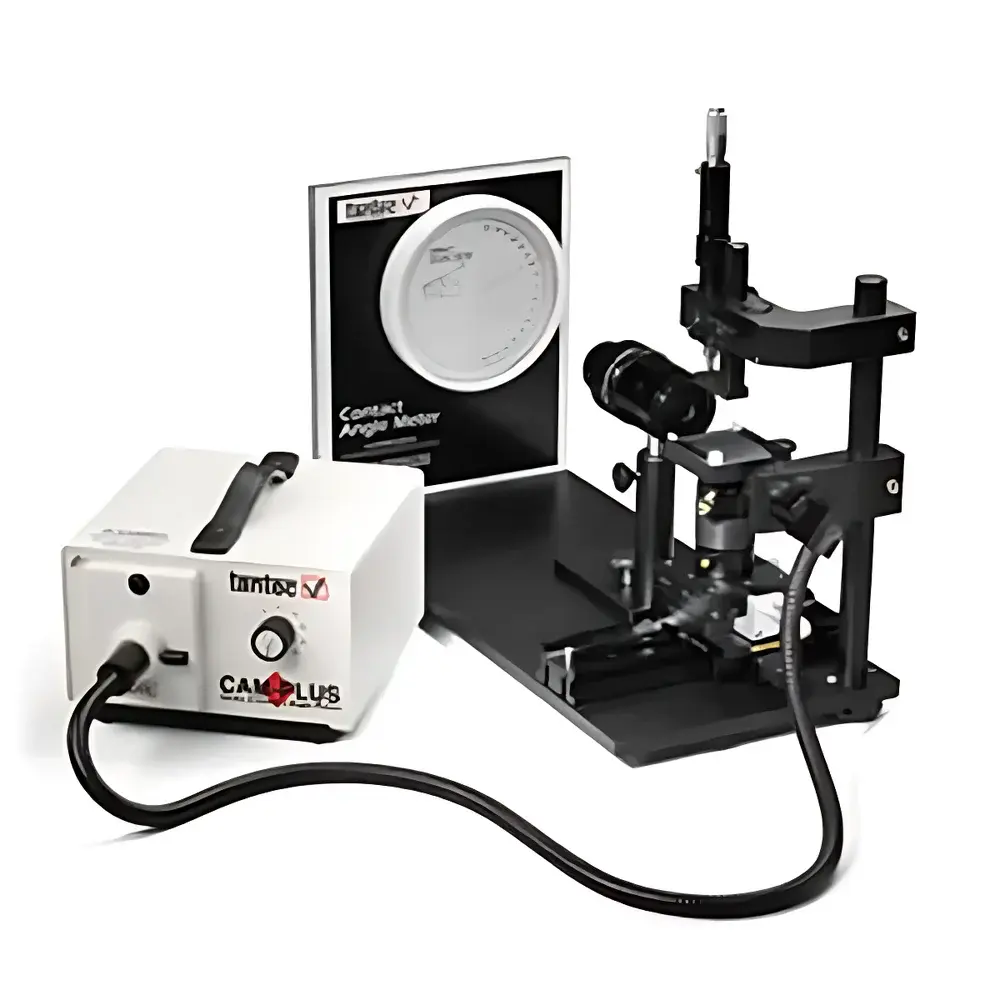
ChemInstruments CAM-PLUS Contact Angle Meter
| Origin | USA |
|---|---|
| Manufacturer Type | Authorized Distributor |
| Origin Category | Imported |
| Model | CAM-PLUS |
| Pricing | Available Upon Request |
Overview
The ChemInstruments CAM-PLUS Contact Angle Meter is a precision optical instrument engineered for quantitative characterization of solid–liquid interfacial interactions via static and dynamic contact angle measurement. It operates on the patented “Half-Angle” measurement principle—a geometrically robust alternative to conventional tangent-based methods—which eliminates operator-dependent variability in baseline definition and droplet edge detection. By measuring the angle subtended at the three-phase contact line using symmetrical chord-based analysis of the sessile drop profile, the CAM-PLUS delivers high reproducibility (< ±0.3° repeatability under controlled environmental conditions) without requiring manual tangent placement or iterative curve-fitting. Designed for routine QC laboratories and R&D facilities, the system complies with ASTM D20.19 (Standard Test Methods for Surface Tension of Solutions), ASTM D724 (Standard Test Method for Surface Wettability of Paper), ASTM D5946 (Standard Test Method for Corona-Treated Plastic Film Using Water Contact Angle Measurements), and TAPPI T458 cm-94—ensuring data traceability and regulatory alignment across coating, packaging, microelectronics, and biomedical material development workflows.
Key Features
- Patented Half-Angle measurement algorithm for objective, operator-independent contact angle determination
- Integrated fixed-position dispenser with calibrated syringe pump for consistent 1–10 µL droplet deposition
- High-brightness LED illumination with thermally isolated remote light source to minimize sample heating and thermal drift
- Optimized stage geometry accommodating substrates up to 150 mm × 150 mm, including flexible films, thin wafers, PCBs, and PBGA packages
- 10.1-inch HD LCD display with real-time image preview, adjustable contrast, and on-screen measurement overlays
- Optional optical magnification modules: 6× or 12× telecentric lens assemblies for enhanced resolution of microstructured or low-contrast surfaces
- Modular design supporting future upgrades including automated XYZ translation stages and environmental chamber integration
Sample Compatibility & Compliance
The CAM-PLUS accommodates rigid and flexible substrates ranging from silicon wafers and polymer films to printed circuit boards and medical device components. Its low-profile sample stage enables direct placement of small-format specimens (minimum dimension: 5 mm × 5 mm) without fixture adaptation. Surface energy calculation is supported via Owens–Wendt, Wu, and van Oss–Chaudhury–Good models using contact angle inputs from two or more probe liquids (e.g., water, diiodomethane, ethylene glycol). All measurement protocols adhere to ISO 19403-2 (Contact angle measurement — Part 2: Static contact angle) and are fully documented to support GLP-compliant reporting. Audit trails, user access logs, and electronic signatures can be enabled to meet FDA 21 CFR Part 11 requirements when integrated with validated LIMS environments.
Software & Data Management
The instrument is operated via ChemInstruments’ proprietary CAM-Soft v4.x platform, a Windows-based application supporting both manual and semi-automated workflows. Software features include real-time video capture at 60 fps, batch processing of multi-sample sequences, automatic baseline correction, and export of raw image stacks (TIFF/AVI), numerical results (CSV/XLSX), and annotated reports (PDF). Data integrity safeguards include timestamped metadata embedding, version-controlled calibration records, and configurable retention policies. Export formats conform to ASTM E2500-18 (Standard Guide for Specification, Design, and Verification of Pharmaceutical and Biopharmaceutical Manufacturing Systems and Equipment), facilitating seamless integration into enterprise quality management systems.
Applications
- Plasma, corona, and flame treatment validation in flexible packaging and automotive trim manufacturing
- Surface energy mapping of photolithographic masks and wafer-level coatings in semiconductor fabrication
- Quality control of hydrophobic/hydrophilic functionalization on surgical meshes and catheter tubing
- Adhesion promoter efficacy assessment in aerospace composite bonding processes
- Batch-to-batch consistency verification of inkjet-printed conductive traces on flexible electronics substrates
- Development and optimization of anti-fog, anti-reflective, and self-cleaning coatings
FAQ
What surface tension range does the CAM-PLUS support for indirect surface energy calculation?
The system supports surface energy determination for solid substrates exhibiting contact angles between 10° and 70°, corresponding to typical polar and dispersive component ranges of 5–50 mJ/m² when paired with standard probe liquids.
Is the Half-Angle method compatible with advancing and receding contact angle measurements?
Yes—the CAM-PLUS supports dynamic contact angle acquisition via programmable syringe dispensing and retraction, enabling full hysteresis profiling with synchronized frame capture.
Can the system be calibrated in-house, and what standards are recommended?
Calibration uses NIST-traceable reference slides (e.g., PTFE, silicon, glass) with certified contact angle values; routine verification follows ASTM D7334-22 (Standard Practice for Surface Energy Determination of Polymer Coatings Using Contact Angle Measurements).
Does the software support multi-user role-based access control?
Yes—CAM-Soft includes configurable user profiles with tiered permissions (Operator, Supervisor, Administrator) aligned with ISO/IEC 17025 and GMP Annex 11 requirements.



