
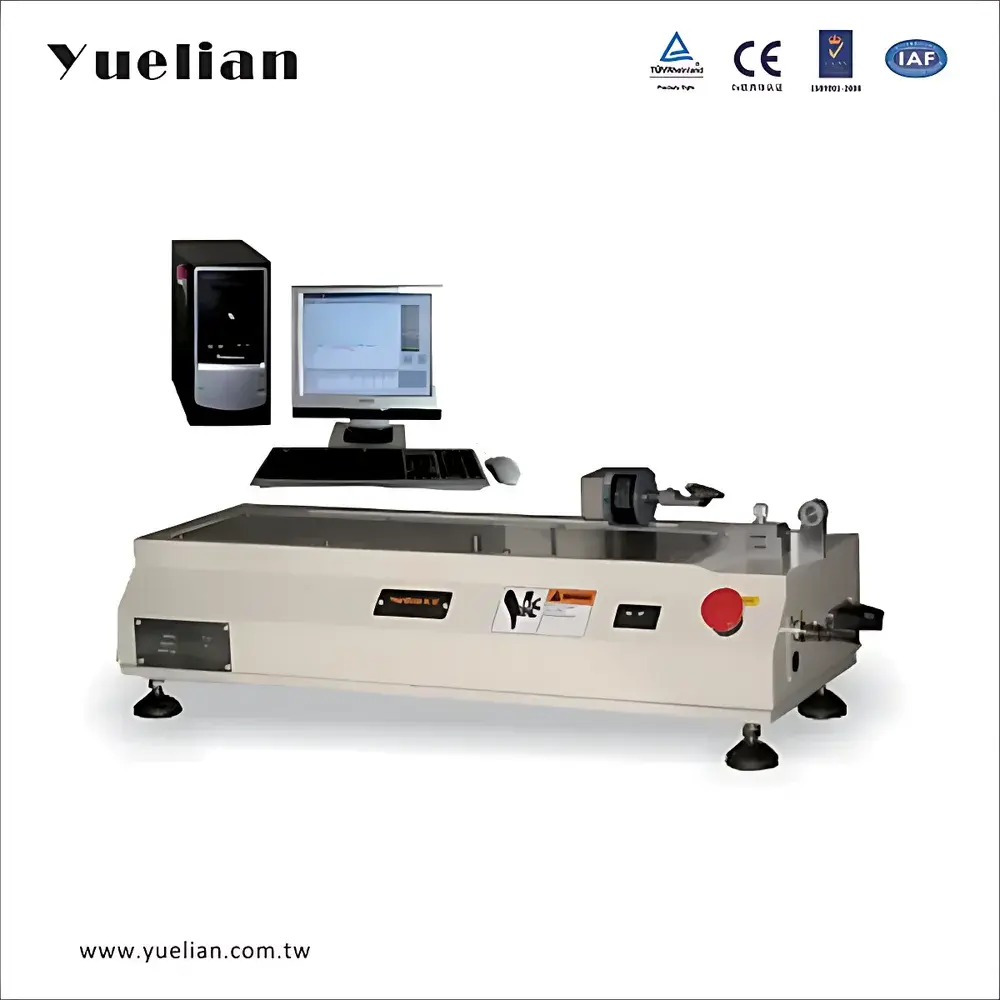
Yuelian YL-1103S Dual-Sided Adhesive Peel Strength Tester
| Brand | Yuelian |
|---|---|
| Origin | Guangdong, China |
| Model | YL-1103S |
| Instrument Type | Electronic Tensile Testing Machine |
| Load Capacity Options | 10 N, 20 N, 50 N, 100 N, 200 N (dual-range configuration available) |
| Force Resolution | 1/500,000 full scale |
| Force Accuracy | ±0.3% of reading |
| Crosshead Travel | 500 mm |
| Test Width | 140 mm |
| Speed Range | 5–500 mm/min (PC-programmable) |
| Displacement Resolution | 1/500,000 full scale |
| Control Mode | PC-based closed-loop control |
| Stop Modes | Overload shutdown, emergency stop, automatic break-stop, upper/lower limit stop, auto-return |
| Power Supply | 220 V AC, 50/60 Hz, 5 A |
| Motor Type | Stepper motor with timing belt and precision ball screw drive |
| Rated Power | 180 W |
| Dimensions (W×D×H) | 1063 × 300 × 200 mm |
| Weight | ~45 kg |
| Standard Accessories | One set of peel fixtures, proprietary test software, USB interface cable |
Overview
The Yuelian YL-1103S Dual-Sided Adhesive Peel Strength Tester is a dedicated electromechanical testing system engineered for standardized quantitative evaluation of interfacial adhesion performance in pressure-sensitive adhesive (PSA) materials—particularly double-sided tapes, transfer adhesives, and laminated films. It operates on the principle of controlled tensile separation under defined geometries and kinematic conditions, conforming to core mechanical test methodologies outlined in ASTM D3330, ASTM D903, ISO 8510-2, and PSTC-101. The system applies uniaxial force perpendicular to the bond line at a constant rate while measuring real-time load and displacement, enabling precise determination of peel initiation force, steady-state peel resistance, and interfacial failure mode (cohesive vs. adhesive). Its microprocessor-controlled architecture integrates high-fidelity force transduction with sub-micron positional feedback, ensuring repeatable execution of peel protocols across variable substrate combinations—including PET, PVC, aluminum foil, paper, and elastomeric backings.
Key Features
- Modular dual-range load cell configuration (10 N / 200 N standard; optional scalable ranges) supports high-resolution measurement across low-force PSA applications and higher-strength industrial bonding systems.
- Stepper motor-driven crosshead with precision ground ball screw and synchronous timing belt transmission ensures smooth, backlash-free motion and long-term mechanical stability.
- Full PC-based control via proprietary Windows-compatible software enables programmable test profiles—including multi-step speed ramps, dwell periods, and conditional stop triggers.
- Real-time force-displacement curve acquisition at ≥1 kHz sampling rate, with synchronized data logging to local MS-ACCESS relational database for audit-ready traceability.
- Automatic return-to-start function after test completion minimizes operator intervention and improves throughput in high-volume QC environments.
- Comprehensive unit conversion (N, kgf, lbf, g, ton, MPa) and SI/metric toggle support facilitates international reporting compliance and cross-laboratory data alignment.
Sample Compatibility & Compliance
The YL-1103S accommodates standard 180° and 90° peel configurations per ISO 29862 and ASTM D6862, with adjustable fixture mounting to accommodate substrates up to 140 mm wide and 5 mm thick. Fixture sets include stainless steel peel arms, rigid backing plates, and interchangeable jaw inserts for textured or delicate surfaces. All mechanical components comply with CE machinery directive (2006/42/EC) and RoHS 2011/65/EU material restrictions. Software architecture supports 21 CFR Part 11-compliant electronic signatures, audit trails, and user-access-level permissions when deployed in regulated manufacturing settings (e.g., medical device tape assembly, automotive interior bonding, or pharmaceutical packaging QA).
Software & Data Management
The embedded test management platform provides calibrated instrument control, real-time visualization of load-extension curves, and automated calculation of ASTM-defined parameters: average peel force, peak force, energy to peel (area under curve), and coefficient of variation (%CV) across replicate tests. Raw data exports to CSV, XLSX, and PDF formats; graphical overlays allow comparative analysis of multiple specimens or batch histories. Database integration permits query-based reporting (e.g., “all peel tests on Lot#2024-087 between June–August”) and supports GLP/GMP documentation workflows through timestamped metadata embedding (operator ID, calibration status, environmental conditions).
Applications
- Quality assurance of double-coated acrylic and rubber-based tapes used in electronics assembly (e.g., display module bonding, flex circuit anchoring).
- Development validation of release liner adhesion balance in medical transdermal patches and wound care dressings.
- Process optimization of hot-melt adhesive lamination in flexible packaging substrates (BOPP/AL/PE composites).
- Comparative benchmarking of aging effects (thermal, UV, humidity) on adhesive durability per ISO 15142-1 accelerated testing protocols.
- Supplier qualification testing per OEM specifications requiring minimum peel thresholds at specified peel angles and rates.
FAQ
What peel angles does the YL-1103S support?
The system is configured for standardized 90° and 180° peel geometries using interchangeable fixture assemblies; custom angular setups (e.g., 45°) can be implemented with third-party tooling.
Is calibration certification included with delivery?
A factory calibration report traceable to NIM (National Institute of Metrology, China) is supplied; users may request UKAS or DAkkS-accredited external calibration services separately.
Can the system perform shear or tack testing?
While primarily optimized for peel, the platform supports basic shear (ASTM D3654) and loop tack (PSTC-101) with optional accessories—though dedicated instruments are recommended for routine high-precision shear/tack metrology.
Does the software meet FDA 21 CFR Part 11 requirements?
Yes—the software includes role-based access control, electronic signature capture, immutable audit logs, and data integrity safeguards compliant with Part 11 Annex 11 expectations for regulated laboratories.
What maintenance intervals are recommended?
Ball screw lubrication every 6 months and annual load cell verification are advised; no consumable parts require replacement under normal operation.



