
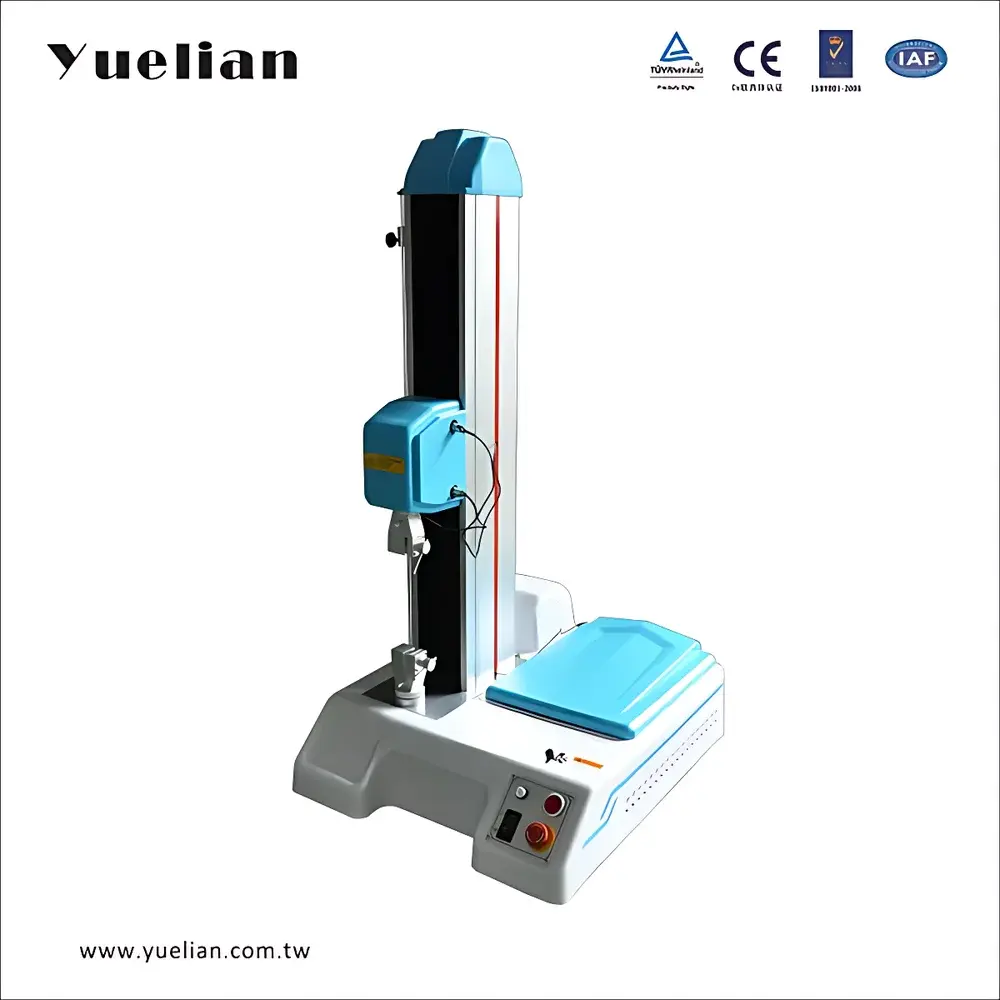
Yuelian YL-S70 Computer-Controlled Universal Tensile Testing Machine
| Brand | Yuelian |
|---|---|
| Origin | Guangdong, China |
| Model | YL-S70 |
| Instrument Type | Electromechanical Universal Testing Machine |
| Load Capacity Options | 10 N, 20 N, 50 N, 100 N, 200 N, 500 N, 1 kN, 2 kN, 5 kN (dual-range configuration available) |
| Force Resolution | 1/500,000 full scale |
| Force Accuracy | ±0.1% of reading |
| Displacement Resolution | 1/500,000 mm |
| Displacement Accuracy | ±0.1% of reading |
| Data Acquisition Rate | 2000 Hz |
| Effective Stroke | 450 mm (customizable) |
| Test Speed Range | 0.001–500 mm/min (customizable) |
| Test Space Diameter | Ø140 mm |
| Control Mode | Full PC-based closed-loop control |
| Power Supply | 220 V AC, 50–60 Hz |
| Motor Type | AC Servo Motor |
| Transmission | Precision Ball Screw |
| Protection Features | Overload cutoff, emergency stop, automatic break detection, upper/lower limit stop, over-travel and over-capacity safeguards |
| Software Functions | Multi-curve real-time display (force–displacement, force–time, displacement–time, stress–strain), statistical analysis (max/min/mean/trimmed mean/median/standard deviation/CPK), up to 7 test segments, 40 manual points, 120 auto-points, customizable multi-step control modes (constant speed, constant displacement, constant load, constant load rate, constant stress, constant stress rate, constant strain, constant strain rate), auto-return, auto-zero, bidirectional sensor polarity switching |
Overview
The Yuelian YL-S70 Computer-Controlled Universal Tensile Testing Machine is an electromechanical materials testing system engineered for precision mechanical characterization across research laboratories, quality control departments, and industrial R&D facilities. Based on servo-controlled closed-loop actuation and high-fidelity signal acquisition, the YL-S70 implements standardized uniaxial mechanical testing protocols in accordance with ISO 6892-1 (tensile testing of metallic materials), ASTM E8/E8M, ASTM D638 (plastics), ASTM D3039 (composites), ISO 179 (impact-modified plastics), and ISO 1184 (paper and board). Its modular architecture supports static and quasi-static mechanical evaluation under tension, compression, bending (3-point and 4-point), shear, tear, peel, puncture, cyclic loading, and creep-hold conditions — enabling consistent correlation between physical specimen behavior and fundamental material parameters including ultimate tensile strength, yield strength, modulus of elasticity, elongation at break, Poisson’s ratio, and energy absorption.
Key Features
- Precision AC servo motor drive coupled with ground ball screw transmission ensures smooth, low-noise, backlash-free motion control and long-term repeatability.
- High-resolution force transducer with 1/500,000 internal resolution and ±0.1% accuracy traceable to national metrological standards.
- Displacement measurement system with sub-micron resolution (1/500,000 mm) and ±0.1% linearity across the full 450 mm effective stroke.
- Real-time data acquisition at 2000 samples per second, supporting dynamic event capture and transient response analysis.
- Intuitive PC-based software interface offering dual-range load cell support, bidirectional force sensing polarity switching, and fully programmable multi-stage test sequences.
- Quick-change modular fixture interface compatible with standardized grips (pneumatic, wedge, vise), bending fixtures, peel testers, puncture probes, and custom tooling per ISO 204, ISO 1133, and ASTM D1894 requirements.
- Comprehensive hardware safety layer: integrated emergency stop, mechanical overload cutoff, software-defined upper/lower limits, and automatic fracture detection via slope thresholding.
- Robust industrial enclosure fabricated from ABS plastic with electrostatic powder coating and aluminum extrusion guard covers featuring sandblasted anodized finish for corrosion resistance and ergonomic service access.
Sample Compatibility & Compliance
The YL-S70 accommodates a broad spectrum of specimen geometries and material classes — including polymers, elastomers, textiles, films, foams, composites, metals (thin sheets and wires), paperboard, adhesives, biomedical sutures, and footwear components. Standardized test configurations comply with ISO, ASTM, DIN, JIS, and GB/T regulatory frameworks governing mechanical property reporting. The system supports GLP-compliant operation when paired with audit-trail-enabled software modules, and its deterministic control architecture facilitates FDA 21 CFR Part 11 readiness through optional electronic signature and user-access-level configuration. All mechanical calibrations adhere to ISO/IEC 17025 principles and may be validated using NIST-traceable reference standards.
Software & Data Management
The embedded Windows-based testing platform provides full traceability, version-controlled method templates, and hierarchical user permission management. Real-time visualization includes synchronized overlay of force–displacement, stress–strain, and time-domain plots with zoom, pan, crosshair cursor, and point extraction tools. Statistical post-processing includes calculation of CPK, Cpk, standard deviation, coefficient of variation, trimmed mean, median, and confidence intervals per ISO 5725. Historical datasets are stored in encrypted SQLite format with metadata tagging (operator ID, timestamp, environmental conditions, calibration status). Export options include CSV, PDF reports, XML, and image snapshots compliant with laboratory information management systems (LIMS) integration requirements.
Applications
- Tensile strength and ductility assessment of thermoplastic films and packaging laminates per ASTM D882.
- Compression testing of polyurethane foam for automotive seating per ISO 3386-1.
- Peel adhesion evaluation of pressure-sensitive tapes per ASTM D3330.
- Three-point flexural modulus determination of fiber-reinforced polymer panels per ASTM D7264.
- Cyclic fatigue performance of silicone elastomer seals under ISO 13356 protocols.
- Puncture resistance of medical glove materials per ASTM D5151.
- Shoe sole bonding integrity verification using ASTM F1677 peel and shear methods.
- Creep compliance measurement of viscoelastic biomaterials under constant load hold profiles.
FAQ
What load capacity options are available for the YL-S70?
The YL-S70 offers nine selectable nominal capacities: 10 N, 20 N, 50 N, 100 N, 200 N, 500 N, 1 kN, 2 kN, and 5 kN. Dual-range configurations allow automatic range switching within a single test sequence.
Is the system compliant with ISO/IEC 17025 calibration requirements?
Yes — the force and displacement subsystems are designed for third-party calibration traceable to national metrology institutes; documentation includes as-found/as-left reports, uncertainty budgets, and calibration certificates.
Can the software generate GLP-compliant test reports?
Yes — when configured with audit trail logging, electronic signatures, and role-based access controls, the software meets core GLP documentation requirements for regulated environments.
What is the minimum test speed achievable?
The system achieves controlled motion down to 0.001 mm/min, suitable for slow-rate creep and relaxation studies.
Does the YL-S70 support ASTM E4 standardization for verification of force-measuring instruments?
Yes — the machine is compatible with Class 1 verification procedures per ASTM E4 using certified deadweight or hydraulic calibration standards.



