
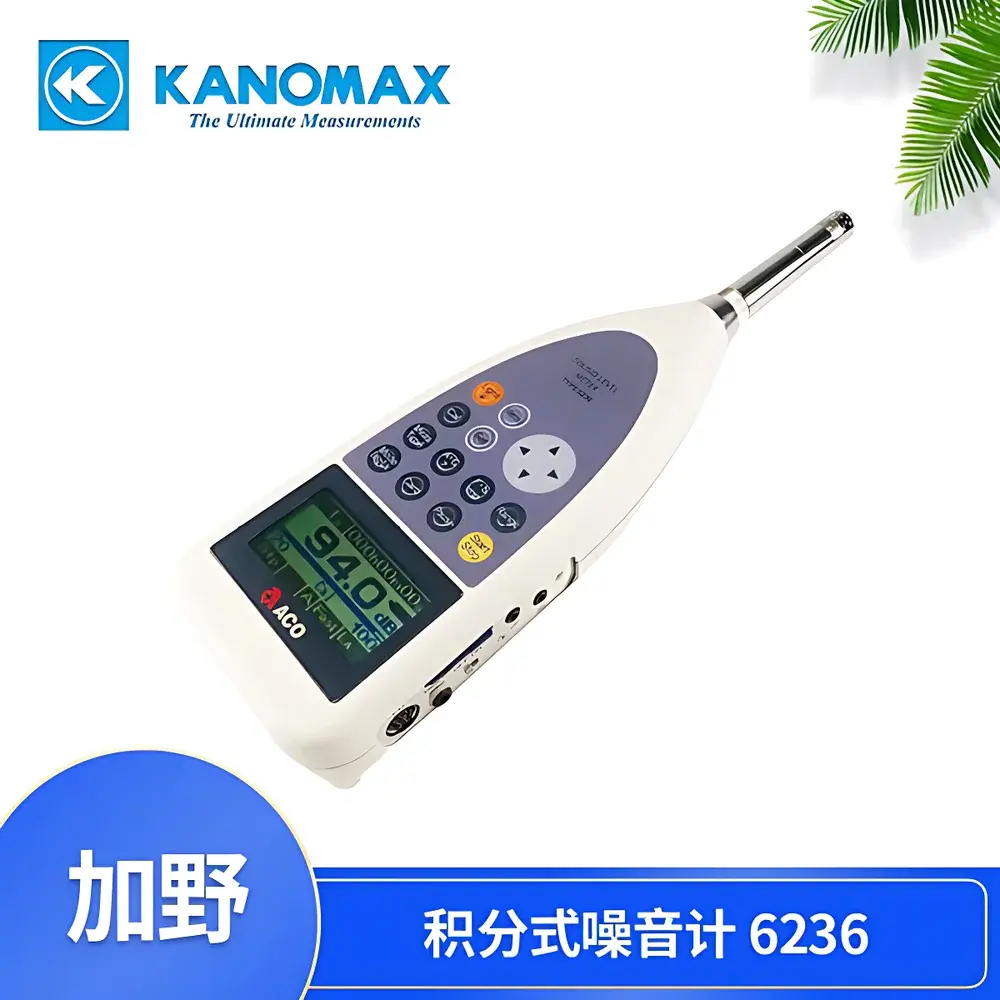
Kanomax Model 6236 Type 1 Precision Integrating Sound Level Meter
| Brand | Kanomax |
|---|---|
| Origin | Japan |
| Model | 6236 |
| Instrument Type | Handheld Sound Level Meter |
| Frequency Range | 20–8,000 Hz |
| Measurement Ranges | 28–130 dB(A), 30–130 dB(C), 38–130 dB(Z) |
| Self-Noise | 0.1 dB |
| Accuracy | ±0.1 dB |
| Maximum Measurement Duration | 199 h 59 min 59 s |
| Microphone | Type 7146NL (Sensitivity: −28 dB re 1 V/Pa, standalone calibration: −23 dB) |
| Compliance | IEC 61672-1:2013 Class 1, ANSI S1.4-1983 Type 1 |
| Time Weighting | Fast / Slow |
| Frequency Weighting | A, C, Z |
| Power Supply | 4 × AA batteries (≈9 h operation) or AC adapter |
| Dimensions | 86 × 285 × 46 mm |
| Weight | ≈450 g |
Overview
The Kanomax Model 6236 is a Class 1 precision integrating sound level meter engineered for rigorous outdoor environmental noise monitoring in accordance with international metrological standards. Based on the principles of electroacoustic transduction via a pre-polarized electret condenser microphone (Type 7146NL), it delivers traceable, high-fidelity acoustic measurements across three frequency weightings—A (for human hearing-weighted assessment), C (for peak and low-frequency energy evaluation), and Z (flat, unweighted response per IEC 61672-1). Its 20 Hz to 8 kHz nominal frequency range satisfies requirements for community noise mapping, industrial perimeter monitoring, transportation noise studies, and regulatory compliance reporting under national environmental protection frameworks. The instrument’s integrated signal processing architecture supports real-time computation of Leq (equivalent continuous sound pressure level), Lmax/Lmin, Lpeak, time-history logging, and percentile-based statistical analysis (e.g., L10, L50, L90), all essential for long-term environmental impact assessments.
Key Features
- Class 1 accuracy per IEC 61672-1:2013 and ANSI S1.4-1983 — certified for legal metrology and regulatory submissions
- Low self-noise floor of 0.1 dB enables reliable measurement near background thresholds, critical for rural or nighttime ambient noise surveys
- High-resolution 0.1 dB measurement resolution with digital display and dynamic analog bar graph for rapid visual trend interpretation
- Extended logging capacity up to 199 hours, 59 minutes, and 59 seconds — suitable for unattended multi-day field deployments
- Dual time-weighting modes (Fast: 125 ms, Slow: 1 s) allow adaptive response to transient versus steady-state noise sources
- Modular program card system enables field-configurable test protocols without firmware reprogramming — ideal for standardized survey workflows
- Rugged, weather-resistant housing (IP54-rated enclosure when used with optional windscreen and rain cover) optimized for outdoor exposure
Sample Compatibility & Compliance
The Model 6236 is validated for use with standardized acoustic couplers and calibrators compliant with IEC 60942 and ISO 16063-21. It accepts external calibration signals at 1 kHz (94 dB or 114 dB reference) and supports periodic verification traceable to NMI-Japan (National Metrology Institute of Japan) or other BIPM-affiliated national standards laboratories. Its Class 1 designation ensures suitability for applications requiring adherence to ISO 1996-1 (acoustics — description, measurement and assessment of environmental noise), ISO 1996-2 (determination of sound pressure levels), and EU Directive 2002/49/EC (Environmental Noise Directive). The device meets electromagnetic compatibility (EMC) requirements per IEC 61326-1 and carries CE marking for conformity with EU environmental and safety directives.
Software & Data Management
Data export is supported via RS-232 serial interface (with optional USB-to-serial adapter) to compatible PC software provided by Kanomax (e.g., Kanomax Sound Logger v3.x). Exported datasets include timestamped Leq, Lmax, Lmin, Lpeak, and statistical percentiles in CSV format, enabling integration into GIS-based noise modeling platforms (e.g., SoundPLAN, CadnaA) or statistical analysis tools (MATLAB, Python pandas). Audit trails are maintained through internal memory timestamps and user-defined project IDs. While the Model 6236 does not feature built-in wireless connectivity or cloud synchronization, its data structure conforms to ISO/IEC 17025-compliant laboratory information management systems (LIMS) when paired with validated transfer protocols and chain-of-custody documentation.
Applications
- Regulatory compliance monitoring at construction sites, industrial facilities, and transportation corridors per local environmental ordinances
- Baseline ambient noise characterization prior to infrastructure development (e.g., wind farms, highways, airports)
- Community noise complaint investigations requiring legally defensible measurement records
- Long-term urban noise mapping campaigns with synchronized multi-station deployments
- Educational and research applications in acoustics engineering, environmental science, and occupational health programs
- Pre- and post-mitigation evaluation of noise control interventions (e.g., acoustic barriers, façade treatments)
FAQ
Is the Model 6236 suitable for occupational noise exposure assessment?
No — while it meets Class 1 accuracy, it lacks real-time octave-band analysis, dose calculation (LEX,8h), and direct integration with OSHA/NIOSH exposure limit algorithms required for workplace compliance under 29 CFR 1910.95 or ISO 9612.
Can the instrument be calibrated in the field without returning to a lab?
Yes — using a certified acoustic calibrator (e.g., Kanomax 9511 or equivalent Class 1 pistonphone), users can perform functional checks and sensitivity adjustments per IEC 61672-3 procedures before and after each measurement session.
Does the Model 6236 support impulse or peak C-weighted measurements?
It measures Lpeak in C-weighting mode with a rise time ≤ 20 µs, satisfying IEC 61672-1 requirements for impulsive noise evaluation, though it does not compute LI (impulse level) as defined in older ISO 532B standards.
What accessories are required for outdoor deployment?
A windscreen (Kanomax WS-1), tripod mount (TM-1), and optional rain cover (RC-1) are recommended to maintain measurement integrity under wind speeds > 5 m/s and precipitation conditions.
Is firmware upgrade capability available?
Firmware updates are performed exclusively by authorized Kanomax service centers using proprietary diagnostic interfaces; no end-user upgradable firmware is provided.
Related Products







