
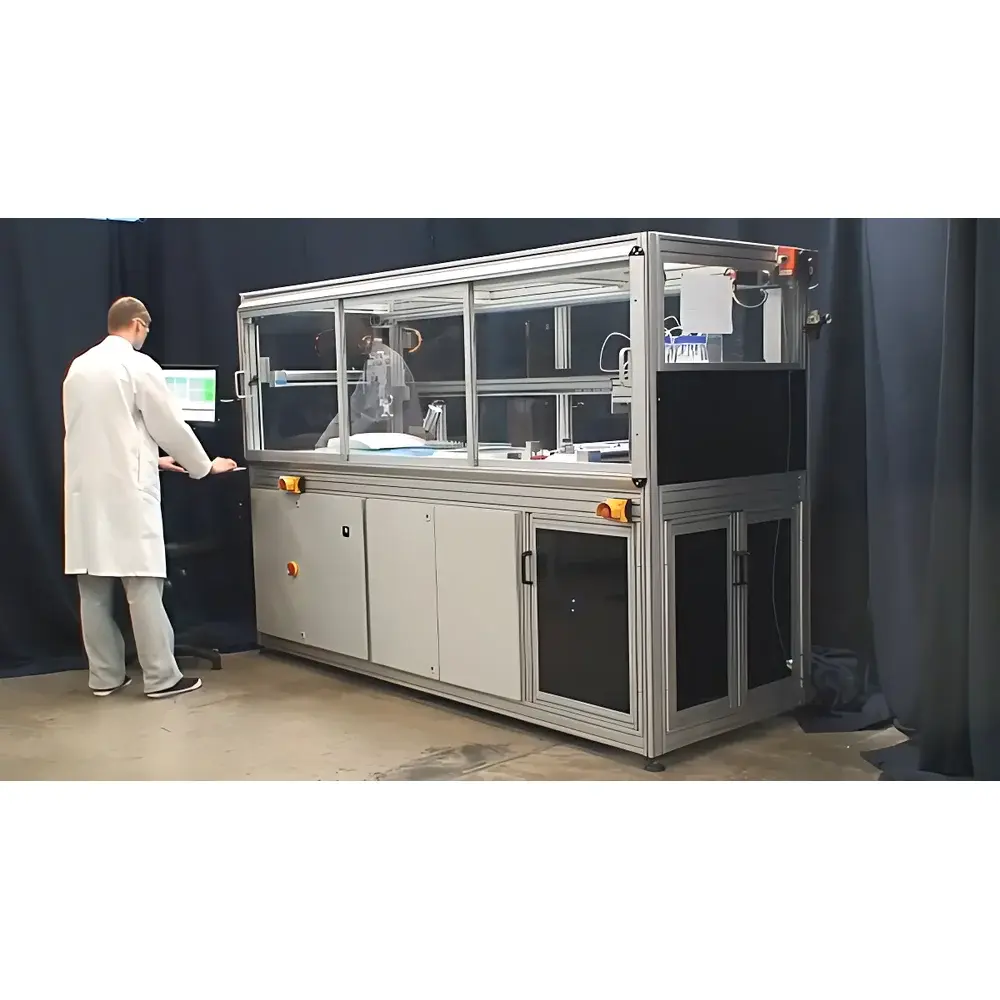
Labman Solid Sample Preparation Workstation
| Brand | Labman |
|---|---|
| Origin | United Kingdom |
| Manufacturer Type | Authorized Distributor |
| Import Status | Imported |
| Model | Solid Sample Preparation Workstation |
| Price Range | USD 260,000 – 390,000 |
Overview
The Labman Solid Sample Preparation Workstation is a fully integrated, programmable automation platform engineered for reproducible, traceable, and high-throughput solid sample processing in regulated and research-intensive laboratory environments. Built upon Labman Automation Ltd.’s four-decade legacy in laboratory robotics, this workstation implements a deterministic sequence of unit operations—including mechanical grinding, precision mass-based dosing, solvent addition (up to 10 distinct reagents), ultrasonic-assisted extraction, orbital shaking, centrifugation, liquid handling (pipetting), and nitrogen-assisted solvent evaporation—to convert heterogeneous solid matrices into analytically ready extracts for downstream chromatographic analysis. Its operational principle relies on gravimetric feedback control during powder dispensing and volumetric calibration of liquid delivery modules, ensuring consistent extract concentration across variable sample masses. Designed for method robustness rather than speed alone, the system prioritizes inter-run repeatability and operator-independent execution—critical for GLP-compliant environmental testing, pharmaceutical impurity profiling, and food safety residue analysis.
Key Features
- Modular architecture supporting custom integration of grinding mills (e.g., cryogenic or ambient vibratory mills), analytical balances (0.01 mg resolution), multi-channel liquid handlers with positive displacement pipettes, ultrasonic baths with temperature monitoring, refrigerated centrifuges (up to 4,000 × g), and nitrogen evaporators with pressure-controlled gas flow.
- Gravimetric sample dosing logic: automatically adjusts solvent volume based on measured powder mass to maintain fixed final extract concentration—enabling quantitative normalization across diverse sample densities and moisture contents.
- Dual-extract output capability per sample: simultaneous preparation of one LC-MS-compatible polar extract and one GC-MS-compatible non-polar extract, each following validated, instrument-specific protocols.
- Full audit trail generation compliant with FDA 21 CFR Part 11 requirements, including electronic signatures, user-level access controls, and immutable event logging for all hardware actions, parameter changes, and error states.
- Open API and I/O interfaces (RS-232, Ethernet/IP, Modbus TCP) for bidirectional communication with LIMS, CDS (Chromatography Data Systems), and enterprise MES platforms.
Sample Compatibility & Compliance
The workstation accommodates solid samples ranging from dry powders (e.g., soil, pharmaceutical tablets, polymer granules) to semi-solid matrices (e.g., sediments, tissue homogenates, food pastes) within standard 10–50 mL screw-cap vials. Grinding media include tungsten carbide, stainless steel, and zirconia beads, selected per ISO 18562-3 biocompatibility and ASTM D7263-06 abrasion resistance criteria. All wetted components meet USP Class VI certification. The system supports method validation per ICH Q2(R2), and its operational documentation package includes IQ/OQ/PQ protocols aligned with ISO/IEC 17025:2017 and EU GMP Annex 11 requirements. Regulatory-ready reports include raw balance readings, solvent delivery logs, centrifuge RCF profiles, and nitrogen purge duration/timing metadata.
Software & Data Management
Controlled via Labman’s proprietary AutoScript™ v5.2 software—a Windows-based, role-based interface with drag-and-drop workflow builder, real-time hardware status dashboard, and embedded Python scripting engine for advanced logic (e.g., conditional branching based on intermediate weight thresholds). All method files are digitally signed and version-controlled; historical methods are archived with SHA-256 hash verification. Raw data export supports CSV, XML, and AnIML formats. Integrated data integrity safeguards include automatic backup to network-attached storage (NAS) with daily incremental snapshots and WORM (Write-Once-Read-Many) archive mode for audit-critical datasets.
Applications
- Environmental labs: Extraction of PAHs, PCBs, and heavy metal species from soil/sediment per EPA Method 3540C and ISO 18238.
- Pharmaceutical QC: Dissolution testing support, content uniformity sampling, and genotoxic impurity screening from solid dosage forms.
- Food safety: Multi-residue pesticide analysis (EU SANTE/11312/2021) in cereals, spices, and infant formula.
- Materials science: Leachate preparation from composite polymers and catalyst supports prior to ICP-MS quantification.
- Clinical research: Homogenization and extraction of frozen tissue biopsies for targeted metabolomics workflows.
FAQ
Can the workstation handle moisture-sensitive or thermolabile samples?
Yes—optional integration of inert-gas purged grinding chambers, Peltier-cooled sample racks (4–15 °C), and low-frequency ultrasonication minimizes thermal degradation and oxidation.
Is method transfer to another Labman workstation possible?
Fully supported: AutoScript™ methods are hardware-agnostic and portable across Labman platforms; calibration parameters are stored separately and auto-mapped during import.
What validation documentation is provided?
Standard delivery includes Factory Acceptance Test (FAT) report, Installation Qualification (IQ) checklist, Operational Qualification (OQ) protocol with pass/fail criteria, and a customizable Performance Qualification (PQ) template aligned with your SOPs.
Does the system support unattended overnight operation?
Yes—equipped with hardware interlocks, emergency stop circuitry compliant with IEC 61508 SIL2, and predictive maintenance alerts triggered by motor current profiling and actuator cycle counters.



