
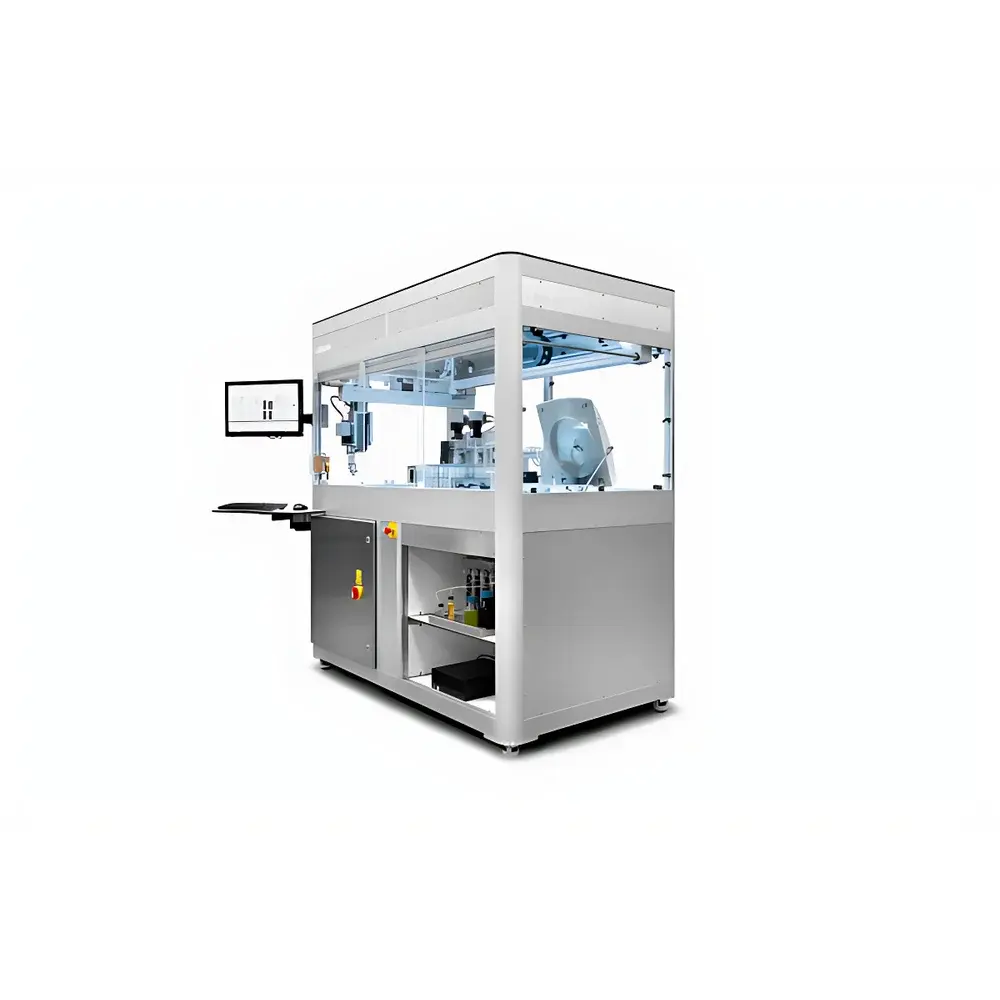
Custom-Built Automated Sample Preparation Workstation for Heavy Metal Analysis in Biological Matrices
| Origin | United Kingdom |
|---|---|
| Manufacturer Type | Authorized Distributor |
| Origin Category | Imported |
| Model | Costom |
| Price Range | USD 270,000 – 405,000 (FOB UK) |
Overview
The Custom-Built Automated Sample Preparation Workstation is an engineered solution designed specifically for high-throughput, reproducible pre-analytical processing of biological specimens—including whole blood, serum, plasma, and urine—prior to heavy metal quantification by ICP-MS, ICP-OES, or graphite furnace AAS. Based on modular robotic architecture and integrated liquid handling, the system implements standardized workflows compliant with ISO/IEC 17025 and CLIA requirements for clinical and environmental testing laboratories. Its core function is to automate sequential operations including tube capping/decapping, precision liquid dispensing, on-deck derivatization or chelation reactions, solid-phase extraction (SPE), internal standard addition, vortex mixing, centrifugation, and temperature-controlled sample staging—all within a single platform. The workstation processes up to 96 samples per 8-hour shift, reducing manual intervention by >85% and eliminating operator exposure to hazardous reagents (e.g., nitric acid digestion mixtures, chelating agents) and biohazardous matrices.
Key Features
- Dual independent capping/decapping stations with barcode-verified lid tracking—ensuring one-to-one correspondence between caps and tubes to prevent cross-contamination and maintain chain-of-custody integrity.
- Two fixed-volume positive-displacement pipettors (1 mL and 5 mL), each equipped with liquid-level sensing and dynamic tip immersion depth adjustment for consistent aspiration across variable sample volumes and viscosities.
- Four programmable syringe pumps supporting multi-step protocols: dilution series generation, timed chemical derivatization (e.g., APDC complexation), SPE conditioning/elution, and precise internal standard spiking at sub-microliter accuracy.
- Integrated vortex mixer capable of simultaneous agitation of six 15 mL conical centrifuge tubes; speed and duration are user-definable and logged with timestamped audit trails.
- Modified refrigerated centrifuge (max. 9,000 rpm, RCF ≈ 10,000 × g) with robotic arm interface and programmable acceleration/deceleration profiles—optimized for consistent pellet formation in trace-metal analysis workflows.
- Subsurface sample deck maintained at 4 °C ± 3 °C via Peltier-based thermal regulation, minimizing analyte degradation and microbial growth during extended unattended runs.
- Intuitive graphical workflow editor with real-time status visualization, error logging, and configurable alarm thresholds for pressure, temperature, liquid level, and motion sequence validation.
Sample Compatibility & Compliance
The workstation accommodates standard ANSI/SLAS-format tubes (1.5–15 mL), 96-well plates, and SPE cartridges (1 mL and 3 mL formats). All wetted components comply with USP Class VI biocompatibility standards and resist corrosion from strong acids (up to 65% HNO₃), oxidizers, and organic solvents. System software supports 21 CFR Part 11-compliant electronic signatures, role-based access control, and full audit trail generation—including user actions, parameter changes, and instrument events—for GLP/GMP-regulated environments. Validation documentation (IQ/OQ/PQ templates) and risk assessment reports (per ISO 14971) are provided upon installation.
Software & Data Management
Control is executed via a Windows-based application built on .NET Framework with embedded Python scripting support for custom protocol development. All method files are encrypted and version-controlled. Raw operational logs (including pump strokes, motor positions, temperature readings, and error codes) are exported in CSV/JSON format for LIMS integration. Optional API enables bidirectional communication with laboratory information management systems (LIMS) and chromatography data systems (CDS), allowing automatic sample ID propagation and result correlation.
Applications
- Automated preparation of clinical specimens for Pb, Cd, As, Hg, and Tl quantification under CAP-accredited toxicology testing protocols.
- High-volume environmental monitoring workflows—processing wastewater, sludge digests, or soil leachates prior to ICP-MS analysis per EPA Method 200.8.
- Standard addition calibration curve generation with integrated internal standard correction for improved matrix-matched accuracy.
- Multi-analyte SPE cleanup of complex biological extracts prior to LC-ICP-MS speciation analysis (e.g., methylmercury, inorganic arsenic).
- Reproducible sample stabilization using chelator cocktails (e.g., EDTA + ascorbic acid) to prevent redox-driven analyte loss during storage.
FAQ
Can the system be validated for regulated clinical laboratories?
Yes—full IQ/OQ/PQ documentation, 21 CFR Part 11 configuration, and GxP-aligned change control procedures are included.
Is remote monitoring and troubleshooting supported?
Yes—secure TLS-encrypted remote desktop access and diagnostic telemetry are available via optional service contract.
What maintenance intervals are recommended?
Pipette calibration every 3 months; syringe pump seal replacement annually; centrifuge rotor balance verification before each use.
Does the workstation integrate with third-party autosamplers or HPLC systems?
Yes—standard RS-232, TCP/IP, and Modbus RTU interfaces enable hardware-level handshake with major analytical instruments.
Can custom reagent racks or tube carriers be added post-installation?
Yes—the mechanical design follows ISO 8573-1 pneumatic and ISO/IEC 61508 functional safety guidelines, permitting certified field modifications by authorized engineers.
Related Products



