
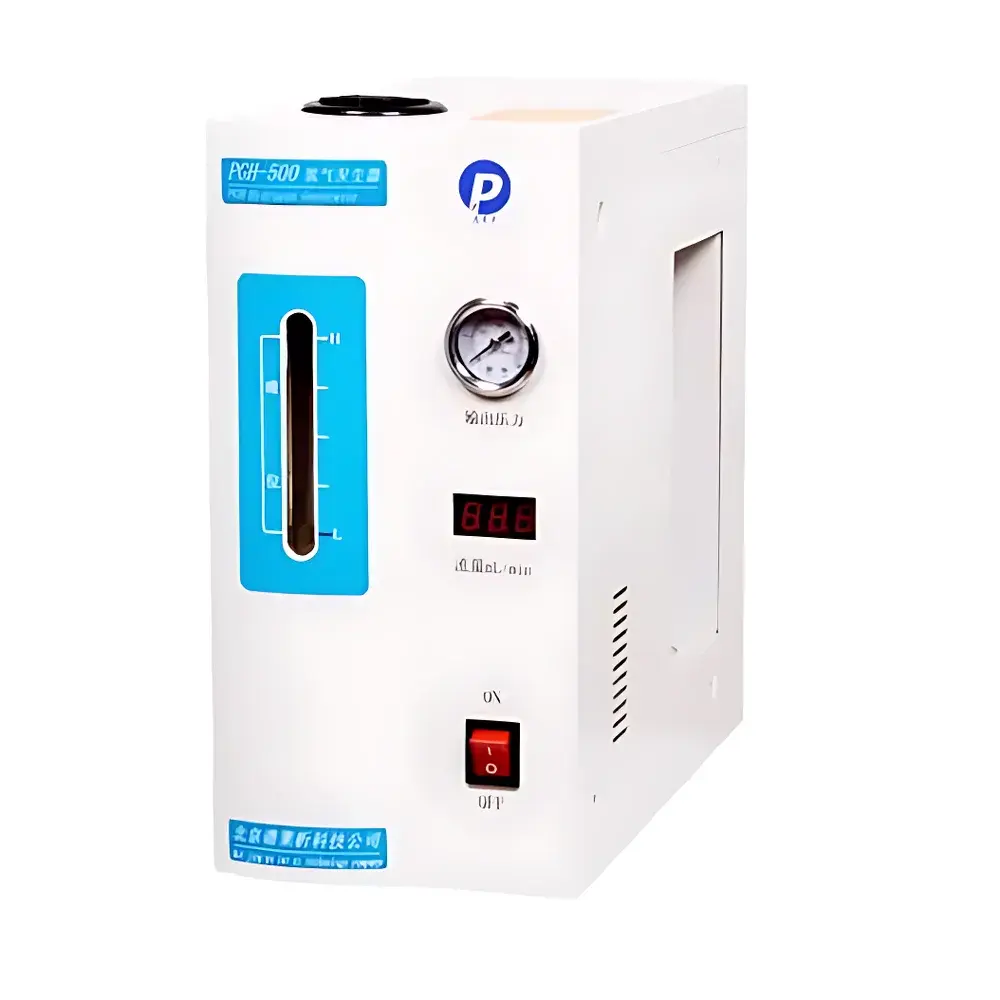
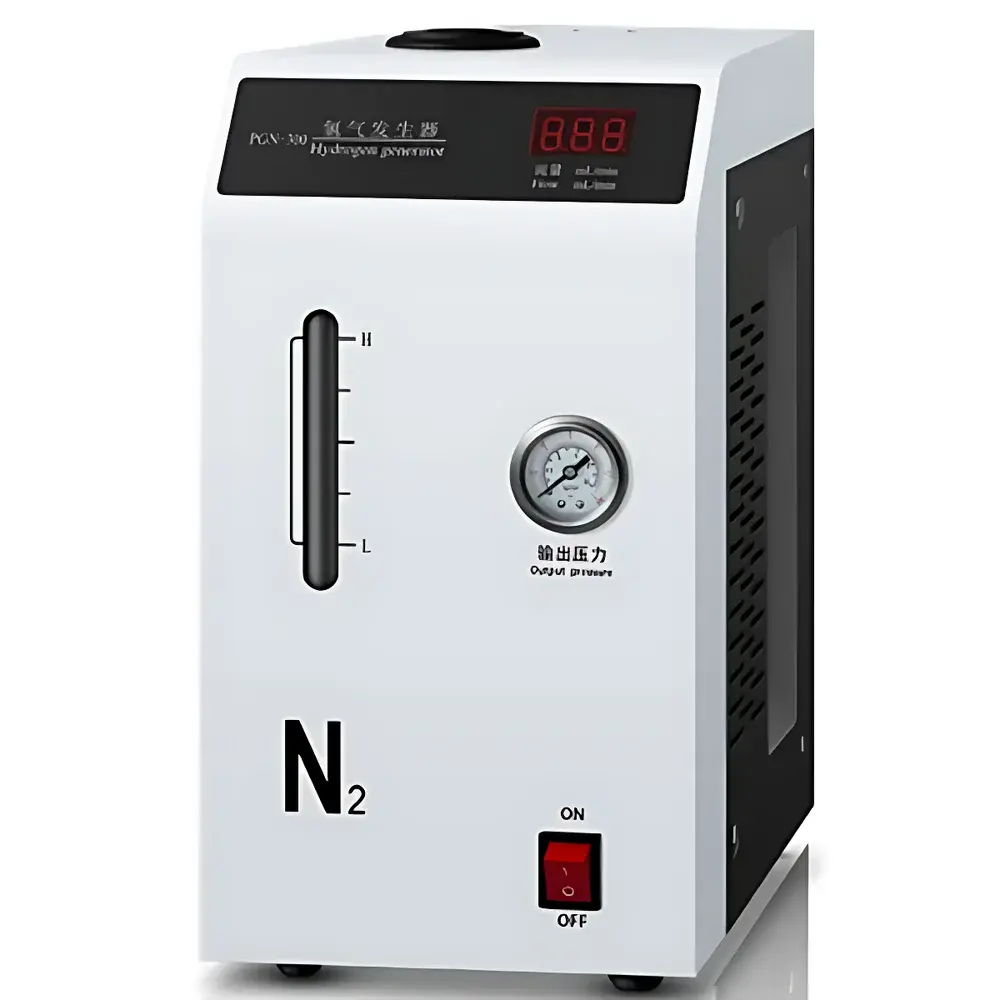
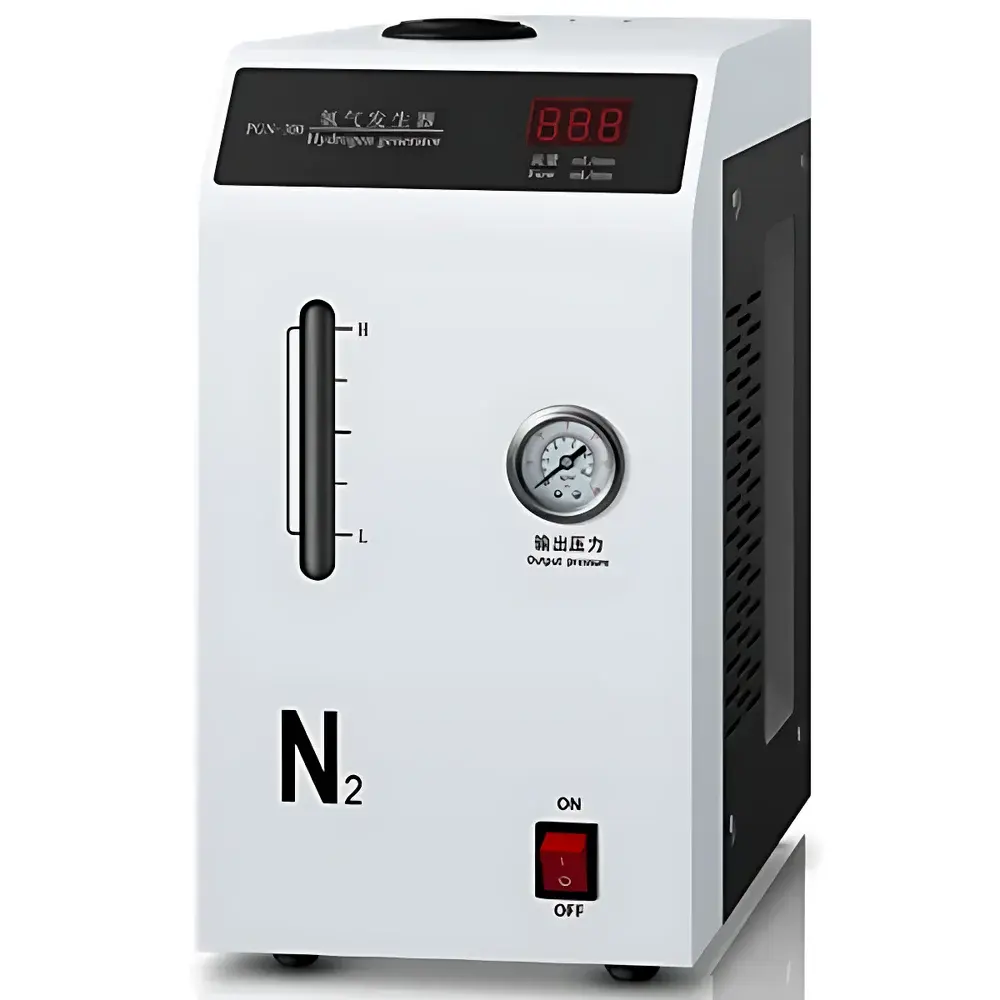
Huayisanpu PGN-300 High-Purity Nitrogen Generator
| Brand | Huayisanpu |
|---|---|
| Origin | Beijing, China |
| Model | PGN-300 |
| Nitrogen Generation Principle | Electrolytic Membrane Separation |
| Output Flow Rate | 0–300 mL/min |
| Output Pressure | 0.4 MPa |
| Nitrogen Purity | 99.999% |
| Dew Point | −10 to −40 °C |
| Input Air Pressure | 0.5 MPa |
| Power Supply | 220 V AC, 50 Hz |
| Max. Power Consumption | 80 W |
| Dimensions (L×W×H) | 385 × 180 × 360 mm |
| Net Weight | ~14 kg |
| Operating Ambient | 10–40 °C, RH < 85%, non-corrosive, low-dust environment |
Overview
The Huayisanpu PGN-300 High-Purity Nitrogen Generator is an electrolytic membrane-based gas generation system engineered for reliable, on-demand production of ultra-high-purity nitrogen (99.999%) in laboratory and analytical instrumentation environments. Unlike pressure swing adsorption (PSA) or hollow-fiber membrane systems, the PGN-300 employs a solid polymer electrolyte (SPE) cell architecture—commonly referred to as proton exchange membrane (PEM) electrolysis—to separate nitrogen from compressed air feedstock via electrochemical dissociation of water vapor. This process yields nitrogen gas with exceptionally low oxygen, moisture, and hydrocarbon content, making it suitable for applications requiring stringent inert gas specifications—including GC carrier gas, LC-MS purge gas, glovebox purging, and sample preparation under inert atmosphere. The unit integrates a multi-layer plate-type electrolytic cell with optimized surface area and thermal management, ensuring stable operation at low cell temperature and extended service life. Its compact footprint (385 × 180 × 360 mm), low power draw (≤80 W), and ambient-condition tolerance (10–40 °C, RH < 85%) support integration into shared lab spaces and mobile analytical platforms.
Key Features
- Electrolytic membrane separation technology delivering consistent 99.999% N₂ purity without consumable cartridges or periodic regeneration cycles.
- Multi-layer plate-type electrolytic cell design with enlarged active surface area and passive thermal dissipation—reducing operational temperature rise and enhancing long-term stability.
- Integrated anti-backflow liquid protection mechanism preventing electrolyte migration into gas lines, eliminating risk of instrument contamination or downstream blockage.
- Automated 10-minute post-startup purge sequence that expels residual atmospheric gases from internal pathways, accelerating time-to-specification nitrogen output.
- Real-time flow indication and precision pressure regulation (0.4 MPa ±0.02 MPa) with built-in overpressure safety cutoff.
- Low-maintenance architecture: no desiccant replacement, no carbon filters, no moving parts beyond solenoid valves—designed for >5,000 hours of continuous duty cycle.
Sample Compatibility & Compliance
The PGN-300 is compatible with all standard laboratory-grade compressed air sources meeting ISO 8573-1 Class 3:4:3 requirements (oil-free, ≤0.1 µm particulate, dew point ≤−20 °C). It does not require external dryers or coalescing filters when fed with properly conditioned air (input pressure: 0.5 MPa). The generated nitrogen meets ASTM D6866-22 criteria for isotopic purity verification and complies with ISO 8573-1:2010 Class 1.2.1 for gaseous impurities (O₂ ≤1 ppmv, H₂O ≤0.1 ppmv, total hydrocarbons ≤0.1 ppmv). While not certified to FDA 21 CFR Part 11 out-of-the-box, its operational logs—including runtime, purge cycles, and pressure/flow status—can be exported manually for GLP/GMP audit documentation. The unit adheres to IEC 61010-1:2012 safety standards for electrical equipment used in laboratory environments.
Software & Data Management
The PGN-300 operates as a standalone hardware system with no embedded microprocessor or digital interface. All control logic is implemented via discrete analog circuitry and electromechanical relays—ensuring electromagnetic compatibility (EMC) resilience in high-interference analytical labs. Flow rate is monitored via calibrated rotameter; pressure is regulated by a stainless-steel diaphragm regulator with mechanical gauge readout. No proprietary software, drivers, or cloud connectivity are required. For laboratories implementing LIMS or ELN workflows, manual logging of operational parameters (start/stop timestamps, flow settings, pressure readings) satisfies traceability requirements under ISO/IEC 17025:2017 Clause 7.7. Maintenance records—including electrolytic cell service intervals and inlet filter inspection dates—should be retained per organizational quality procedures.
Applications
- Gas chromatography (GC) carrier and detector make-up gas, especially for ECD, TCD, and FID systems demanding O₂-free environments.
- LC-MS and GC-MS systems requiring inert purge gas for ion source conditioning and vacuum manifold blanking.
- Controlled-atmosphere sample storage, solvent evaporation stations, and Schlenk line inerting.
- Calibration gas blending systems where high-purity nitrogen serves as matrix gas for ppb-level standard mixtures.
- Research-scale catalysis studies requiring reproducible, low-humidity inert blankets during reaction monitoring.
- Quality control labs performing ASTM D4052 density measurements or ASTM D93 flash point analysis under nitrogen inerting protocols.
FAQ
What compressed air quality is required for optimal PGN-300 performance?
The unit requires oil-free, desiccated compressed air at 0.5 MPa with particulate filtration ≤0.1 µm and dew point ≤−20 °C. Failure to meet these conditions may accelerate electrolyte degradation and reduce nitrogen purity.
Does the PGN-300 require periodic electrolyte replenishment?
No. The solid polymer electrolyte membrane is sealed and maintenance-free for the rated service life. Only routine visual inspection of inlet air filters is recommended every 6 months.
Can the output pressure be adjusted beyond 0.4 MPa?
No. The integrated pressure regulator is factory-set to 0.4 MPa and is not user-adjustable. Over-pressurization voids warranty and risks membrane delamination.
Is the nitrogen output suitable for use in medical or pharmaceutical manufacturing processes?
The PGN-300 meets technical specifications for laboratory-grade nitrogen but is not certified to USP , EP 2.5.27, or ISO 8573-7 for pharmaceutical-grade applications. Validation per client-specific PQ protocols is required prior to GMP deployment.
How does ambient temperature affect nitrogen dew point performance?
Dew point output (−10 to −40 °C) reflects post-drying performance under nominal load. At ambient temperatures >35 °C or relative humidity >80%, dew point may shift toward the upper limit due to reduced condensation efficiency in the internal drying stage.
Related Products



