
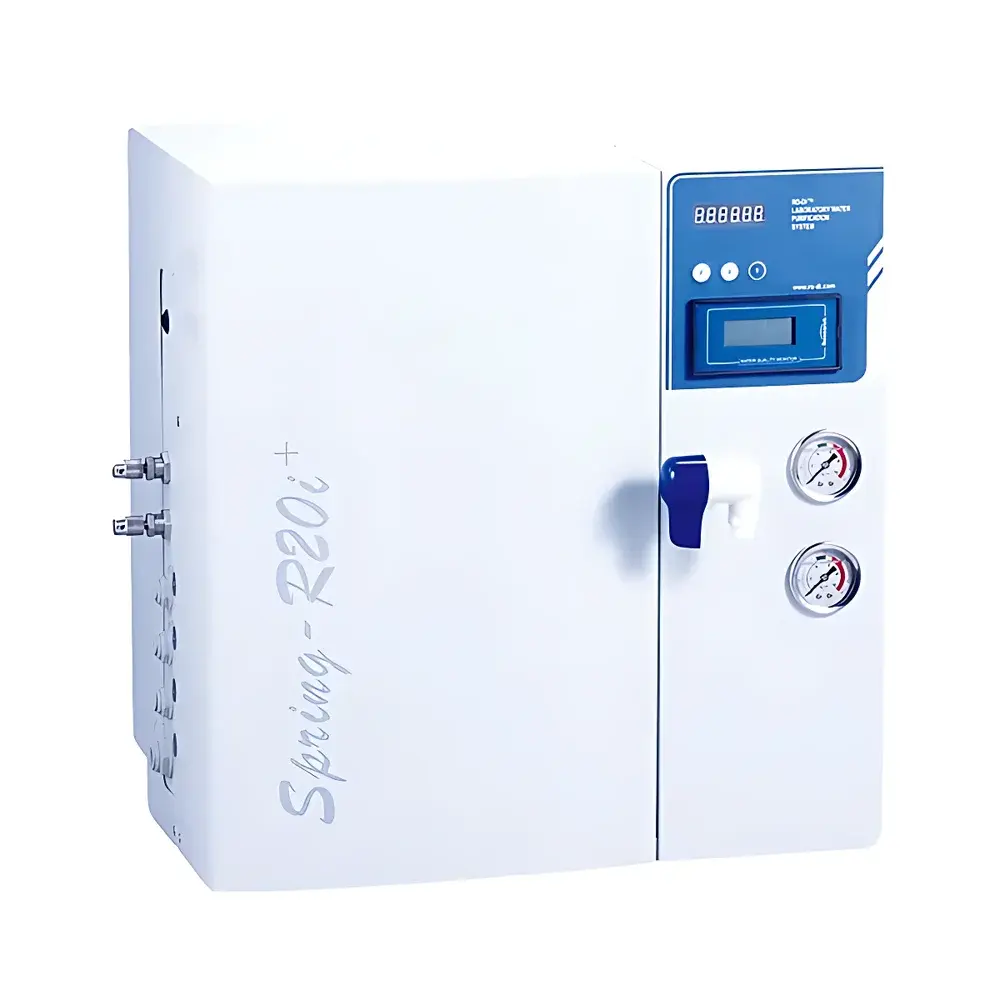
RSJ Spring Series Benchtop Ultrapure Water System
| Brand | RSJ |
|---|---|
| Origin | Fujian, China |
| Manufacturer Type | Direct Manufacturer |
| Product Category | Domestic |
| Model | Spring-S / Spring-R |
| Pure Water Grade | Type I (ASTM D1193-20) |
| Resistivity | ≥18.2 MΩ·cm @ 25°C |
| Total Organic Carbon (TOC) | <15 ppb (UV-equipped models: <5 ppb) |
| Feed Water | Municipal tap water (5–40°C, pressure ≥0.1 MPa) |
| RO Configuration | Single-stage (S-series) or Dual-stage (R-series) |
| RO Recovery Rate | 30–60% (S), 20–30% (R) |
| Ion Removal Efficiency | 96–98% |
| Microbial & Particulate Removal (>0.22 µm) | >99% |
| Conductivity | <5 µS/cm |
| Max Flow Rate | ≥1.8 L/min |
| Quantitative Dispensing Range | 0.1–25 L (±2% accuracy) |
| Dimensions (W×H×D) | 423 × 445 × 280 mm |
| Power Supply | 220 V AC, 50–100 W |
| Certifications | NSF/ANSI Standard 58 & 61 compliant materials (NSF-certified wetted components) |
Overview
The RSJ Spring Series Benchtop Ultrapure Water System is an engineered solution for laboratories requiring reliable, space-efficient production of Type I ultrapure water per ASTM D1193-20 and ISO 3696 Class 1 specifications. Designed around a compact, modular architecture—occupying only 0.053 m³ footprint—the system integrates either single-stage (Spring-S) or dual-stage reverse osmosis (Spring-R) pretreatment with post-RO polishing modules including ion exchange, activated carbon, and optional 185/254 nm UV oxidation. The core purification mechanism relies on size-exclusion membrane filtration (RO), electrochemical deionization (EDI or mixed-bed resin), and photochemical organic decomposition (UV), delivering consistent resistivity ≥18.2 MΩ·cm at 25°C and TOC <15 ppb (down to <5 ppb with integrated UV). Its DC24V low-voltage control architecture, full electrical/water isolation, and NSF-certified wetted materials ensure compliance with IEC 61000-6-2/4 electromagnetic compatibility and UL 61010-1 safety standards.
Key Features
- Compact benchtop form factor (423 × 445 × 280 mm) with wall-mount capability—ideal for constrained lab spaces without compromising output capacity.
- Dual-stage RO configuration (Spring-R) achieves >98% salt rejection and stable feed-to-permeate recovery rates of 20–30%, minimizing wastewater generation and operational cost over time.
- Intelligent monitoring suite: real-time resistivity/conductivity tracking, predictive filter life algorithm, early-stage fouling detection, and automated cartridge replacement alerts.
- Precision dispensing module with programmable timer (1–60 min) and volumetric delivery (0.1–25 L), calibrated to ±2% accuracy per ISO 8655-7, enabling unattended bulk water preparation.
- NSF/ANSI 58 and 61 certified contact materials—including polypropylene housings, EPDM seals, and food-grade stainless steel fittings—ensuring chemical inertness and regulatory traceability.
- Energy-optimized operation: nominal power draw of 50–100 W supports continuous 24/7 duty cycles while maintaining thermal stability within ambient lab conditions (5–40°C).
Sample Compatibility & Compliance
The Spring Series produces water meeting or exceeding the purity requirements for analytical, cell culture, and diagnostic instrumentation feed applications. It complies with GB/T 6682-2008 (China National Standard) Grade I specifications and aligns with key international benchmarks: ASTM D1193-20 Type I, ISO 3696:1987 Class 1, and CLSI EP22-A2 guidelines for clinical laboratory water. All wetted components are validated for extractables and leachables per USP , and the system supports GLP/GMP documentation workflows through audit-trail-capable event logging. Optional UV integration satisfies USP TOC validation criteria for pharmaceutical water systems.
Software & Data Management
The embedded microcontroller provides local LCD interface for real-time parameter visualization (resistivity, TOC, flow rate, filter status). No proprietary software installation is required; data export is supported via USB-C dump (CSV format) for integration into LIMS or ELN platforms. Event logs—including cartridge replacement timestamps, alarm history, and daily production volume—are timestamped and non-erasable, fulfilling FDA 21 CFR Part 11 requirements for electronic records when paired with institutional access controls. Remote diagnostics via optional RS485 Modbus RTU interface enable centralized fleet monitoring in multi-unit lab environments.
Applications
- Primary Purified Water Applications: Feed water for ultrapure polishing systems, buffer and media preparation, glassware rinsing, microbial assay diluents, spectrophotometric blanking, and HPLC mobile phase formulation.
- Advanced Ultrapure Applications: Flame atomic absorption spectroscopy (FAAS), primary cell culture maintenance, immunocytochemistry staining, electrophysiology recording solutions, electrochemical sensor calibration, and reagent-grade water for ELISA and PCR setup.
- Instrumental Support: Continuous supply to autoclaves, washer-disinfectors, clinical analyzers (e.g., Cobas, Vitros), environmental chambers, and humidification systems where conductivity-sensitive processes demand strict ion control.
FAQ
What is the difference between Spring-S and Spring-R configurations?
The Spring-S employs single-stage RO for high-recovery operation (30–60%) and is optimized for municipal feed water with low TDS (<500 ppm). The Spring-R uses dual-stage RO to achieve higher deionization efficiency and lower TOC carryover—recommended for feed sources with elevated hardness, silica, or organic load.
Does the system support IQ/OQ validation protocols?
Yes. Factory-provided qualification documents include Installation Qualification (IQ) checklists, Operational Qualification (OQ) test scripts for resistivity, TOC, and flow verification, and template reports compatible with ISO/IEC 17025-accredited labs.
Can the Spring Series be integrated with existing lab water networks?
It operates as a standalone point-of-use system but includes 1/4″ push-to-connect fittings and pressure-regulated output ports compatible with standard lab plumbing. Optional booster pump kits are available for low-pressure municipal supply scenarios.
Is UV treatment mandatory for TOC reduction?
No—standard models meet <15 ppb TOC via advanced carbon polishing. UV modules (185/254 nm) are optional upgrades required for applications demanding <5 ppb TOC, such as LC-MS solvent preparation or semiconductor rinse validation.
How often do consumables require replacement?
Pre-filters: every 6 months (or 3,000 L); RO membranes: 2–3 years depending on feed quality; polishing cartridges: 6–12 months based on usage volume and resistivity decay trends—automatically tracked and reported by the onboard system.



