
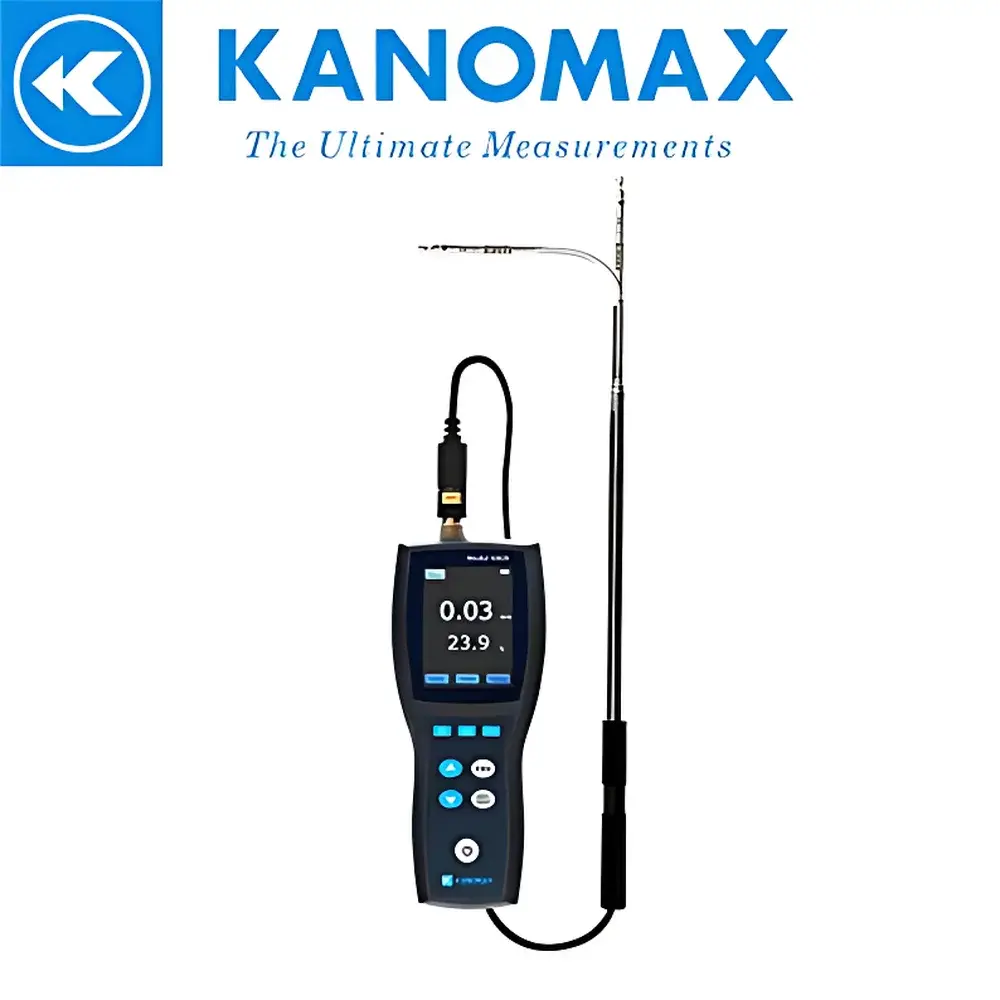
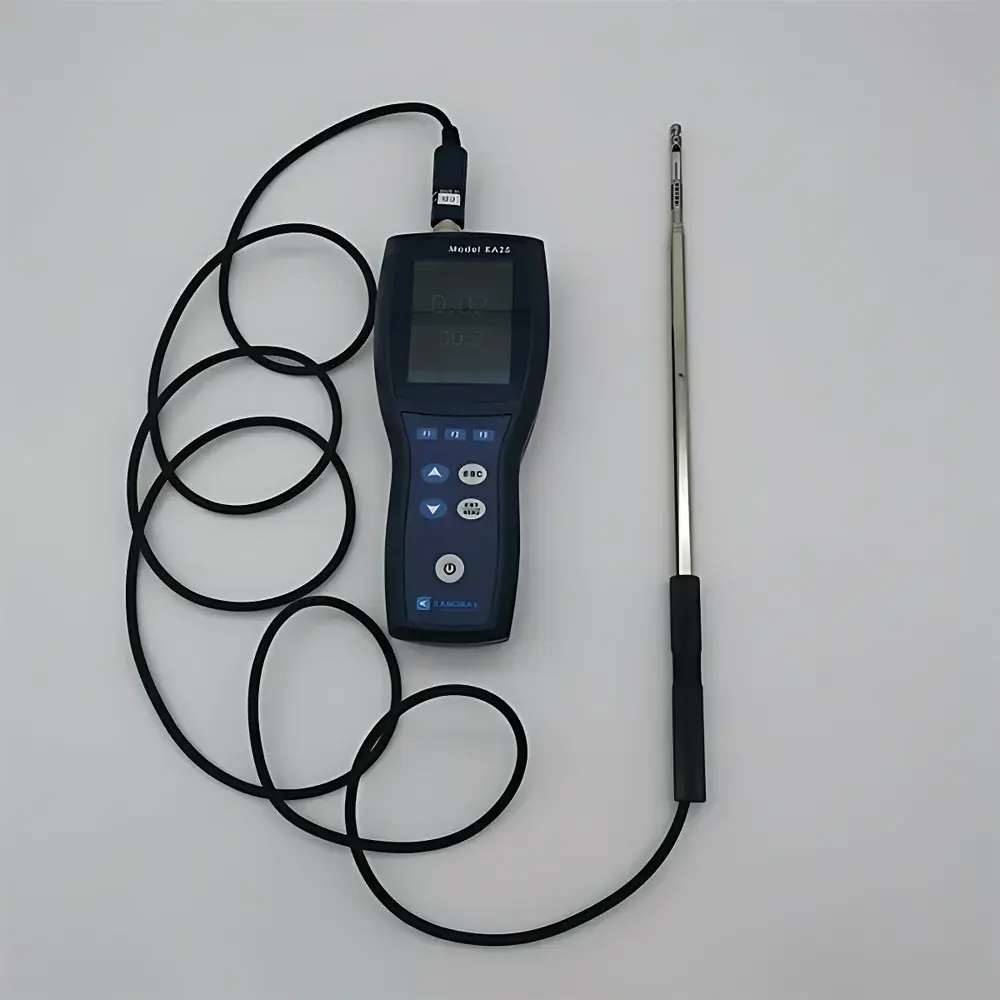
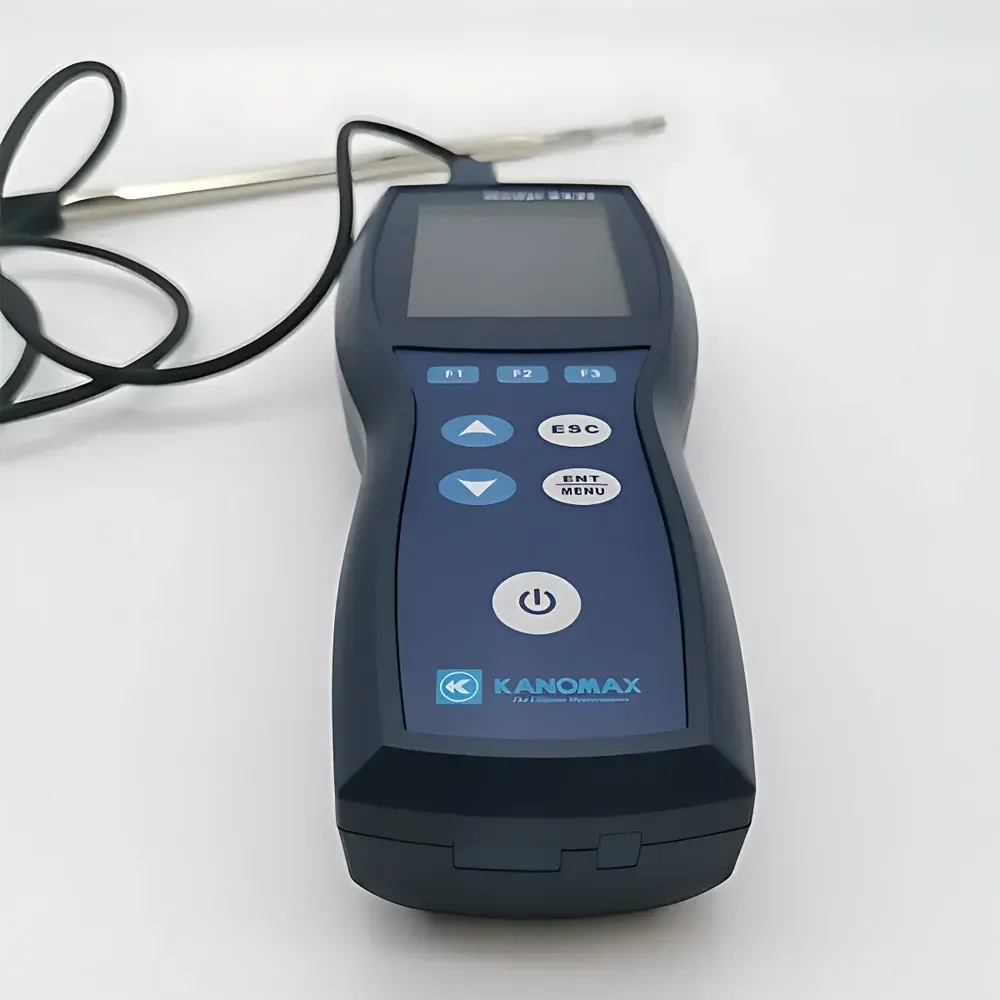
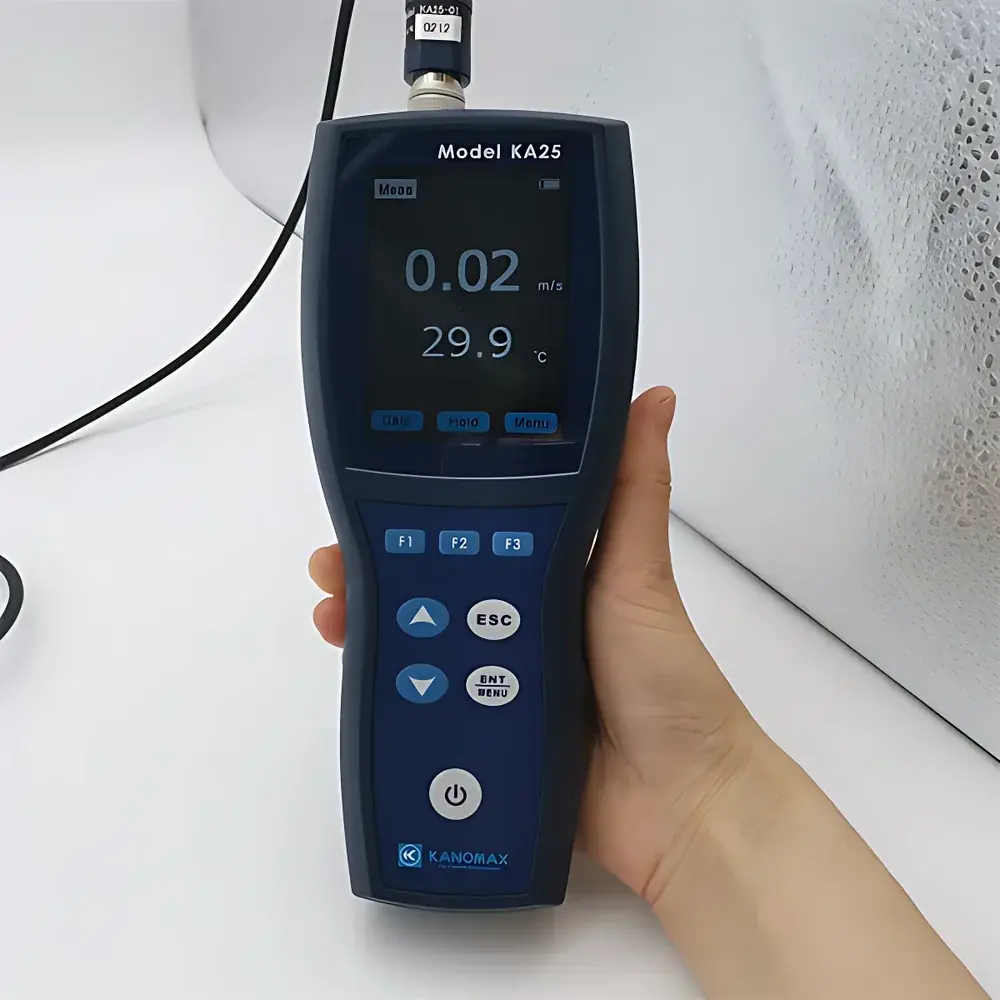
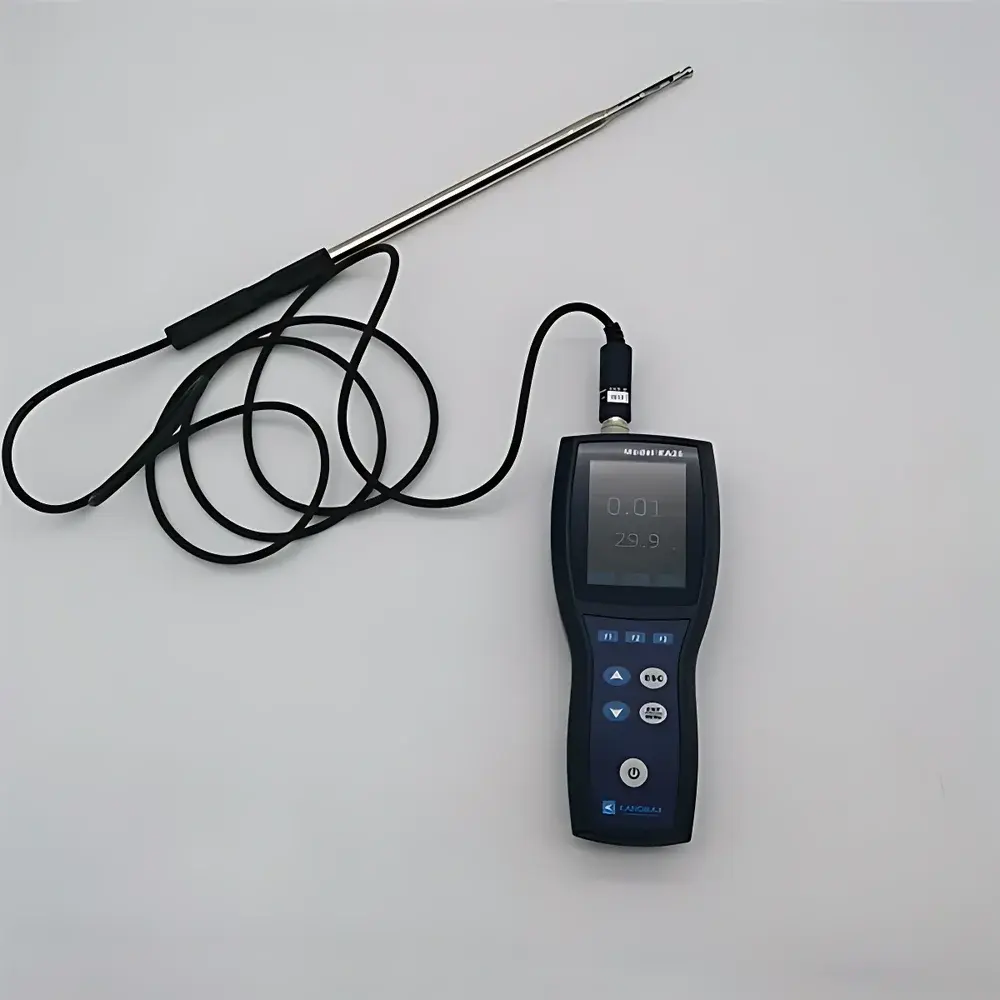
Kanomax KA25 Hot-Wire Anemometer and Air Flow Meter
| Brand | Kanomax |
|---|---|
| Origin | Japan |
| Model | KA25 |
| Instrument Type | Hot-Wire Anemometer |
| Resolution | 0.01 m/s |
| Measurement Range | 0.01–20.0 m/s |
| Accuracy | ±(3% of reading + 0.03 m/s) |
| Operating Temperature | −20 to 70 °C |
| Operating Humidity | 2–98% RH |
| Temperature Accuracy | ±0.5 °C (at v > 0.5 m/s) |
| Temperature Resolution | 0.1 °C |
| Air Volume Resolution | 1 m³/h |
| Response Time (Velocity) | ~1 s (90%, at 1 m/s) |
| Response Time (Temperature) | ~30 s (90%, at 1 m/s) |
| Probe Dimensions | Ø6 mm (sensor), Ø14 mm × 294–1060 mm (telescoping handle) |
| Body Dimensions | 200 × 85 × 40 mm |
| Weight | ~220 g (without batteries) |
| Power | 4 × AA alkaline batteries |
| Battery Life | ~15 h (at 1 m/s, 20 °C) |
| Auto-Off Options | 3/5/10 min |
| Time Constant Settings | 1/5/10/20 s |
| Statistical Functions | Min/Avg/Max |
| Pipe Shape Support | Rectangular & Circular |
| Pipe Size Input Range | 0.1–255.0 cm |
| Display | 3-level backlight LCD |
Overview
The Kanomax KA25 is a portable, handheld hot-wire anemometer engineered for precise, real-time measurement of air velocity and temperature in HVAC commissioning, cleanroom validation, industrial ventilation assessment, and environmental monitoring applications. Based on constant-temperature anemometry (CTA), the KA25 employs a fine platinum-coated tungsten wire sensor heated to a stable differential above ambient temperature. As airflow passes over the sensor, convective cooling alters the electrical resistance of the wire; this change is precisely regulated via feedback control and converted into a linear velocity output. Unlike cup or vane anemometers, the KA25 delivers high sensitivity at low velocities (down to 0.01 m/s) with minimal flow disturbance—critical for laminar flow characterization and duct traverse profiling. Its integrated temperature sensor enables simultaneous thermal measurement, and when cross-sectional dimensions are entered, the instrument computes volumetric air flow (m³/h) directly—eliminating manual calculation errors and streamlining field reporting.
Key Features
- Hot-wire sensing principle optimized for low-velocity accuracy and rapid transient response (~1 s for 90% velocity step response at 1 m/s)
- Telescoping and flexible probe design (Ø6 mm sensor, Ø14 mm handle, 294–1060 mm extension range) for access to ducts, grilles, fume hoods, and confined spaces
- Intuitive 3-level backlight LCD with simultaneous display of velocity, temperature, and calculated air volume
- On-device statistical processing: real-time min/avg/max tracking across user-defined sampling intervals
- Configurable time constant (1/5/10/20 s) to balance responsiveness and signal smoothing per application requirement
- Data hold function with automatic storage of last measured value for documentation and comparison
- Auto-power-off (selectable 3/5/10 min) and battery level indicator to extend operational uptime
- Robust mechanical architecture: IP-rated probe housing, shock-absorbing body casing, and corrosion-resistant sensor coating for long-term field reliability
Sample Compatibility & Compliance
The KA25 is validated for use with clean, dry, non-corrosive air—making it suitable for ISO 14644-3 cleanroom airflow mapping, ASHRAE 111 duct traverse protocols, and laboratory fume hood face velocity verification. It complies with JIS B 7555 (Japanese Industrial Standard for anemometers) and meets general requirements for portable environmental instrumentation under IEC 61000-6-3 (EMC emission) and IEC 61010-1 (safety). While not intrinsically safe, its low-voltage operation (6 V DC) and absence of moving parts ensure safe deployment in Class 1 Div 2 environments. The instrument supports GLP-aligned workflows through traceable calibration records (NIST-traceable certificate optional), manual entry of pipe geometry (rectangular or circular), and timestamp-free data logging compatible with external QA/QC documentation systems.
Software & Data Management
The KA25 operates as a standalone field instrument without proprietary software dependency. All measurements—including velocity, temperature, air volume, and statistical aggregates—are viewable on-device and exportable manually via recorded values. For integration into broader facility management systems, users may transcribe results into compliant electronic lab notebooks (ELNs) or LIMS platforms supporting ASTM E2500 or FDA 21 CFR Part 11 audit trail requirements. Calibration certificates include uncertainty budgets referenced to NIST-traceable standards, enabling full metrological traceability. Firmware updates (if issued) are delivered via Kanomax’s authorized service centers—not over-the-air—to maintain regulatory integrity and device stability.
Applications
- HVAC system balancing and commissioning per ASHRAE Guideline 1 and TAB best practices
- Cleanroom ISO class verification (airflow uniformity, face velocity at HEPA filters and supply diffusers)
- Fume hood and biosafety cabinet performance testing (ANSI/ASHRAE 110, EN 14175)
- Industrial exhaust duct monitoring for OSHA PEL compliance and ventilation rate validation
- Environmental chamber airflow profiling during pharmaceutical stability testing (ICH Q1)
- Academic and research aerodynamics studies requiring low-range, high-resolution velocity capture
FAQ
What types of duct geometries does the KA25 support for air volume calculation?
The KA25 accepts user-input dimensions for both rectangular and circular ducts, with width/height or diameter entries ranging from 0.1 to 255.0 cm. Cross-sectional area is computed internally to derive volumetric flow (m³/h) from average velocity.
Is the KA25 suitable for measuring airflow in humid or dusty environments?
It is rated for operation at 2–98% RH but is intended for clean air only. High particulate loading or condensable vapors may contaminate the hot-wire sensor and degrade accuracy; use with inline particulate filtration is recommended in non-laboratory settings.
How is calibration maintained and verified?
Kanomax recommends annual recalibration against a NIST-traceable reference standard. Field verification can be performed using a calibrated wind tunnel or rotating vane reference anemometer at representative velocities (e.g., 0.5, 5.0, and 15.0 m/s).
Can the KA25 measure gases other than air?
No—the instrument’s velocity calibration is specific to dry air at standard temperature and pressure. Density and thermal conductivity differences in other gases invalidate the CTA output without custom compensation algorithms.
What is the minimum measurable velocity, and how is low-flow stability ensured?
The KA25 resolves down to 0.01 m/s with a specified accuracy of ±(3% of reading + 0.03 m/s). Stability at sub-0.1 m/s is enhanced by selectable longer time constants (10 s or 20 s) and internal digital filtering to suppress thermal drift and electrical noise.







