
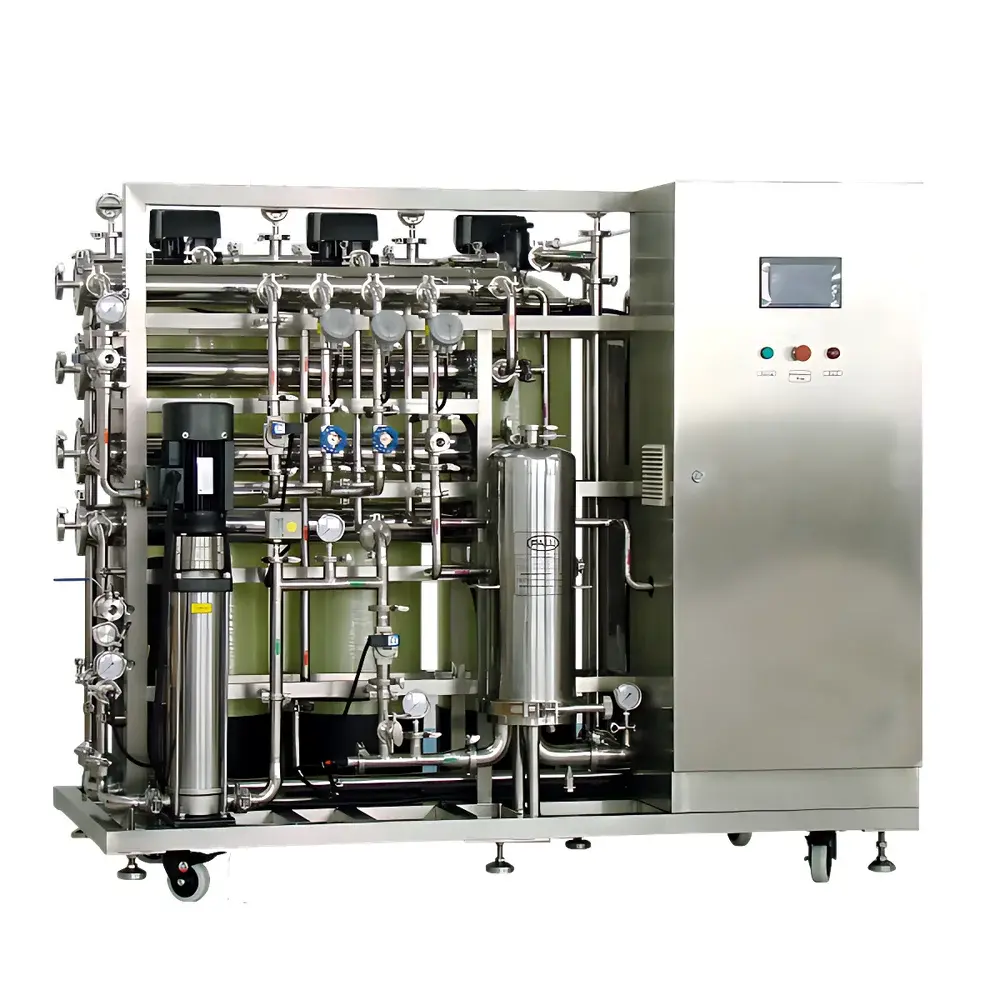
Apollo RSJ APOLLO Sanitary-Grade Central Ultra-Pure Water System
| Brand | RSJ |
|---|---|
| Origin | Fujian, China |
| Manufacturer Type | Direct Manufacturer |
| Origin Category | Domestic |
| Model | APOLLO |
| Quotation | Upon Request |
| Purified Water Grade | Chinese Pharmacopoeia Grade II (Purified Water) |
| Resistivity | ≥10 MΩ·cm @ 25 °C |
| Production Capacity | 500–5000 L/h (at 5–35 °C) |
| Feedwater Pretreatment | Automatic sand filtration + automatic activated carbon filtration + automatic softening (regeneration-capable) |
| Primary Purification | Reverse Osmosis + Electrodeionization (RO+EDI) |
| Product Water Resistivity | >5 MΩ·cm @ 25 °C (meets Chinese Pharmacopoeia requirements for Purified Water) |
| Final Polishing Output (with optional DI) | 15–18 MΩ·cm @ 25 °C |
| Conductivity | <1 µS/cm @ 25 °C (post-polishing) |
| Supply Pressure Range | 2–8 bar (adjustable) |
| Control System | PLC + HMI touchscreen interface |
| Data Logging | SD card storage with timestamped conductivity, pressure, flow, and alarm history |
| Remote Monitoring & Control | Supported via Ethernet/Modbus TCP |
| Sanitary Design | 316L stainless steel piping, orbital welds, sloped drainage, zero-stagnation geometry, compliant with ASME BPE-2022 surface finish (Ra ≤ 0.4 µm) |
| Microbial Control | Automated thermal or chemical sanitization cycles with temperature/chemical concentration validation logging |
| Compliance | Designed to support compliance with GMP (Annex 1), GLP, USP <1231>, EP 2.2.42, and ISO 23500:2023 for pharmaceutical water systems |
Overview
The Apollo RSJ APOLLO Sanitary-Grade Central Ultra-Pure Water System is an engineered solution for continuous, validated production of pharmacopeial-grade purified water (PW) and high-resistivity ultra-pure water (UPW) in regulated biopharmaceutical, diagnostic reagent, and life science manufacturing environments. Based on a dual-stage purification architecture—reverse osmosis (RO) followed by continuous electrodeionization (EDI)—the system eliminates dependence on ion-exchange resin regeneration and chemical dosing while maintaining stable resistivity ≥10 MΩ·cm at point-of-use. Its sanitary design adheres to ASME BPE-2022 standards, featuring electropolished 316L stainless steel distribution loops, fully drainable geometry, and validated microbial control protocols. The system operates under constant-flow demand management, dynamically adjusting pump speed and energy input to sustain precise output volume across variable ambient temperatures (5–35 °C), making it suitable for integration into multi-point distribution networks serving cleanrooms, QC labs, and upstream/downstream processing suites.
Key Features
- Sanitary-grade construction: All wetted surfaces fabricated from ASTM A270 TP316L stainless steel with Ra ≤ 0.4 µm electropolished finish; orbital-welded joints certified per ASME B31.3 and AWS D18.1
- Automated pretreatment: Self-monitoring sand filter, activated carbon column, and softener—all equipped with programmable backwash, brine regeneration, and differential pressure-based service-life tracking
- RO+EDI core: High-rejection thin-film composite RO membrane coupled with stack-type EDI modules enabling >99.9% ionic removal without chemical regeneration
- Final polishing option: Integrated mixed-bed deionization (DI) cartridge for post-EDI resistivity enhancement to 15–18 MΩ·cm, trace organic removal, and endotoxin reduction
- Intelligent control: PLC-based automation with 7-inch color HMI touchscreen, real-time graphical trend display, and configurable setpoints for flow, pressure, temperature, and conductivity
- Data integrity: SD card logging of all critical parameters (conductivity, pressure, flow rate, UV intensity, temperature, alarm status) with time/date stamping and tamper-resistant file structure
- Sanitization protocol: Programmable hot-water (80–85 °C) or ozone-based sanitization with cycle validation, temperature mapping, and hold-time verification
- Remote operation: Modbus TCP/Ethernet connectivity supporting SCADA integration, remote diagnostics, and audit-ready event logs aligned with FDA 21 CFR Part 11 requirements
Sample Compatibility & Compliance
The APOLLO system is designed for feedwater sources meeting municipal potable water quality per GB 5749–2022 or equivalent (e.g., WHO Guidelines). It accommodates inlet total dissolved solids (TDS) up to 500 ppm and chlorine residuals ≤1.0 ppm. Final product water meets or exceeds the specifications for Purified Water defined in the Chinese Pharmacopoeia (ChP), United States Pharmacopeia (USP ), European Pharmacopoeia (EP 2.2.42), and Japanese Pharmacopoeia (JP XVII). Distribution loop design supports ISO 23500:2023 requirements for pharmaceutical water systems, including dead-leg minimization (1.5 m/s), and continuous recirculation. Documentation packages include FAT/SAT protocols, IQ/OQ templates, material certifications (MTRs), weld logs, and surface roughness reports to facilitate GMP and GLP audits.
Software & Data Management
The embedded control software provides full lifecycle data governance: automatic generation of electronic batch records, user-access-level permissions (admin/operator/auditor), electronic signatures for critical actions (e.g., sanitization start, DI cartridge replacement), and configurable alarm escalation (email/SMS via optional gateway). All logged data are stored in CSV format with SHA-256 hash integrity verification. Audit trails capture operator ID, timestamp, parameter change, and reason-for-change—fully compliant with ALCOA+ principles and FDA 21 CFR Part 11 Subpart C requirements. Historical data export supports trending analysis in third-party platforms such as LabVantage or Empower.
Applications
- Biopharmaceutical manufacturing: Preparation of buffers, media, and cleaning solutions for cell culture, purification, and fill-finish operations
- In vitro diagnostic (IVD) reagent production: Formulation of calibrators, controls, and assay diluents requiring low ionic interference and minimal endotoxin load
- Pharmaceutical R&D laboratories: Solvent preparation for HPLC, LC-MS, and elemental analysis where trace metal contamination must be minimized
- Cosmetic and nutraceutical facilities: Compliant water sourcing for GMP-aligned product development and stability testing
- Veterinary pharmaceutical and feed additive production: Scalable PW supply meeting regional regulatory expectations for veterinary drug manufacturing
FAQ
What pharmacopeial standards does the APOLLO system meet?
It delivers water conforming to ChP Purified Water, USP , EP 2.2.42, and JP XVII specifications, with optional DI polishing to meet USP Water for Injection (WFI) precursor requirements.
Is the system suitable for sterile applications?
While APOLLO produces non-sterile Purified Water, its sanitary design, automated sanitization, and ISO 23500-compliant distribution enable seamless integration with downstream sterilizing-grade filtration (0.22 µm) and steam-in-place (SIP) loops.
Can the system be validated per GMP requirements?
Yes—RSJ provides IQ/OQ documentation templates, FAT/SAT execution support, and traceable calibration certificates for all field instruments (conductivity sensors, pressure transducers, flow meters).
How is microbial control maintained in the distribution loop?
Through continuous recirculation at >1.5 m/s, periodic thermal or ozone sanitization with temperature/concentration validation, and real-time conductivity monitoring at return points.
What maintenance intervals are recommended for consumables?
Pretreatment filters: 3–6 months depending on feedwater quality; RO membranes: 2–3 years with proper pretreatment; EDI stacks: 5+ years with stable feed conductivity; DI cartridges: replaced upon resistivity drop below setpoint or after 6–12 months.



