
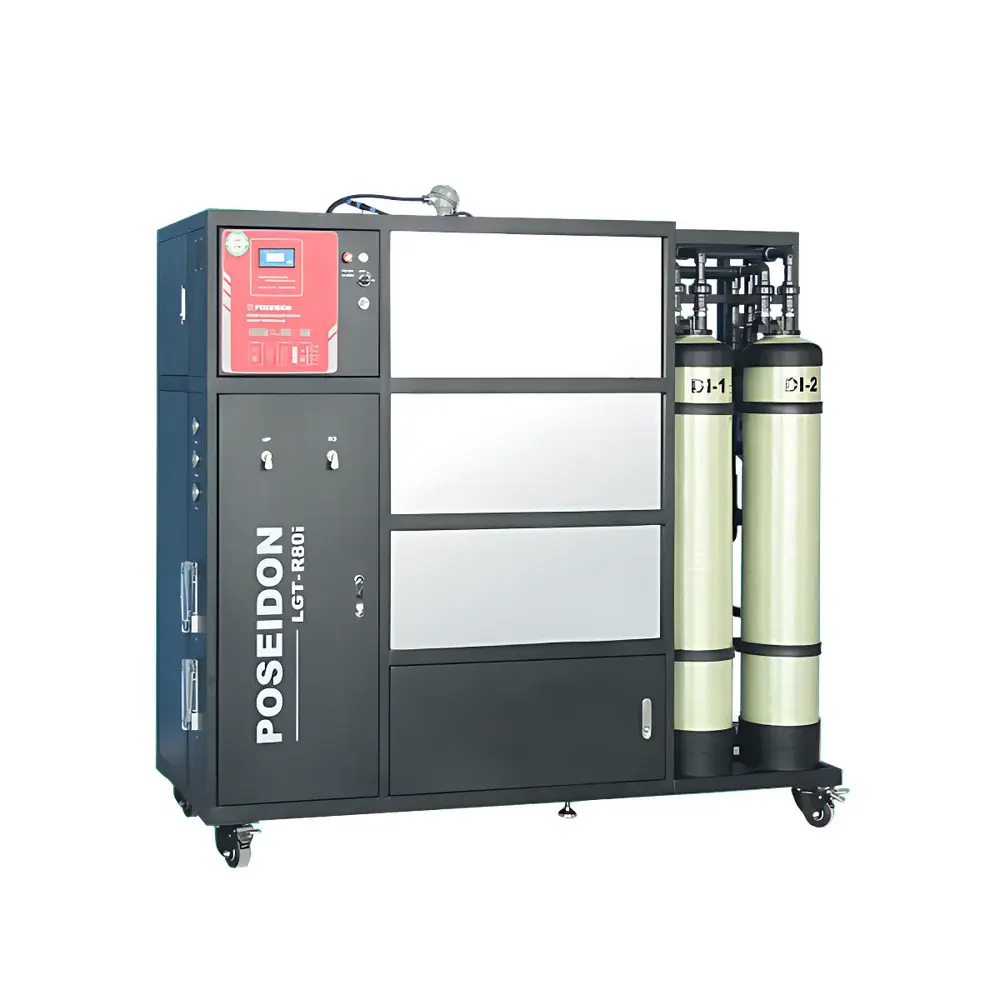
LGT Series Benchtop Laboratory Ultra-Pure Water System
| Brand | RSJ (Rui Sijie) |
|---|---|
| Origin | Fujian, China |
| Manufacturer Type | Direct Manufacturer |
| Country of Origin | China |
| Model | LGT |
| Pricing | Upon Request |
| Purified Water Grade | ASTM Type I / GB/T 6682–2008 Grade I |
| Resistivity | >15 MΩ·cm @ 25 °C |
| Total Organic Carbon (TOC) | <5 ppb (typical), with >99% removal efficiency for TOC, bacteria, and particles >0.22 µm |
| Particulates (>0.1 µm) | >99% removal of organic contaminants (MW >100 Da) |
| Process Configuration | Dual-Stage RO + Deionization (DI) |
| Output Capacity | 80–100 L/h |
| Conductivity (Pure Water Mode) | <5 µS/cm @ 25 °C (typical) |
| Dimensions (Pure Water Mode) | 1300 mm W × 650 mm D × 1700 mm H |
| Dimensions (Ultra-Pure Mode) | 1800 mm W × 650 mm D × 1700 mm H |
| Standard Storage Tank | 500 L stainless steel (316L) |
| Optional Upgrades | Automated UV-based recirculation disinfection, PLC-integrated process control with full digital audit trail, real-time conductivity/TOC monitoring, and GLP/GMP-compliant data logging |
Overview
The LGT Series Benchtop Laboratory Ultra-Pure Water System is an engineered solution for laboratories requiring consistent, high-fidelity Type I ultrapure water per ASTM D1193–20 and GB/T 6682–2008 specifications. Designed around a validated dual-stage reverse osmosis (RO) pretreatment followed by mixed-bed deionization (DI), the system delivers stable resistivity >15 MΩ·cm at 25 °C with sub-5 ppb total organic carbon (TOC) — critical for HPLC mobile phase preparation, cell culture media formulation, trace elemental analysis (ICP-MS), and molecular biology applications including PCR and sequencing. Its compact footprint (as narrow as 650 mm depth) enables integration into space-constrained lab environments without compromising flow rate or purity stability. All wetted components comply with USP Class VI and FDA 21 CFR Part 11-ready architecture when configured with optional PLC control and electronic audit trail functionality.
Key Features
- Modular dual-stage RO + DI purification train ensures robust rejection of ions, colloids, microorganisms, and low-MW organics (MW >100 Da)
- 500 L electropolished 316L stainless steel storage tank with integrated 185/254 nm UV irradiation and recirculation loop
- Energy-efficient design: average power consumption <1.2 kW during continuous operation at 100 L/h output
- Standardized mechanical architecture enabling field-upgradable modules — including automated thermal or chemical disinfection cycles, real-time TOC sensor integration, and redundant conductivity monitoring
- 15+ year service life validated under ISO 9001-certified manufacturing and accelerated lifecycle testing per IEC 60730-1
- Full firmware and control software provided at no additional cost over system lifetime, with version-controlled release notes and cybersecurity patching
Sample Compatibility & Compliance
The LGT system produces water meeting or exceeding key international standards for analytical and life science use: ASTM Type I, CLSI EP22-A, ISO 3696:1987 Grade 1, and GB/T 6682–2008 Grade I. It achieves >99% removal efficiency for bacteria, endotoxins (0.22 µm, and organic contaminants — verified via independent third-party validation reports (available upon request). The system supports compliance workflows for ISO/IEC 17025-accredited labs, FDA-regulated QC environments, and GLP studies through optional configuration with time-stamped digital logs, user-access controls, and electronic signature capability aligned with 21 CFR Part 11 Annex 11 requirements.
Software & Data Management
When equipped with the optional PLC-based control module, the LGT system provides comprehensive digital oversight: real-time display of inlet conductivity, RO rejection rate, DI bed exhaustion status, TOC concentration, and UV lamp intensity; configurable alarm thresholds with SMS/email notification; encrypted local database storage (minimum 12 months of operational history); and exportable CSV/Excel reports compliant with ALCOA+ principles (Attributable, Legible, Contemporaneous, Original, Accurate, Complete, Consistent, Enduring, Available). Audit trail records include operator ID, timestamp, parameter change, and reason code — fully traceable for internal audits or regulatory inspection.
Applications
- HPLC, UHPLC, and LC-MS mobile phase and column rinsing
- Preparation of buffers and reagents for ELISA, Western blotting, and flow cytometry
- Cell culture media, stem cell expansion, and transfection-grade solutions
- ICP-OES and ICP-MS calibration standards and diluent preparation
- Genomic applications including qPCR, NGS library prep, and CRISPR reagent formulation
- Centralized feedwater supply for washers, glassware cleaners, and small-scale cleanrooms
FAQ
What is the expected service life of the LGT system’s core purification modules?
RO membranes are rated for 2–3 years under typical municipal feedwater conditions (TDS <300 ppm); DI cartridges last 6–12 months depending on feed quality and usage volume. Full replacement schedules are auto-generated by the onboard controller.
Can the system be validated per GMP Annex 15 or IQ/OQ/PQ protocols?
Yes — RSJ provides vendor-qualified validation documentation packages, including FAT/SAT checklists, URS templates, and test scripts compatible with client-led qualification activities.
Is remote monitoring supported?
With optional Ethernet/Wi-Fi connectivity and RSJ CloudLink™ gateway, real-time status, alarms, and historical trends can be accessed via secure web interface or integrated into existing BMS/LIMS platforms.
Does the system support multi-point distribution to multiple lab benches?
Yes — standard configuration includes a 3/4″ sanitary stainless steel outlet manifold; custom distribution manifolds with pressure-regulated taps and point-of-use 0.22 µm filters are available.
How is microbial control maintained in the storage and distribution loop?
Continuous 254 nm UV irradiation, periodic 185 nm photolysis for TOC reduction, and optional automated hot-water or ozone sanitization cycles ensure bioburden remains below 1 CFU/100 mL across the entire loop.



