
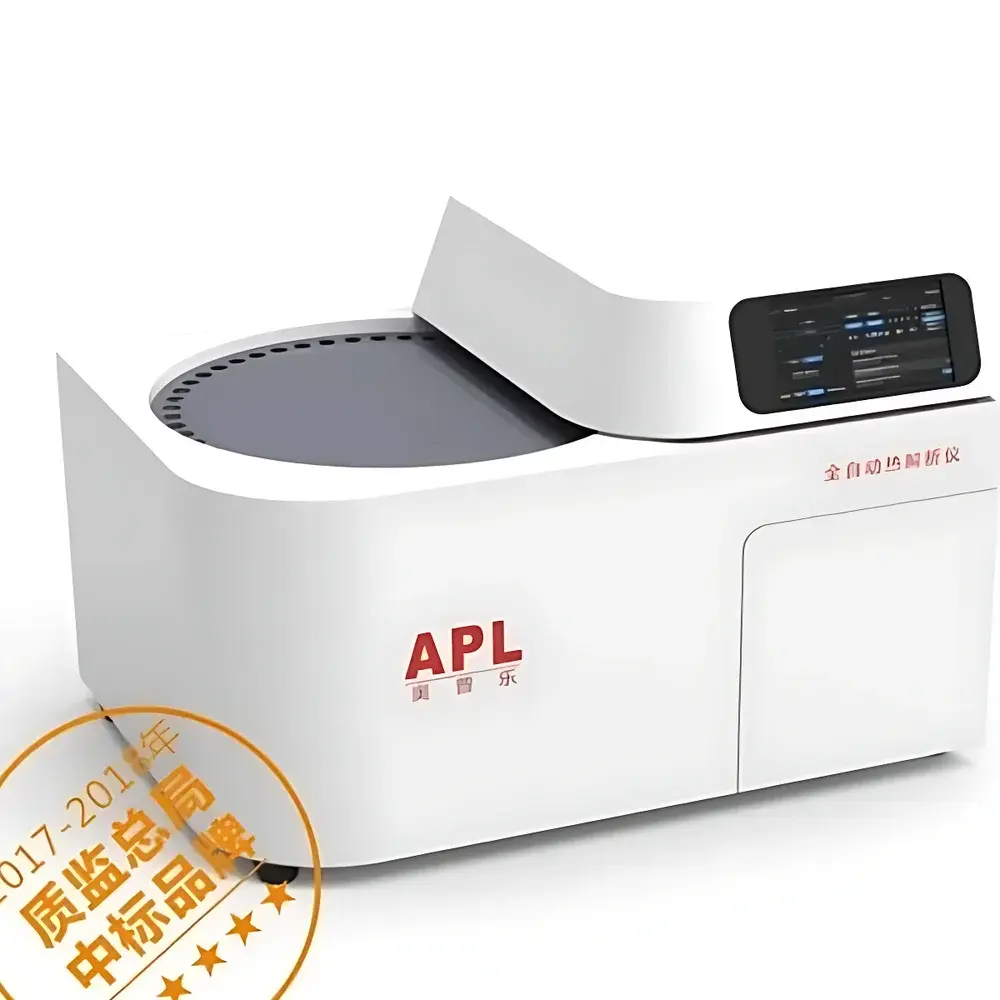
APL Optolong APL-TD25 Fully Automated 25-Position Thermal Desorber
| Brand | APL |
|---|---|
| Origin | Sichuan, China |
| Manufacturer Type | Manufacturer |
| Region of Origin | Domestic (China) |
| Model | APL-TD25 |
| Instrument Type | Dual-Stage Thermal Desorber |
| Automation Level | Fully Automated |
| Desorption Temperature Range | −35 °C to 400 °C |
| Valve Injection Zone Temperature Range | Ambient to 300 °C |
| Transfer Line Temperature Range | Ambient to 300 °C |
| Cold Trap Temperature Range | −35 °C |
| Temperature Control Accuracy | < ±0.1 °C |
| Analyte Recovery Rate | >98% (compound-dependent) |
| Sample Capacity | 25 adsorption tubes |
Overview
The APL Optolong APL-TD25 is a fully automated, dual-stage thermal desorber engineered for high-fidelity sample introduction in trace-level volatile organic compound (VOC) analysis by gas chromatography–mass spectrometry (GC–MS) or gas chromatography–flame ionization detection (GC–FID). It operates on the principle of controlled thermal desorption: adsorbed VOCs are quantitatively released from sorbent-packed tubes under precisely regulated heating and cryofocusing conditions, followed by rapid transfer and injection into the GC system. The instrument integrates a programmable cold trap capable of cryogenic focusing at −35 °C, enabling sharp band formation and minimizing analyte dispersion. Its dual-stage architecture—comprising primary desorption, cold trapping, and secondary thermal desorption—ensures superior sensitivity, reproducibility, and recovery for target compounds across environmental, occupational health, indoor air quality, and industrial emission monitoring applications.
Key Features
- Fully automated 25-position sample carousel with barcode-ready tube identification support and unattended overnight operation
- Dual-zone temperature control system: independent regulation of desorption oven (−35 °C to 400 °C), valve/injection module (ambient to 300 °C), and heated transfer line (ambient to 300 °C)
- Cryogenic cold trap operating down to −35 °C with < ±0.1 °C temperature stability, ensuring consistent focusing and minimal breakthrough
- High-efficiency thermal desorption with >98% analyte recovery for common VOCs (e.g., benzene, toluene, ethylbenzene, xylenes, C2–C12 aliphatics), validated per compound-specific calibration protocols
- Robust stainless-steel flow path with inert surface treatment to minimize adsorption losses and memory effects
- Integrated leak detection and pressure monitoring during desorption and transfer phases to ensure method integrity
Sample Compatibility & Compliance
The APL-TD25 supports standard 6 mm OD × 89 mm length sorbent tubes (e.g., Tenax TA, Carbopack B/C, Carboxen 1000, or multi-bed configurations) and accommodates both single- and multi-bed tube formats. It is explicitly designed to meet the operational requirements of major Chinese environmental and indoor air quality standards, including HJ 644–2013 (ambient air VOCs by TD-GC–MS), HJ 583–2010 (benzene series in ambient air), HJ 734–2014 (VOCs in stationary source emissions), HJ/T 400–2007 (in-vehicle VOCs), GB/T 18883–2002 (indoor air quality), and GB 50325–2010 (civil building pollution control). While not certified to ISO/IEC 17025 or ASTM D6196, its thermal performance, repeatability, and traceability align with GLP-aligned laboratory practices for method validation under CNAS-accredited environments.
Software & Data Management
The system is operated via a Windows-based control interface supporting method creation, sequence programming, real-time status monitoring, and event logging. All temperature profiles, timing parameters, pressure traces, and run metadata are timestamped and stored locally in a structured database format compatible with CSV export. Audit trail functionality records user actions, parameter changes, and system alerts—supporting basic 21 CFR Part 11 readiness when deployed with network-authenticated user accounts and file encryption. Raw data files are exportable for integration with third-party chromatography data systems (CDS), including Thermo Chromeleon, Agilent OpenLab, and Shimadzu GCMSsolution.
Applications
- Regulatory monitoring of ambient and indoor air VOCs per national environmental standards
- Occupational exposure assessment in manufacturing, printing, coating, and petrochemical facilities
- Quality control of building materials, adhesives, and furnishings for VOC emissions compliance
- Method development and validation for EPA TO-17–compatible workflows in accredited laboratories
- Research-scale studies on sorbent efficiency, breakthrough behavior, and thermal stability of target analytes
FAQ
What types of sorbent tubes are compatible with the APL-TD25?
Standard 6 mm OD × 89 mm sorbent tubes—including single-bed (e.g., Tenax TA) and multi-bed configurations (e.g., Carbopack B/C + Carboxen 1000)—are supported. Tube orientation and sealing are mechanically verified prior to desorption.
Does the system support splitless or split injection modes?
Yes—the APL-TD25 provides selectable carrier gas flow routing and optional split vent configuration, enabling both splitless transfer for maximum sensitivity and split-mode operation for high-concentration samples.
Is remote monitoring or network integration possible?
Local Ethernet connectivity allows remote desktop access and sequence initiation via LAN; however, native cloud API or OPC UA integration is not implemented.
How is calibration verification performed?
Calibration is conducted using certified standard permeation tubes or dynamic spiking with known VOC mixtures; recovery checks and retention time stability are tracked per batch using built-in QC report templates.
What maintenance intervals are recommended?
Cold trap cryogen refills (if liquid N₂–based) and O-ring replacement every 6 months; valve actuator and heater calibration annually or after 500 cycles—per documented service log guidance in the technical manual.
Related Products





