
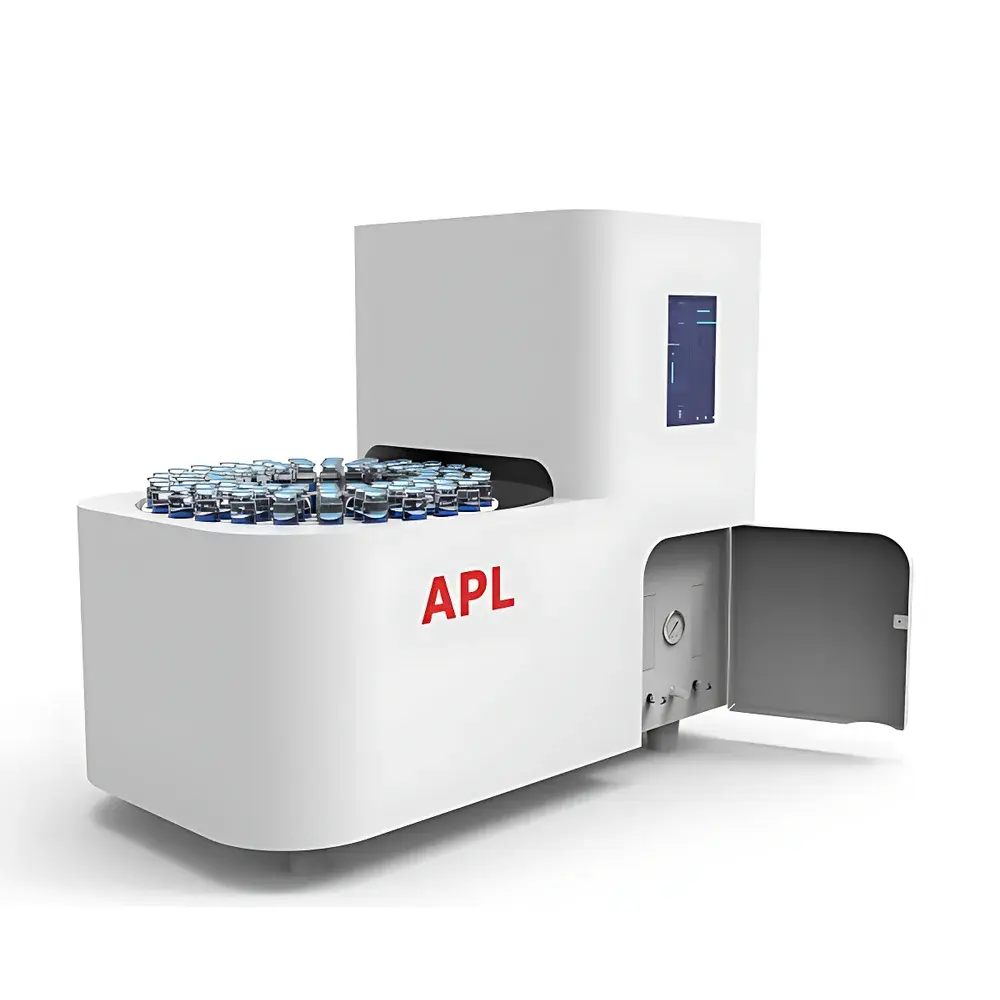
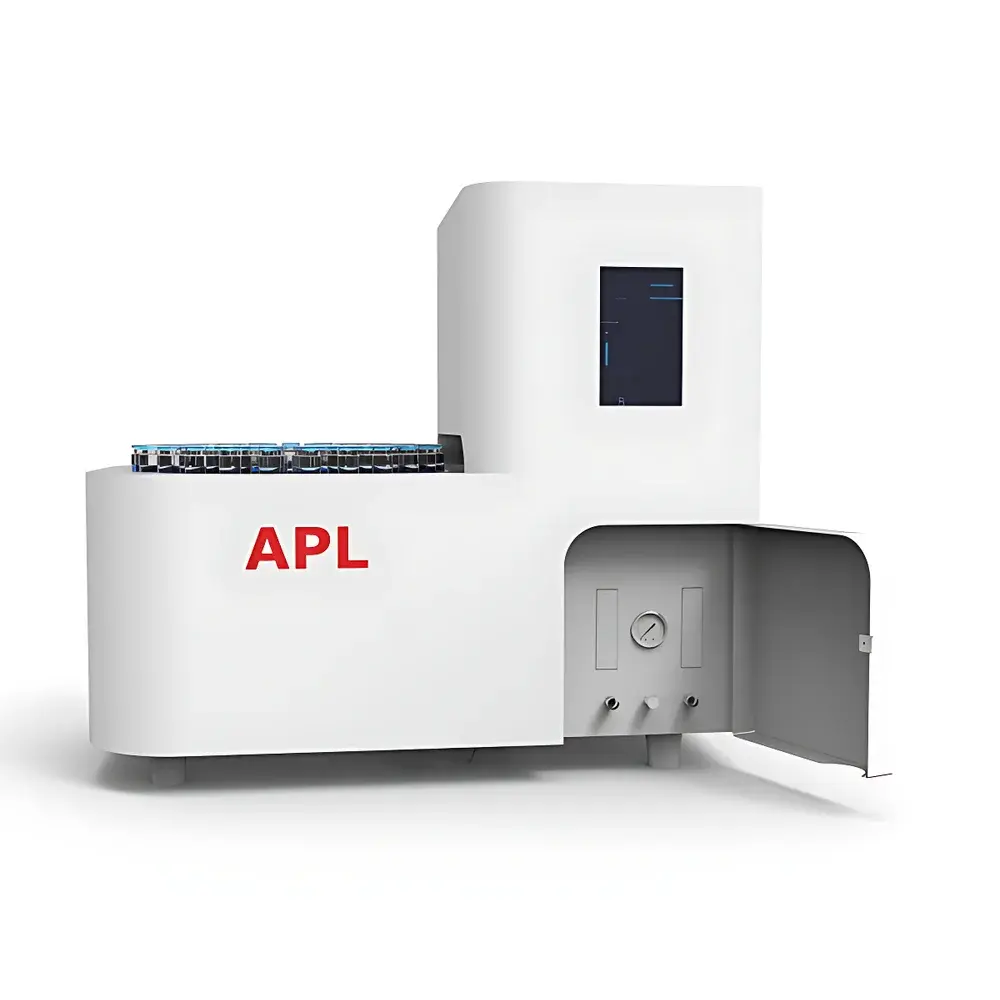
APL Optol PT-75D Fully Automated Purge and Trap System
| Brand | APL Optol |
|---|---|
| Model | PT-75D |
| Sample Capacity | 75 positions |
| Injection Precision | RSD < 3% |
| Trap Temperature Range | −30 °C to 400 °C |
| Sample Heating Range | Ambient to 120 °C |
| Sample Vial Cooling | −30 °C |
| Water Removal Trap Temp | Ambient to 240 °C |
| Valve & Transfer Line Temp | Ambient to 220 °C |
| Purge Flow | 0–100 mL/min (adjustable) |
| Desorption Time | 1–3 min |
| Bake-out Temp | Up to 250 °C |
| Vial Format | 40 mL |
Overview
The APL Optol PT-75D Fully Automated Purge and Trap System is an engineered solution for quantitative trace-level analysis of volatile organic compounds (VOCs) in aqueous, solid, and semi-solid matrices—including drinking water, wastewater, soil, sediment, sludge, and food samples. It operates on the principle of dynamic headspace extraction: inert gas (typically helium or nitrogen) purges VOCs from the sample matrix into a cryogenically cooled trap packed with sorbent material (e.g., Tenax®, Carbopack™, or multi-bed configurations). Following moisture removal via a dedicated chilled water trap, the analytes are thermally desorbed in a narrow, focused band and transferred directly to a gas chromatograph (GC) or GC–mass spectrometer (GC–MS) for separation and detection. Designed for compliance with U.S. EPA Methods 502.2, 524.4, 624, and 8260, as well as ISO 15681-2 and ASTM D6058, the PT-75D supports method validation under GLP and regulated environmental testing frameworks.
Key Features
- Fully automated batch processing of up to 75 samples without manual intervention—ideal for high-throughput environmental laboratories performing routine VOC monitoring.
- Independent, precision temperature control across four critical zones: purge valve assembly (ambient to 220 °C), transfer line (ambient to 220 °C), water removal trap (ambient to 240 °C), and trap cartridge (−30 °C to 400 °C), minimizing condensation and ensuring reproducible desorption efficiency.
- Integrated magnetic stirring with variable speed control (0–1,200 rpm) enhances mass transfer kinetics during purge, especially for heterogeneous or viscous samples such as sediments and sludges.
- Programmable time-segmented operation: fully customizable sequences for purge, dry purge (moisture removal), trap desorption, GC injection trigger, and post-run bake-out (up to 250 °C for 5 min), reducing carryover and maintaining baseline stability.
- Dual-stage anti-contamination design: automatic back-flush of both the transfer line and six-port valve using inert gas, preventing cross-sample memory effects and extending component service life.
- Universal GC/GC–MS interface: TTL-compatible start signal output and mechanical adapter kits available for Agilent, Thermo Fisher, Shimadzu, PerkinElmer, and Waters systems—no proprietary software lock-in required.
Sample Compatibility & Compliance
The PT-75D accommodates standard 40 mL EPA-compliant vials and supports direct analysis of liquid samples (water, leachates), slurries, and homogenized solids (soil, sediment, tissue). Its −30 °C sample vial cooling capability improves recovery of highly volatile analytes (e.g., vinyl chloride, chloromethane) by suppressing evaporation loss prior to purge initiation. The system meets regulatory requirements for data integrity under FDA 21 CFR Part 11 when paired with compliant LIMS or chromatography data systems (CDS). Method-specific validation documentation—including precision (RSD < 3%), linearity (r² ≥ 0.999 over 0.05–100 µg/L), and method detection limits (MDLs ≤ 0.01 µg/L for BTEX and chlorinated solvents)—is supported per ISO/IEC 17025 accreditation criteria.
Software & Data Management
Control is executed via a Windows-based embedded interface with real-time graphical animation of all thermal and pneumatic states (valve positions, trap temperature ramping, flow profiles). All method parameters—including temperature setpoints, timing segments, purge/back-flush flows (0–100 mL/min, digitally regulated), and GC trigger logic—are stored in encrypted, version-controlled method files. Audit trails record operator ID, timestamp, parameter changes, and run completion status—enabling full traceability for GLP audits. Export formats include CSV and XML for seamless integration with laboratory information management systems (LIMS) and electronic lab notebooks (ELN).
Applications
- Regulatory environmental testing: VOC analysis in drinking water (EPA 524.4), groundwater (EPA 624), and industrial effluents per HJ 639–2012 and HJ 605–2011.
- Soil and sediment screening: petroleum hydrocarbons (C6–C9), halogenated VOCs (e.g., chloroform, TCE), and emerging contaminants (e.g., 1,4-dioxane) per HJ 1020–2019 and HJ 735–2015.
- Food safety and flavor chemistry: quantification of residual solvents (e.g., dichloromethane, hexane) and natural volatiles (e.g., limonene, ethyl acetate) in beverages, dairy, and plant extracts.
- Waste characterization: volatile halocarbons in landfill leachate and incinerator ash per HJ 713–2014.
FAQ
Does the PT-75D support unattended overnight operation?
Yes—the system includes hardware-level fault detection (e.g., pressure loss, temperature deviation, vial misalignment) and automatically pauses execution while logging error codes. Completed runs are timestamped and archived independently.
Can I use custom sorbent traps other than those supplied by APL Optol?
Yes—trap cartridges follow standard ¼″ OD stainless-steel format and accept third-party packed beds; however, optimal desorption profiles require validation against your selected sorbent geometry and thermal mass.
Is method translation from EPA 502.2 to ISO 15681-2 supported?
All temperature, flow, and timing parameters are freely configurable; application notes detailing ISO-compliant settings—including cold trap conditioning and humidity compensation—are provided in the user manual.
How is data integrity ensured during long-term deployment?
The embedded OS writes raw method logs and run metadata to redundant internal storage with SHA-256 checksum verification; optional network backup to NAS or cloud-based CDS is supported via TLS 1.2 encrypted FTP/SFTP.
What maintenance intervals are recommended for routine operation?
Valve seals and O-rings: every 6 months or 500 runs; trap cartridges: conditioned before first use and revalidated every 100 injections; water trap desiccant: replaced after 200 runs or visible saturation.
Related Products



