
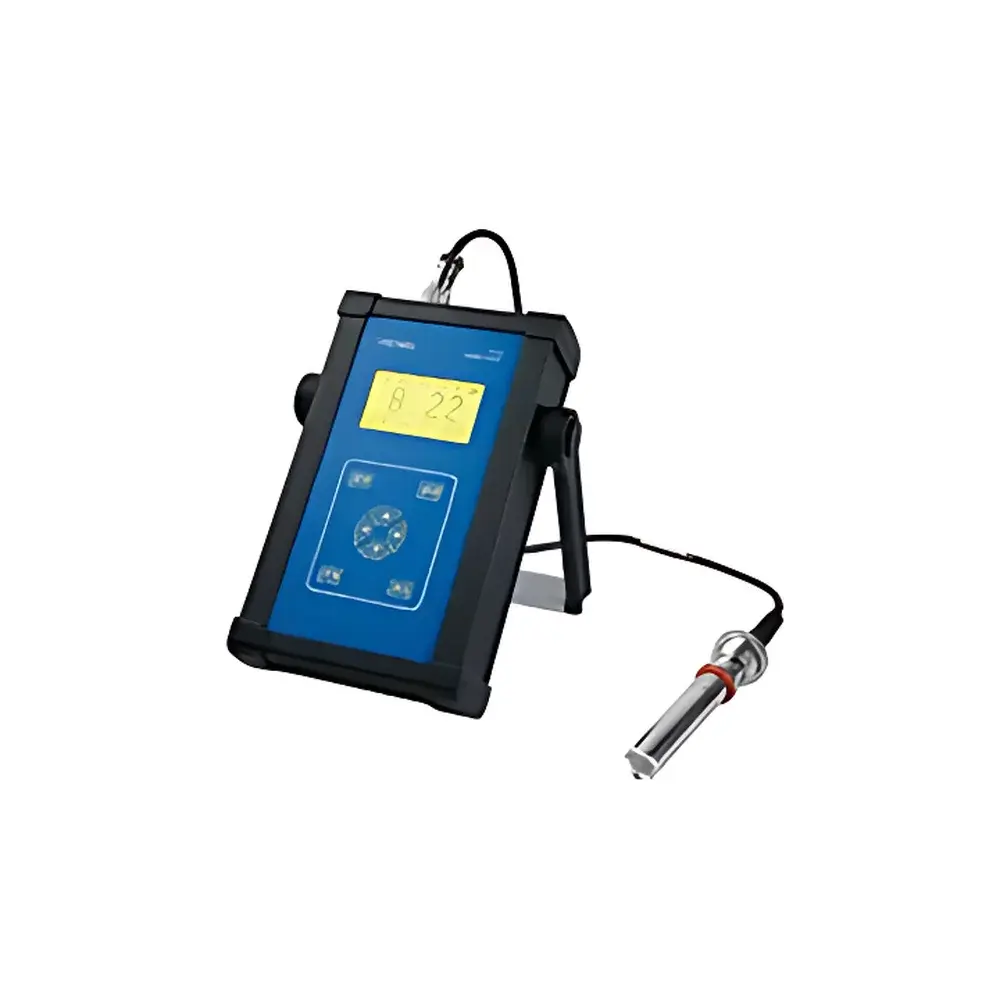
Timepower TP350 Portable ppb-Level Dissolved Oxygen Analyzer
| Brand | Timepower |
|---|---|
| Origin | Beijing, China |
| Manufacturer Type | Direct Manufacturer |
| Product Category | Domestic |
| Model | TP350 |
| Instrument Type | Portable |
| Measurement Principle | Electrochemical Clark-type Polarographic Sensor |
| Measurement Range | 0.0–100 µg/L |
| Accuracy | ±1.0% FS |
| Repeatability | ≤1% |
| Detection Limit | ±1.0% FS |
| Resolution | 0.1 µg/L (0–100 µg/L), 1.0 µg/L (100–1000 µg/L), 0.01 mg/L (1.00–20.00 mg/L) |
| Response Time (T90) | <5 min at 25 °C |
| Temperature Compensation Range | 0–60.0 °C |
| Sample Temperature Range | 5–45 °C |
| Operating Ambient | 5–45 °C, ≤90% RH (non-condensing) |
| Enclosure Rating | IP65 |
| Temperature Sensor | Pt1000 |
| Power Supply | AC 85–265 V, 45–65 Hz |
| Power Consumption | ≤1 W |
| Dimensions | 285 × 60 × 255 mm |
| Weight | 2.28 kg |
| Display | 128 × 64 LCD, Chinese interface |
| Data Storage | Cyclic memory with >10-year data retention after power loss |
| Battery Life | Up to 8 hours continuous operation (fully charged) |
Overview
The Timepower TP350 Portable ppb-Level Dissolved Oxygen Analyzer is a high-precision, field-deployable instrument engineered for trace-level dissolved oxygen (DO) quantification in aqueous solutions across environmental, pharmaceutical, power generation, and semiconductor ultrapure water applications. It operates on the Clark-type polarographic principle: molecular oxygen diffuses through a gas-permeable membrane (composed of polytetrafluoroethylene and polyethylene) into an electrolyte-filled chamber housing a platinum working electrode and a silver/silver chloride or lead reference electrode. Under a fixed polarizing voltage, oxygen reduction generates a diffusion-limited current linearly proportional to the partial pressure of dissolved O₂. This electrochemical transduction—combined with integrated Pt1000 temperature compensation—ensures thermally stable, stoichiometrically grounded measurements from sub-ppb (0.1 µg/L) up to 20 mg/L, automatically switching ranges without manual intervention.
Key Features
- True ppb-range capability: resolution down to 0.1 µg/L in the lowest range, validated for ultrapure water monitoring per ASTM D8287 and IAPWS guidelines.
- Polarographic sensor architecture with imported PTFE composite membrane: delivers rapid T90 response (<5 min at 25 °C), long-term stability, and resistance to fouling and elevated temperatures (up to 45 °C sample temp).
- High-fidelity signal acquisition: 24-bit analog-to-digital conversion ensures minimal quantization error and robust noise rejection in electrically noisy field environments.
- Embedded microcontroller platform with ultra-low-power design: enables 8-hour continuous operation on internal rechargeable battery, supporting extended unattended surveys.
- IP65-rated rugged enclosure: dust-tight and protected against low-pressure water jets—suitable for outdoor deployment, wastewater channels, and boiler feedwater sampling points.
- Onboard data management: cyclic storage retains ≥10,000 measurement records with timestamp and temperature metadata; all data preserved for >10 years post-power-loss via non-volatile memory.
- Intuitive Chinese-language UI: menu-driven navigation, real-time graphical trend display, and context-sensitive prompts reduce operator training burden while maintaining technical rigor.
Sample Compatibility & Compliance
The TP350 is validated for use with deionized water, condensate, boiler feedwater, surface water, groundwater, and treated effluent. Its polarographic probe design minimizes flow dependence when used with optional flow-through cells—critical for low-oxygen systems where ambient air ingress must be avoided (e.g., using rigid stainless-steel or PFA tubing instead of permeable silicone lines). The analyzer complies with ISO 5814:2012 (electrochemical determination of dissolved oxygen) and supports GLP/GMP-aligned workflows via audit-ready calibration logs, user-accessible calibration history, and configurable pass/fail thresholds. While not FDA 21 CFR Part 11-certified out-of-box, its data export functionality (via USB or RS232) enables integration into validated LIMS environments requiring electronic record integrity.
Software & Data Management
No proprietary PC software is required for basic operation; however, optional PC connectivity allows bulk data export in CSV format for post-processing in Excel, MATLAB, or LabVIEW. All calibration events—including zero-point and span adjustments—are time-stamped and stored with sensor ID, operator code (if enabled), and ambient conditions. Memory management follows FIFO logic: oldest entries auto-rotate upon overflow, preserving continuity without manual deletion. Firmware updates are performed via secure USB interface, with version rollback capability for validation traceability.
Applications
- Power plant cycle chemistry: real-time monitoring of condensate and feedwater DO to prevent flow-accelerated corrosion (FAC) in carbon steel piping per EPRI TR-102147 recommendations.
- Pharmaceutical water systems: verification of USP purified water and Water for Injection (WFI) oxygen compliance during distribution loop sanitization cycles.
- Environmental field studies: profiling hypolimnetic oxygen depletion in lakes/reservoirs and detecting early-stage anaerobic conditions in sediment pore water.
- Semiconductor fab UPW loops: routine surveillance of TOC-free ultrapure water at point-of-use, where DO <10 µg/L may indicate membrane integrity failure or nitrogen purge inefficiency.
- Research laboratories: kinetic studies of oxygen consumption in bioreactors, enzymatic assays, and corrosion inhibition testing under controlled redox environments.
FAQ
How often must the DO membrane and electrolyte be replaced?
Typical service intervals are 3–6 months under continuous operation; however, replacement is mandatory if response time degrades (>8 min T90), baseline current drifts beyond ±5% of initial polarization value, or physical membrane damage is observed.
Is temperature compensation automatic?
Yes—the integrated Pt1000 sensor continuously measures sample temperature and applies Nernst-based correction in real time across the full 0–60.0 °C range.
Can the TP350 be used in flowing streams without a flow cell?
It is strongly recommended to use the optional flow-through cell with regulated laminar flow (0.3–1.0 L/min); direct immersion in turbulent or stagnant water yields unreliable readings due to boundary layer effects and localized oxygen depletion.
Does the instrument support multi-point calibration?
The TP350 performs single-point (air-saturated water or zero-oxygen sodium sulfite solution) calibration; multi-point calibration is not implemented, as the polarographic sensor exhibits linear response across its entire dynamic range per ISO 5814.
What maintenance is required between calibrations?
Daily visual inspection of membrane clarity and electrolyte level; weekly cleaning of the membrane surface with soft tissue moistened with deionized water; quarterly verification of polarization voltage stability using manufacturer-provided test jig.
Related Products







