
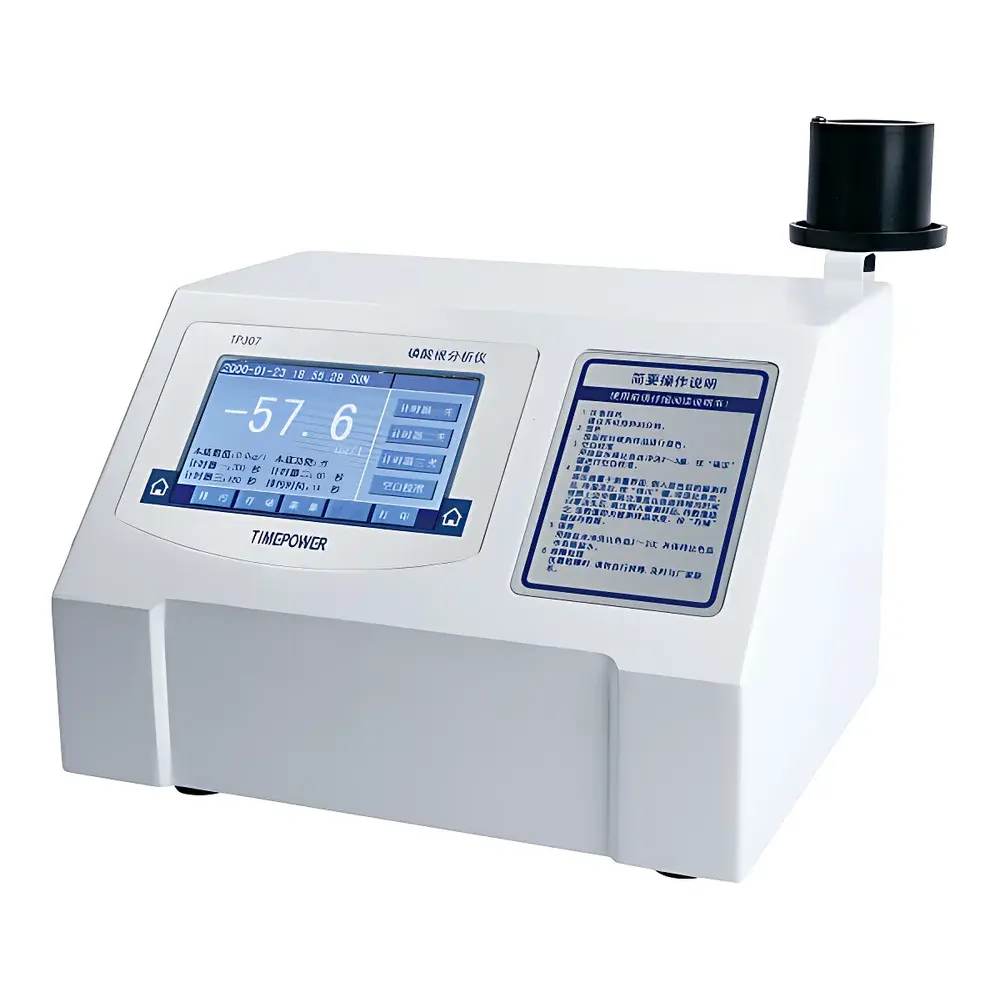
TimePower TP307 Laboratory Phosphate Analyzer
| Brand | TimePower |
|---|---|
| Origin | Beijing, China |
| Manufacturer Type | OEM Manufacturer |
| Region | Domestic (China) |
| Model | TP307 |
| Pricing | Upon Request |
Overview
The TimePower TP307 Laboratory Phosphate Analyzer is a benchtop photometric analyzer engineered for precise quantification of orthophosphate (PO₄³⁻) in ultra-pure and process water streams. It operates on the established vanadomolybdophosphoric acid colorimetric method—where orthophosphate in acidic aqueous samples reacts with ammonium metavanadate and ammonium molybdate to form a stable yellow heteropoly acid complex (phosphovanadomolybdate) with absorbance maxima near 420 nm. Absorbance is measured via single-beam photometry following the Lambert–Beer law, enabling linear correlation between optical density and phosphate concentration within defined calibration ranges. Designed specifically for power generation and high-purity industrial applications, the TP307 supports routine monitoring of boiler feedwater, condensate, desalinated water, and steam-cycle chemistry control per ASTM D859 and ISO 6878 standards.
Key Features
- Integrated optoelectronic architecture featuring a precision-calibrated imported cold-light monochromatic LED source (420 ± 5 nm), delivering long-term photometric stability, low thermal drift, and >10,000-hour operational lifetime.
- High-density surface-mount technology (SMT) PCB design with embedded microcontroller unit (MCU), optimized for low-power operation (<30 W), electromagnetic compatibility (EMC), and resistance to ambient temperature fluctuations (5–45 °C).
- 5.0-inch capacitive touch TFT-LCD display with native Chinese UI—supporting real-time measurement, calibration status, data history, and system diagnostics without external software dependency.
- Automated timing prompts for reagent addition, reaction incubation, and measurement cycles—reducing operator-induced variability and improving procedural repeatability.
- Dual-point zero compensation: programmable blank calibration eliminates electronic offset, dark current drift, and cuvette-related baseline errors—critical for sub-mg/L-level trace analysis.
- Circular memory buffer storing up to 256 measurement records with timestamp, sample ID, and calibration reference; auto-rollover overwrite prevents data loss during extended unattended operation.
Sample Compatibility & Compliance
The TP307 accepts liquid samples with total dissolved solids (TDS) < 10 ppm and conductivity < 0.2 µS/cm—typical of high-purity water from mixed-bed deionization or EDI systems. Sample introduction is manual via calibrated glass or quartz cuvettes (10 mm path length). The analyzer complies with core requirements for laboratory-grade water quality instrumentation under ISO/IEC 17025:2017 (Clause 6.4.3 on measurement traceability) and supports GLP documentation workflows. While not FDA 21 CFR Part 11–certified out-of-the-box, audit trails (calibration logs, blank checks, user timestamps) are stored locally and exportable via USB for regulatory review in pharmaceutical or biotech QC environments.
Software & Data Management
No proprietary PC software is required for basic operation—the instrument functions autonomously with on-device calibration, data logging, and report recall. All calibration curves (linear or two-point) are stored in non-volatile flash memory with checksum validation. Measurement data—including date/time stamps, operator ID input, and calibration verification flags—can be exported as CSV files via standard USB-A port. Firmware updates are performed offline using FAT32-formatted USB drives. For enterprise integration, optional RS-232 or Modbus RTU output (via accessory module) enables connection to SCADA or LIMS platforms with configurable polling intervals and ASCII-based protocol framing.
Applications
- Power plant chemistry labs: continuous monitoring of phosphate carryover in turbine condensate and drum boiler water per EPRI guidelines and IAPWS Technical Guidance Document No. 2015-01.
- Pharmaceutical water systems: verification of phosphate residuals in purified water (PW) and water for injection (WFI) per USP and EU Annex 1 requirements.
- Chemical and fiber manufacturing: batch-wise verification of phosphate-based corrosion inhibitors in closed-loop cooling systems and process rinse waters.
- Environmental testing laboratories: screening of low-concentration phosphate in treated effluents prior to discharge compliance reporting (e.g., EPA Method 365.4 adaptation).
- Research institutions: method development and validation studies involving orthophosphate speciation in simulated steam-cycle chemistries.
FAQ
What is the recommended frequency for blank calibration?
Daily blank calibration is mandatory to compensate for photodetector aging, cuvette fouling, and ambient light leakage—especially when operating below 1 mg/L detection thresholds.
Can the TP307 measure samples with turbidity or suspended solids?
No. Turbid or particulate-laden samples must undergo membrane filtration (0.45 µm pore size) prior to analysis; undissolved phosphate species (e.g., calcium phosphate precipitates) will not be detected.
Is the instrument compatible with international calibration standards?
Yes—certified phosphate reference standards traceable to NIST SRM 3139a or equivalent national metrology institutes (e.g., BAM, NMIJ) are fully supported for curve verification and accuracy validation.
Does the TP307 support automatic dilution for out-of-range samples?
No. Manual dilution with high-purity deionized water (resistivity ≥18.2 MΩ·cm) is required before analysis; the instrument does not include integrated fluidics or dilution modules.
What maintenance is required beyond daily blanking?
Biweekly full calibration curve verification using at least three certified standards (0, 5, and 15 mg/L) is advised; optical path cleaning with lint-free wipes and isopropanol should occur monthly to prevent residue buildup on the LED lens and photodiode window.
Related Products




