
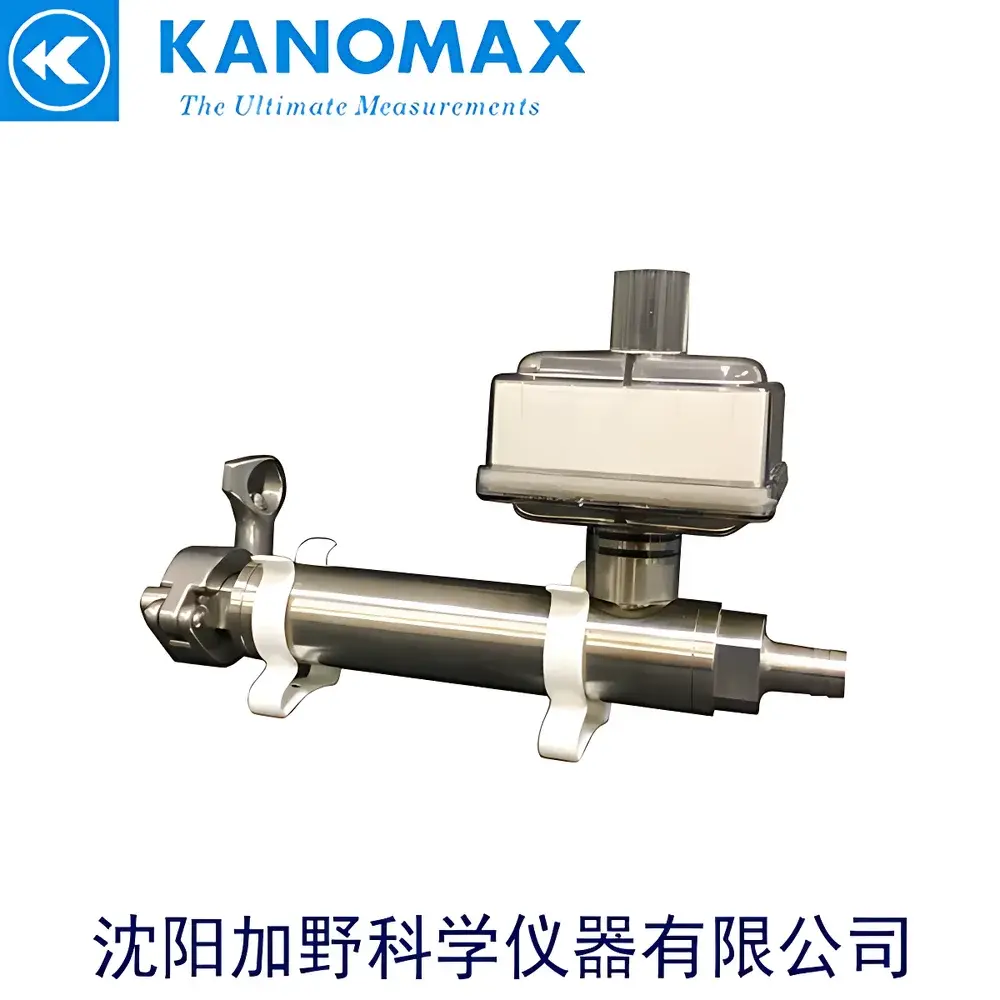
Kanomax High-Pressure Air Diffuser Model 100 for Particle Counting and Microbial Sampling
| Brand | Kanomax |
|---|---|
| Flow Rate | 100 L/min |
| Operating Pressure Range | 21–125 psi |
| Temperature Range | 10–35°C |
| Relative Humidity | 0–85% RH (non-condensing) |
| Material | Stainless Steel |
| Inlet Connection | Stainless steel ferrule, OD Φ12.7 mm, clamp Φ25 mm |
| Outlet Connection | 1/2" ID tubing |
| Dimensions | Φ30 mm × 185 mm |
| Weight | ~1.0 kg |
| Gas Compatibility | Clean, dry compressed air and non-toxic inert gases |
| Compliance | Designed to support ISO 8573-1, ISO 14644-1, and EU & US GMP Annex 1 requirements for compressed air quality monitoring |
Overview
The Kanomax High-Pressure Air Diffuser Model 100 is an engineered flow-conditioning device designed specifically for the reliable sampling of compressed air in regulated pharmaceutical, biotechnology, and medical device manufacturing environments. It operates on the principle of controlled pressure reduction and laminar flow diffusion—converting high-pressure, turbulent gas streams (up to 125 psi) into stable, low-velocity, uniformly distributed airflow suitable for precision instrumentation. This diffuser ensures consistent volumetric delivery to downstream particle counters (e.g., Kanomax LPC 3920) and microbial samplers, eliminating flow-induced measurement artifacts such as particle bounce, electrostatic loss, or impaction inefficiency. Its mechanical design complies with fundamental fluid dynamics requirements for isokinetic sampling integrity and is integral to validated compressed air monitoring systems aligned with current Good Manufacturing Practice (cGMP) expectations.
Key Features
- Stainless steel construction (316L-grade compatible variants available upon request) ensures corrosion resistance, cleanability, and compliance with ASME BPE surface finish standards for pharmaceutical gas systems.
- Two calibrated flow configurations: dedicated 50 L/min and 100 L/min versions—each with geometrically optimized internal diffuser geometry to maintain Reynolds number stability across the full operating pressure range (21–125 psi).
- No moving parts or electronic components—fully passive operation eliminates calibration drift, power dependency, and failure modes associated with active regulators or mass flow controllers.
- Precision-machined inlet ferrule (OD 12.7 mm) and clamp interface (Φ25 mm) enable secure, leak-tight connection to standard compressed air distribution piping; outlet supports 1/2-inch ID conductive or stainless tubing per ISO 8573-7 recommendations.
- Compact cylindrical form factor (Φ30 mm × 185 mm) allows integration into confined sampling manifolds or mobile validation carts without compromising structural rigidity or thermal stability.
Sample Compatibility & Compliance
The Model 100 diffuser is validated for use with clean, dry compressed air meeting ISO 8573-1 Class 2:2:2 (solid particles, water, oil) and non-toxic inert gases including nitrogen and argon. It does not condition moisture or remove oil aerosols—upstream filtration and drying per ISO 8573-2 and ISO 8573-4 remain mandatory. The device supports regulatory alignment with EU GMP Annex 1 (2022), FDA Guidance for Industry: Sterile Drug Products Produced by Aseptic Processing (2004), and ISO 14644-1:2015 for cleanroom-associated utility monitoring. When deployed within a documented qualification protocol—including Installation Qualification (IQ), Operational Qualification (OQ), and Performance Qualification (PQ)—it contributes to data integrity for compressed air system validation under 21 CFR Part 11-compliant electronic records environments.
Software & Data Management
As a hardware-level flow conditioning component, the Model 100 requires no embedded firmware, drivers, or software integration. Its performance is verified through physical calibration traceable to NIST-traceable flow standards (e.g., primary bell prover or critical flow venturi). When paired with Kanomax LPC 3920 or equivalent particle counters, raw count data—including channel distribution, concentration (particles/m³), and sampling duration—is captured and timestamped via the host instrument’s native software platform. Audit trails, user access controls, and electronic signature functionality are managed at the particle counter level, satisfying ALCOA+ principles and facilitating GLP/GMP audit readiness.
Applications
- Compressed air quality verification in Grade A/B/C/D cleanrooms per EU GMP Annex 1 Section 8.112.
- In-process monitoring of instrument air used in filling lines, lyophilizers, and isolator glove ports.
- Validation of compressed air systems during commissioning, requalification, and change control events.
- Supporting environmental monitoring programs where particle and viable counts must be correlated under identical flow conditions.
- Calibration verification of flow meters and mass flow controllers used in gas distribution networks.
FAQ
Can the Model 100 be used for both particle counting and microbial sampling simultaneously?
Yes—when installed upstream of a dual-path manifold, it delivers conditioned flow to parallel particle counters and impactor-based microbial samplers, provided total system backpressure remains within specified limits.
Is sterilization or autoclaving supported?
The standard unit is not autoclavable; however, optional electropolished 316L stainless steel variants with Ra ≤ 0.4 µm surface finish are available for SIP (steam-in-place) compatibility upon engineering review.
Does this diffuser require periodic recalibration?
No—its passive hydraulic design is inherently stable over time; verification is performed via flow rate measurement using a NIST-traceable reference meter during PQ execution.
Can it handle oil-laden or humid air?
No—oil aerosols and liquid water will compromise internal flow uniformity and risk contamination; ISO 8573-2 Class 2 coalescing filters and ISO 8573-4 Class 2 desiccant dryers must be installed upstream.
What documentation is supplied with the unit?
Each unit ships with a Certificate of Conformance, dimensional drawing, material certification (EN 10204 3.1), and installation guidance compliant with ISO/IEC 17025-accredited test methods.







