
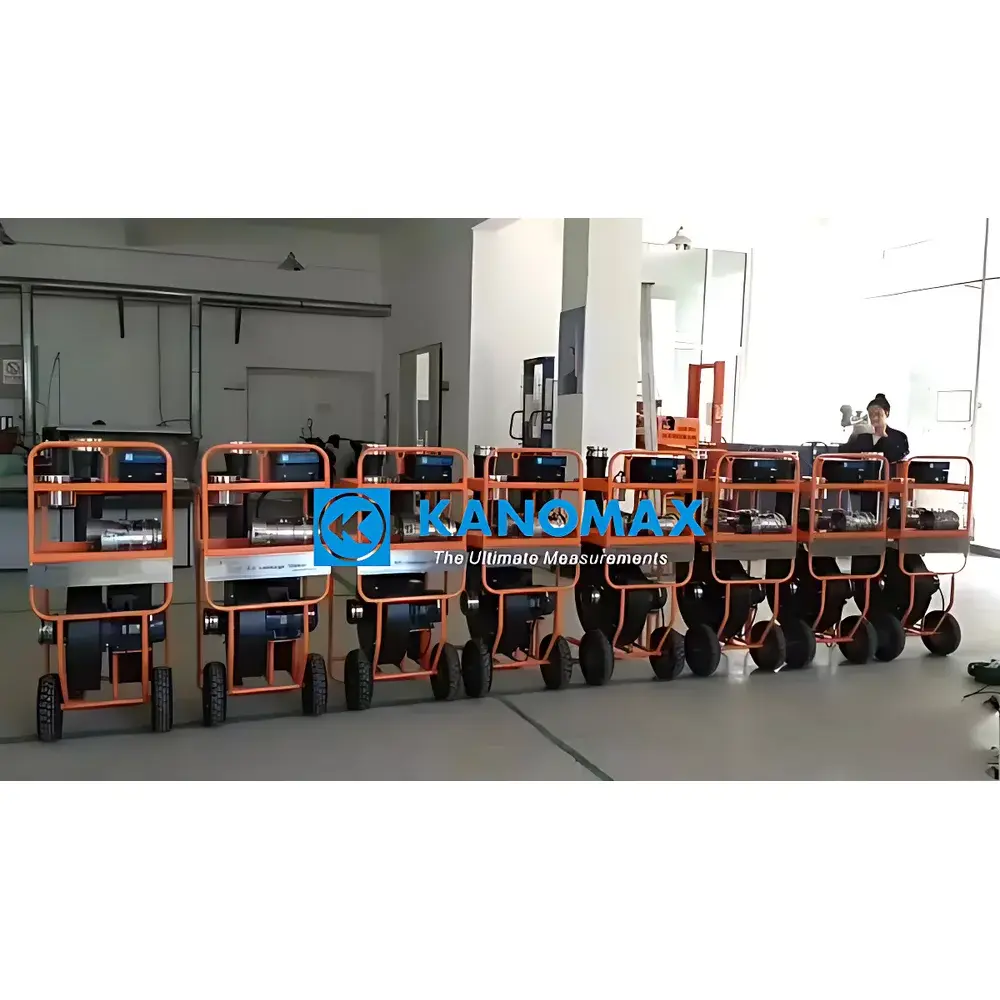
Kanomax DAL.T6900 Air Leakage Tester for Ductwork – Positive & Negative Pressure Certification System
| Brand | Kanomax |
|---|---|
| Model | DAL.T6900 |
| Origin | China (Liaoning) |
| Power Supply | DAL.T6900-0E: 110–120 V, 1-phase, 50/60 Hz, 16 A |
| DAL.T6900-1E | 220–240 V, 1-phase, 50/60 Hz, 10 A |
| Airflow Range | 36–640 m³/h (main duct) |
| Accuracy | ±2.5% of reading ±0.1 m³/h (airflow) |
| Resolution | 0.01 m³/h (airflow) |
| Static Pressure Range | ±2500 Pa |
| Temperature Range | 0–60 °C |
| Atmospheric Pressure Range | 70–130 kPa |
| Data Storage | 1000 test records |
| Display | 4.7-inch color LCD touchscreen |
| Dimensions (W×D×H) | 540 × 500 × 1200 mm |
| Net Weight | ~72 kg |
Overview
The Kanomax DAL.T6900 Air Leakage Tester is a precision-engineered, dual-mode (positive and negative pressure) certification system designed for quantitative ductwork airtightness verification in HVAC installations. It operates on the principle of controlled pressurization/depressurization of sealed duct sections, measuring volumetric airflow required to maintain a target static pressure differential—thereby calculating leakage rate per unit area or total system volume. Compliant with international duct sealing standards—including EN 1507:2006 (flexible ducts), EN 12237:2002 (rigid circular ducts), Eurovent 2/2, DW/143, SMACNA HVAC Air Duct Leakage Test Manual, and GB 50243–2002 (Chinese Code for Acceptance of Ventilation and Air Conditioning Engineering)—the DAL.T6900 serves as a primary reference instrument for third-party commissioning agents, building inspection authorities, and certified testing laboratories. Its metrological traceability supports calibration validation under national measurement standards, enabling formal accreditation by provincial or national institutes of metrology.
Key Features
- Dual-pressure capability: Simultaneous positive (+2500 Pa) and negative (–2500 Pa) pressure testing modes for comprehensive duct integrity assessment across operational pressure regimes.
- High-fidelity dual-range airflow measurement: Primary range (36–640 m³/h) for whole-system evaluation; secondary nozzle-based range (4–36 m³/h) for high-resolution low-leakage detection—ensuring accuracy across Class A through Class D duct systems per SMACNA.
- Real-time multi-parameter monitoring: Synchronized display of leakage airflow (m³/h), static pressure (Pa), ambient temperature (°C), and atmospheric pressure (kPa) during test execution.
- Integrated metrological assurance: Factory-calibrated transducers with documented uncertainty budgets; compatible with periodic recalibration against NIST-traceable or CNAS-accredited reference standards.
- Intuitive human-machine interface: 4.7-inch capacitive touchscreen with multilingual UI (English default), context-sensitive soft keys, and guided test sequence navigation.
- Robust field deployment architecture: IP54-rated enclosure, shock-absorbing chassis, and modular hose/fitting kit optimized for on-site use in mechanical rooms, rooftops, and construction zones.
Sample Compatibility & Compliance
The DAL.T6900 accommodates rectangular, round, and oval duct geometries ranging from 100 mm to 2,500 mm in equivalent diameter, supporting both segmented (sectional) and whole-system (as-installed) testing protocols. It is validated for use with galvanized steel, aluminum, fiberglass-reinforced plastic (FRP), and flexible insulated ducts. All test reports generated meet GLP-aligned documentation requirements, including operator ID, timestamp, environmental conditions, pressure ramp profile, stabilization duration, and pass/fail determination per selected standard clause. The device conforms to IEC 61000-4 electromagnetic compatibility standards and carries CE marking for EMC and LVD compliance. For regulatory submissions under LEED v4.1 EA Prerequisite: Minimum Energy Performance or BREEAM HEA 01, test data exported from the DAL.T6900 satisfies auditable evidence requirements when paired with lab-issued calibration certificates.
Software & Data Management
Data acquisition and reporting are managed via embedded firmware compliant with ISO/IEC 17025:2017 clause 7.5.2 (control of data). Each test record includes digital signatures, automatic time/date stamping, and immutable metadata (e.g., firmware version, sensor serial numbers, battery voltage). Up to 1000 complete test logs—including raw pressure vs. time curves and calculated leakage coefficients—are stored onboard with timestamped export via USB 2.0 to CSV or PDF formats. Optional PC software (Kanomax DLT-Manager v3.x) enables batch analysis, statistical trend plotting (leakage vs. duct surface area), automated report generation per EN 12237 Annex B, and integration into enterprise CMMS platforms via API-compatible XML schema. Audit trails comply with FDA 21 CFR Part 11 requirements for electronic records when used with user-authenticated login and role-based access control.
Applications
- Pre-commissioning verification of HVAC ductwork in commercial high-rises, hospitals, data centers, and cleanrooms.
- Post-installation compliance testing for fire-rated duct assemblies (e.g., UL 555S, EN 1366-2) where air leakage directly impacts fire damper performance.
- Energy retrofit assessments quantifying baseline leakage before and after duct sealing interventions (ASHRAE Guideline 12-2020).
- Third-party certification for green building rating systems (LEED, BREEAM, CASBEE) requiring documented airtightness performance.
- Quality assurance audits conducted by provincial construction quality supervision stations and metrology institutes across China.
- Research applications in building physics laboratories studying pressure-driven infiltration dynamics in envelope-integrated duct systems.
FAQ
What standards does the DAL.T6900 natively support for automated pass/fail evaluation?
The instrument implements built-in logic for EN 1507:2006, EN 12237:2002, Eurovent 2/2, DW/143, SMACNA, and GB 50243–2002—allowing real-time classification (e.g., Class A–D) and immediate go/no-go output based on measured leakage vs. allowable limits.
Can test data be integrated into a centralized building commissioning database?
Yes. Exported CSV files include all mandatory fields defined in ASHRAE Guideline 0-2019 Appendix C, and optional DLT-Manager software provides ODBC connectivity for direct ingestion into Oracle, SQL Server, or cloud-based commissioning platforms.
Is the DAL.T6900 suitable for testing ducts under operating HVAC system pressure?
No. It performs static pressure tests only—duct sections must be isolated and sealed prior to testing. Dynamic in-situ measurement requires supplementary instrumentation such as hot-wire anemometry or tracer gas decay methods.
How frequently must the unit undergo metrological recalibration?
Kanomax recommends annual recalibration against accredited reference standards; however, interval adjustments may be justified per ISO/IEC 17025:2017 clause 7.7.1 based on usage frequency, environmental exposure, and internal verification results.
Does the device meet requirements for use in GMP-regulated pharmaceutical facilities?
When operated under documented SOPs—including daily system checks, calibrated reference standards, and full audit trail retention—the DAL.T6900 satisfies Annex 15 (Qualification and Validation) and EU GMP Chapter 3 (Premises and Equipment) for HVAC duct integrity verification.
Related Products







