
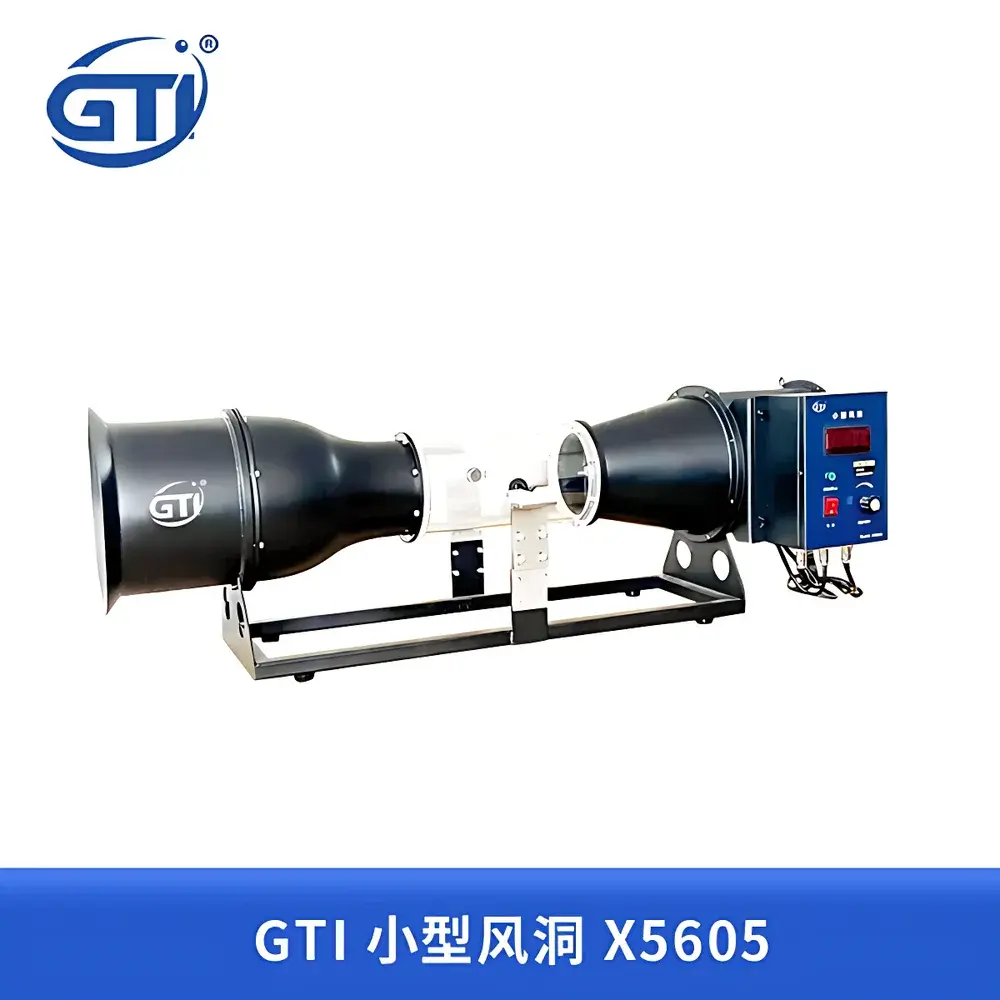
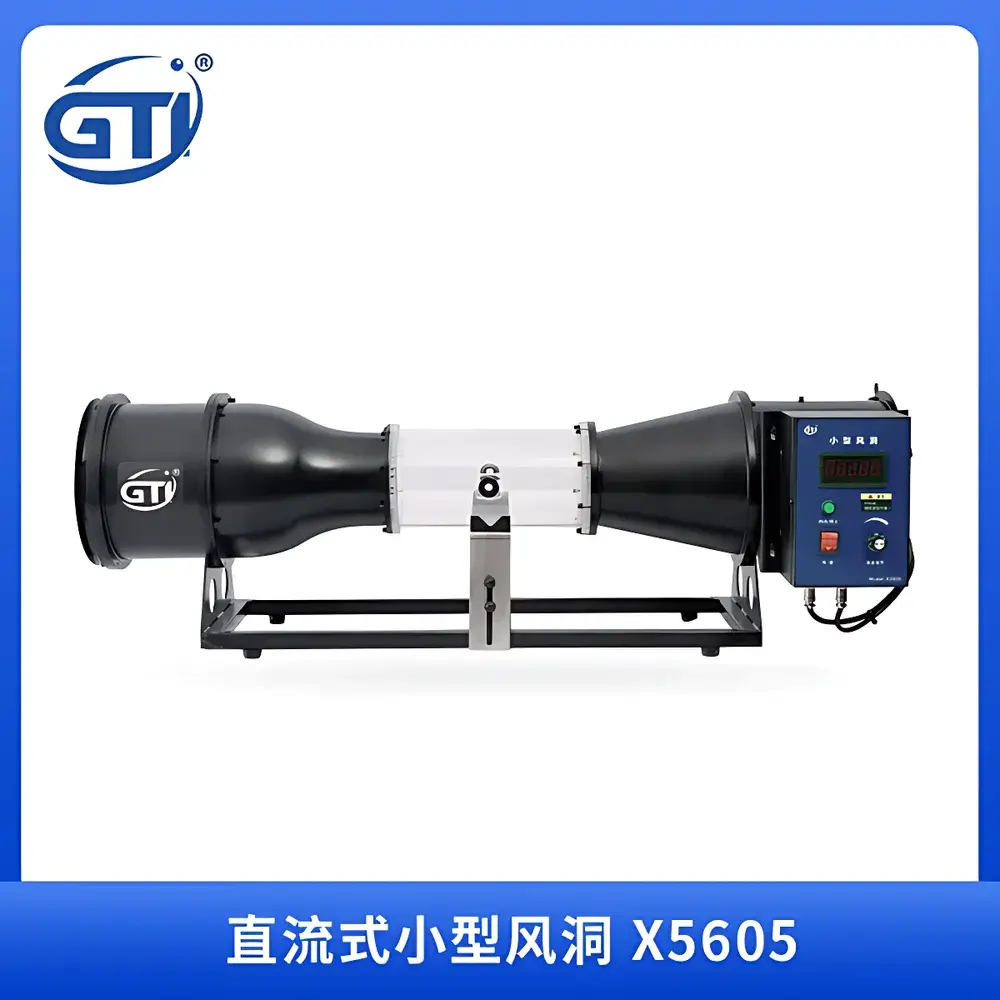
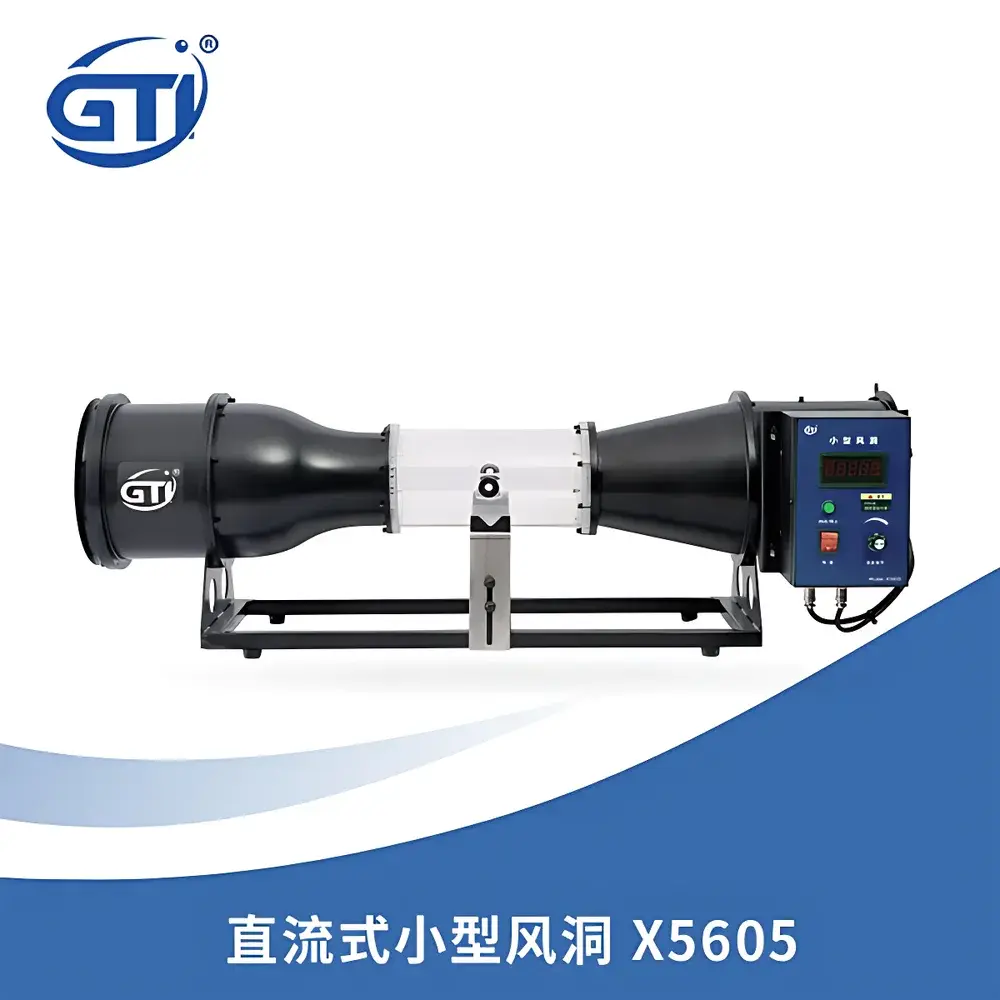
GTI X5605 Compact Educational Wind Tunnel
| Brand | GTI |
|---|---|
| Origin | Liaoning, China |
| Manufacturer Type | Authorized Distributor |
| Country of Origin | China |
| Model | X5605 |
| Price | USD 2,750 (FOB) |
| Wind Speed Range | 1–30 m/s |
| Tunnel Type | DC Suction-Type |
| Test Section Dimensions | 230 mm (L) × φ120 mm (ID) |
| Test Port Diameter | φ2–20 mm |
| Overall Dimensions | 1002 × 237 × 319 mm (L×W×H) |
| Power Supply | AC 220 V, 50 Hz, 450 W |
| Weight | ~20 kg |
Overview
The GTI X5605 Compact Educational Wind Tunnel is a benchtop-scale, DC-powered suction-type wind tunnel engineered for precision airflow generation and controlled aerodynamic experimentation in academic laboratories, engineering training centers, and metrology calibration facilities. It operates on the principle of axial-flow induction with integrated flow conditioning to produce laminar-to-moderately-turbulent boundary-layer flows within a defined test section. Unlike open-loop or fan-bench setups, the X5605 incorporates a closed-loop duct architecture with a calibrated impeller drive system, enabling repeatable velocity setpoints across its operational range of 1–30 m/s. Its design prioritizes flow uniformity, directional stability, and optical accessibility—critical parameters for qualitative flow visualization (e.g., smoke-wire or tuft-based studies) and quantitative sensor validation. The tunnel meets foundational requirements for undergraduate fluid mechanics pedagogy while supporting ISO/IEC 17025-aligned calibration workflows for anemometers, Pitot tubes, and differential pressure transducers.
Key Features
- Stable, digitally regulated DC-driven blower delivering consistent air velocity from 1 to 30 m/s with <±0.3 m/s repeatability under steady-state conditions
- Integrated honeycomb flow straightener and contraction nozzle upstream of the test section to minimize turbulence intensity (<3% at centerline) and ensure axial flow alignment within ±1.5° deviation
- Optically transparent acrylic test section (230 mm long × φ120 mm internal diameter) enabling real-time observation of flow patterns, model placement, and smoke visualization
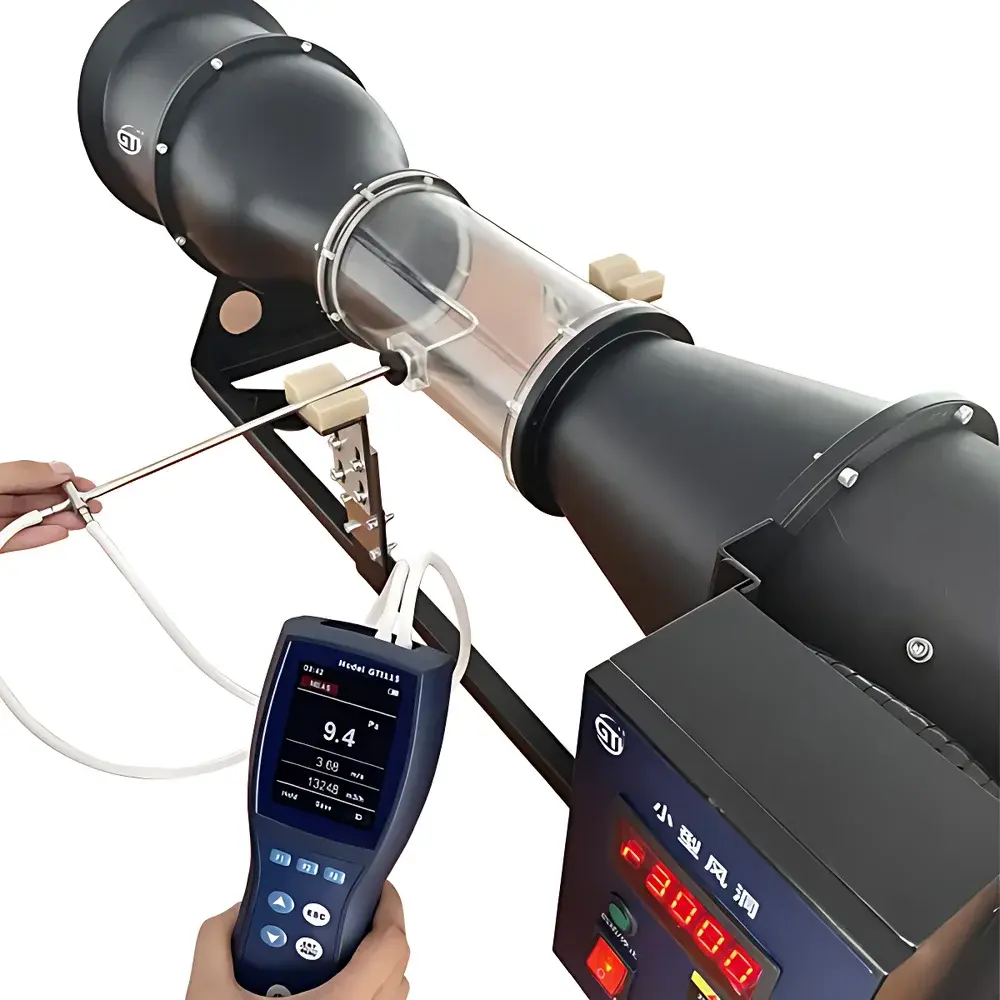
- Modular test port configuration with interchangeable collars accommodating sensor diameters from φ2 mm to φ20 mm—compatible with standard hot-wire probes, thermal anemometers, and miniature Pitot-static tubes
- Compact footprint (1002 × 237 × 319 mm) and self-supporting mechanical structure requiring no external mounting, vibration isolation, or auxiliary support frames
- Low-noise operation (<62 dB(A) at 1 m), CE-compliant power interface (AC 220 V, 50 Hz, 450 W), and built-in thermal protection circuitry
Sample Compatibility & Compliance
The X5605 accommodates physical scale models up to 100 mm in chord length and 80 mm in span, including NACA airfoil sections, bluff bodies (cylinders, cubes), and HVAC component prototypes. Its test section geometry supports surface pressure tap arrays (via optional 1/8″ NPT ports), six-component force balance integration (with custom adapter plates), and particle image velocimetry (PIV) seeding injection points. From a compliance perspective, the system facilitates traceable calibration per ASTM D5096 (Standard Test Method for Calibration of Anemometers) and ISO 7726 (Ergonomics of the thermal environment — Instruments for measuring physical quantities). While not certified as a primary standard, it serves as a secondary reference tunnel suitable for GLP-regulated verification protocols when operated with NIST-traceable reference sensors and documented SOPs.
Software & Data Management
The X5605 operates as a hardware platform without embedded firmware or proprietary software; instead, it interfaces seamlessly with third-party data acquisition systems (e.g., National Instruments DAQmx, Keysight BenchVue, or MATLAB Data Acquisition Toolbox) via analog voltage output (0–5 V corresponding to 0–30 m/s) and digital tachometer signal. Users may implement custom control loops using PID algorithms to stabilize velocity against ambient pressure fluctuations. All calibration records, test logs, and uncertainty budgets are managed externally—ensuring full auditability under FDA 21 CFR Part 11 (when paired with compliant electronic lab notebooks) and ISO/IEC 17025 Clause 7.7 (Control of Records). Optional RS-485 Modbus RTU module available for industrial SCADA integration.
Applications
- Aerodynamic coefficient measurement (drag, lift, moment) on scaled models using strain-gauge balances or pressure scanning systems
- Flow field characterization via smoke visualization, laser sheet illumination, or hot-wire anemometry
- Calibration and linearity verification of cup anemometers, vane anemometers, thermal mass flow sensors, and Pitot-static assemblies
- Boundary layer development studies—including transition point detection and wall shear stress estimation
- Teaching laboratory exercises covering Bernoulli’s principle, continuity equation, Reynolds number scaling, and drag coefficient correlation
- Pre-validation testing of HVAC grilles, filter media, and fan shrouds under controlled inlet conditions
FAQ
Is the X5605 suitable for ISO/IEC 17025 accredited calibration labs?
Yes—when used with traceable reference instruments, documented procedures, and environmental controls (temperature ±1°C, humidity <70% RH), it satisfies Clause 6.4 (Equipment) and Clause 7.7 (Records) requirements for secondary standard wind tunnels.
Can I mount a 6-component force balance inside the test section?
The φ120 mm internal diameter and 230 mm length permit installation of compact balances (e.g., AMTI MC6 series with custom mounting plate); maximum model weight supported is 1.2 kg.
Does the system include uncertainty analysis documentation?
No—uncertainty budgets must be developed by the user per GUM (JCGM 100:2008) based on sensor specifications, flow uniformity measurements, and repeatability testing.
What maintenance is required for long-term stability?
Annual inspection of bearing wear, impeller balance, honeycomb integrity, and electrical insulation resistance—no scheduled lubrication or filter replacement needed.
Is remote operation possible?
Yes—via optional analog/digital I/O expansion module (X5605-IO) supporting Ethernet/IP or Modbus TCP for integration into centralized lab management systems.
Related Products







