
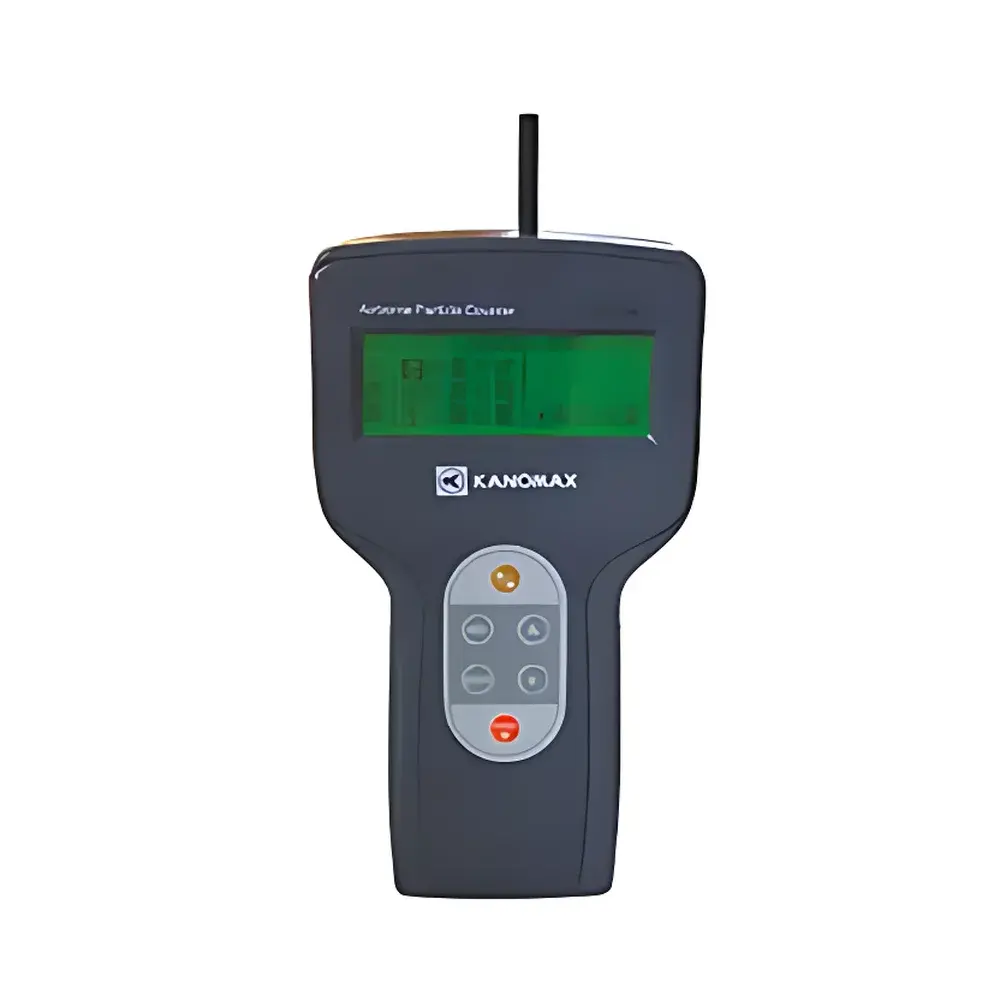
Kanomax 3887L Handheld Laser Particle Counter
| Brand | Kanomax |
|---|---|
| Origin | Japan |
| Model | 3887L |
| Instrument Type | Handheld |
| Flow Rate | 2.83 L/min |
| Flow Accuracy | < ±1 particle per 5 min |
| Timing Accuracy | < ±1 s over 6-min sampling |
| Repeatability | ≤ ±10% FS |
| Size Distribution Error | ≤ ±30% |
| Indication Error | ≤ ±30% FS |
| Detectable Particle Sizes | 0.3, 0.5, 1.0, 3.0, 5.0 µm (user-selectable single or dual channels) |
| Compliance | GB/T 16292–2010, ISO 14644-1:2015, China GMP (2010) Annex 1 |
| Data Storage | Internal high-capacity non-volatile memory with statistical reporting |
| Power Management | Auto-save on power interruption, programmable delay start |
Overview
The Kanomax 3887L is a compact, battery-powered handheld laser particle counter engineered for real-time airborne particulate monitoring in cleanrooms, pharmaceutical manufacturing suites, hospital isolation rooms, and controlled laboratory environments. It operates on the principle of single-particle light scattering: aerosol samples are drawn through a calibrated optical sensing chamber where a focused diode laser illuminates individual particles; scattered light intensity is detected by a photodiode array and converted into pulse signals corresponding to particle size bins. The instrument supports simultaneous or sequential detection across five user-selectable size thresholds—0.3, 0.5, 1.0, 3.0, and 5.0 µm—with a nominal volumetric flow rate of 2.83 L/min (0.1 CFM), meeting the fundamental sampling requirement for ISO 14644-1 Class 5–8 cleanroom classification. Its design prioritizes field robustness, operator ergonomics, and regulatory traceability—making it suitable for routine environmental monitoring (EM), qualification studies, and ongoing compliance verification under cGMP and GLP frameworks.
Key Features
- Laser-based optical sensing with NIST-traceable calibration methodology and factory-certified performance verification
- Intuitive full-color LCD interface with Chinese language support (default), configurable for English, Japanese, or Korean via firmware update
- Programmable pre-delay function (0–600 s) to eliminate operator-induced contamination during setup
- Backlit display optimized for low-illumination cleanroom gowning areas and ambient lighting variability
- Non-volatile internal memory capable of storing >10,000 sample records with timestamp, location tag, and operator ID fields
- Auto-resume functionality upon power interruption: resumes interrupted sampling sequences without data loss or manual reconfiguration
- Integrated real-time statistical engine calculating mean, standard deviation, max/min, and % deviation from target limits per size channel
Sample Compatibility & Compliance
The 3887L is validated for use with ambient air, compressed gases (via optional inlet filter and pressure regulator), and HEPA-filtered room air. It complies with international cleanroom monitoring standards including ISO 14644-1:2015 (Annex B), GB/T 16292–2010 (Chinese national standard for pharmaceutical cleanrooms), and Annex 1 of China’s Good Manufacturing Practice for Pharmaceutical Products (2010 revision). All measurement algorithms adhere to ISO 21501-4:2018 for light-scattering airborne particle counters. While not intrinsically rated for hazardous area use (e.g., ATEX/IECEx), it may be deployed in non-explosive zones with appropriate inlet filtration. Calibration certificates include uncertainty budgets traceable to JCSS (Japan Calibration Service System) reference instruments.
Software & Data Management
Data export is supported via USB-C interface using Kanomax’s proprietary KAN-PC software (Windows 10/11 compatible), enabling batch download, graphical trend analysis, PDF report generation (with customizable headers, footers, and digital signature fields), and CSV export for integration with LIMS or MES platforms. Audit trail functionality logs all user actions—including parameter changes, calibration events, and data deletions—with timestamps and operator credentials. The firmware supports 21 CFR Part 11-compliant electronic signatures when paired with validated authentication modules and time-stamped log files, satisfying FDA-regulated quality systems requirements.
Applications
- ISO Class 5–8 cleanroom certification and periodic requalification per ISO 14644-2
- Environmental monitoring in sterile manufacturing areas under EU Annex 1 and USP /
- Filter integrity verification (pre- and post-HEPA/ULPA installation)
- Personnel gowning procedure validation and behavioral impact assessment
- In-process contamination control during aseptic filling, lyophilization, and isolator operation
- Baseline airborne particle characterization in HVAC commissioning and balancing
FAQ
What is the recommended calibration interval for the 3887L?
Kanomax recommends annual calibration against NIST-traceable reference aerosols (e.g., PSL spheres) in accordance with ISO/IEC 17025-accredited laboratories. Field verification using zero-air and challenge aerosol checks should be performed before each daily use.
Can the 3887L be used in compressed air lines?
Yes—when equipped with the optional pressure-reducing inlet adapter (KANOMAX PRA-3887) and hydrophobic membrane filter (0.2 µm), the instrument safely measures particles in oil-free, desiccated compressed air per ISO 8573-1:2010 Class 2 or better.
Does the device support remote monitoring or network connectivity?
No—the 3887L is a standalone, offline instrument. Real-time telemetry requires external integration via USB data polling and middleware scripting; no built-in Wi-Fi, Bluetooth, or Ethernet interfaces are provided.
How does the 3887L handle coincidence error at high concentrations?
The instrument applies pulse-height discrimination and dwell-time correction algorithms to mitigate coincidence loss up to 2×10⁶ particles/m³ for 0.3 µm; above this threshold, users must dilute the sample stream or reduce sampling duration per ISO 21501-4 guidance.
Is firmware upgrade capability available?
Yes—firmware updates are distributed quarterly via Kanomax Global Support Portal and installed via USB-connected PC using KAN-PC software; version history and release notes are publicly archived with change-control documentation.







