
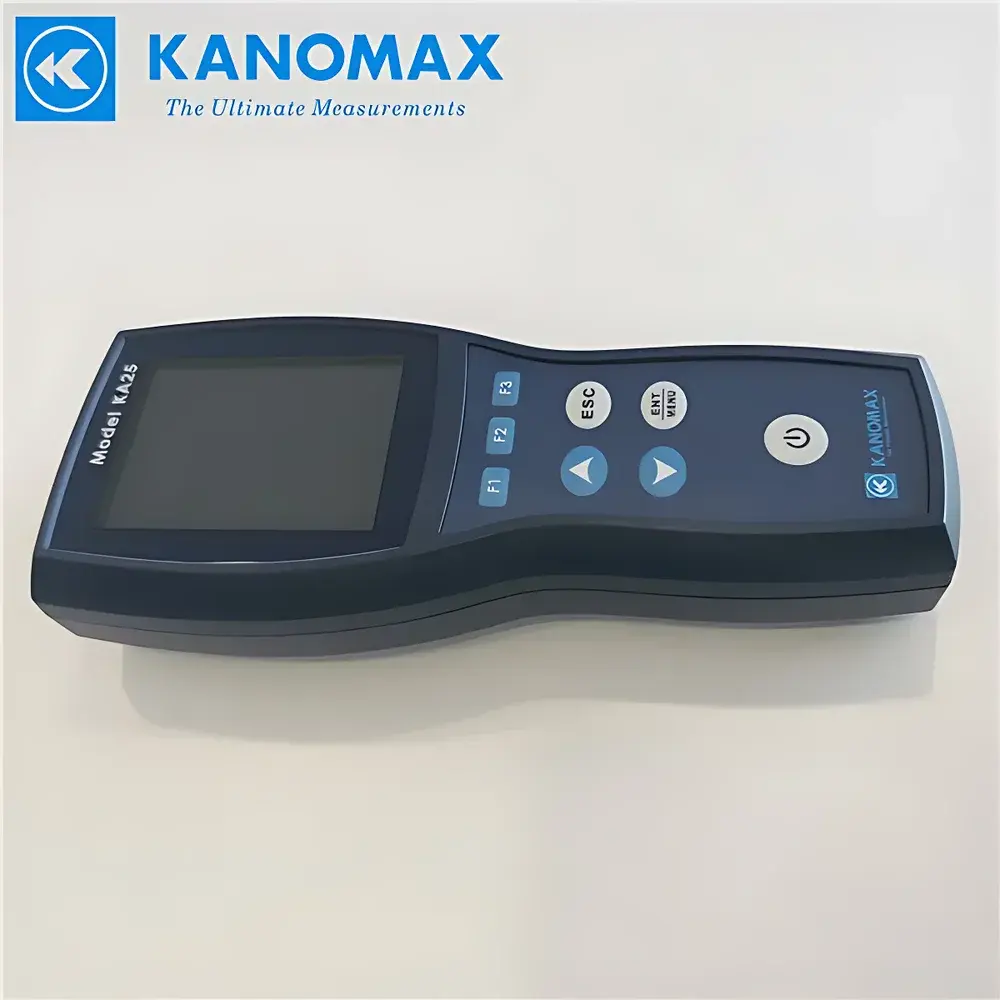
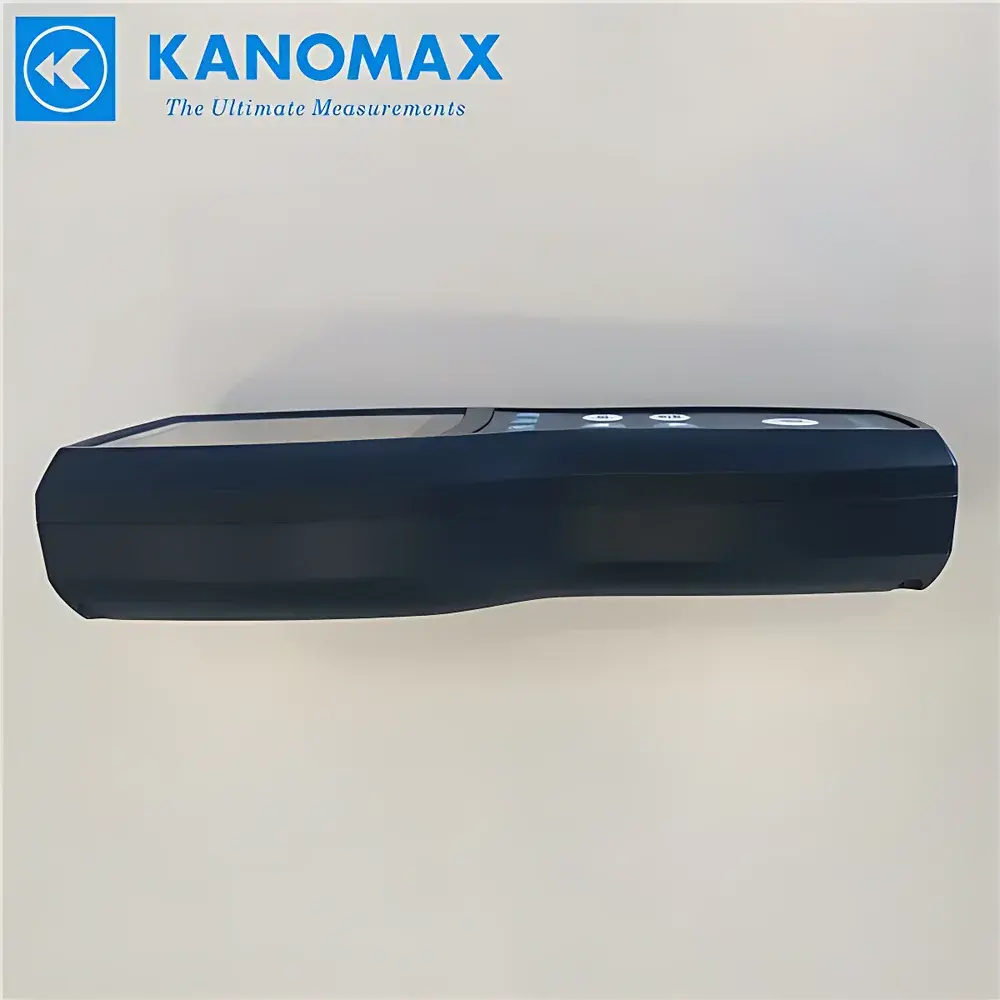
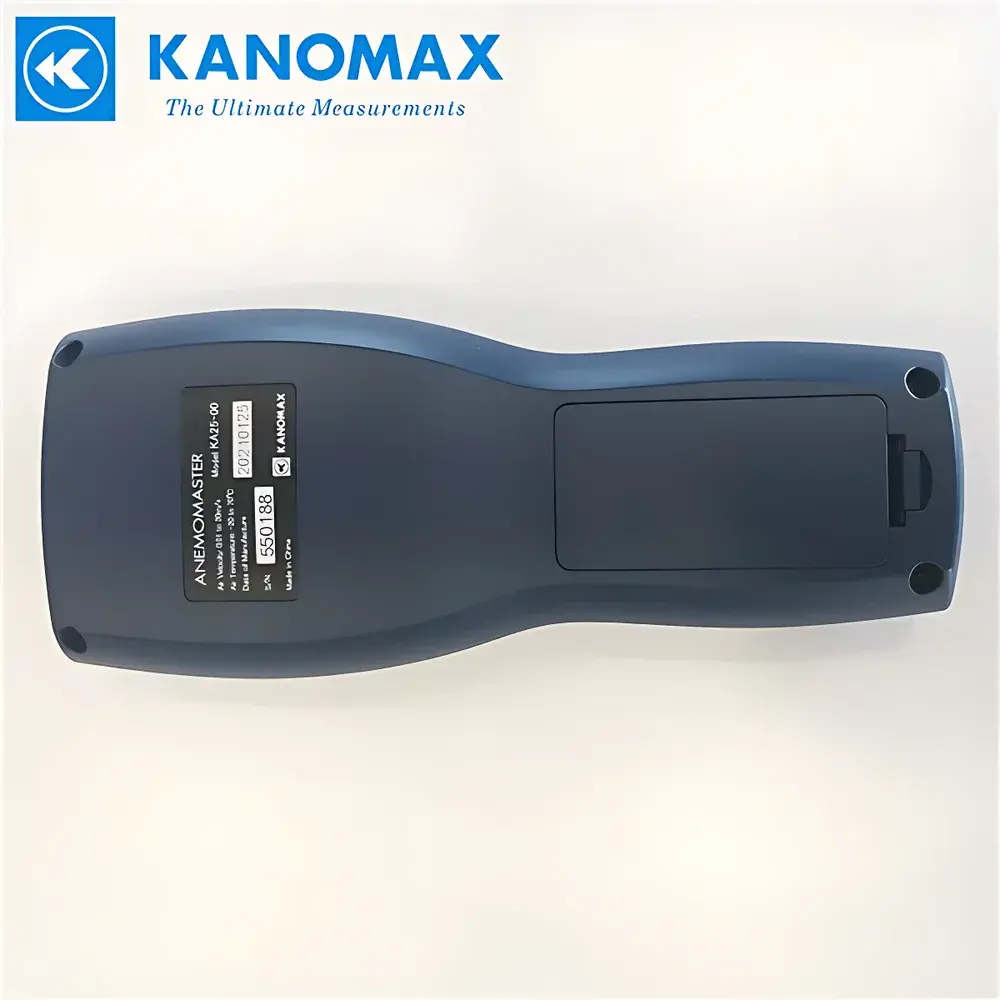
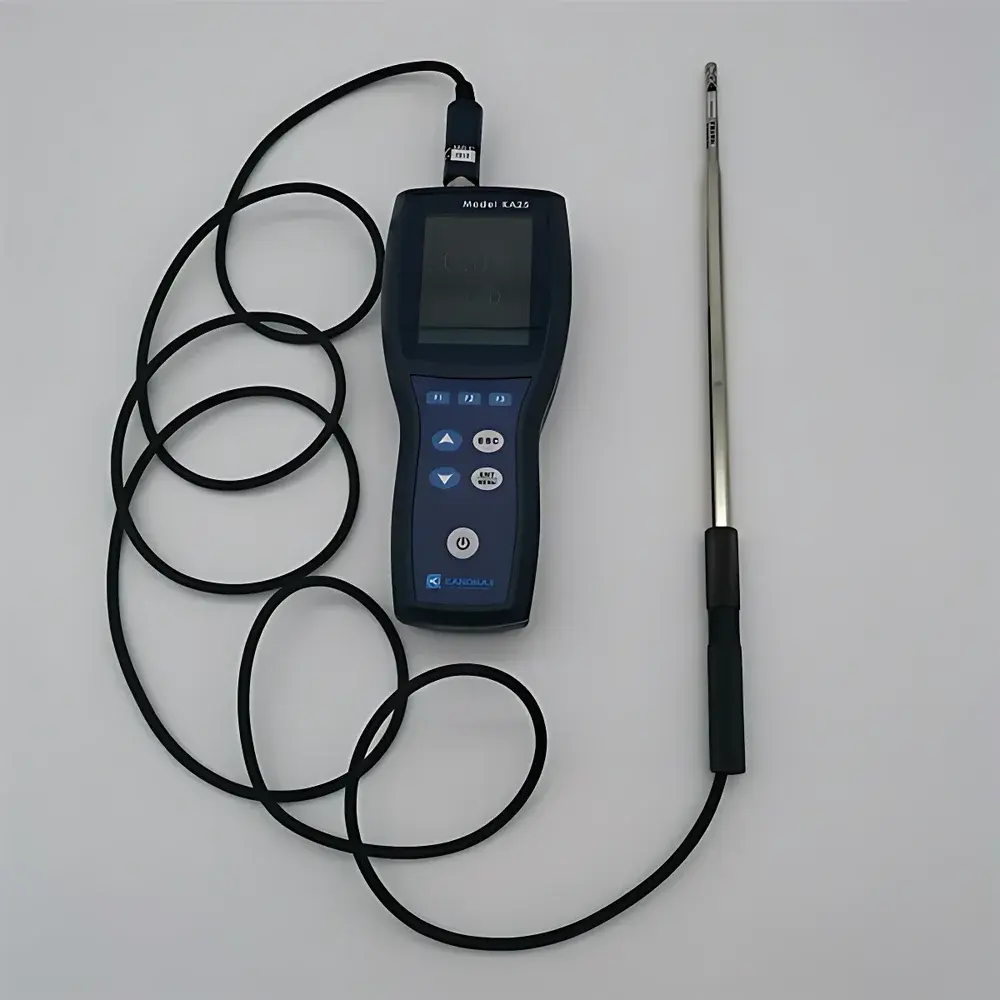
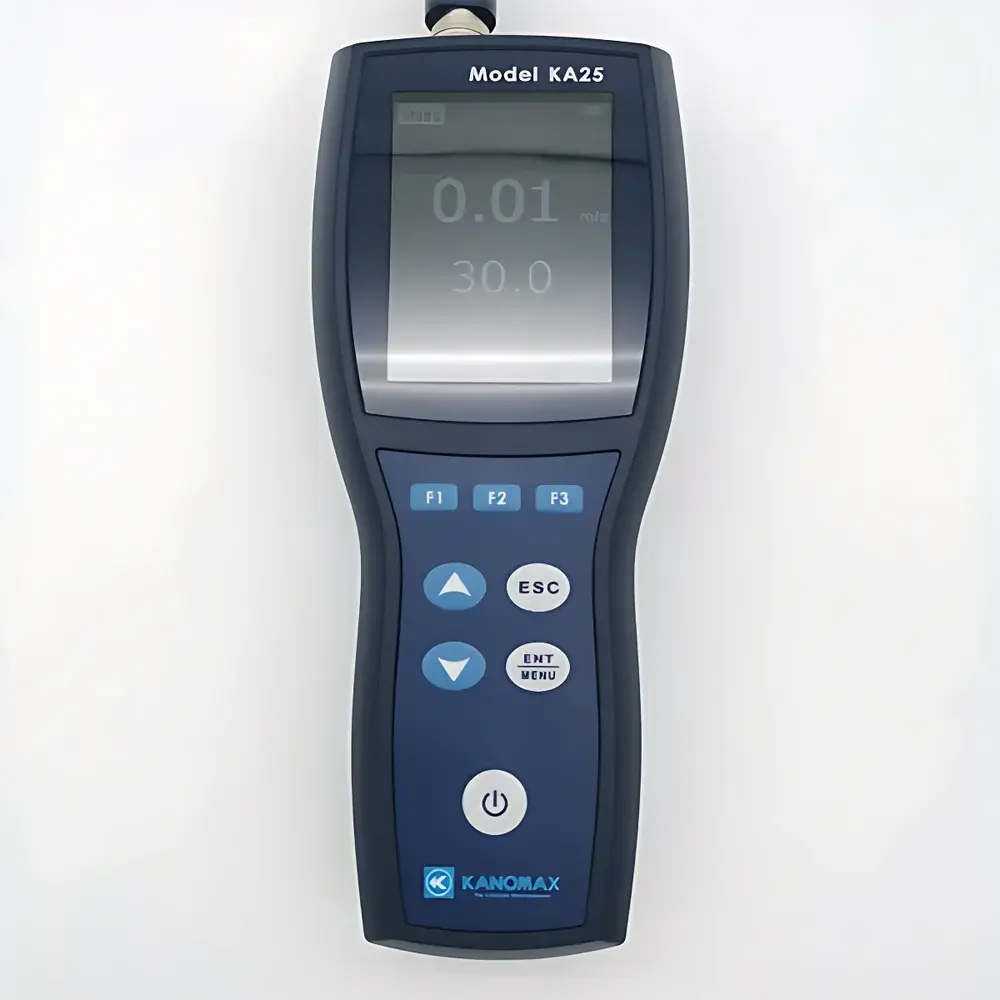
Kanomax KA25 Handheld Thermal Anemometer
| Brand | Kanomax |
|---|---|
| Origin | Japan |
| Instrument Type | Thermal Anemometer |
| Measurement Range | 0.01–20.0 m/s |
| Resolution | 0.01 m/s |
| Accuracy | ±(3% of reading + 0.03 m/s) |
| Temperature Range (Air) | −20.0 to +70.0 °C |
| Temperature Accuracy | ±0.5 °C (at v > 0.5 m/s) |
| Temperature Resolution | 0.1 °C |
| Air Volume Calculation | Yes (rectangular & circular ducts, 0.1–255.0 cm dimensions) |
| Response Time (Velocity) | ~1 s (90%, at 1 m/s) |
| Response Time (Temperature) | ~30 s (90%, at 1 m/s) |
| Time Constant Settings | 1 s / 5 s / 10 s / 20 s |
| Data Hold Function | Yes |
| Statistical Functions | Min / Avg / Max |
| Auto Power-Off | 3 / 5 / 10 min selectable |
| Display | 3-level backlight LCD |
| Power Supply | 4 × AA alkaline batteries |
| Battery Life | Approx. 15 h (1 m/s, 20 °C) |
| Operating Environment (Body) | 5–40 °C |
| (Probe) | −20–70 °C |
| Storage Temperature | −20–60 °C |
| Weight | ~220 g (body only, no batteries) |
| Probe Dimensions | Ø6 mm (sensor) / Ø14 mm (handle) × 294–1060 mm (telescoping & flexible) |
| Cable Length | 2000 mm |
| Housing Material | Impact-resistant ABS |
| Compliance | CE-marked |
Overview
The Kanomax KA25 Handheld Thermal Anemometer is an ISO-traceable, field-deployable instrument engineered for precise real-time measurement of air velocity and ambient temperature in HVAC commissioning, indoor air quality (IAQ) assessment, cleanroom validation, and industrial ventilation audits. Based on constant-temperature anemometry (CTA), the KA25 employs a thermally sensitive platinum resistance sensor housed in a low-inertia probe tip. As airflow cools the heated element, the instrument maintains thermal equilibrium by dynamically adjusting current—enabling linear, high-fidelity velocity transduction across its full 0.01–20.0 m/s range. Unlike cup or vane anemometers, the KA25 delivers true low-velocity sensitivity (<0.1 m/s) with minimal flow disturbance, making it suitable for laminar flow profiling, fume hood face velocity verification (per ASHRAE 110), and ISO 14644-3 compliant cleanroom airflow uniformity mapping.
Key Features
- Thermal sensing architecture optimized for high reproducibility at low velocities (0.01 m/s resolution, ±3% RDG + 0.03 m/s accuracy)
- Integrated dual-parameter measurement: simultaneous air velocity and temperature acquisition with independent calibration traceability
- Telescoping and bendable probe (Ø6 mm sensor tip, 294–1060 mm extended length) for access to ducts, grilles, and confined spaces
- Real-time air volume calculation for both rectangular and circular duct geometries (input dimensions: 0.1–255.0 cm)
- User-configurable time constant (1/5/10/20 s) to balance dynamic response and signal smoothing in turbulent or pulsating flows
- On-device statistical analysis: live display of minimum, maximum, and arithmetic mean over user-defined sampling intervals
- Backlit LCD with three brightness levels for operation under low-light conditions (e.g., ceiling plenums, mechanical rooms)
- Robust mechanical design: IP54-rated probe housing, impact-resistant ABS body, and corrosion-resistant sensor coating
Sample Compatibility & Compliance
The KA25 is validated for use with clean, dry, non-corrosive air—making it appropriate for Class 5–8 cleanrooms (ISO 14644-1), hospital HVAC systems, laboratory exhaust hoods, and general industrial ventilation. It is not intended for use with saturated steam, condensing moisture, particulate-laden exhaust streams, or chemically aggressive gases. The instrument conforms to electromagnetic compatibility standards IEC 61000-6-2 (immunity) and IEC 61000-6-3 (emissions), carries CE marking, and complies with RoHS Directive 2011/65/EU. While not FDA 21 CFR Part 11–certified (as it lacks audit-trail software), its stable analog signal path and manual data recording workflow support GLP-aligned documentation practices when used with controlled logbooks.
Software & Data Management
The KA25 operates as a standalone field instrument with no proprietary software dependency. All measurements are displayed and stored locally on the device. Data hold mode freezes readings for transcription; statistical values are retained until reset. No Bluetooth, USB, or cloud connectivity is included—eliminating firmware update dependencies and cybersecurity surface area. This architecture ensures long-term operational continuity in regulated environments where IT policy restricts peripheral device integration. For laboratories requiring digital archiving, users may manually record timestamped values into validated spreadsheets or LIMS platforms compliant with 21 CFR Part 11 Annex 11 requirements.
Applications
- HVAC system balancing and TAB (Testing, Adjusting, Balancing) per ASHRAE Guideline 12
- Cleanroom airflow visualization and uniformity verification (ISO 14644-3 Annex B)
- Fume hood face velocity surveys (OSHA 1910.1200 & ANSI/AIHA Z9.5)
- Industrial exhaust stack velocity profiling (EPA Method 2)
- Indoor environmental quality (IEQ) assessments per LEED IEQ Credit 2
- Validation of laminar flow cabinets and biosafety cabinets (NSF/ANSI 49)
- Educational aerodynamics labs and engineering field practicums
FAQ
What is the recommended calibration interval for the KA25?
Kanomax recommends annual calibration against NIST-traceable standards in accordance with ISO/IEC 17025-accredited laboratories. Field verification using zero-air and fixed-velocity references (e.g., calibrated wind tunnel) is advised before critical measurements.
Can the KA25 measure velocity in humid or dusty environments?
The probe is rated for 2–98% RH but must remain free of condensation and particulate buildup. Prolonged exposure to >85% RH or airborne oil mist may degrade sensor stability and require recalibration.
Does the KA25 support metric/imperial unit switching?
No—the instrument displays velocity exclusively in m/s and temperature in °C, consistent with international metrological practice and ISO standards.
Is the telescoping probe mechanically locked during extension?
Yes—a friction-fit collar provides secure positioning at any length between 294 mm and 1060 mm without slippage during handheld use.
How does the time constant setting affect measurement uncertainty?
Shorter time constants (1 s) increase responsiveness to transient flow changes but amplify noise; longer settings (20 s) suppress fluctuations but reduce fidelity in unsteady flows. Selection should align with application-specific turbulence intensity (e.g., 5 s for general duct surveys, 1 s for jet stream profiling).
Related Products







