
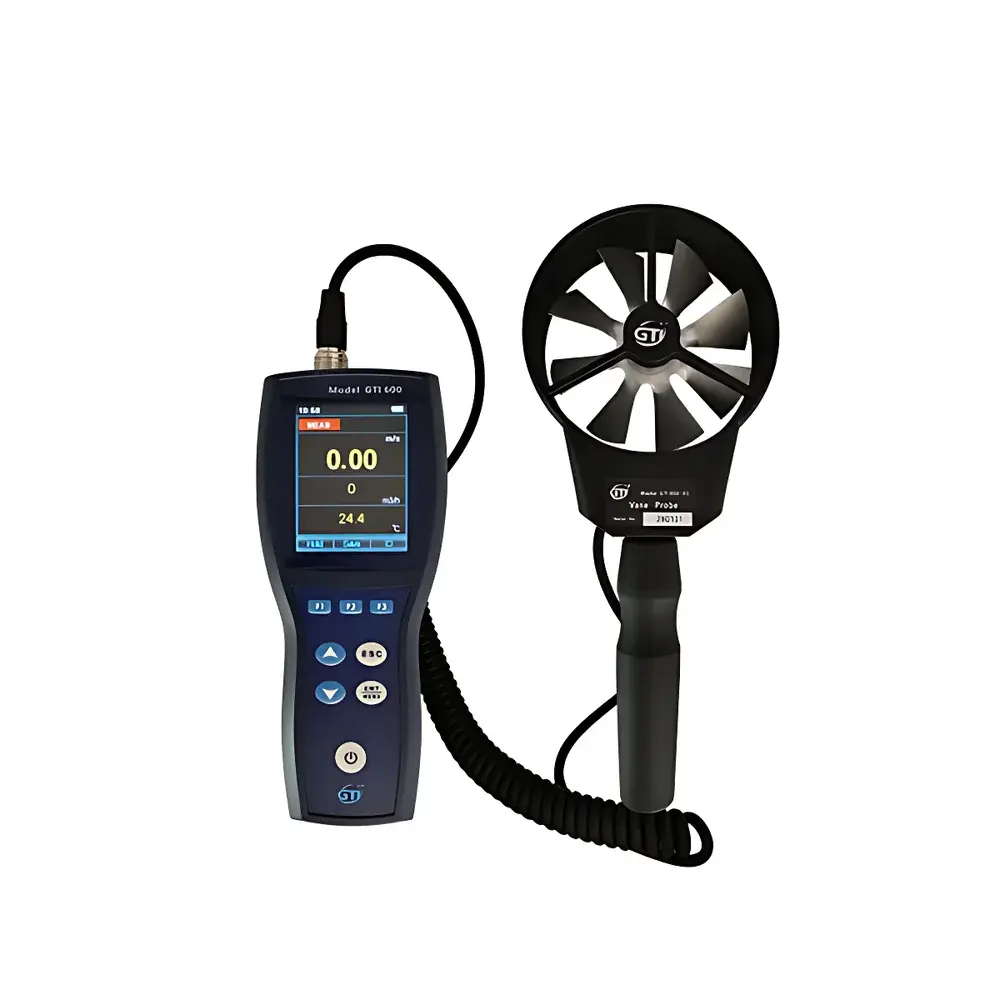
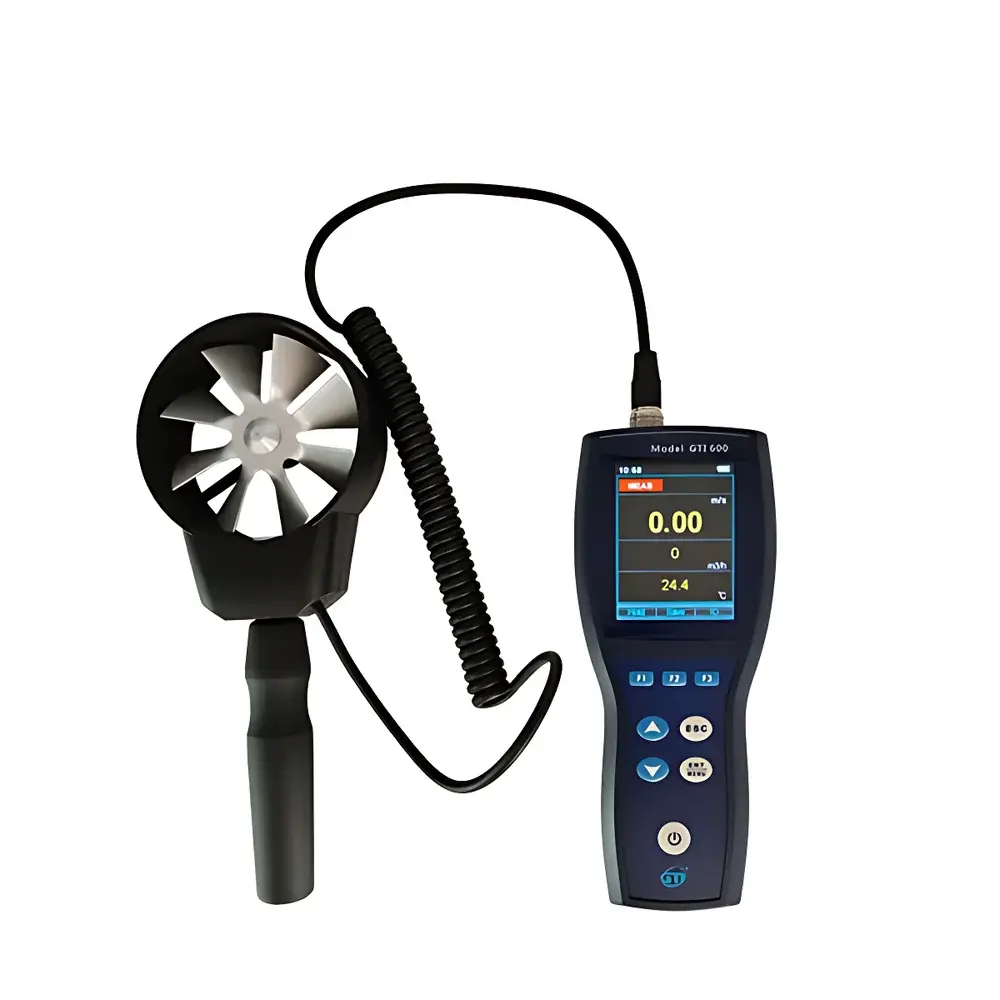
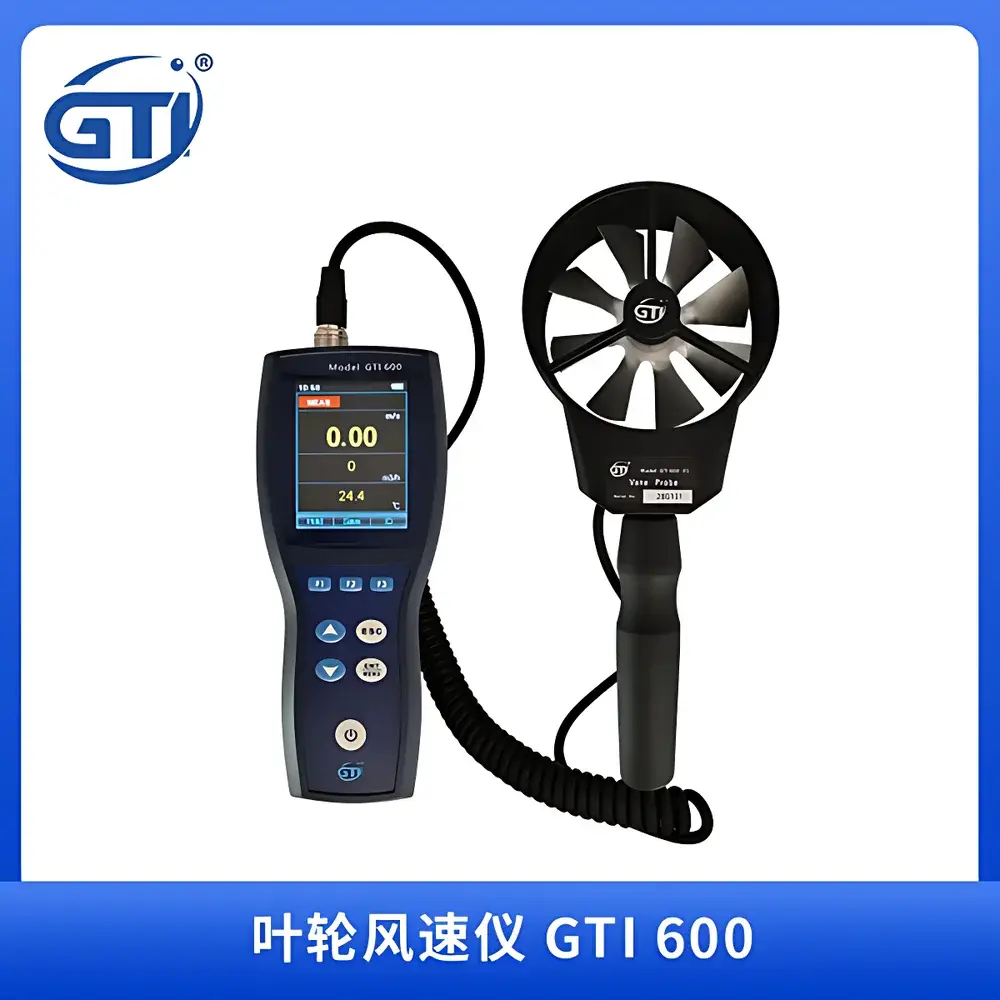
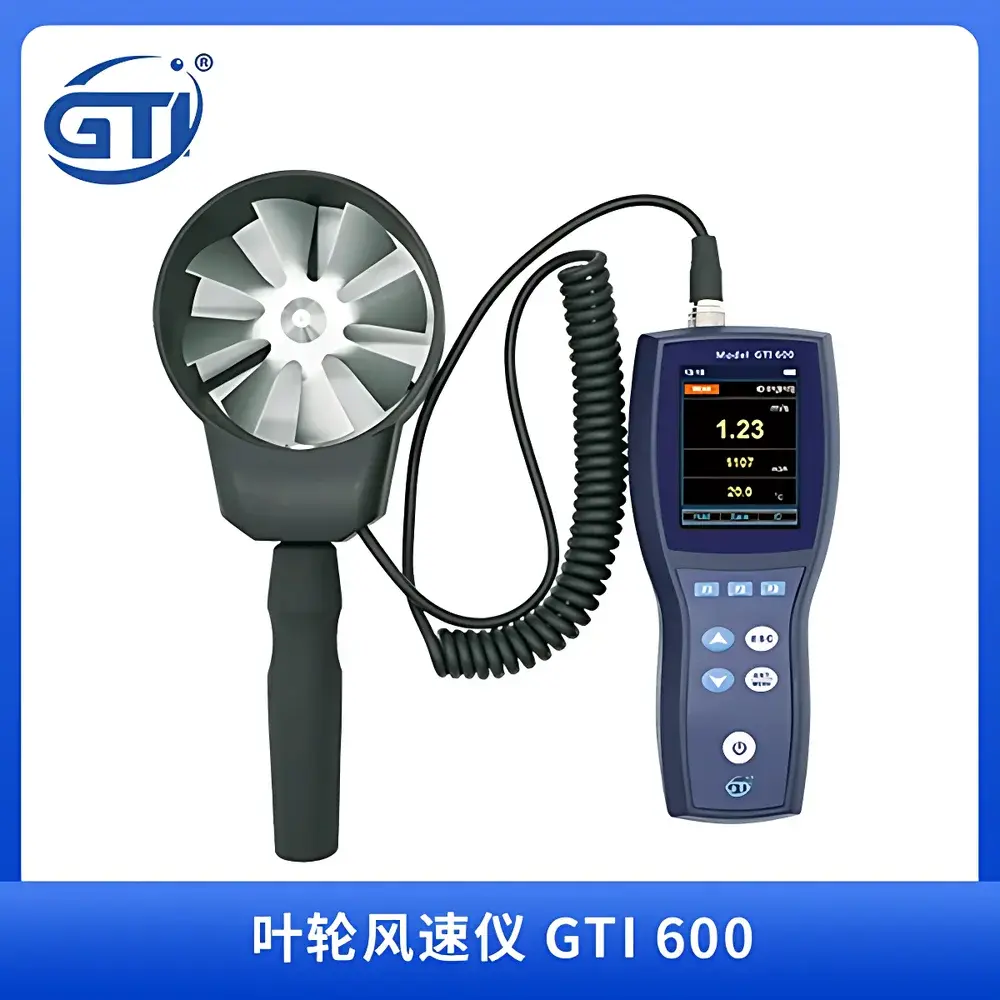
GTI GTI-600 Precision Handheld Vane Anemometer
| Brand | GTI |
|---|---|
| Origin | Liaoning, China |
| Manufacturer Type | Authorized Distributor |
| Country of Origin | China |
| Model | GTI-600 |
| Instrument Type | Vane Anemometer |
| Wind Speed Range (FV100) | 0.30–35 m/s |
| Wind Speed Range (FV70) | 0.10–35 m/s |
| Wind Speed Range (FV14) | 0.80–25 m/s |
| Wind Speed Accuracy | ±3% ±0.1 m/s (low range), ±1% ±0.3 m/s (high range) |
| Temperature Range | 0–60 °C |
| Temperature Accuracy | ±0.5 °C |
| Temperature Resolution | 0.1 °C |
| Wind Speed Resolution | 0.01 m/s |
| Data Storage Capacity | 10,000 records |
| Power Supply | 4 × AA batteries or optional AC adapter |
| Operating Temperature | 0–60 °C |
| Storage Temperature | −20–60 °C |
| Weight | ~600 g |
Overview
The GTI GTI-600 Precision Handheld Vane Anemometer is an engineered solution for quantitative airflow characterization in HVAC commissioning, indoor air quality (IAQ) assessment, and environmental validation protocols. It operates on the principle of rotational vane anemometry: airflow imparts torque on a calibrated axial impeller, whose angular velocity—measured via optical or magnetic sensing—is linearly correlated to local fluid velocity under laminar-to-turbulent transitional flow conditions (Re ≈ 1×10⁴–5×10⁵). Unlike thermal anemometers, vane-based measurement exhibits minimal sensitivity to ambient temperature gradients and humidity fluctuations, delivering stable output in mixed-air environments typical of ductwork, diffusers, and laminar flow hoods. The GTI-600 integrates real-time dual-parameter acquisition (velocity + temperature), enabling simultaneous calculation of volumetric flow rate (m³/h) when geometric cross-section dimensions are entered—supporting both rectangular and circular duct configurations per ISO 16813 and ASHRAE Guideline 12.
Key Features
- Tri-sensor interchangeability: Field-replaceable FV14 (miniature, 14 mm diameter), FV70 (standard, 70 mm), and FV100 (large-aperture, 100 mm) vane probes—each optimized for distinct velocity profiles and spatial constraints (e.g., FV14 for grille slots; FV100 for open-area averaging).
- Adaptive measurement modes: Select between instantaneous sampling (for transient event capture) or moving-average mode (configurable 3–30 second window) to suppress turbulence-induced variance—critical for compliance with EN 13725 and ISO 14644-3 airflow uniformity assessments.
- On-device volumetric flow computation: Input duct geometry (width/height or diameter) and select profile type; instrument applies standardized area-weighted integration algorithms to derive m³/h without external calculation.
- Robust data integrity architecture: Stores up to 10,000 timestamped records with metadata (sensor ID, mode, ambient T, date/time); supports USB mass-storage export for traceable CSV logging compatible with LIMS and audit-ready reporting.
- Ergonomic industrial design: IP54-rated enclosure, 600 g mass with balanced center-of-gravity, tactile keypad feedback, and persistent display of battery status, duct type, hold-lock state, and active sensor identifier.
Sample Compatibility & Compliance
The GTI-600 accommodates heterogeneous airflow fields encountered in HVAC balancing—particularly non-uniform velocity distributions across diffusers, perforated plates, HEPA filter banks, and variable-air-volume (VAV) terminal units. Its vane sensors maintain metrological validity at angles of attack up to ±20° relative to flow direction, minimizing cosine error per ISO 7726 Annex B. Calibration is traceable to NIM (National Institute of Metrology, China) standards, with documented uncertainty budgets available upon request. Device firmware adheres to IEC 61000-4 electromagnetic compatibility requirements and meets RoHS 2011/65/EU material restrictions. While not FDA 21 CFR Part 11-certified out-of-box, audit trails generated during data export satisfy GLP/GMP documentation prerequisites for HVAC system qualification (IQ/OQ/PQ).
Software & Data Management
Data retrieval occurs via standard USB 2.0 interface—no proprietary drivers required. Exported .csv files contain columns: Record_ID, Timestamp_UTC, Sensor_Model, Measured_Velocity_mps, Temperature_C, Calculated_Flow_m3h, Measurement_Mode, Duct_Type, Dimensions_mm, Battery_Voltage_V. Optional GTI DataLink desktop utility (Windows/macOS) enables batch statistical analysis—including min/mean/max aggregation across multi-point traverses—and generates PDF reports compliant with ISO/IEC 17025 clause 7.8.2 for result reporting. All stored records retain immutable timestamps; no field editing is permitted post-acquisition to preserve evidential integrity.
Applications
- HVAC system commissioning and TAB (Testing, Adjusting, Balancing) per ASHRAE Standard 111.
- ISO Class 5–8 cleanroom airflow mapping and uniformity verification (ISO 14644-3).
- Lab ventilation safety validation—including fume hood face velocity surveys per ANSI/AIHA Z9.5.
- Building energy audits requiring duct static pressure and volumetric flow correlation.
- Pharmaceutical facility environmental monitoring (Grade A–D zones) during media fill simulations.
- Educational laboratory instruction on fluid mechanics fundamentals and instrumentation uncertainty propagation.
FAQ
What calibration standards does the GTI-600 reference?
The device is factory-calibrated against NIM-traceable wind tunnel standards (uncertainty ≤ ±0.8% k=2) across its full operating range. Certificate of Conformance includes as-found/as-left data and is supplied with each unit.
Can the GTI-600 measure airflow in exhaust stacks with high particulate loading?
FV100 and FV70 sensors feature stainless-steel vanes and sealed bearing assemblies rated for ISO 12103-1 A4 test dust exposure; however, routine cleaning after dusty environment use is recommended to maintain long-term repeatability.
Is real-time data streaming possible via Bluetooth or Wi-Fi?
No. The GTI-600 prioritizes measurement integrity and battery longevity over wireless connectivity; all communication occurs via secure, isolated USB mass-storage transfer to prevent electromagnetic interference with analog sensor circuits.
How does the moving-average algorithm handle sudden airflow transients?
The firmware implements a first-order low-pass digital filter with configurable time constant (τ = RC equivalent); users may select 3 s (fast response) to 30 s (high stability) depending on application-specific turbulence intensity.
Does the instrument support custom unit conversions (e.g., CFM, ft/min)?
Unit selection is fixed to SI base units (m/s, °C, m³/h) per ISO 80000-4 to ensure unambiguous interpretation in international regulatory submissions; no imperial conversions are implemented.







