
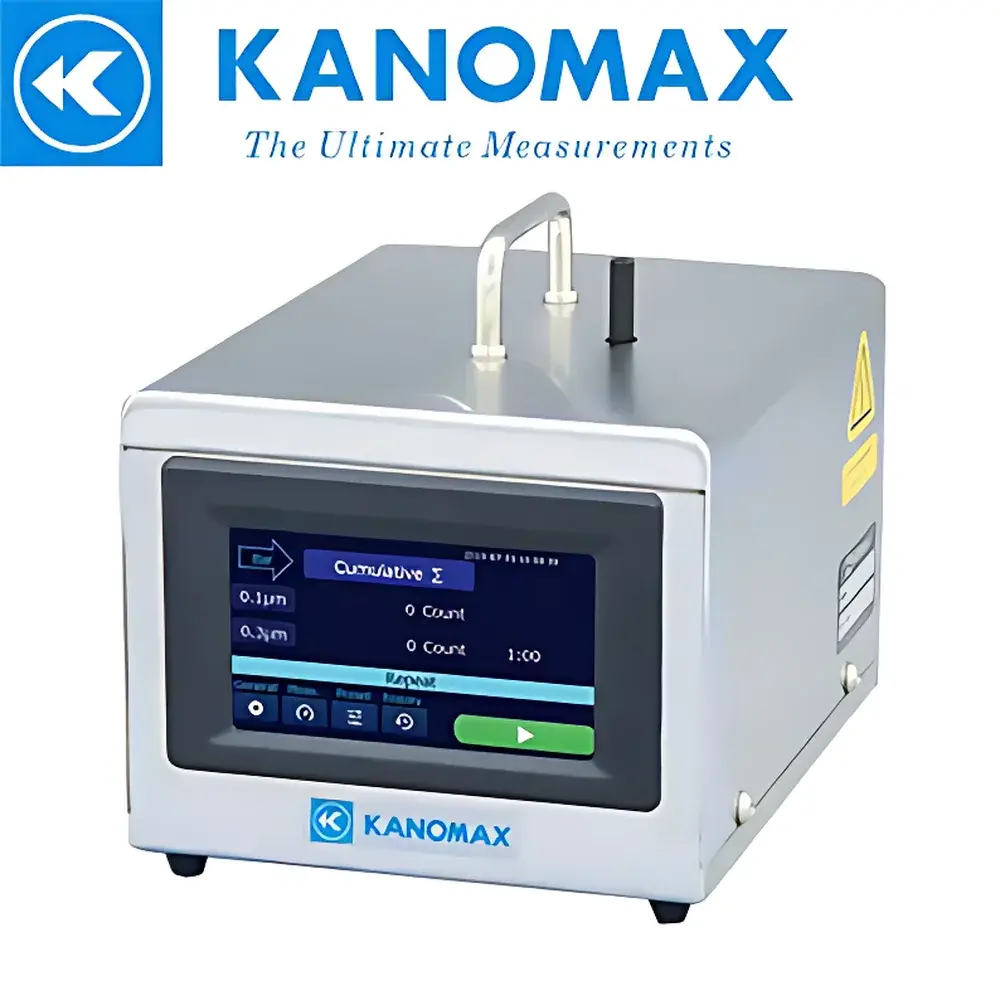
Kanomax 3950 Ultra-Compact Laser Particle Counter for 0.1 µm Detection
| Brand | Kanomax |
|---|---|
| Origin | Japan |
| Model | 3950 |
| Flow Rate | 2.83 L/min (0.1 CFM) |
| Flow Accuracy | ±5% |
| Timing Accuracy | ±1 s per 6 min |
| Repeatability | ±5% |
| Size Distribution Error | ±15% |
| Indication Error | ±30% |
| Particle Detection Channels | 0.1 µm, 0.3 µm |
| Maximum Concentration | 10⁷ particles/m³ |
| Counting Efficiency | 50±20% at 0.1 µm (PSL), 100±10% at 0.15–0.2 µm (PSL) |
| False Count Rate | <1 count/35 min |
| Size Resolution | ≤15% (relative to 0.3 µm PSL) |
| Display | 4.3″ color TFT touchscreen |
| Communication | USB (Host/Device), Ethernet, RS-485 (9600–38400 baud) |
| Data Storage | up to 10,000 records in CSV format |
| Operating Environment | 15–35 °C, 0–85% RH (non-condensing) |
| Dimensions | 150 × 163 × 228 mm |
| Weight | 3.4 kg |
| Compliance | JIS B9921, ISO 21501-4 |
Overview
The Kanomax 3950 Ultra-Compact Laser Particle Counter is an OEM-integrated environmental monitoring instrument engineered for real-time, high-sensitivity airborne particle quantification in critical process environments. Utilizing calibrated laser light scattering (LLS) detection with a 650 nm diode laser source, the 3950 achieves reliable discrimination of sub-micron particulates down to 0.1 µm—enabling precise classification and trending in cleanrooms, semiconductor fabrication tools, medical device assembly enclosures, and pharmaceutical isolators. Its design prioritizes embeddability: at just 3.4 kg and 150 × 163 × 228 mm, it meets stringent spatial constraints typical of integrated sensor modules in automated manufacturing equipment. The instrument operates at a nominal volumetric flow rate of 2.83 L/min (0.1 CFM), conforming to ISO 21501-4 and JIS B9921 for optical particle counter performance validation—including counting efficiency, size resolution, false count rate, and flow stability.
Key Features
- Two-channel simultaneous detection at 0.1 µm and 0.3 µm—optimized for ultra-clean environment qualification where sub-100 nm particulate control is essential.
- Integrated vacuum pump with flow regulation circuitry ensures stable aspiration across variable backpressure conditions common in duct-mounted or tool-integrated deployments.
- 4.3-inch full-color resistive touchscreen interface supports intuitive local operation, real-time histogram visualization (cumulative ∑ and differential Δ modes), and on-device measurement mode selection (single, repeat, continuous, ISO-compliant, GB-based, or calculation mode).
- Ruggedized industrial-grade enclosure rated for continuous operation at 15–35 °C and up to 85% RH (non-condensing), with EMI-hardened electronics suitable for factory-floor integration.
- Multi-protocol digital connectivity: native USB Device/Host (for direct PC communication or printer/USB storage interfacing), 10/100BASE-T Ethernet (TCP/IP stack enabled), and isolated RS-485 (configurable baud rates: 9600, 19200, 38400 bps) for seamless integration into SCADA, MES, or facility monitoring systems.
Sample Compatibility & Compliance
The 3950 is validated for use with ambient air and compressed dry air (oil-free, dew point ≤ −20 °C) in non-corrosive, non-explosive atmospheres. It is not intended for aerosols containing condensable vapors, reactive chemicals, or high-humidity saturated streams without prior conditioning. Calibration traceability follows NIST-traceable PSL (polystyrene latex) standards per ISO 21501-4 Annex B. Instrument-level compliance includes JIS B9921:2010 (Japanese Industrial Standard for airborne particle counters) and ISO 21501-4:2018 (Determination of particle size distribution—Part 4: Light scattering airborne particle counter for clean spaces). While the unit itself does not carry FDA 21 CFR Part 11 certification, its data export architecture (CSV timestamped logs, audit-ready metadata) supports implementation within GMP/GLP-compliant workflows when deployed with validated software platforms and procedural controls.
Software & Data Management
Raw measurement data—including particle counts per channel, sampling duration, location ID (up to 99 user-defined zones), and timestamps—is stored internally in comma-separated value (CSV) format. A total of 10,000 records can be retained onboard; data export occurs via USB mass storage mode or Ethernet FTP/SFTP transfer. No proprietary desktop application is bundled, but the standardized CSV schema (headers: Date, Time, Location, Mode, 0.1um_Count, 0.3um_Count, Duration_s, Flow_Lmin) ensures compatibility with third-party analytics tools (e.g., Python Pandas, MATLAB, LabVIEW, or enterprise LIMS). For regulatory environments, users may implement external audit trail solutions that log configuration changes, user access events, and data export actions—aligning with ALCOA+ principles (Attributable, Legible, Contemporaneous, Original, Accurate, Complete, Consistent, Enduring, Available).
Applications
- Embedded particle sensing in semiconductor photolithography steppers, etch tools, and wafer inspection stations.
- In-line monitoring of ISO Class 1–3 cleanroom supply air ducts and recirculation loops.
- Validation and routine surveillance of aseptic filling lines, RABS, and isolator glove ports per EU GMP Annex 1 and USP .
- Research-grade nanoparticle emission characterization in nanomaterial synthesis labs and filtration media testing.
- Environmental baseline studies in controlled laboratories requiring trace-level background particulate mapping.
FAQ
What is the minimum detectable particle size, and how is calibration verified?
The 3950 is specified for 0.1 µm detection using PSL reference standards; counting efficiency is validated at 50±20% for 0.1 µm particles and 100±10% for 0.15–0.2 µm particles per ISO 21501-4.
Can the instrument operate continuously without manual intervention?
Yes—it supports unattended continuous measurement mode with programmable cycle intervals (6 seconds to 99 minutes 59 seconds) and auto-stored logging for up to 10,000 records.
Is external power conditioning required for stable operation?
No; the internal switching power supply accepts 100–240 V AC, 50/60 Hz, and incorporates surge suppression and line noise filtering appropriate for industrial settings.
Does the device support remote firmware updates?
Firmware updates are performed locally via USB flash drive; network-based updates are not supported to maintain deterministic behavior in embedded applications.
How is flow rate accuracy maintained over time and temperature variation?
Flow is monitored in real time by a thermal mass flow sensor and actively compensated via closed-loop pump speed control, ensuring ±5% deviation across the rated operating temperature range (15–35 °C).







