
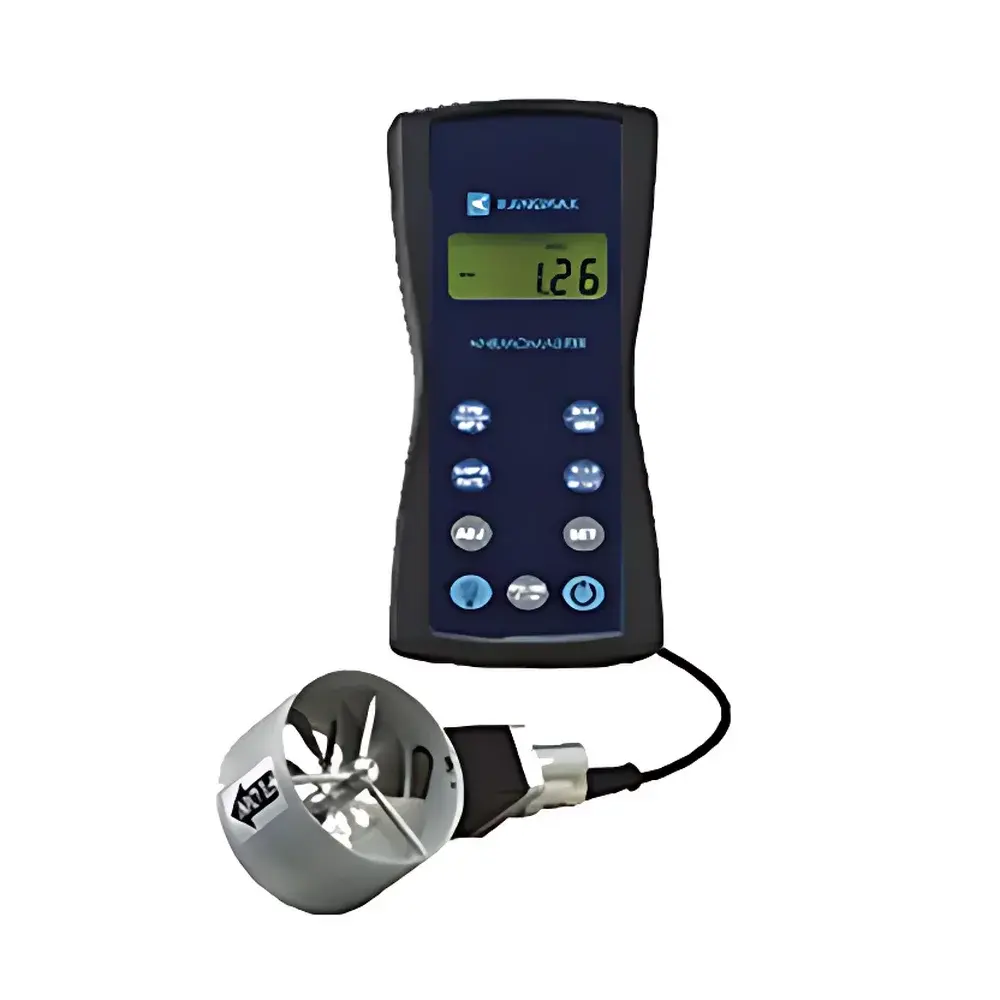
Kanomax Model 6821/6823 Vane Anemometer
| Brand | Kanomax |
|---|---|
| Origin | Japan |
| Model | 6821 / 6823 |
| Instrument Type | Vane Anemometer |
| Resolution | 0.01 m/s |
| Measurement Range | 0.2–40.0 m/s |
| Accuracy | ±3% of reading or ±0.1 m/s (whichever is greater) |
| Temperature Range | –20 to +100 °C |
| Temperature Accuracy | ±0.3 °C + 0.2% of reading |
| Air Volume Range | 0–9,999 CFM |
| Probe Diameter | 70 mm |
| Power Supply | 3 × AA batteries |
| Dimensions | 81 × 165 × 38 mm |
| Weight | 1750 g (including batteries) |
Overview
The Kanomax Model 6821 and 6823 are precision-engineered vane anemometers designed for reliable, real-time measurement of air velocity, temperature, and volumetric airflow in HVAC commissioning, industrial ventilation assessment, cleanroom validation, and environmental monitoring applications. Based on robust mechanical vane rotation principles—where airflow induces proportional angular velocity in a calibrated impeller—the instruments deliver stable, low-drift readings across a broad dynamic range (0.2–40.0 m/s). Unlike thermal anemometers, vane-based sensing provides superior immunity to transient humidity fluctuations and moderate particulate exposure, making these models especially suitable for duct traverse surveys, exhaust hood evaluations, and supply register characterization where mechanical durability and repeatability are critical. Both units integrate a built-in thermistor for simultaneous temperature acquisition, enabling direct calculation of volumetric flow (CFM) when users input duct geometry (rectangular or circular cross-section) and dimensions via the intuitive keypad interface.
Key Features
- Vane-type airflow sensor with high-stability aluminum alloy impeller and precision ball-bearing assembly, optimized for long-term rotational consistency and minimal hysteresis.
- Simultaneous dual-parameter display: real-time wind speed (m/s or ft/min) and ambient temperature (°C/°F) on a backlit LCD screen with auto-ranging capability.
- Integrated airflow calculation engine: accepts user-defined duct shape (square, rectangular, round), width, height, or diameter to compute total volumetric flow (CFM or m³/h) without external software.
- Rugged handheld form factor (81 × 165 × 38 mm) with ergonomic grip and IP54-rated enclosure—resistant to dust ingress and incidental water splashing during field use.
- Low-power design powered by three standard AA alkaline batteries, supporting continuous operation for up to 20 hours under typical usage conditions.
- Zero-point calibration function accessible via front-panel controls, allowing field verification and drift compensation without disassembly or service tools.
Sample Compatibility & Compliance
The Model 6821/6823 is compatible with standard HVAC duct configurations—including round, square, and rectangular cross-sections—enabling rapid traverse point selection per ASHRAE Guideline 12 and ISO 16813 Annex B. Its operational temperature range (–20 to +100 °C) supports deployment in both chilled air handling systems and high-temperature exhaust streams, including fume hood exhausts and drying oven ducts. The device complies with IEC 61000-4-2 (ESD immunity) and IEC 61000-4-3 (radiated RF immunity) standards. While not certified for intrinsic safety in hazardous locations, its non-sparking vane mechanism and battery-only power architecture render it appropriate for general industrial indoor environments. Calibration traceability follows JIS Z 8001 and NIST-traceable reference standards maintained by Kanomax Japan’s metrology laboratory.
Software & Data Management
These standalone instruments operate without PC connectivity; all measurements are displayed and stored locally on-screen. No internal memory or data logging is provided—consistent with their role as field verification tools rather than continuous monitoring platforms. However, results can be manually recorded or photographed for inclusion in GLP-compliant test reports. For laboratories requiring audit-ready documentation, Kanomax recommends pairing the 6821/6823 with external digital loggers or using them as primary field validators prior to automated system commissioning. The absence of wireless transmission or cloud interfaces ensures compliance with facilities operating under strict IT security policies (e.g., pharmaceutical manufacturing sites governed by FDA 21 CFR Part 11 Annex 11 requirements for instrument qualification).
Applications
- HVAC system balancing and TAB (Testing, Adjusting, and Balancing) per SMACNA and NEBB protocols.
- Cleanroom airflow uniformity mapping and ISO 14644-3 compliant supply/exhaust velocity checks.
- Fume hood face velocity verification per ANSI/ASHRAE 110 and UK HSE guidance.
- Industrial dryer, kiln, and combustion flue pre-checks where thermal anemometers may suffer sensor fouling.
- Educational laboratory exercises in fluid mechanics and environmental engineering curricula.
- Preventive maintenance screening of fan performance degradation across multi-zone ventilation networks.
FAQ
Does the Model 6821/6823 support data export or Bluetooth connectivity?
No. These are dedicated handheld field meters with no serial, USB, or wireless communication interfaces. All data must be recorded manually.
Can the vane probe be replaced or recalibrated in-house?
The vane assembly is a sealed, factory-calibrated module. Field replacement is not supported; recalibration requires return to an authorized Kanomax service center with NIST-traceable airflow standards.
Is the temperature sensor separately calibrated from the vane sensor?
Yes. The thermistor is independently characterized during final assembly, and its accuracy specification (±0.3 °C + 0.2% of reading) applies regardless of concurrent wind speed measurement.
What is the recommended recalibration interval?
Kanomax recommends annual recalibration for routine QA/QC use, or prior to critical validation activities such as cleanroom certification or HVAC re-commissioning.
Does the device meet ISO/IEC 17025 requirements for accredited testing labs?
When operated within its specified environmental limits and used with documented calibration certificates, the instrument satisfies the technical competence criteria for measurement equipment under ISO/IEC 17025:2017 Clause 6.4—provided that the lab maintains appropriate uncertainty budgets and traceability records.
Related Products







