
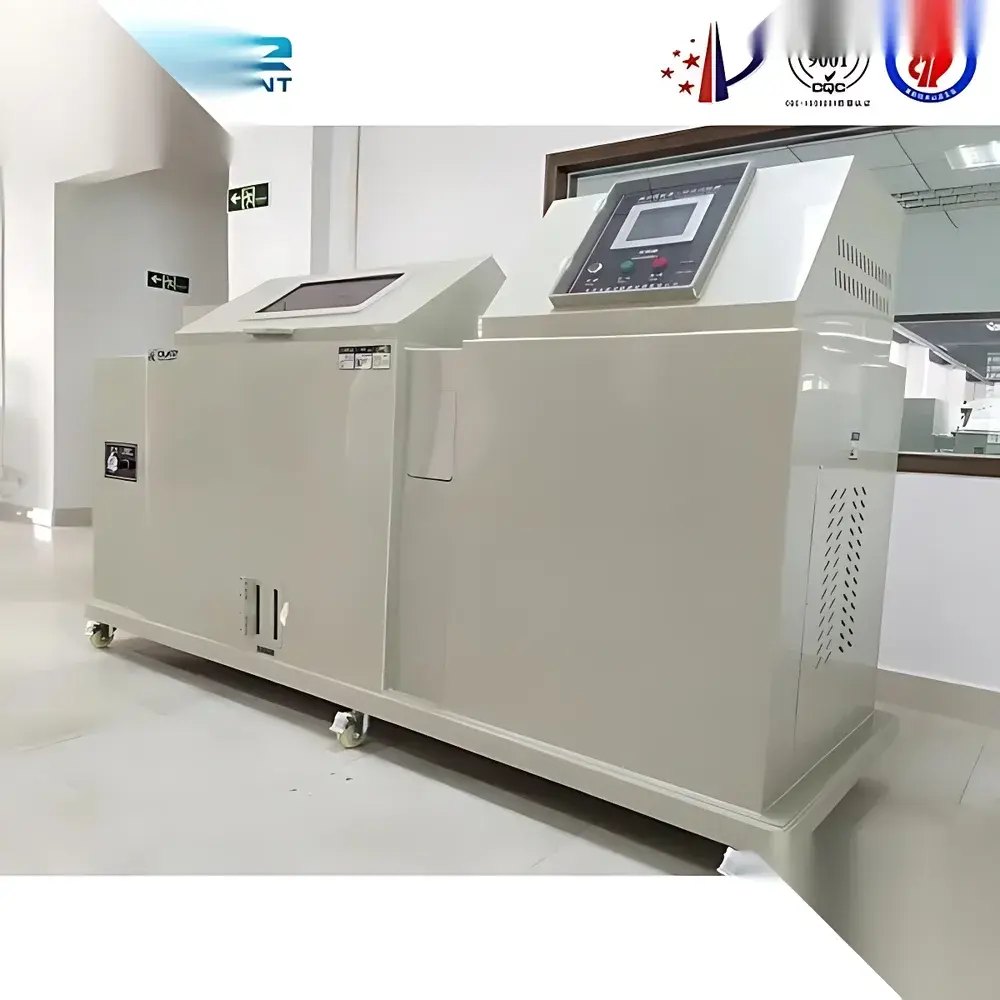
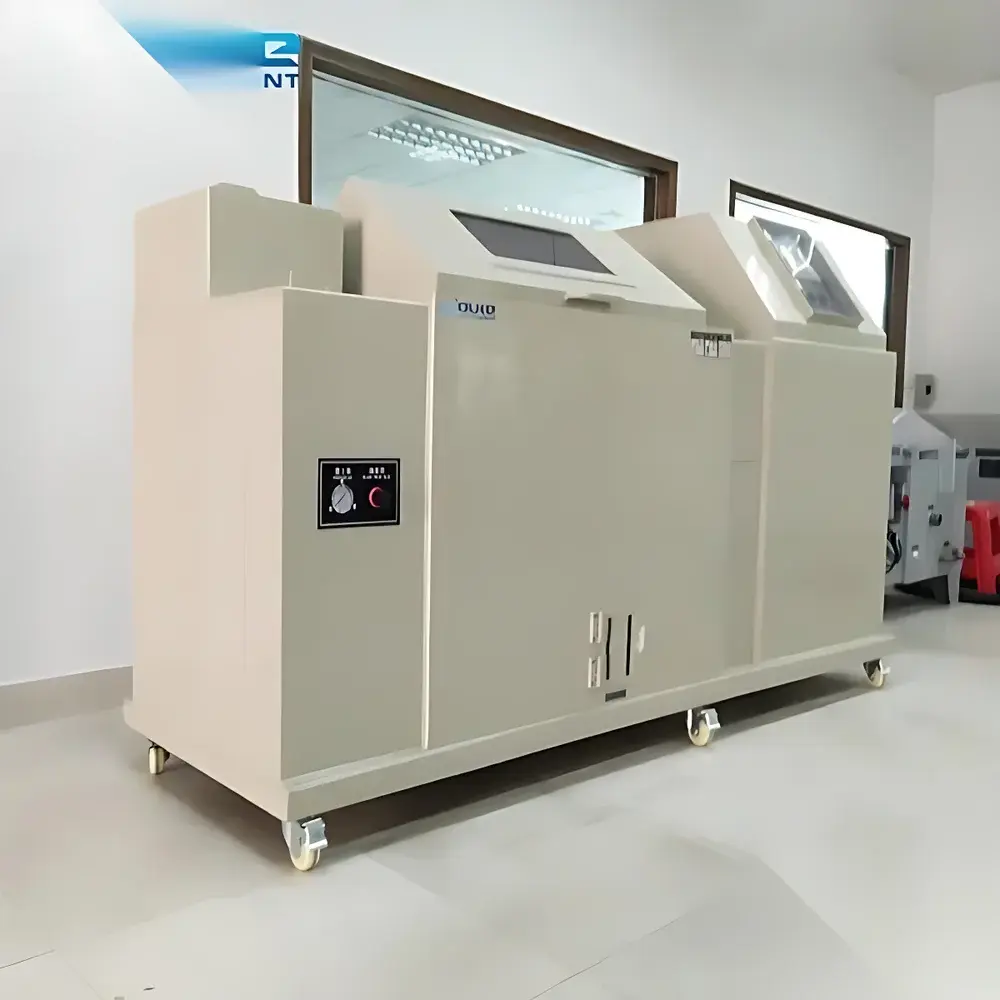
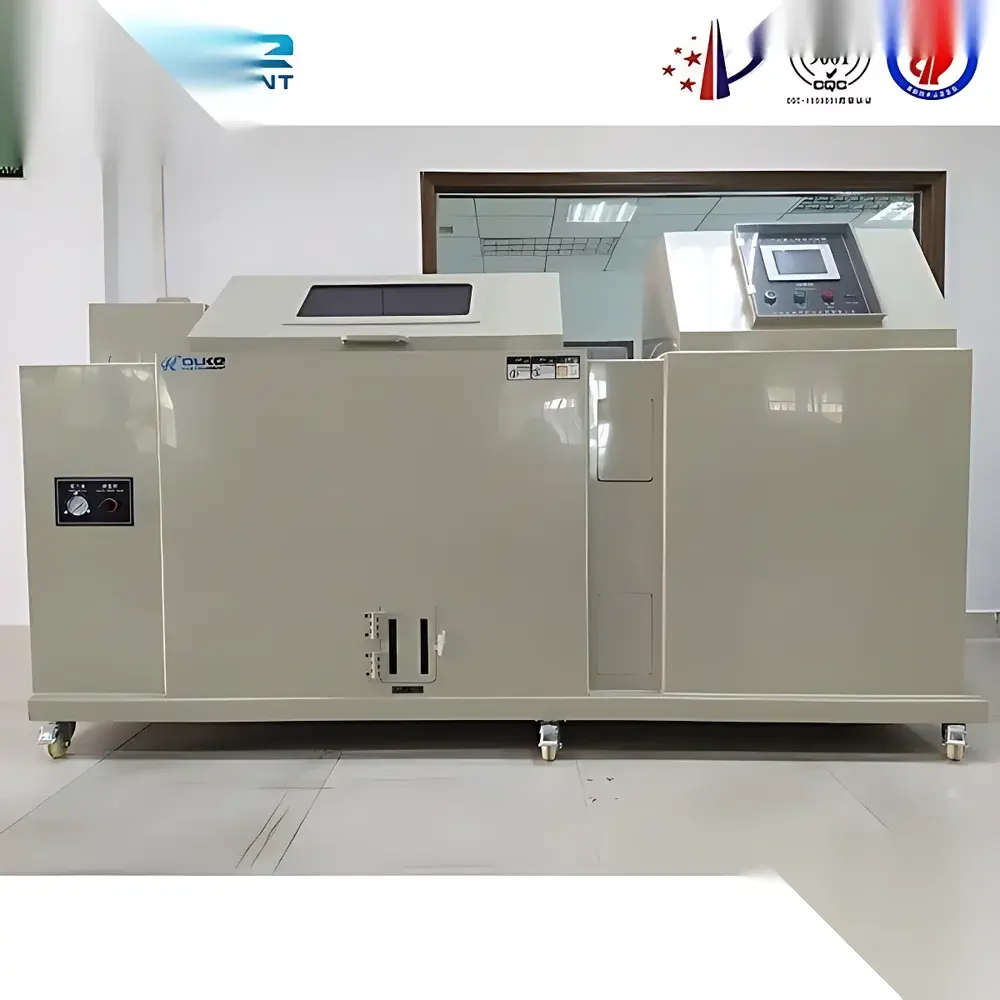
Multi-Environment Corrosion Test Chamber for SO₂, H₂S, and Cyclic Salt Spray Testing
| Brand | OEM / Custom-Built |
|---|---|
| Origin | Imported |
| Manufacturer Type | Authorized Distributor |
| Price | USD 21,500 (FOB) |
| Chamber Models | SH-60 (W1300×D850×H600 mm), SH-80 (W1600×D850×H600 mm), SH-120 (W2000×D900×H600 mm) |
| Temperature Range | +10°C to +50°C |
| Humidity Range | 85–98% RH |
| Temp. Uniformity | ≤2°C |
| Temp. Stability | ±0.5°C |
| SO₂/H₂S Delivery | High-Purity Gas Cylinder System |
| Gas Concentration Control | 0.1–1.0 vol% (adjustable via mass flow controller) |
| Salt Spray Modes | Continuous (ASTM B117), Cyclic (GB/T 9789–1988, DIN 50018) |
| Saturation Tank Temp. | 47°C (NSS), 63°C (Corrosion Mode) |
| Controller | PID-Based Digital Display with ±0.1°C Accuracy |
| Safety Features | Dual Over-Temperature Protection, Auto-Water Replenishment, Low-Water Level Alarm |
Overview
The Multi-Environment Corrosion Test Chamber is an engineered environmental simulation system designed to replicate aggressive atmospheric corrosion conditions involving sulfur dioxide (SO₂), hydrogen sulfide (H₂S), salt aerosol, humidity cycling, and controlled temperature regimes. It operates on the principles of electrochemical corrosion acceleration under standardized climatic stress—specifically aligned with ISO 9223, ASTM G85 Annex A2 (SO₂-accelerated testing), GB/T 9789–1988 (“Metallic and other inorganic coatings — Sulfur dioxide test with condensation”), and DIN 50018 (“Testing of metallic materials — Sulfur dioxide test in saturated atmosphere”). Unlike conventional salt spray cabinets, this chamber integrates three distinct corrosive stressors—gaseous pollutants, hygrothermal cycling, and electrolytic salt deposition—within a single, programmable workspace. Its architecture enables precise temporal sequencing of dry, humid, salt-laden, and gaseous exposure phases, facilitating realistic evaluation of coating integrity, galvanic compatibility, and material degradation kinetics in industrial, marine, and urban environments.
Key Features
- Triple-stress environmental control: independent regulation of SO₂/H₂S gas concentration (0.1–1.0 vol%), relative humidity (85–98% RH), and chamber temperature (+10°C to +50°C) with real-time feedback loops.
- Programmable cyclic operation: supports ASTM B117 (continuous neutral salt fog), GB/T 2423.17 (cyclic salt mist), and custom multi-phase profiles including dry-off, wet-condensation, salt deposition, and gas exposure intervals.
- PYREX® precision glass nozzles with conical diffusers ensure uniform, non-crystallizing salt雾 distribution; nozzle geometry prevents clogging and maintains consistent droplet size (median diameter ~1–2 µm).
- Saturation air tower operating per Henry’s Law principle: heated and humidified compressed air ensures stable fog generation and reproducible deposition rates across test cycles.
- Dual-stage safety architecture: redundant over-temperature cutoffs (mechanical + electronic), auto-refill water reservoir with level sensor, and audible/visual low-water alerts to prevent heater dry-run or test interruption.
- Direct steam heating system for rapid, uniform chamber warm-up; eliminates thermal lag and improves test repeatability between runs.
Sample Compatibility & Compliance
The chamber accommodates flat panels, fasteners, coated substrates, printed circuit boards, and small assemblies up to 2000 mm wide (SH-120 model). All internal surfaces are constructed from PP or PVC-coated stainless steel to resist acid gas corrosion and chloride attack. The system meets structural and operational requirements of ISO/IEC 17025-accredited laboratories for corrosion testing validation. It supports full traceability per GLP and GMP frameworks—including audit-ready test logs, operator ID tagging, and timestamped parameter records. Optional integration with LIMS enables direct data export compliant with FDA 21 CFR Part 11 for electronic signatures and record retention.
Software & Data Management
Equipped with a touchscreen HMI running embedded Linux-based firmware, the controller stores ≥100 programmable test profiles with up to 99 cycle steps per profile. Each step defines target temperature, RH, gas injection duration, salt spray ON/OFF state, and dwell time. Real-time graphs display chamber temp/RH, gas concentration (via optional IR sensor input), and system status. Data export is supported via USB 2.0 (CSV format) or Ethernet (Modbus TCP). Firmware includes password-protected administrator mode, calibration lockout, and event-driven log archiving (e.g., “water refill initiated”, “SO₂ valve opened”). Calibration certificates for temperature, humidity, and gas flow sensors are provided with NIST-traceable documentation.
Applications
This chamber is routinely deployed in R&D labs evaluating corrosion resistance of automotive body panels, aerospace fasteners, marine-grade alloys, zinc-nickel electroplated components, and printed electronics encapsulation. It supports qualification testing per IEC 60068-2-60 (mixed flowing gas tests), MIL-STD-810 Method 509.6 (corrosion), and EN 60068-2-52 (cyclic salt mist). End users include Tier-1 automotive suppliers validating paint systems under simulated coastal-industrial atmospheres, photovoltaic module manufacturers assessing frame corrosion in high-sulfur regions, and defense contractors certifying electronic enclosures for deployment in refinery or port environments.
FAQ
What standards does this chamber validate against?
It is configured to execute GB/T 9789–1988, DIN 50018, ASTM G85 Annex A2, ISO 9223, and IEC 60068-2-60 test protocols out-of-the-box.
Can SO₂ and H₂S be introduced simultaneously?
Yes—the dual-gas manifold supports concurrent or sequential delivery with independent mass flow controllers and interlocked solenoid valves.
Is calibration support included?
Initial factory calibration with certificate is provided; annual recalibration services are available through authorized service centers with ISO/IEC 17025 accreditation.
What maintenance is required for long-term reliability?
Monthly inspection of PYREX nozzles, quarterly cleaning of saturation tower internals, biannual verification of gas flow meters, and annual PID controller recalibration.
Does the system support remote monitoring?
Via optional Ethernet interface and Modbus TCP protocol, enabling integration into facility SCADA or centralized lab monitoring platforms.
Related Products



