
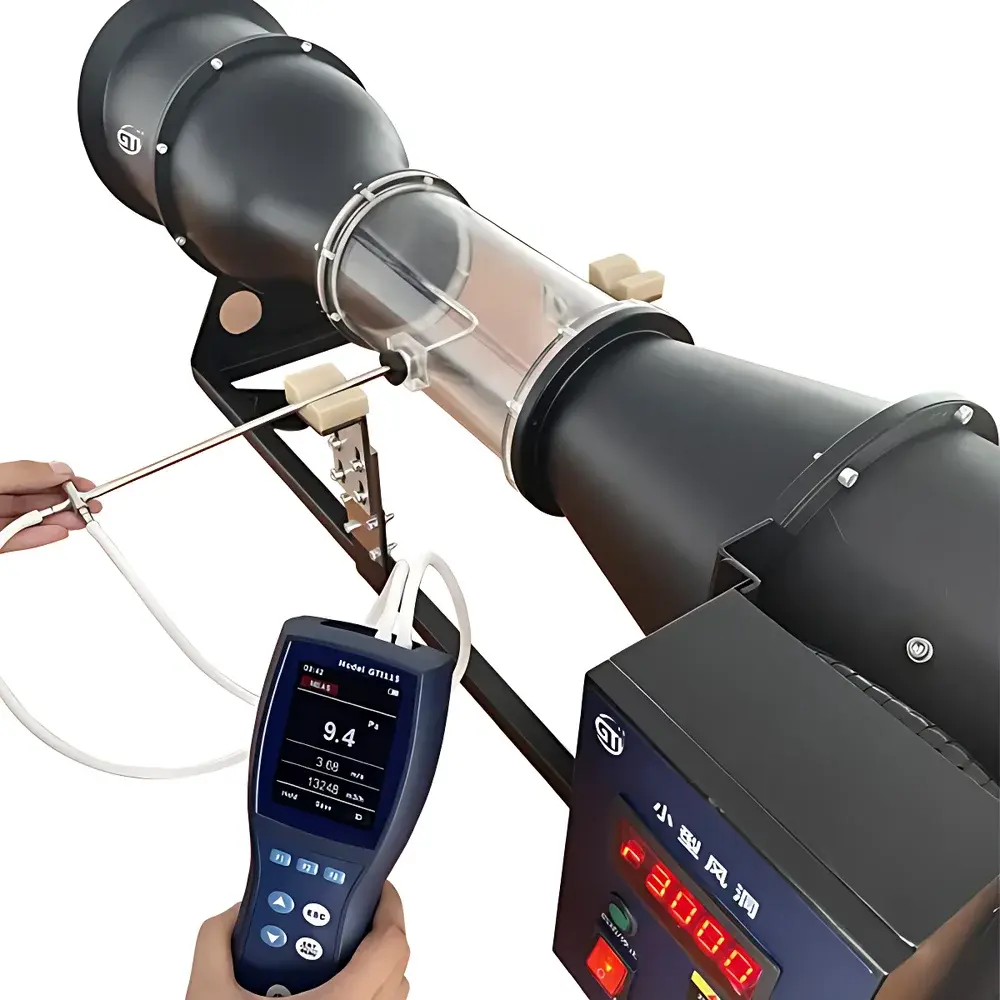
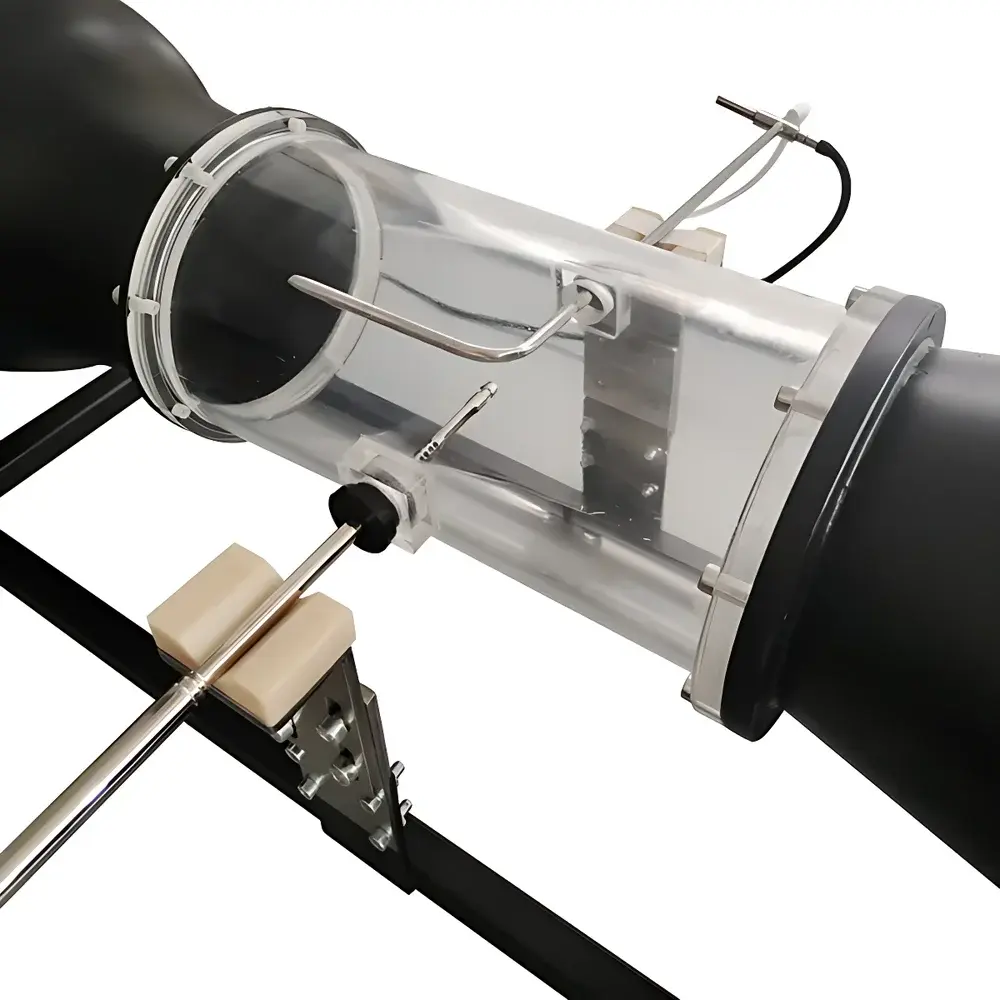
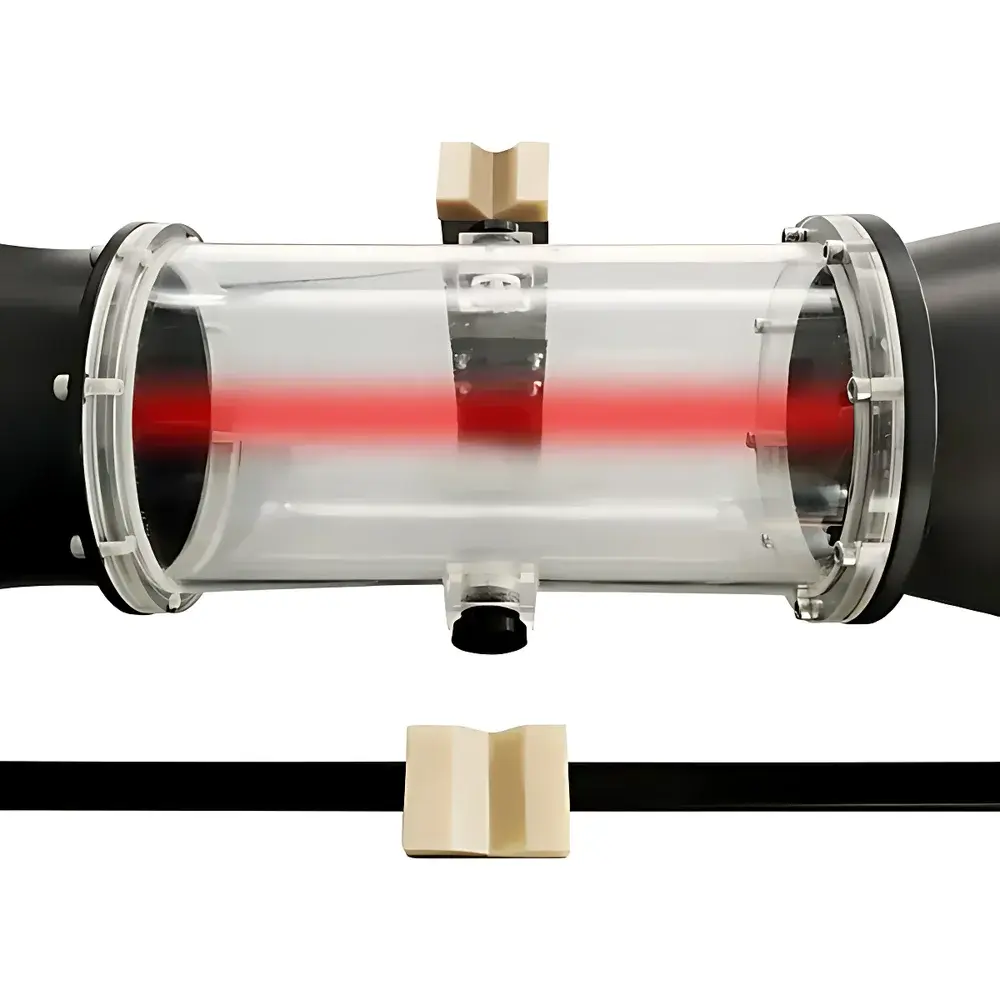
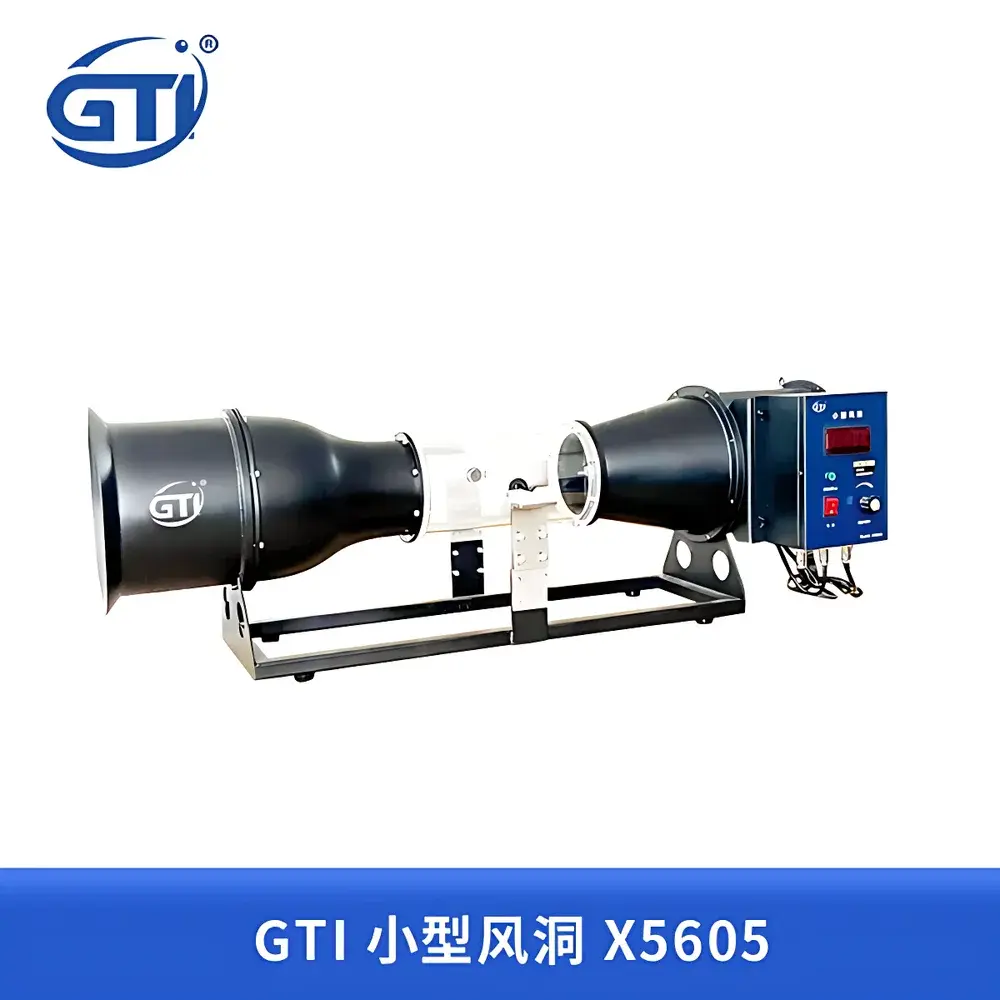
GTI X5605 DC-Type Small-Scale Wind Tunnel
| Brand | GTI |
|---|---|
| Origin | Liaoning, China |
| Manufacturer Type | Authorized Distributor |
| Country of Origin | China |
| Model | GTI X5605 |
| Air Velocity Range | 1–30 m/s |
| Wind Tunnel Type | DC Suction-Type |
| Test Section Dimensions | 230 mm (L) × φ120 mm (ID) |
| Test Port Diameter | φ2–20 mm |
| Overall Dimensions | 1002 × 237 × 319 mm |
| Power Supply | AC 220 V, 50 Hz, 450 W |
| Weight | ~20 kg |
Overview
The GTI X5605 DC-Type Small-Scale Wind Tunnel is a compact, benchtop-grade aerodynamic test facility engineered for precision airflow generation and controlled boundary-layer investigation. Operating on a suction-driven DC fan principle, it delivers a stable, laminarized airflow across a defined test section—enabling quantitative calibration, flow visualization, and low-speed aerodynamic characterization of sensors, probes, and scaled physical models. Unlike open-loop or fan-bank setups, the X5605 integrates an upstream honeycomb flow straightener and contraction nozzle to minimize turbulence intensity (<1.5% at mid-range velocities) and ensure axial flow alignment within ±0.5° deviation. Its design conforms to foundational wind tunnel best practices outlined in ISO 5167-4 (flow conditioning) and ASTM D5096 (calibration of air velocity instruments), making it suitable for metrological traceability in laboratory and third-party calibration environments.
Key Features
- Stable, adjustable air velocity range from 1 to 30 m/s, digitally controllable via integrated variable-frequency drive for repeatable setpoint accuracy (±0.2 m/s typical repeatability)
- Honeycomb flow conditioner and optimized contraction ratio ensure uniform velocity profile (≤±2.5% spatial variation across test section cross-section) and minimal swirl
- Transparent acrylic test section (230 mm length × φ120 mm internal diameter) enables real-time optical access for smoke-wire visualization, PIV seeding, or high-speed imaging
- Modular test port system with interchangeable gaskets and clamping collars supports secure mounting of pitot tubes, hot-wire anemometers, cup/vane anemometers, and custom model fixtures (φ2–20 mm interface)
- Self-contained mechanical architecture: no external ducting, anchoring, or structural reinforcement required; footprint optimized for standard lab benches (1002 × 237 × 319 mm)
- Low acoustic signature (<62 dB(A) at 1 m) and thermally stable operation (ambient temperature drift <0.3°C/h under continuous duty)
Sample Compatibility & Compliance
The GTI X5605 accommodates a broad spectrum of test articles—including NIST-traceable anemometers, industrial pitot-static probes, HVAC airflow sensors, miniature UAV components, and educational aerodynamic models (e.g., NACA 0012 airfoils, bluff bodies). All test section interfaces comply with ISO 10780-2 (velocity measurement in ducts) and support calibration protocols aligned with ISO/IEC 17025:2017 requirements for testing laboratories. The device itself does not bear CE or UKCA marking; however, its electrical subsystem meets IEC 61000-6-3 (EMC emission limits) and IEC 61000-6-2 (immunity). For GLP/GMP-regulated calibration workflows, users may implement audit-ready documentation using external data loggers compliant with FDA 21 CFR Part 11 when paired with validated software.
Software & Data Management
The X5605 operates as a hardware platform without embedded firmware or proprietary control software. It interfaces seamlessly with industry-standard instrumentation ecosystems: analog voltage outputs (0–5 V or 0–10 V) from connected sensors can be acquired via USB DAQ systems (e.g., National Instruments USB-6009, Keysight 34972A); digital signals are compatible with LabVIEW, MATLAB Data Acquisition Toolbox, or Python-based PyVISA frameworks. Optional integration kits include RS-485 Modbus RTU output for PLC synchronization and timestamped CSV export capability through user-configured SCADA frontends. All raw velocity data, timestamps, and environmental metadata (ambient T/P/RH logged externally) remain fully accessible and unencrypted—supporting full data lineage per ISO/IEC 17025 clause 7.5.2.
Applications
- Primary calibration of vane, cup, thermal, and pressure-based anemometers against NIST-traceable reference standards
- Aerodynamic force/moment coefficient estimation for sub-scale models using six-component balance adapters (user-supplied)
- Boundary layer development studies via surface static pressure tap arrays or surface-mounted hot-film sensors
- Smoke visualization experiments for teaching fluid mechanics concepts (e.g., separation, vortex shedding, wake structure)
- Validation of CFD simulations at Reynolds numbers between 1×10⁴ and 2×10⁵ (based on test section diameter and air properties)
- Pre-compliance screening for EN 12599 (ventilation duct testing) and ASHRAE Standard 111 (instrument calibration procedures)
FAQ
What is the maximum allowable backpressure for the X5605 test section?
The unit is designed for open-discharge operation; backpressure exceeding 150 Pa at the outlet significantly degrades velocity uniformity and must be avoided.
Can the X5605 be used for hot-wire anemometry (HWA)?
Yes—its low turbulence intensity and stable mean flow make it suitable for HWA; users must supply compatible constant-temperature anemometer (CTA) circuitry and probe holders.
Is the test section compatible with vacuum-compatible accessories?
No—the acrylic test section and gasket materials are rated for ambient-pressure operation only; vacuum or overpressure use voids warranty and compromises structural integrity.
Does GTI provide calibration certificates with purchase?
GTI supplies a factory verification report (non-accredited) confirming airflow linearity and repeatability; accredited calibration per ISO/IEC 17025 requires engagement with an independent accredited lab.
What maintenance intervals are recommended?
Fan motor bearings require inspection every 2,000 operating hours; honeycomb strainer cleaning is advised after each 50 hours of smoke-based visualization work.
Related Products







