
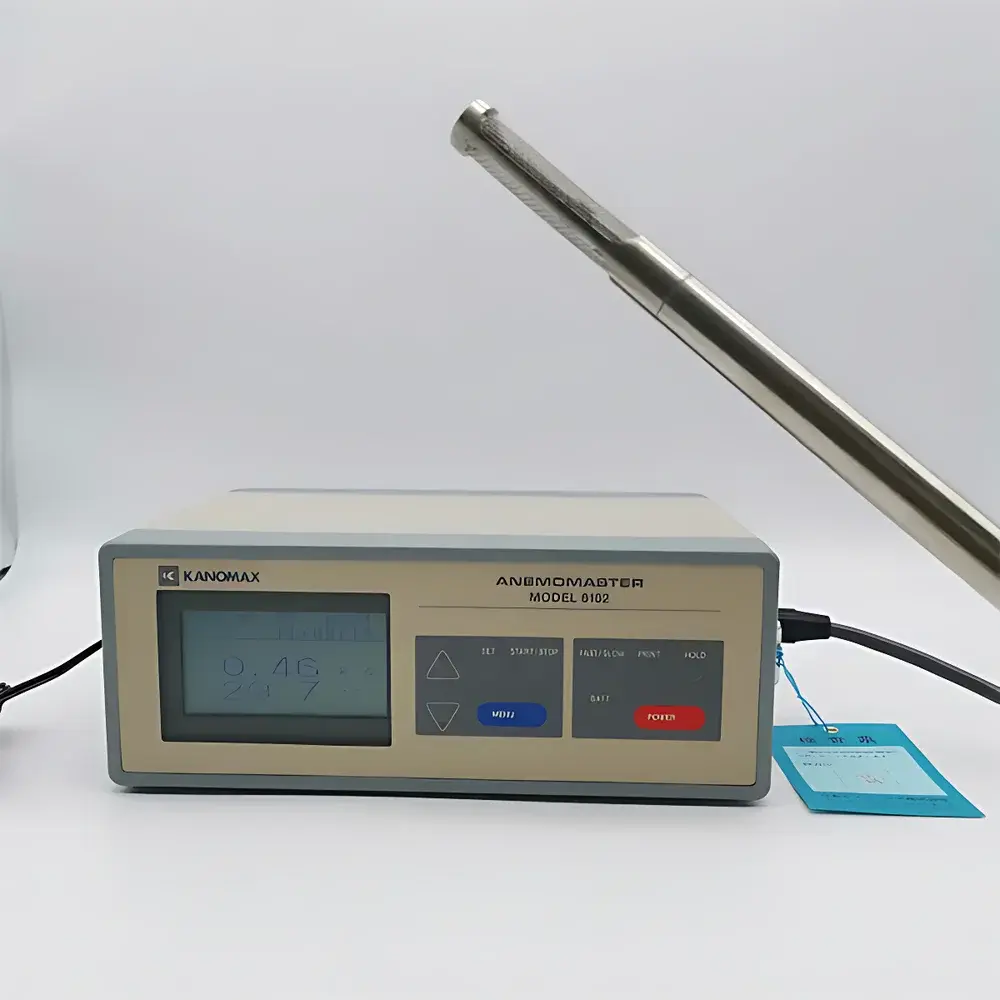
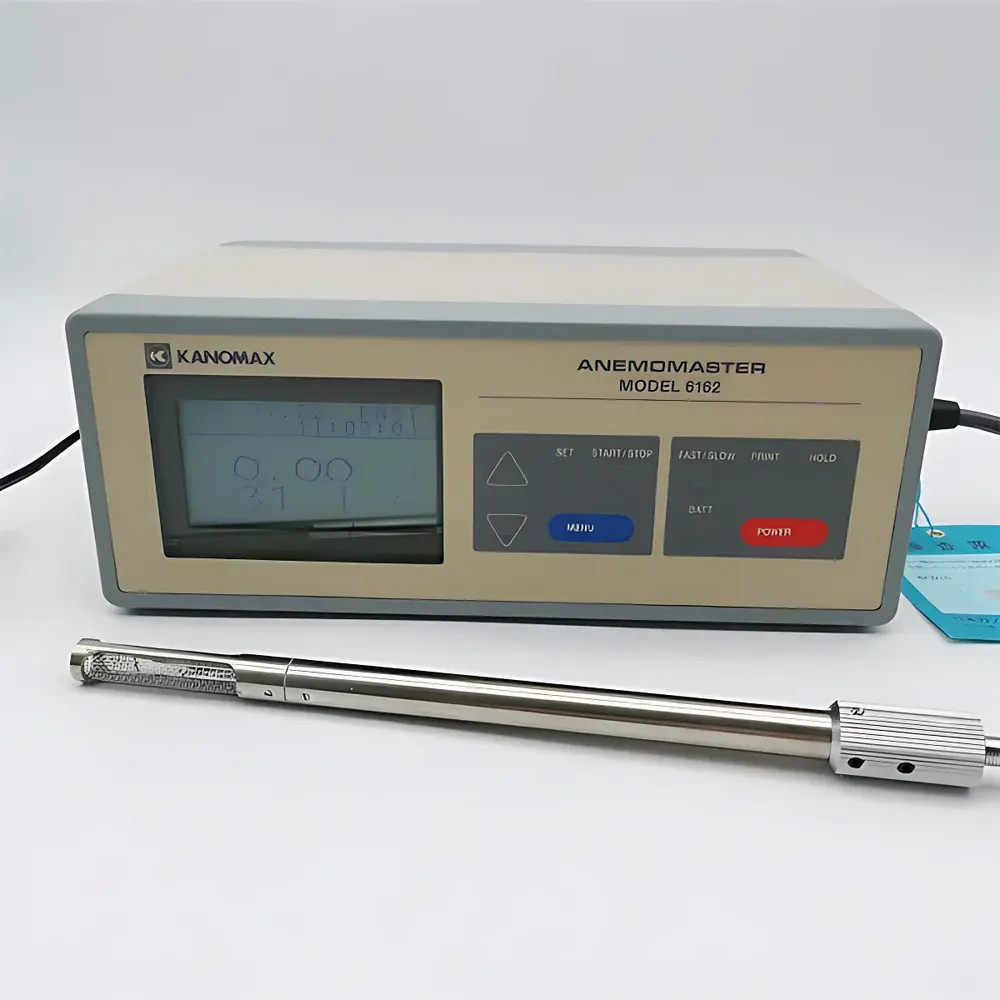
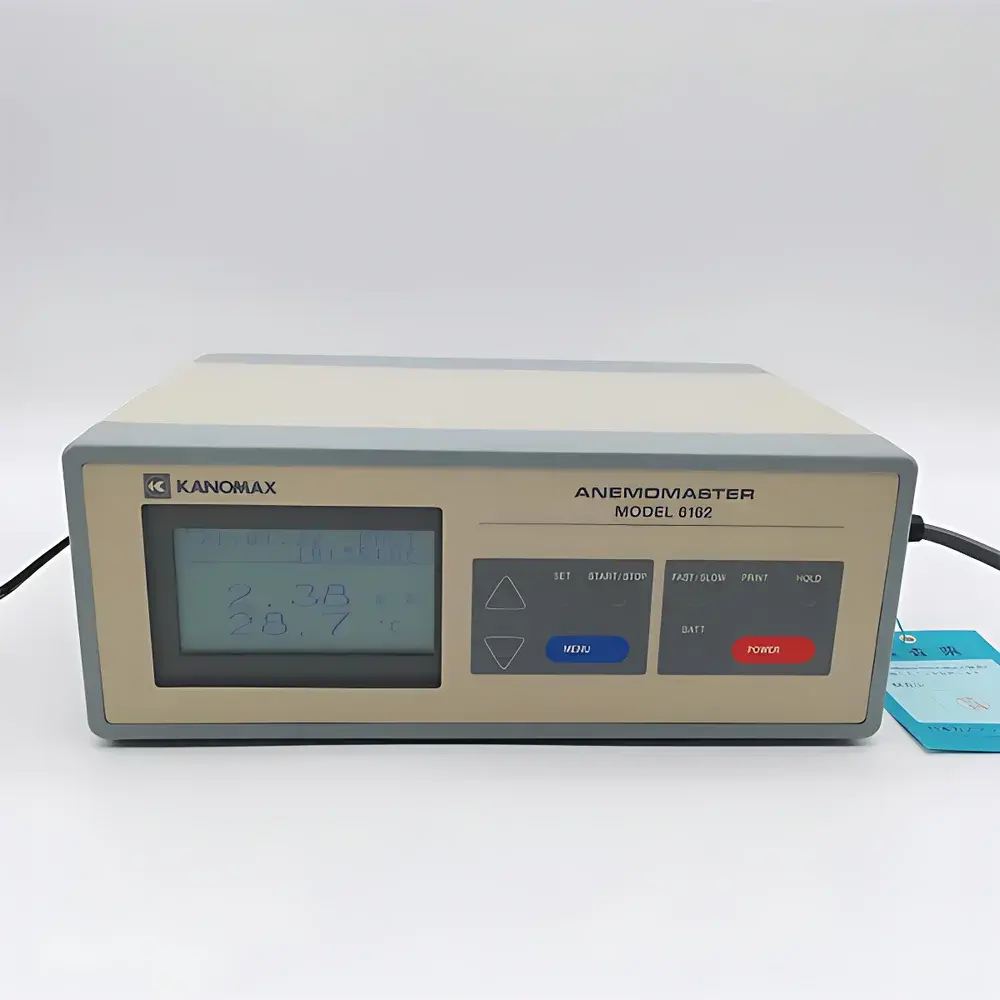
Kanomax 6162 High-Temperature Thermal Anemometer
| Brand | Kanomax |
|---|---|
| Origin | Liaoning, China |
| Manufacturer Type | Authorized Distributor |
| Country of Origin | China |
| Model | 6162 |
| Instrument Type | Thermal Anemometer |
| Resolution | 0.01 m/s |
| Velocity Range | 0–50.0 m/s |
| Accuracy | ±3% of reading (with range-dependent offset compensation) |
| Operating Temperature Range | 0–500 °C |
| Operating Humidity Range | 0–100% RH |
| Temperature Measurement Range | 0–500 °C |
| Temperature Accuracy | ±(1% of reading + 1 °C) |
| Probe Compatibility | Interchangeable probes (0203, 0204, 0205) |
| Data Storage | 999 records |
| Statistical Functions | Max/Min/Avg |
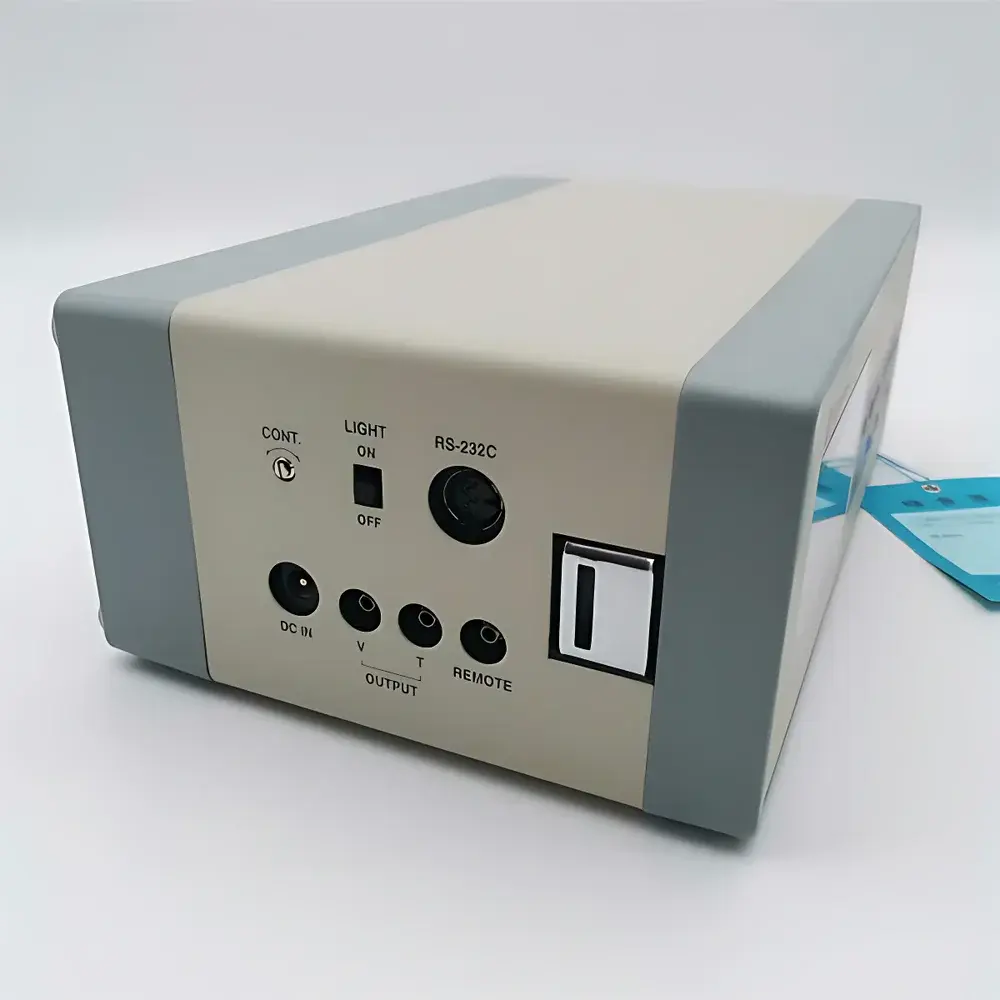
| Analog Output | 0–1 V DC |
| Communication Interface | RS-232C |
| Power Supply | 6 × 1.5 V AA batteries or 12.5 V / 450 mA AC adapter |
| Probe Cable | PTFE-insulated, rated to 200 °C |
| Extension Cable | PVC-insulated, rated to 80 °C |
| Dimensions (Main Unit) | 220 × 150 × 85 mm |
| Weight (Main Unit) | 1.8 kg |
| Probe Dimensions & Weight | Φ11 × 208 mm / 200 g |
Overview
The Kanomax 6162 High-Temperature Thermal Anemometer is a precision-engineered instrument designed for simultaneous velocity and temperature measurement in thermally demanding industrial environments—particularly within semiconductor and flat-panel display manufacturing processes. It operates on constant-temperature anemometry (CTA) principles, where a heated sensor element maintains a fixed temperature differential relative to ambient gas; convective heat loss is directly correlated to fluid velocity. Unlike conventional vane or cup anemometers, the 6162’s thermal probe architecture enables stable, low-inertia response in high-temperature laminar and turbulent flows up to 500 °C—critical for monitoring nitrogen purge streams, annealing furnace exhausts, and cleanroom HVAC ducts in LCD panel fabrication lines. Its modular probe design supports application-specific configuration without recalibration, and its dual-parameter output facilitates real-time volumetric flow calculation when cross-sectional area is entered—a key requirement for ISO 14644-3-compliant cleanroom airflow validation.
Key Features
- Simultaneous high-temperature air velocity and temperature measurement (0–500 °C) with integrated thermal probe calibration
- Multi-range velocity sensitivity: automatic range switching based on ambient temperature (e.g., 0.2 m/s threshold at ≤99 °C; 1.0 m/s threshold at 300–400 °C)
- Probe interchangeability across three configurations (0203, 0204, 0205) supporting duct, stack, and confined-space access
- Onboard statistical analysis: real-time calculation and logging of maximum, minimum, and average values over user-defined intervals
- RS-232C serial interface compliant with standard ASCII command protocols for integration into SCADA or MES systems
- 0–1 V analog output with linear scaling for connection to PLCs, chart recorders, or DCS controllers
- Robust mechanical architecture: main unit housing rated IP54; PTFE-insulated probe cables certified for continuous operation at 200 °C
Sample Compatibility & Compliance
The 6162 is validated for use in non-corrosive, non-explosive gas streams—including dry air, nitrogen, argon, and flue gases with particulate loading <10 mg/m³. It complies with IEC 61000-4 electromagnetic immunity standards and meets CE marking requirements for industrial instrumentation. While not intrinsically safe, it is routinely deployed in Class 100–10,000 cleanrooms per ISO 14644-1 and qualifies for process validation under FDA 21 CFR Part 11 when paired with audit-trail-enabled data acquisition software. Its temperature accuracy specification (±1% of reading + 1 °C) aligns with ASTM D5465-20 for thermal anemometer field verification, and its velocity uncertainty profile satisfies ISO 7726 Annex B for occupational thermal environment assessment.
Software & Data Management
Data from the 6162 is captured via RS-232C using Kanomax-supplied terminal emulation software or third-party applications supporting Modbus RTU or ASCII framing. Each stored record includes timestamp, velocity, temperature, and probe ID. The 999-point internal memory supports sequential overwrite or manual lock functionality to preserve critical test sequences during LCD oven qualification runs. Exported CSV files include metadata fields required for GLP/GMP documentation: operator ID, instrument serial number, calibration due date, and environmental conditions. Optional PC-based software provides trend visualization, statistical process control (SPC) charts, and PDF report generation with digital signature support for regulatory submission.
Applications
- Real-time monitoring of nitrogen purge velocity in LCD substrate coating and drying chambers
- Exhaust gas velocity profiling in thermal annealing furnaces operating above 400 °C
- Volumetric flow verification in HVAC supply ducts serving photolithography cleanrooms
- Commissioning and periodic requalification of laminar flow hoods per ISO 14644-3
- Thermal management validation in LED backlight curing ovens
- Stack emission testing for combustion efficiency analysis in pilot-scale glass melting units
FAQ
Can the 6162 be used in reducing atmospheres such as H₂/N₂ mixtures?
Yes—provided oxygen concentration remains below 1% vol and no condensable vapors are present. Sensor drift may occur above 2% H₂; pre-use verification against a traceable hot-wire reference is recommended.
Is probe calibration traceable to NIST or other national standards?
Each probe is factory-calibrated against Kanomax’s primary wind tunnel facility, accredited to ISO/IEC 17025. NIST-traceable calibration certificates are available as an optional service with documented uncertainty budgets.
How does the instrument handle rapid temperature transients during furnace door opening?
The thermal mass of the probe tip and proprietary thermal compensation algorithm minimize overshoot. Response time (t₉₀) is <2.5 s for temperature and <1.8 s for velocity in 300 °C air at 10 m/s.
Does the 6162 support automated pass/fail alarms during inline process monitoring?
Not natively—the analog output can be routed to external logic controllers for threshold triggering, but onboard alarm thresholds require firmware upgrade (Kanomax Option Code ALM-6162).







