
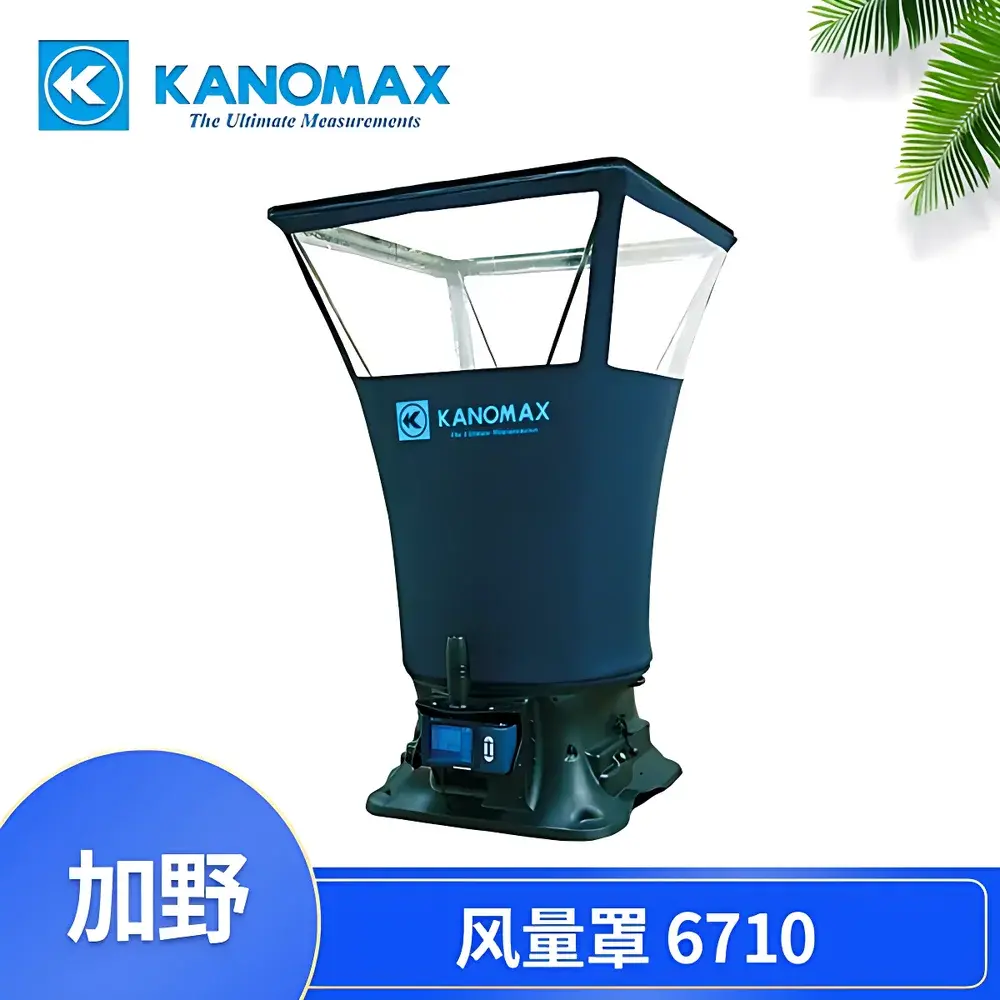
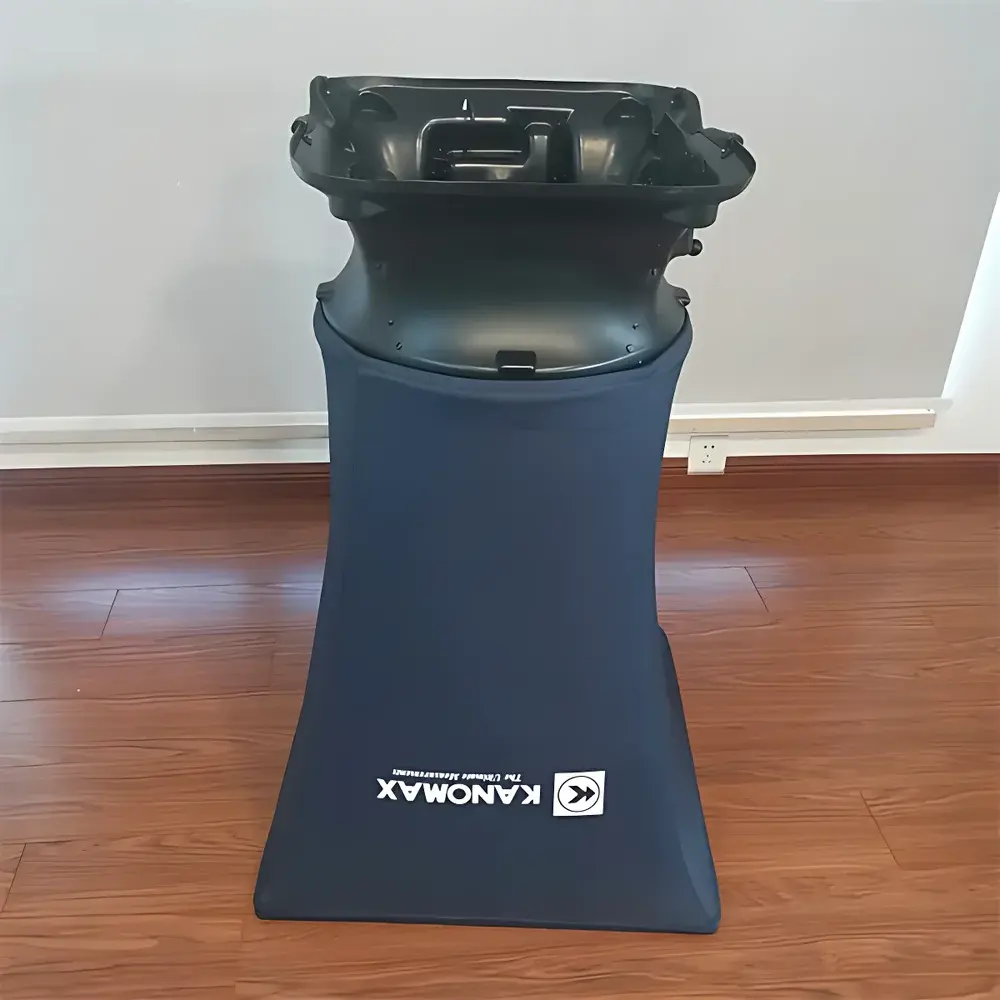
Kanomax 6710 Air Flow Hood Anemometer
| Brand | Kanomax |
|---|---|
| Origin | Japan |
| Model | 6710 |
| Air Flow Range | 40–4300 m³/h |
| Accuracy | ±3% of reading ±10 m³/h |
| Temperature Range | 0–60 °C (±0.5 °C) |
| Relative Humidity Range | 0–100 %RH (±3 %RH, 10–90 %RH) |
| Display | 3.5-inch color LCD with auto-rotation |
| Data Storage | 3,000 measurement sets |
| Power Supply | 4 × AA batteries (9 h typical), DC 5 V adapter |
| Weight | ~3.5 kg |
| Standard Hood Size | 610 × 610 mm |
| Optional Hood Sizes | 305×1220 mm, 500×500 mm, 610×1220 mm, 800×800 mm, 800×1100 mm, 915×610 mm, 915×915 mm, 1220×1220 mm, 1400×800 mm |
| Backpressure Compensation | Yes |
| Accessories Included | 610×610 mm hood, carrying case, batteries, instruction manual, communication cable, PC software |
Overview
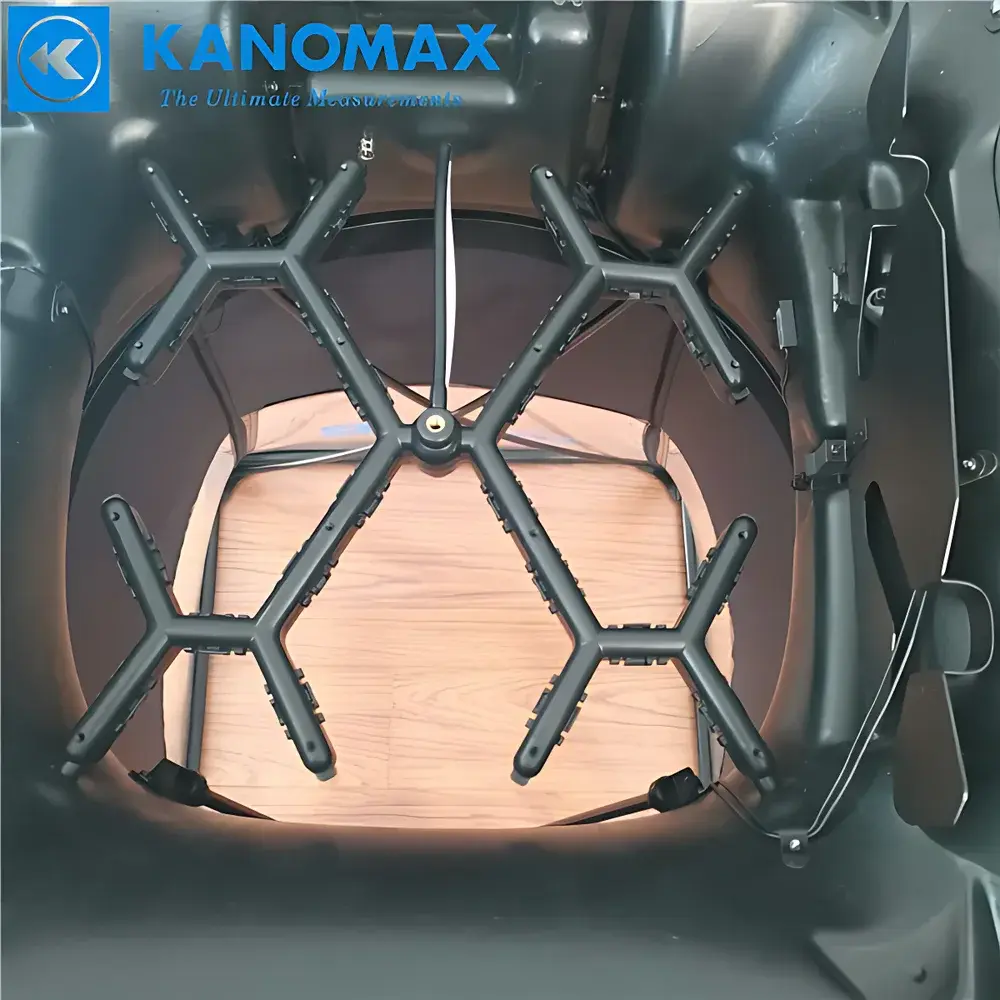
The Kanomax 6710 Air Flow Hood Anemometer is a precision-engineered instrument designed for quantitative, real-time volumetric air flow measurement in HVAC system commissioning, cleanroom validation, and laboratory ventilation assessment. It operates on the principle of integrated velocity-area integration: an array of calibrated thermal anemometer sensors within the hood face measures local air velocity across the defined aperture, while internal temperature and relative humidity sensors provide environmental compensation. The device applies backpressure correction algorithms to maintain accuracy under variable static pressure conditions—critical when measuring airflow at supply diffusers, exhaust grilles, or laminar flow hoods where duct resistance affects flow profile. Its robust mechanical architecture supports field deployment in diverse indoor environments—from pharmaceutical cleanrooms operating under ISO 14644-3 Class 5 conditions to hospital isolation rooms requiring ASHRAE 170-compliant air change verification.
Key Features
- Simultaneous measurement of volumetric air flow (40–4300 m³/h), temperature (0–60 °C), and relative humidity (0–100 %RH) with traceable calibration uncertainty
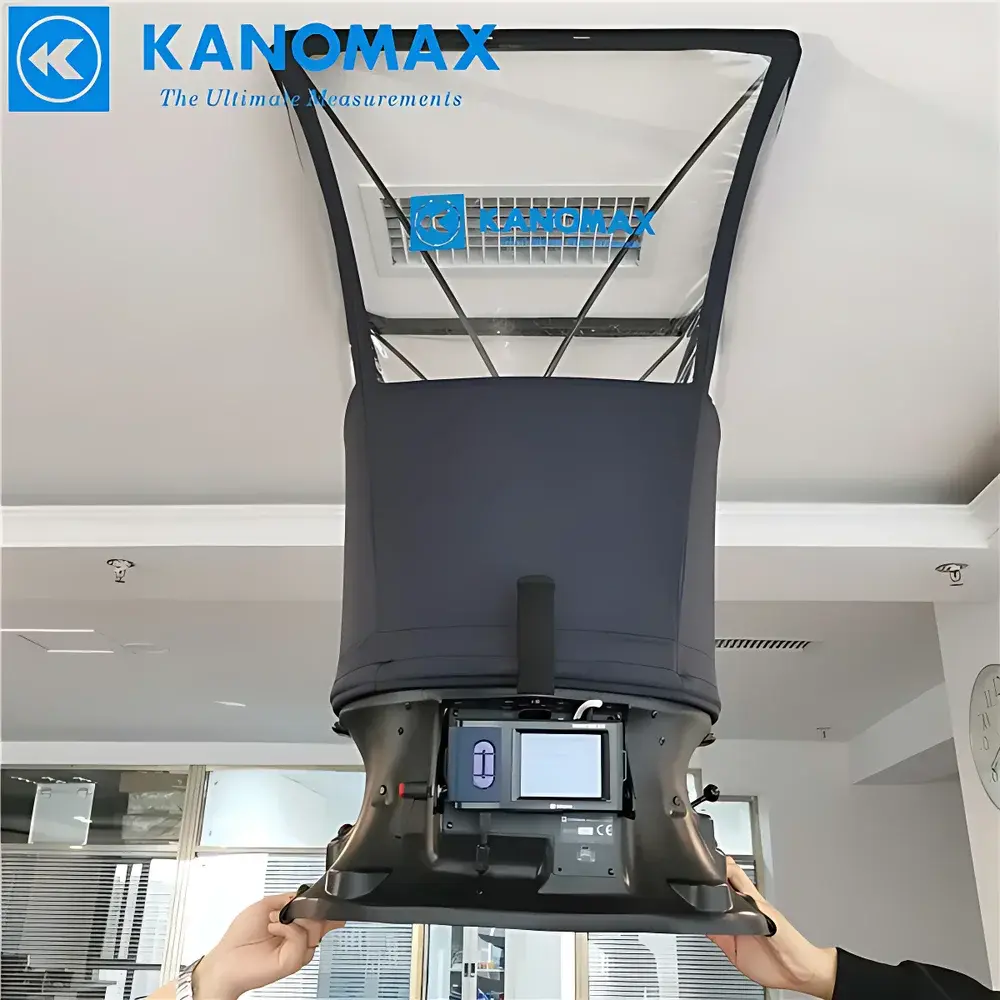
- Auto-rotating 3.5-inch color LCD display enabling ergonomic viewing at up to 30° tilt—optimized for ceiling-mounted or recessed grille measurements
- Integrated backpressure compensation ensures consistent accuracy across varying duct static pressures without manual recalibration
- Onboard data storage capacity of 3,000 measurement records with timestamp, location tag, and environmental metadata
- Dual communication interfaces: USB for PC synchronization and firmware updates; RS-232 for direct connection to legacy thermal printers used in GxP documentation workflows
- Modular hood system with 10 standardized sizes (from 305×1220 mm to 1400×800 mm) supporting ISO 14644-3, ISO 14644-4, and EN 13779-compliant test protocols
- Compliance-ready features including real-time clock, battery-level indicator, and audit-trail-capable PC software for 21 CFR Part 11–aligned reporting
Sample Compatibility & Compliance
The Kanomax 6710 is validated for use with standard rectangular and square HVAC outlets, including perforated plates, linear slot diffusers, and HEPA-filtered supply terminals. Its modular hood design accommodates non-standard geometries via optional custom-fit adapters. The instrument meets IEC 61000-4 electromagnetic compatibility requirements and conforms to JIS B 7553 (Japanese Industrial Standard for air flow hoods). For regulated environments, it supports GLP/GMP-aligned workflows through time-stamped data export, user-accessible calibration logs, and software-generated PDF reports containing measurement uncertainty budgets per ISO/IEC 17025 Annex A.5. It is routinely deployed in facilities subject to FDA pre-approval inspections, EU Annex 1 cleanroom audits, and JGMP certification processes.
Software & Data Management
The included PC application enables full configuration of sampling intervals (1–300 s), auto-zero routines, and multi-point averaging modes. Data files are exported in CSV and XML formats compatible with LIMS integration and statistical process control platforms (e.g., Minitab, JMP). The software provides built-in calculation modules for air change rate (ACH), face velocity uniformity (per ISO 14644-3 Annex B), and dew point derivation from simultaneous RH/temperature inputs. Audit trail functionality records operator ID, parameter changes, and export events—satisfying ALCOA+ data integrity principles required under FDA 21 CFR Part 11 and EMA Annex 11.
Applications
- HVAC balancing and TAB (Testing, Adjusting, and Balancing) in commercial and healthcare buildings per ASHRAE Guideline 12 and ISO 16813
- Cleanroom classification and re-certification per ISO 14644-1 and EU GMP Annex 1 Section 4.22
- Pharmaceutical facility qualification (IQ/OQ/PQ) of laminar airflow workstations and isolators
- Exhaust system verification in biosafety laboratories (BSL-2/3) per NIH/CDC guidelines
- Energy efficiency audits using airflow-to-power ratio analysis in variable air volume (VAV) systems
- Academic and industrial research involving controlled environmental chamber characterization
FAQ
What hood sizes are available for the Kanomax 6710, and how are they selected?
Standard and optional hood dimensions are listed in the technical specifications. Selection depends on outlet geometry, required measurement uncertainty class, and applicable standard (e.g., ISO 14644-3 mandates hood coverage ≥1.2× outlet area). Custom sizing is supported upon request.
Does the 6710 support calibration traceability to national standards?
Yes—each unit ships with a NIST-traceable calibration certificate (JCSS-accredited in Japan) covering air flow, temperature, and RH channels. Field recalibration kits and accredited service centers are available globally.
Can measurement data be exported directly to Excel or LIMS?
Yes—CSV exports retain all metadata (timestamp, hood ID, ambient conditions, operator code). XML schema complies with ASTM E2500-13 for structured data interchange in regulated environments.
Is the device suitable for high-humidity environments such as steam sterilizer exhaust ducts?
It operates reliably up to 100 %RH at 50 °C; however, condensation on sensor surfaces may affect short-term accuracy. Use of the optional heated hood or post-measurement drying protocol is recommended for sustained operation above 90 %RH.
How does backpressure compensation improve measurement fidelity?
By dynamically adjusting velocity calculations based on real-time static pressure differentials across the hood, it mitigates under-reading errors common in high-resistance duct configurations—ensuring compliance with ISO 14644-3 Annex C tolerance limits.







