
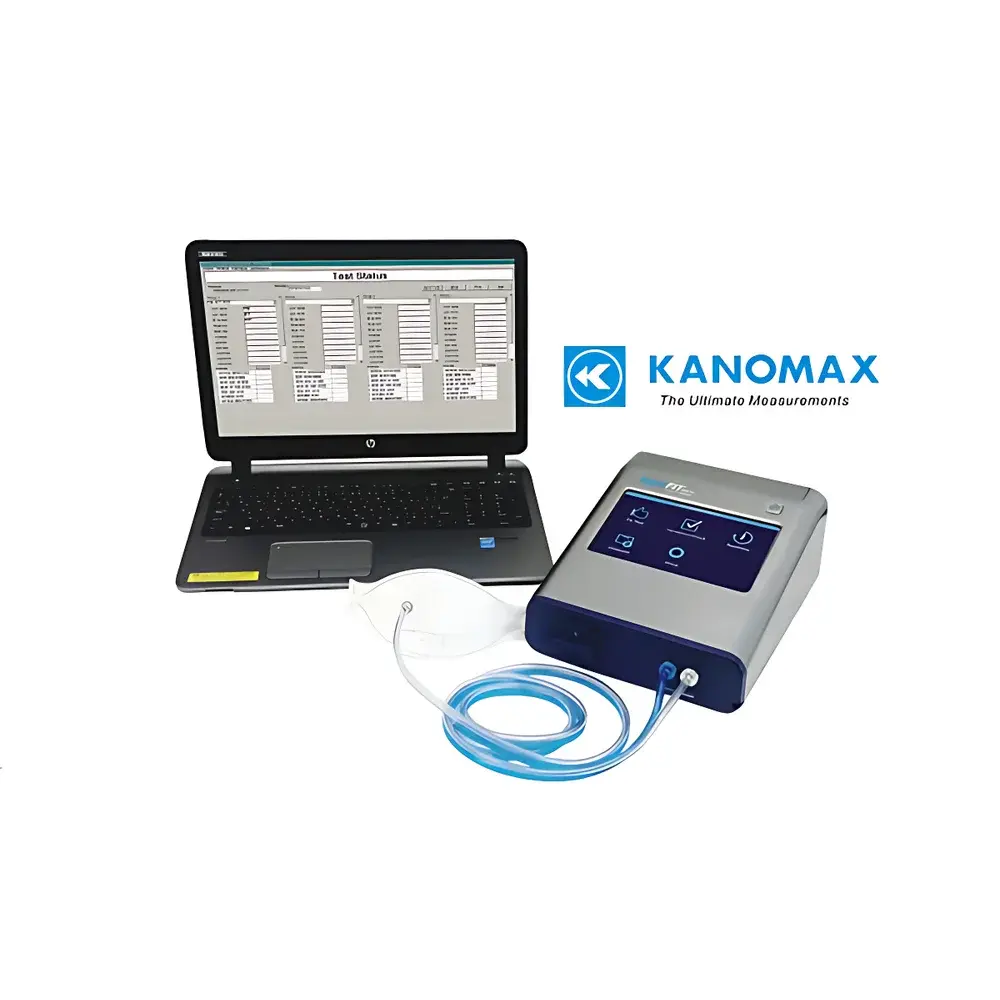
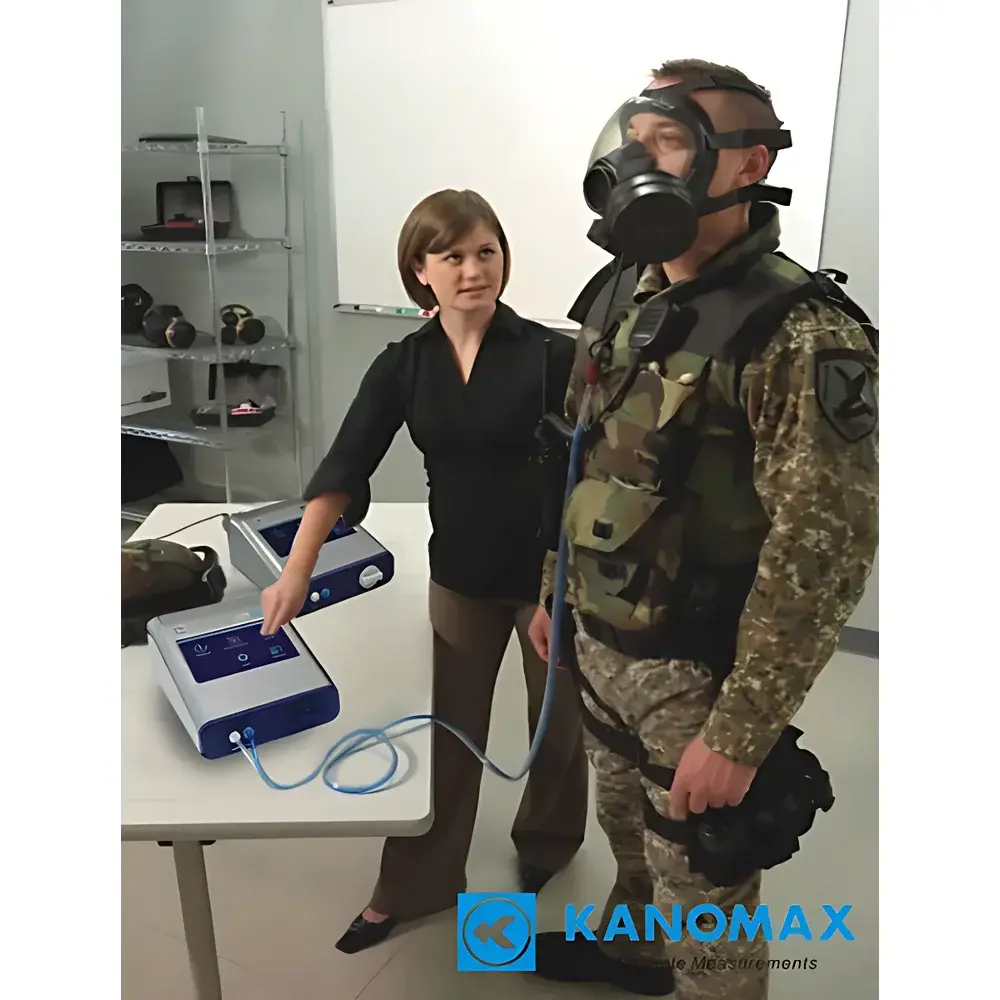
Kanomax AccuFIT 9000 Quantitative Fit Tester for Respirators
| Brand | Kanomax |
|---|---|
| Origin | Japan |
| Model | Kanomax 3000-0C |
| Concentration Range | 0–100,000 particles/cm³ |
| Particle Size Range | 0.02–1.0 µm |
| Sampling Flow Rate | 100 cm³/min |
| Total Flow Rate | 700 cm³/min |
| Fit Factor Calculation Method | Direct (Cout/Cin) |
| Test Aerosol | 99.5% ethanol + analytical-grade isopropanol |
| Display | 7-inch true-color touchscreen |
| Communication Interfaces | USB (Host ×2, Device ×1), Ethernet ×1, Wi-Fi enabled |
| Operating Temperature | 15–35 °C |
| Power Supply | AC 110–240 V, 50/60 Hz |
| Dimensions | 208 × 117 × 262 mm |
| Weight | 2.1 kg |
| Supported Languages | English, French, Spanish, Portuguese, Chinese |
| Max Simultaneous Units Controlled via PC | 4 |
| Data Export Format | Microsoft Excel |
Overview
The Kanomax AccuFIT 9000 is a quantitative respirator fit tester engineered for precision, regulatory compliance, and field-deployable robustness. It employs the controlled negative pressure (CNP)–compatible ambient aerosol condensation nucleus counter (CNC) method to measure real-time particle concentration both outside (Cout) and inside (Cin) the respirator facepiece during wearer movement. By calculating the quantitative fit factor (FF = Cout/Cin), the instrument objectively evaluates the degree of leakage at the face seal—critical for verifying performance of N95, KN95, FFP2, P3, HEPA, and other tight-fitting particulate respirators. Unlike qualitative methods relying on subjective sensory response, the AccuFIT 9000 delivers traceable, numerical results required under OSHA 29 CFR 1910.134, CSA Z94.4-18, and GB 2626–2019. Its CNC-based architecture ensures high sensitivity across the 0.02–1.0 µm aerodynamic diameter range—covering ultrafine particles relevant to viral aerosols and combustion-derived particulates.
Key Features
- Real-time dual-channel particle counting using calibrated condensation nucleus detection with <0.02 µm lower detection limit and linear dynamic range up to 100,000 particles/cm³
- Integrated alcohol-based challenge aerosol generation (99.5% ethanol + analytical-grade isopropanol) with automated flow regulation and zero-count verification capability
- 7-inch industrial-grade capacitive touchscreen with five-language UI (English, French, Spanish, Portuguese, Chinese) and intuitive workflow-guided test protocols
- Dual-mode operation: standalone testing or synchronized multi-unit control—up to four AccuFIT 9000 units can be managed concurrently from a single Windows-based PC via Ethernet or USB
- Comprehensive connectivity suite: three USB ports (two Host, one Device), Gigabit Ethernet, and optional Wi-Fi module for secure LAN integration and remote diagnostics
- Regulatory-ready data handling: timestamped raw particle counts, calculated fit factors per test cycle, operator ID logging, and audit-trail-compatible export to Microsoft Excel (.xlsx)
Sample Compatibility & Compliance
The AccuFIT 9000 supports quantitative fit testing for all classes of tight-fitting respirators—including disposable filtering facepieces (N95, KN95, FFP2, P3), half-masks, full-facepieces, and elastomeric air-purifying respirators (APRs). It meets the technical requirements specified in ISO 16900-1:2015 (Respiratory protective devices — Methods of test and test equipment — Part 1: Determination of inward leakage), ASTM F1885–22 (Standard Practice for Quantitative Fit Testing of Negative-Pressure Respirators), and GB 2626–2019 (Respiratory protection — Self-contained filtering devices against particles). For medical applications, it satisfies the fit factor ≥100 requirement defined in GB 19083–2010 (Technical requirements for medical protective masks) and aligns with FDA guidance for respiratory protection in healthcare settings. All firmware and calibration routines are designed to support GLP-compliant documentation and 21 CFR Part 11–ready electronic records when deployed with validated PC software.
Software & Data Management
The instrument operates natively via embedded firmware but integrates seamlessly with Kanomax’s AccuFIT Manager PC application (Windows 10/11, x64). This application enables centralized test protocol configuration, multi-instrument synchronization, batch report generation, and long-term trend analysis. Each test record includes operator ID, subject ID, respirator model, test duration, ambient temperature/humidity metadata, raw Cout/Cin time-series data, and final fit factor per exercise phase (e.g., normal breathing, deep breathing, head movement, talking). Data exports preserve full traceability: Excel files contain worksheet tabs for summary metrics, raw counts, and QC flags (e.g., flow deviation >±5%, aerosol instability, sensor saturation). Optional digital signature and password-protected user roles support audit readiness in regulated environments.
Applications
- Occupational health departments conducting mandatory annual respirator fit testing per OSHA or national regulatory frameworks
- Hospital infection prevention & control (IPC) teams validating surgical N95 and medical protective mask performance prior to pandemic deployment
- Respirator manufacturers performing design validation and comparative leakage analysis across facial anthropometries
- Research laboratories studying face seal dynamics under thermal stress, facial hair interference, or prolonged wear conditions
- Government certification bodies executing third-party conformity assessments for GB 2626–2019 or EN 149:2001+A1:2009 certification
FAQ
What aerosol does the AccuFIT 9000 use for challenge testing?
It uses a stable, non-toxic mixture of 99.5% ethanol and analytical-grade isopropanol, atomized into sub-100 nm particles via controlled pneumatic nebulization.
Can the instrument be used for qualitative fit testing?
No—it is exclusively a quantitative fit tester; qualitative methods (e.g., saccharin or Bitrex) require separate hardware and are not supported.
Does it comply with FDA 21 CFR Part 11 requirements?
When operated with validated AccuFIT Manager software, configured user access controls, electronic signatures, and audit-trail logging, it supports Part 11–compliant workflows.
Is calibration traceable to NIST or other national standards?
Yes—Kanomax provides factory calibration certificates traceable to JCSS (Japan Calibration Service System), with optional annual recalibration services available through ISO/IEC 17025-accredited labs.
What is the minimum detectable fit factor resolution?
The system reports fit factors as integers ≥1, with measurement uncertainty ≤±5% at FF = 100 under ISO 16900-1 reference conditions.







