
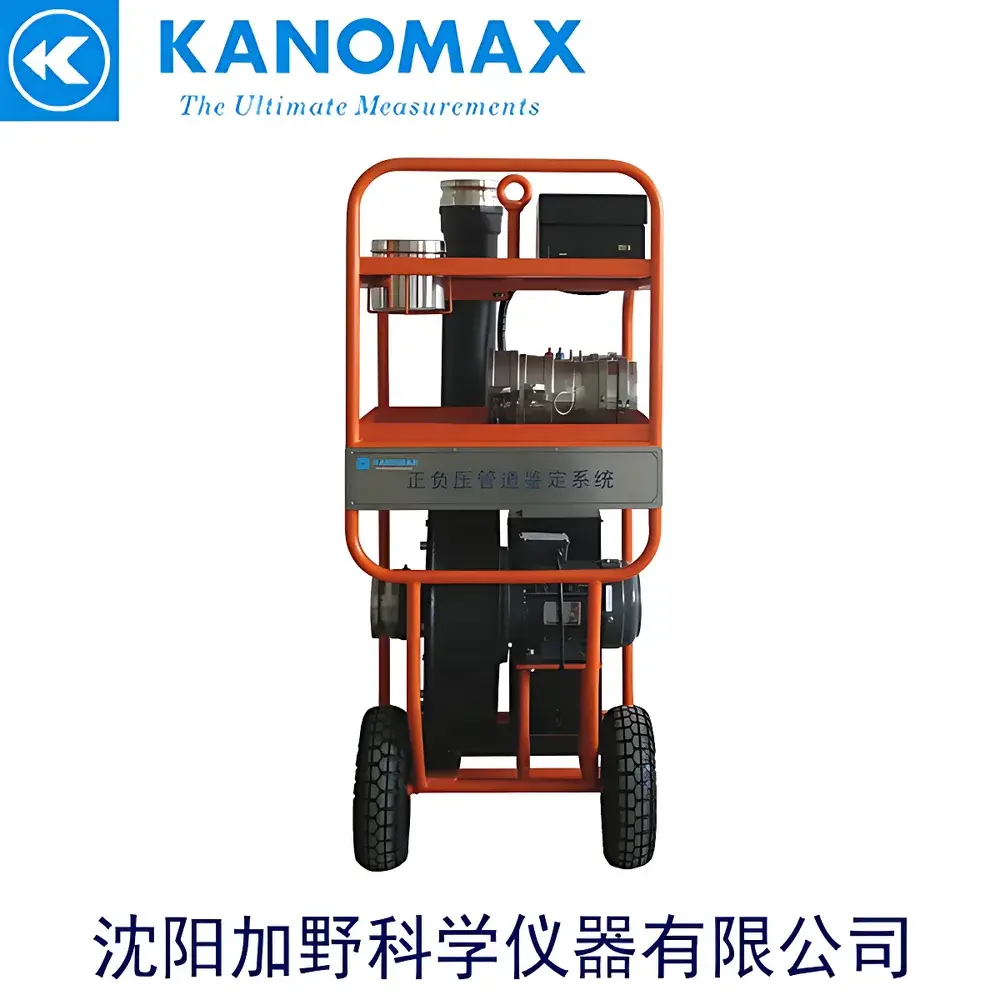
Kanomax DALT6900 Positive/Negative Pressure Duct Leakage Tester
| Brand | Kanomax |
|---|---|
| Origin | China (Liaoning Province) |
| Model | DALT6900 |
| Flow Range | 36–640 m³/h (nozzle range: 4–36 m³/h) |
| Accuracy | ±2.5% of reading ±0.1 m³/h (flow), ±1% of reading ±1 Pa (static pressure), ±0.5 °C (temperature), ±2% of reading (atmospheric pressure) |
| Resolution | 0.01 m³/h (flow), 0.1 Pa (pressure), 0.1 °C (temperature), 0.1 kPa (atmospheric pressure) |
| Static Pressure Range | ±2500 Pa |
| Temperature Range | 0–60 °C |
| Atmospheric Pressure Range | 70–130 kPa |
| Power Supply | DALT6900-0E: 110–120 V, 1-phase, 50/60 Hz, 16 A |
| DALT6900-1E | 220–240 V, 1-phase, 50/60 Hz, 10 A |
| Dimensions | 540 × 500 × 1200 mm |
| Net Weight | ~72 kg |
| Data Storage | 1000 test records |
Overview
The Kanomax DALT6900 Positive/Negative Pressure Duct Leakage Tester is a precision-engineered instrument designed for quantitative airtightness verification of HVAC ductwork systems in accordance with internationally recognized building performance and commissioning standards. It operates on the principle of controlled pressurization—either positive or negative—of sealed duct sections, followed by real-time measurement of volumetric airflow required to maintain a target static pressure differential. This method directly quantifies leakage rate (m³/h) under defined pressure conditions, enabling objective compliance assessment against regulatory thresholds. The system integrates a calibrated blower, multi-range nozzle assembly, high-stability pressure transducers, and environmental sensors to deliver traceable, repeatable measurements across the full operational envelope of commercial and institutional air distribution systems.
Key Features
- Bi-directional pressurization capability: validated performance at ±2500 Pa static pressure, supporting both positive-pressure (e.g., supply ducts) and negative-pressure (e.g., return/exhaust ducts) testing protocols
- Dual-range airflow measurement architecture: primary blower path (36–640 m³/h) combined with precision low-flow nozzle bank (4–36 m³/h), ensuring high resolution and accuracy across the entire dynamic range
- Integrated environmental compensation: simultaneous real-time monitoring of ambient temperature (0–60 °C, ±0.5 °C), atmospheric pressure (70–130 kPa, ±2% of reading), and duct static pressure (±2500 Pa, ±1% of reading ±1 Pa)
- Intuitive 4.7-inch color LCD touchscreen interface with graphical pressure stabilization feedback and step-by-step guided test sequences
- Onboard data management: non-volatile memory stores up to 1000 complete test records—including date/time stamp, pressure setpoint, measured leakage volume, environmental parameters, and pass/fail status—accessible for review, export, or deletion
- Robust mechanical design: compact footprint (540 × 500 × 1200 mm), reinforced chassis, and tool-free modular components facilitate field deployment, transport, and maintenance
Sample Compatibility & Compliance
The DALT6900 is engineered for use on rigid and semi-rigid duct systems installed in commercial, healthcare, educational, and governmental facilities. It accommodates rectangular, round, and oval duct geometries across standard nominal sizes (up to 2.5 m² cross-section). Sealing adaptors and flexible transition kits enable secure connection to duct access ports, plenums, and equipment casings (e.g., AHUs, fire dampers, VAV boxes). The instrument conforms to the technical requirements and procedural frameworks specified in EN 1507:2006 (flexible ducts), EN 12237:2002 (rigid ducts), Eurovent 2/2, DW/143, SMACNA HVAC Air Duct Leakage Test Manual, and GB 50243–2002 (Chinese national standard for ventilation and air conditioning engineering quality acceptance). Its measurement uncertainty budget supports audit-ready documentation for LEED EA Credit 1, ASHRAE Guideline 12–2020, and ISO 9001-compliant commissioning workflows.
Software & Data Management
All test data are timestamped and stored locally with full metadata context. While the DALT6900 does not require external PC software for operation, exported records (via USB interface) retain structured fields compatible with common spreadsheet and database platforms. Each record includes: test ID, operator ID (manually entered), duct system identifier, pressure class, target test pressure, stabilized leakage flow, environmental correction factors, and automated pass/fail determination based on user-defined acceptance criteria aligned with applicable standards. Audit trail integrity is maintained through immutable timestamps and absence of post-test editing capability—supporting GLP-aligned documentation practices and facilitating FDA 21 CFR Part 11 readiness when integrated into validated QA/QC environments.
Applications
- Pre-commissioning verification of newly installed duct systems prior to final insulation and ceiling closure
- Post-construction leak detection and quantification during TAB (Testing, Adjusting, and Balancing) procedures
- Periodic performance audits of aging HVAC infrastructure to identify degradation trends and prioritize retrofit interventions
- Validation of duct sealing remediation efforts following smoke testing or infrared thermography surveys
- Third-party certification testing for green building rating systems (e.g., BREEAM, Green Star, CASBEE)
- Regulatory compliance verification for hospital HVAC systems governed by HTM 03-01 or FGI Guidelines
FAQ
What standards does the DALT6900 explicitly support?
The instrument implements test methodologies and calculation logic compliant with EN 1507:2006, EN 12237:2002, Eurovent 2/2, DW/143, SMACNA, and GB 50243–2002.
Can the DALT6900 be used for both supply and exhaust duct testing?
Yes—it is fully capable of generating and maintaining stable positive or negative pressure differentials up to ±2500 Pa, making it suitable for supply, return, exhaust, and relief duct systems.
Is calibration traceable to national standards?
All internal pressure and flow sensors are factory-calibrated against NIST-traceable references; users receive a calibration certificate with each unit, and periodic recalibration is recommended annually per ISO/IEC 17025 guidelines.
How is environmental compensation applied during testing?
Real-time temperature and barometric pressure readings are automatically factored into volumetric flow calculations using standardized gas law corrections, ensuring consistent results regardless of site elevation or ambient conditions.
Does the device support remote data transfer or network integration?
The DALT6900 operates as a standalone field instrument; data export is performed via USB flash drive. No Wi-Fi, Bluetooth, or Ethernet connectivity is provided, preserving measurement integrity and simplifying cybersecurity validation in regulated environments.







