
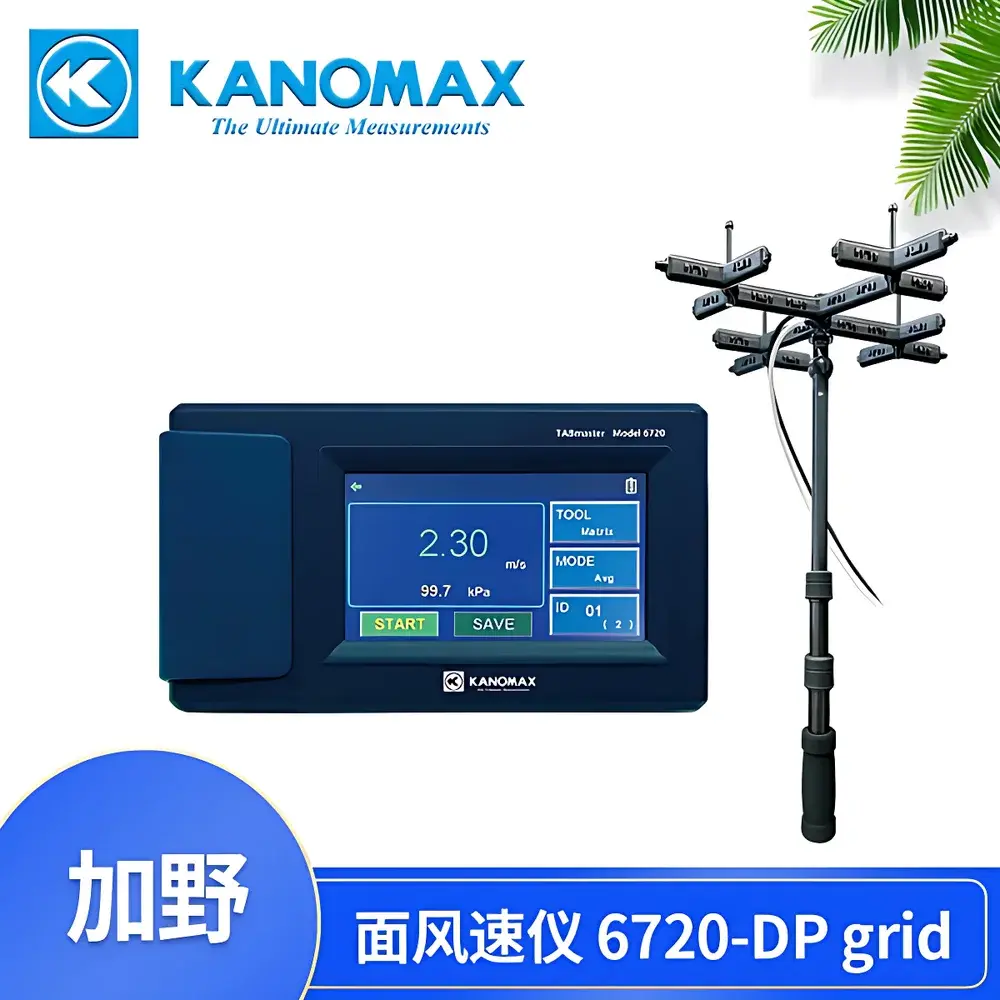
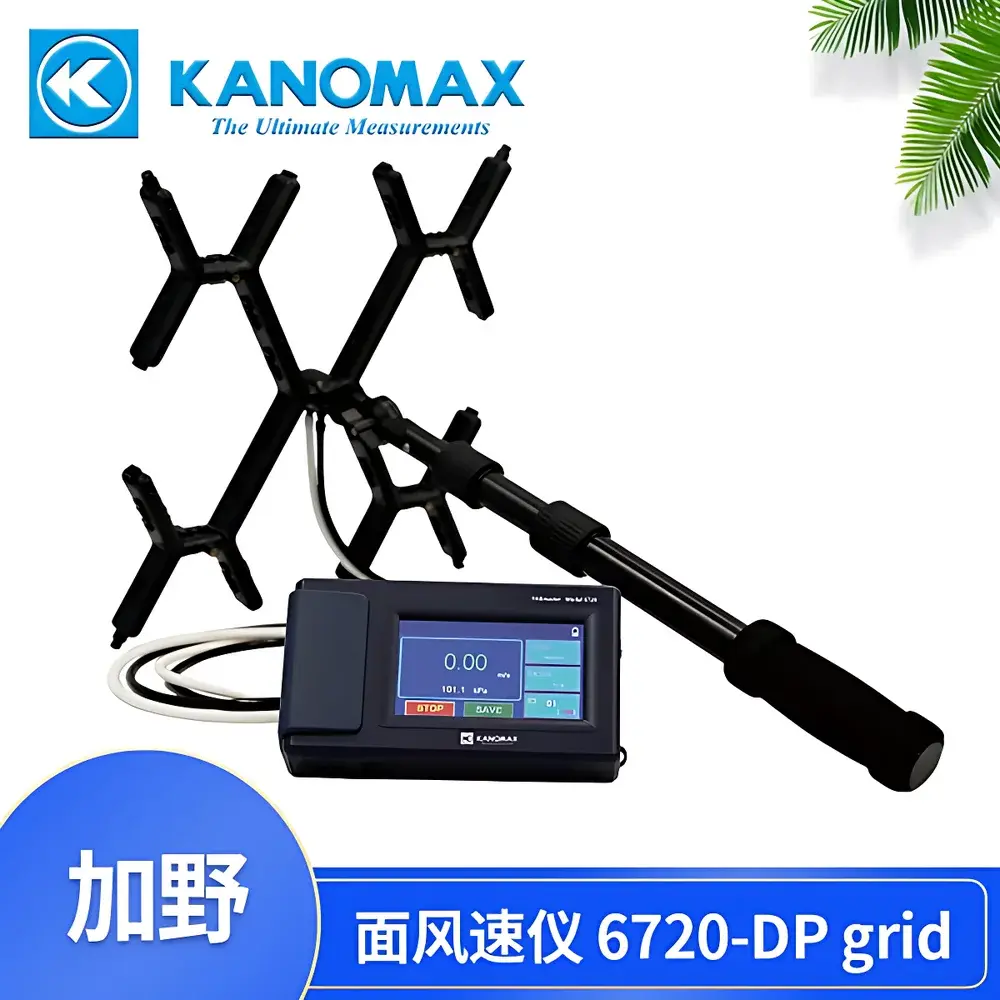
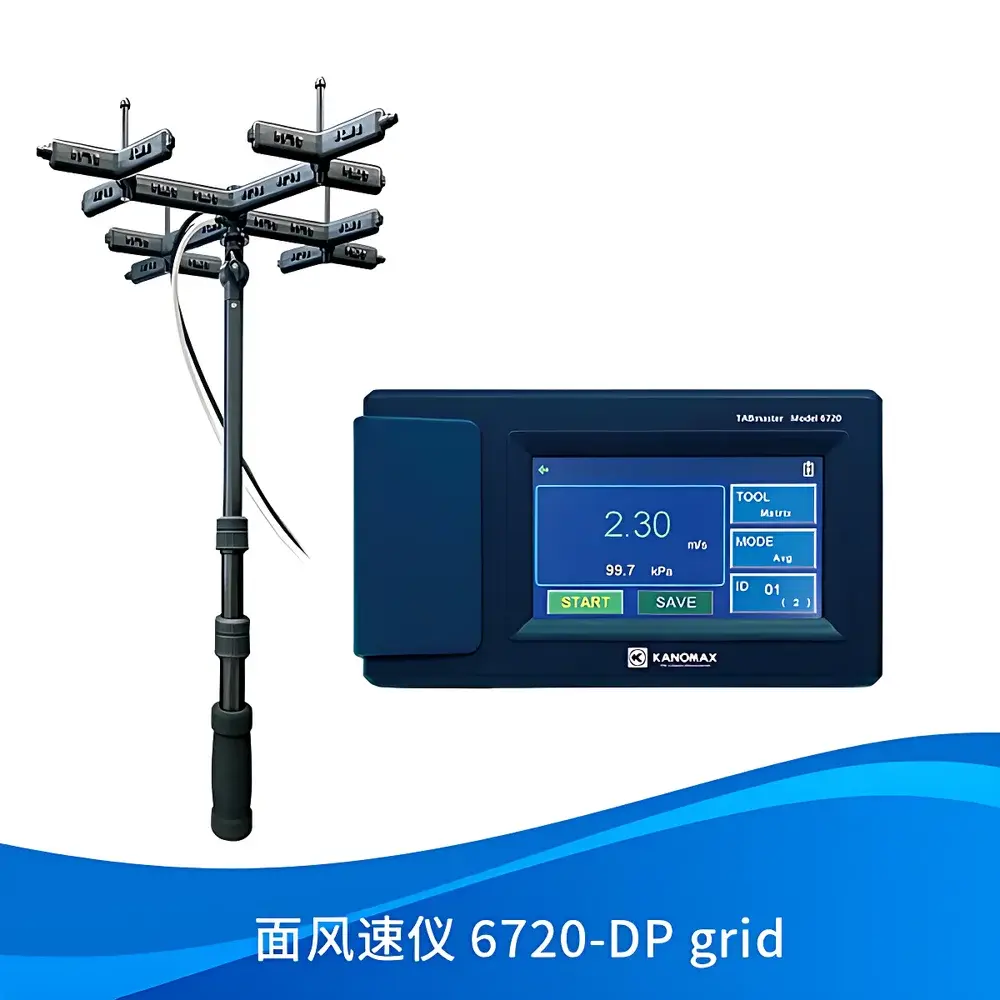
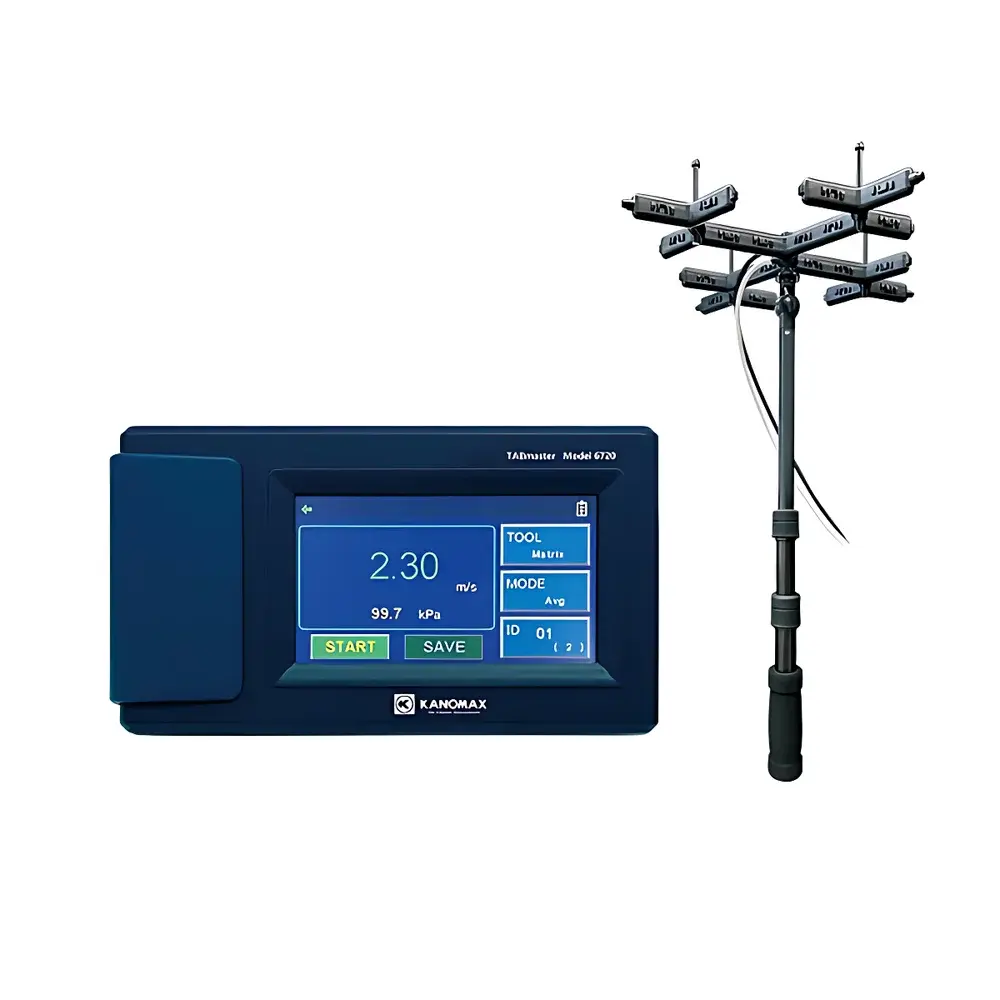
Kanomax 6720-DP Grid Multi-Parameter Air Velocity & Differential Pressure Meter
| Brand | Kanomax |
|---|---|
| Origin | Japan |
| Model | 6720-DP Grid |
| Instrument Type | Pitot Tube Anemometer with Grid Sensor Array |
| Resolution | 0.01 m/s (velocity), 0.001 Pa (differential pressure), 1 m³/h (airflow) |
| Measurement Range | 0.15–40 m/s (pitot tube), 0.15–15 m/s (grid sensor), −2500 to +2500 Pa (ΔP), 40–4300 m³/h (airflow) |
| Accuracy | ±3% ±0.05 m/s (>0.25 m/s), ±3% ±8 m³/h (>85 m³/h), ±1.5% ±0.25 Pa |
| Operating Temperature | 0–60 °C (non-condensing) |
| Operating Humidity | 0–100 %RH |
| Display | 4.3-inch full-color touchscreen |
| Data Storage | 8,000 records (device), 10,000 records (mobile app) |
| Battery Life | ~14 h (4 × AA alkaline) |
| Weight | ~3.6 kg |
Overview
The Kanomax 6720-DP Grid is a high-precision, multi-parameter environmental monitoring instrument engineered for quantitative airflow validation in controlled environments—particularly ISO Class 5–8 cleanrooms, pharmaceutical aseptic processing suites, semiconductor fabrication laminar flow hoods, and medical device manufacturing enclosures. It integrates three core measurement modalities—pitot tube-based air velocity, grid-sensor array velocity profiling, and differential pressure—within a single handheld platform. The instrument operates on the principle of dynamic pressure differential measurement (via pitot-static tube) combined with thermal anemometry (for grid matrix mode), enabling traceable, repeatable quantification of face velocity across filter banks, supply/exhaust grilles, and laminar airflow workstations. Its architecture complies with fundamental requirements of ISO 14644-3, EU GMP Annex 1 (2022), and USP for environmental monitoring system qualification.
Key Features
- Simultaneous real-time acquisition of air velocity (0.15–40 m/s via pitot tube; 0.15–15 m/s via 16-point grid sensor), volumetric airflow (40–4300 m³/h), and differential pressure (−2500 to +2500 Pa).
- 4.3-inch capacitive touchscreen interface with intuitive icon-driven navigation, calibrated backlighting, and on-device unit conversion (m/s, ft/min, m³/h, CFM, Pa, mmH₂O, inH₂O).
- Integrated Bluetooth 4.2 module supporting secure pairing with iOS/Android devices running the official Kanomax AirFlow Manager app for remote configuration, live streaming, and audit-ready data export (CSV, PDF, XML).
- K-factor compensation function for system-specific calibration adjustment—critical when measuring across non-standard duct geometries or HEPA filter configurations.
- Dual storage architecture: 8,000 measurement sets retained locally (with timestamp, location tag, operator ID, and environmental conditions); up to 10,000 records synchronized to mobile app with optional cloud backup.
- Low-power design with auto-sleep mode after 5 minutes of inactivity; powered by four standard AA alkaline cells (typical runtime: 14 hours), or optionally via 5 V DC external supply.
Sample Compatibility & Compliance
The 6720-DP Grid is validated for use in non-explosive, non-corrosive, particle-laden air streams typical of GxP-regulated facilities. Its pitot probe and detachable grid sensor are compatible with standard ISO 14644-3 test protocols—including uniformity mapping of unidirectional airflow (UDAF) at critical process points (e.g., ISO 5 hood face, filling line barriers). All measurement algorithms adhere to ISO 7726 (ergonomics of thermal environments) and ANSI/ASHRAE Standard 111 (methods of testing to determine airflow performance). Device firmware supports configurable pass/fail thresholds aligned with facility SOPs and supports GLP/GMP-compliant metadata tagging (operator, location, date/time, calibration status). While not intrinsically rated for hazardous locations, its IP54-rated enclosure ensures protection against dust ingress and water splashing during routine cleanroom audits.
Software & Data Management
The bundled AirFlow Manager software (Windows/macOS) and companion mobile application provide full lifecycle data governance. Exported datasets include raw sensor values, calculated airflow volumes, K-factor logs, and statistical summaries (mean, min/max, SD, CV%). All data files embed digital signatures and immutable timestamps compliant with FDA 21 CFR Part 11 requirements when used with enabled electronic signature workflows. Audit trails record every parameter change, data deletion, or report generation event. USB-C and Bluetooth interfaces support direct transfer to LIMS or QMS platforms without intermediate file manipulation. Calibration certificates (traceable to JCSS-accredited labs) can be embedded into report headers for regulatory submission readiness.
Applications
- Validation and routine monitoring of laminar airflow hoods (ISO Class 5), biosafety cabinets (Class II A2/B2), and isolators per ISO 14644-3 Annex B.
- Face velocity verification across HEPA/ULPA filter banks in cleanroom supply ceilings and wall-mounted diffusers.
- Differential pressure gradient mapping between adjacent classified zones (e.g., Grade C to Grade A corridors) to confirm containment integrity.
- Quantitative assessment of HVAC system balancing—supply vs. exhaust airflow reconciliation, duct traverse surveys, and fan performance trending.
- Supporting ISO 14644-1 classification studies through spatially resolved velocity profiling using the grid sensor array.
- Environmental qualification for sterile product manufacturing per EU GMP Annex 1 Section 4.39–4.42 and PIC/S PI 007-6.
FAQ
Is the 6720-DP Grid suitable for ISO 14644-3 compliance testing?
Yes—the instrument meets the metrological requirements for velocity and differential pressure measurements specified in ISO 14644-3:2019, including stated accuracy, resolution, and sampling frequency for unidirectional airflow characterization.
Can the grid sensor be used for ISO Class 5 hood face velocity mapping?
Yes—the 4×4 grid sensor enables rapid point-by-point velocity capture across standardized 0.3 m × 0.3 m test areas, reducing manual probe repositioning time by >60% compared to single-point pitot methods.
Does the device support 21 CFR Part 11 compliance?
When deployed with configured user roles, electronic signatures, and audit-trail-enabled software, the system satisfies technical controls required under 21 CFR Part 11 for electronic records and signatures.
What is the recommended calibration interval?
Kanomax recommends annual calibration against NIST-traceable standards; however, facility SOPs may require more frequent verification (e.g., pre- and post-validation, quarterly) based on risk assessment and usage intensity.
Are replacement probes and accessories available with documented calibration certificates?
Yes—certified pitot tubes, grid sensor modules, Bluetooth thermal printers, and extendable carbon-fiber poles are supplied with individual JCSS or UKAS-accredited calibration reports.







