
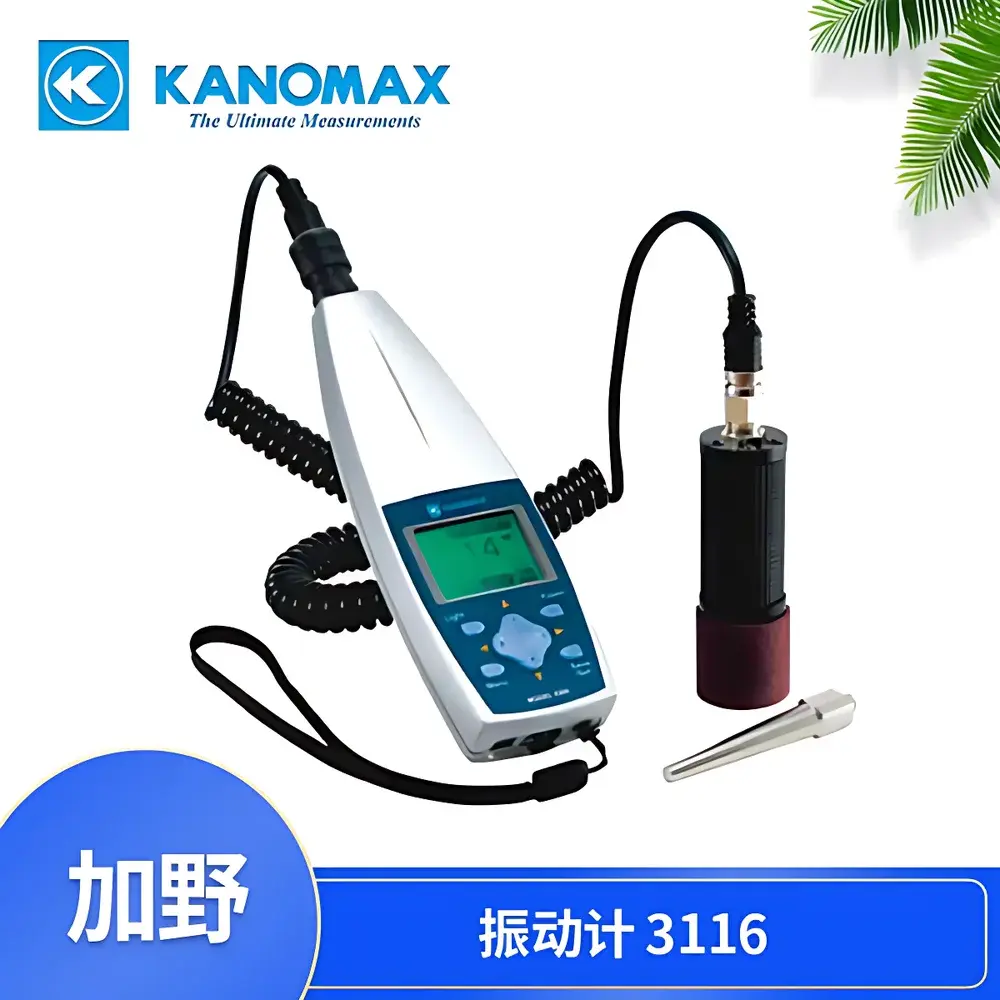
KANOMAX 3116 Portable Vibration Meter
| Brand | KANOMAX |
|---|---|
| Origin | Japan |
| Model | 3116 |
| Acceleration Range | 0.02–200 m/s² RMS |
| Velocity Range | 0.02–200 mm/s RMS |
| Displacement Range | 2–2000 µm EQp-p |
| Accuracy | ±5% |
| Acceleration Frequency Range | 3 Hz–10 kHz |
| Velocity Frequency Range | 10 Hz–1 kHz (compliant with JIS B 0907-1989) |
| Displacement Frequency Range | 10–400 Hz |
| AC Output | 1 Vrms (full scale) |
| Headphone Output | Yes, with volume control |
| Communication Interface | RS-232C |
| Power Supply | Two AAA batteries or optional AC adapter |
| Dimensions | 145 mm (H) × 48 mm (W) × 23 mm (D) |
| Weight | Approx. 130 g |
Overview
The KANOMAX 3116 Portable Vibration Meter is an engineered precision instrument designed for field and laboratory-based vibration assessment in industrial maintenance, machinery health monitoring, and environmental compliance applications. Utilizing a high-stability piezoelectric acceleration sensor integrated with a compact, handheld meter unit, the 3116 operates on the principle of inertial sensing to quantify mechanical vibration in three fundamental physical domains: acceleration, velocity, and displacement (equivalent peak-to-peak). Its measurement architecture adheres to JIS B 0907-1989 standards for vibration evaluation of rotating and reciprocating machinery, ensuring metrological traceability and repeatability across diverse operational environments. The device is not intended for structural vibration analysis or seismic applications but is optimized for routine condition monitoring of motors, pumps, gearboxes, fans, and HVAC components where ISO 10816-1 and ISO 20816-1 thresholds apply.
Key Features
- Integrated tri-mode measurement capability: simultaneous real-time display of acceleration (m/s² RMS), velocity (mm/s RMS), and displacement (µm EQp-p) — selectable via front-panel toggle.
- High-fidelity piezoelectric accelerometer with built-in magnetic base for rapid, repeatable mounting on ferromagnetic surfaces; includes removable contact probe for non-magnetic or irregular surfaces.
- Frequency-weighted and flat-response modes support both diagnostic and regulatory reporting requirements, with configurable bandpass filtering aligned to JIS B 0907-1989 velocity bandwidth (10–1 kHz) and displacement bandwidth (10–400 Hz).
- Dual power configuration: long-duration operation using two standard AAA alkaline cells (typical battery life >15 hours), plus optional AC adapter compatibility for benchtop or continuous-duty use.
- RS-232C serial interface enables direct data logging to PC-based analysis software, supporting time-stamped waveform capture and batch export in CSV format for trend analysis and report generation.
- Ergonomic, ruggedized housing (130 g) with IP54-rated ingress protection against dust and light splashing water — suitable for workshop, plant floor, and outdoor deployment.
Sample Compatibility & Compliance
The KANOMAX 3116 is compatible with rigid metallic surfaces, cast iron housings, steel bearing pedestals, and other vibration-conductive machine structures. Magnetic mounting ensures stable coupling for measurements above 10 Hz; for low-frequency (<10 Hz) or non-ferrous substrates, the included contact probe provides mechanical impedance matching. The instrument conforms to JIS B 0907-1989 for general-purpose vibration measurement and supports alignment with ISO 20816-1 (Mechanical vibration — Evaluation of machine vibration by measurements on non-rotating parts) for machinery condition classification. While not certified for explosion-proof or intrinsically safe environments, its low-power design and absence of wireless transmitters make it suitable for Class I, Division 2 areas when used per local electrical safety protocols.
Software & Data Management
The 3116 communicates via standard RS-232C protocol at 9600 bps (8N1), enabling integration with third-party data acquisition platforms including LabVIEW, MATLAB, and custom Python-based scripts using PySerial. KANOMAX provides basic Windows-compatible utility software for real-time graphing, threshold alarm configuration, and ASCII-formatted data export. All logged datasets include timestamp, measurement mode, sensor ID (if assigned), and operator-defined tags — supporting GLP-compliant recordkeeping when paired with audit-trail-enabled laboratory information management systems (LIMS). No proprietary cloud service or firmware-over-the-air updates are implemented; all calibration and configuration parameters reside locally within the device’s non-volatile memory.
Applications
- Routine predictive maintenance checks on rotating equipment in manufacturing, power generation, and water treatment facilities.
- Vibration baseline establishment during commissioning and post-repair verification per ISO 14624-1.
- Verification of vibration isolation effectiveness in cleanroom HVAC systems and precision instrumentation mounts.
- Compliance screening for occupational exposure limits defined in ISO 5349-1 (hand-arm vibration) and ISO 2631-1 (whole-body vibration), though dedicated human-vibration analyzers are recommended for formal exposure assessment.
- Academic and vocational training in mechanical diagnostics, where portability and multi-parameter visualization aid conceptual understanding of vibration spectra and energy distribution.
FAQ
Does the KANOMAX 3116 support FFT spectral analysis?
No — the 3116 is a single-value broadband vibration meter and does not perform frequency-domain decomposition. For spectral analysis, consider KANOMAX’s 3880 series or complementary FFT-capable analyzers.
Is calibration certificate included with purchase?
A factory calibration report (traceable to JCSS-accredited standards) is provided; full ISO/IEC 17025-certified calibration is available as an optional service through authorized KANOMAX calibration centers.
Can the device store measurement data internally?
No — internal memory is not implemented. Data must be captured in real time via RS-232C connection or manually recorded from the LCD display.
What is the recommended recalibration interval?
Annual recalibration is advised under normal usage conditions; more frequent verification is recommended if subjected to mechanical shock, extreme temperature cycling, or high-humidity environments.
Is the magnetic base suitable for stainless steel surfaces?
Only for ferritic or martensitic stainless steels (e.g., SUS430, SUS410); austenitic grades (e.g., SUS304, SUS316) are non-magnetic and require use of the contact probe or adhesive mounting kit.







