
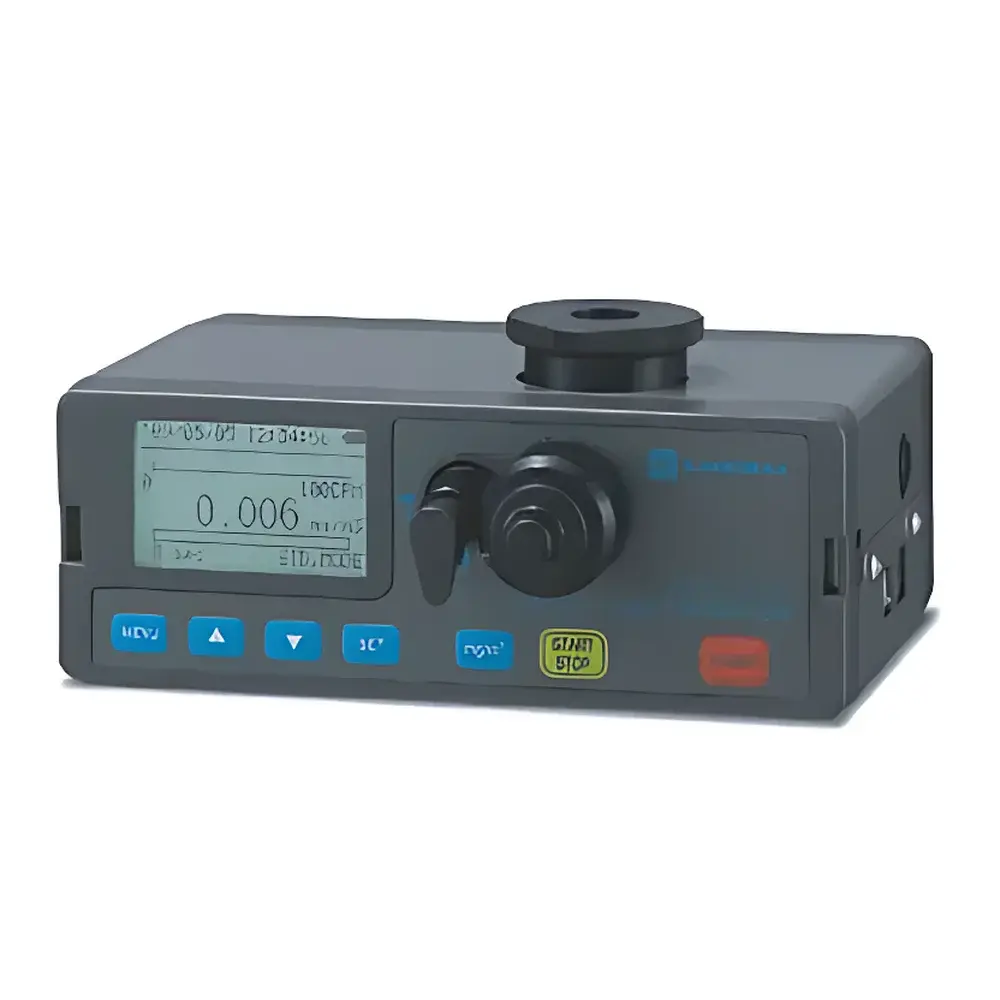
KANOMAX Model 3443 Optical Scattering Digital Dust Monitor
| Brand | KANOMAX |
|---|---|
| Origin | Japan |
| Model | 3443 |
| Measurement Principle | Optical Light Scattering (90° detection geometry) |
| Particle Size Range | 0.1–10 μm |
| Resolution | 0.01 mg/m³ |
| Accuracy | ±10% of reading |
| Relative Error | ≤ ±2% |
| Sampling Duration | Programmable from 10 to 3600 seconds (preset modes: 24 s and 120 s) |
| Data Storage Capacity | 500 records |
| Communication Interface | RS-232C compliant |
| Safety Classification | Non-explosion-proof |
| Compliance | Designed for indoor/outdoor ambient air quality monitoring per ISO 17025-aligned laboratory practices and compatible with GLP data integrity workflows |
Overview
The KANOMAX Model 3443 Optical Scattering Digital Dust Monitor is a portable, microprocessor-controlled instrument engineered for real-time quantitative measurement of airborne particulate mass concentration in the respirable and inhalable size fractions. It operates on the principle of forward- and side-scattered light detection—specifically utilizing a 90° scattering geometry with a high-stability laser diode (650 nm wavelength) and a calibrated photodetector assembly. When aerosol particles pass through the illuminated sensing chamber, scattered light intensity is linearly correlated to particle surface area and mass concentration under controlled humidity and refractive index assumptions (calibrated for urban dust with typical density ~1.5 g/cm³). The device outputs continuous PM2.5 and PM10 equivalent mass concentrations (mg/m³), computed via factory-established Mie-theory-based calibration curves traceable to NIST-traceable reference aerosols (e.g., Arizona Test Dust, PSL standards). Its compact form factor and battery-powered operation support field-deployable monitoring in occupational hygiene surveys, building ventilation assessments, cleanroom qualification, and environmental baseline studies.
Key Features
- Real-time dual-range particulate quantification: simultaneous PM2.5 and PM10 mass concentration output with 1-second response time (T90 ≤ 3 s)
- Programmable sampling duration: fixed presets (24 s, 120 s) plus user-defined intervals from 10 s to 3600 s—enabling compliance with ISO 8502-12 (short-term exposure limit assessment) and OSHA Method ID-125G protocols
- Integrated memory storage: non-volatile EEPROM retains up to 500 timestamped measurement records with date/time stamp, averaging period, and unit identifier
- Optical chamber maintenance alert: automatic notification when optical window contamination exceeds threshold (validated via internal reference signal drift monitoring)
- Ergonomic design with detachable sampling inlet: facilitates cleaning of the isokinetic probe and optical path without tools; compatible with optional cyclone pre-separators for size-selective sampling
- RS-232C serial interface compliant with EIA/TIA-232-F standard: supports bidirectional communication for firmware updates, configuration export, and raw data retrieval using KANOMAX-supplied PC software (Windows 10/11 compatible)
Sample Compatibility & Compliance
The Model 3443 is validated for use with ambient air, indoor workplace air, and filtered process airstreams containing non-volatile, non-fibrous particulates—including mineral dusts, carbonaceous soot, pollen, and industrial aerosols. It is not intended for explosive atmospheres (ATEX/IECEx Zone 0–2 or NEC Class I/II/III environments) or corrosive/hygroscopic aerosols (e.g., concentrated HCl mist, ammonium nitrate solutions). Calibration stability meets ISO 17025 requirements for accredited laboratories when operated within specified environmental conditions (10–40 °C, <85% RH non-condensing). Instrument output is compatible with regulatory reporting frameworks including EPA PM2.5 Reference Method equivalence criteria (40 CFR Part 53) for indicative monitoring, and supports audit-ready documentation for GLP and ISO 9001 quality systems.
Software & Data Management
KANOMAX’s proprietary Windows-based communication software enables secure data download, visualization, and report generation. Each record includes acquisition timestamp (RTC-synchronized), sampling duration, measured concentration, and instrument status flags (e.g., low battery, optical alert). Export formats include CSV (for Excel/Python analysis) and PDF (with embedded calibration certificate metadata). The software enforces audit trail functionality: all parameter changes, data exports, and firmware modifications are logged with user ID and timestamp—supporting FDA 21 CFR Part 11 compliance when deployed with electronic signature modules. No cloud connectivity is embedded; data remains fully on-premise unless explicitly exported by the operator.
Applications
- Occupational health & safety: TWA and STEL evaluation per ACGIH TLVs® and EU Directive 2004/37/EC (carcinogens)
- Indoor air quality (IAQ) audits: ASHRAE Standard 62.1-compliant source identification and ventilation effectiveness verification
- Construction site dust control: real-time feedback during demolition, grinding, and excavation activities
- Filter efficiency testing: upstream/downstream concentration comparison for HVAC and industrial baghouse systems
- Educational and research use: aerosol physics demonstrations, filter penetration studies, and low-cost networked environmental monitoring deployments
FAQ
What particle size distribution does the Model 3443 assume for its PM2.5/PM10 conversion?
It applies a fixed Mie-scattering calibration derived from polydisperse Arizona Road Dust and PSL spheres, optimized for urban ambient aerosol morphology. No real-time size distribution output is provided.
Can the instrument be used outdoors for extended periods?
Yes—when mounted in a weather-protected enclosure with temperature stabilization; however, direct rain, snow, or condensation on the optical window invalidates measurements and may damage the sensor.
Is factory recalibration required annually?
KANOMAX recommends annual verification against a gravimetric reference (e.g., PM10 cyclone + filter weighing per ISO 7708) and optical alignment check. Full recalibration is advised after physical shock, lens cleaning, or deviation >±7% from reference.
Does the RS-232C interface support Modbus or other industrial protocols?
No—it uses a proprietary ASCII command set. Integration with SCADA systems requires custom middleware translation.
How is the 0.01 mg/m³ resolution achieved?
Through 16-bit analog-to-digital conversion of the photodetector signal, combined with digital noise filtering and zero-drift compensation algorithms applied over the full 0.01–10 mg/m³ dynamic range.







