
Kanomax 65 Ser Hot-Wire Anemometer with Integrated Environmental Monitoring
| Brand | Kanomax |
|---|---|
| Origin | China (Liaoning Province) |
| Manufacturer Type | Authorized Distributor |
| Instrument Type | Hot-Wire Anemometer |
| Resolution | 0.01 m/s |
| Measurement Range | Probe-Dependent (e.g., 0–30 m/s typical for standard probes) |
| Accuracy | ±3% of reading or ±0.015 m/s (whichever is greater) for velocity |
| Operating Temperature | −20 to +70 °C |
| Operating Humidity | 0–100% RH |
| Data Storage Capacity | 20,000 records |
| Communication Interface | USB |
| Analog Output | 0–1 V |
| Power Supply | 6 × AA batteries or AC adapter |
| Dimensions | 88 × 188 × 41 mm |
| Weight | 400 g |
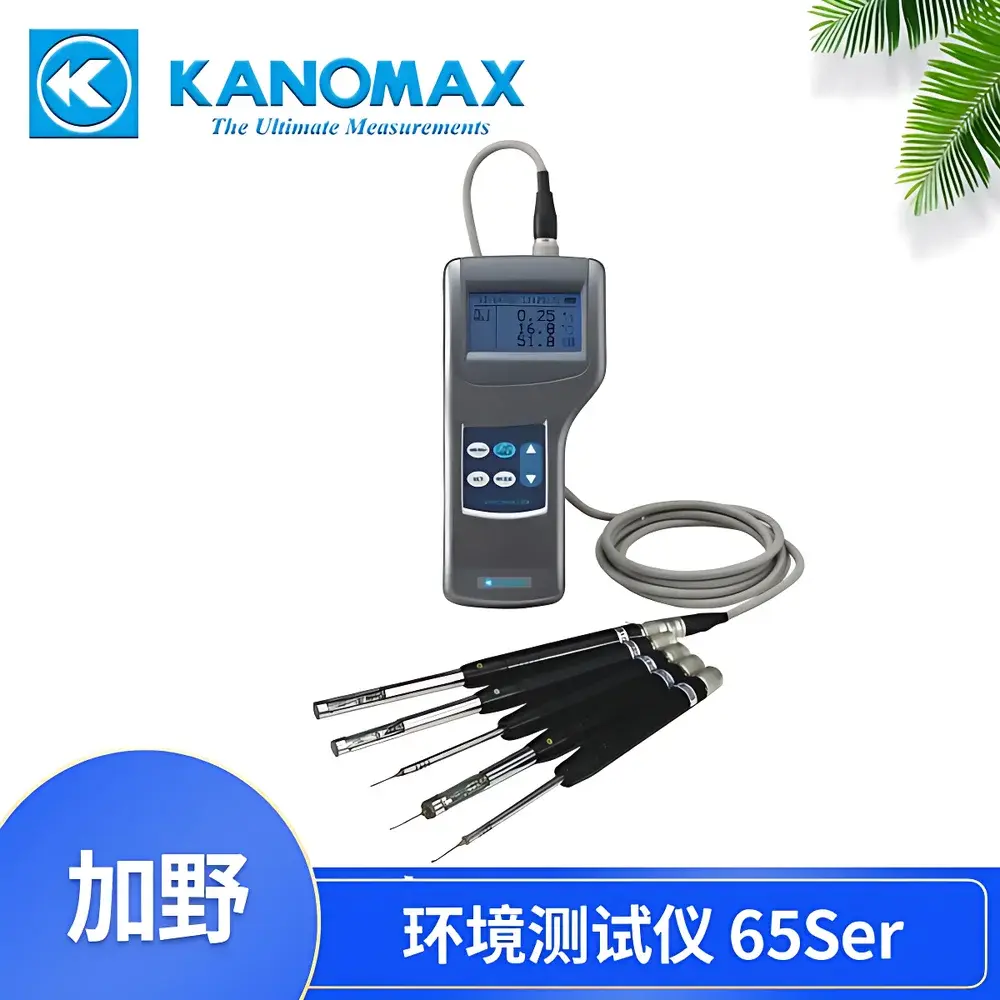
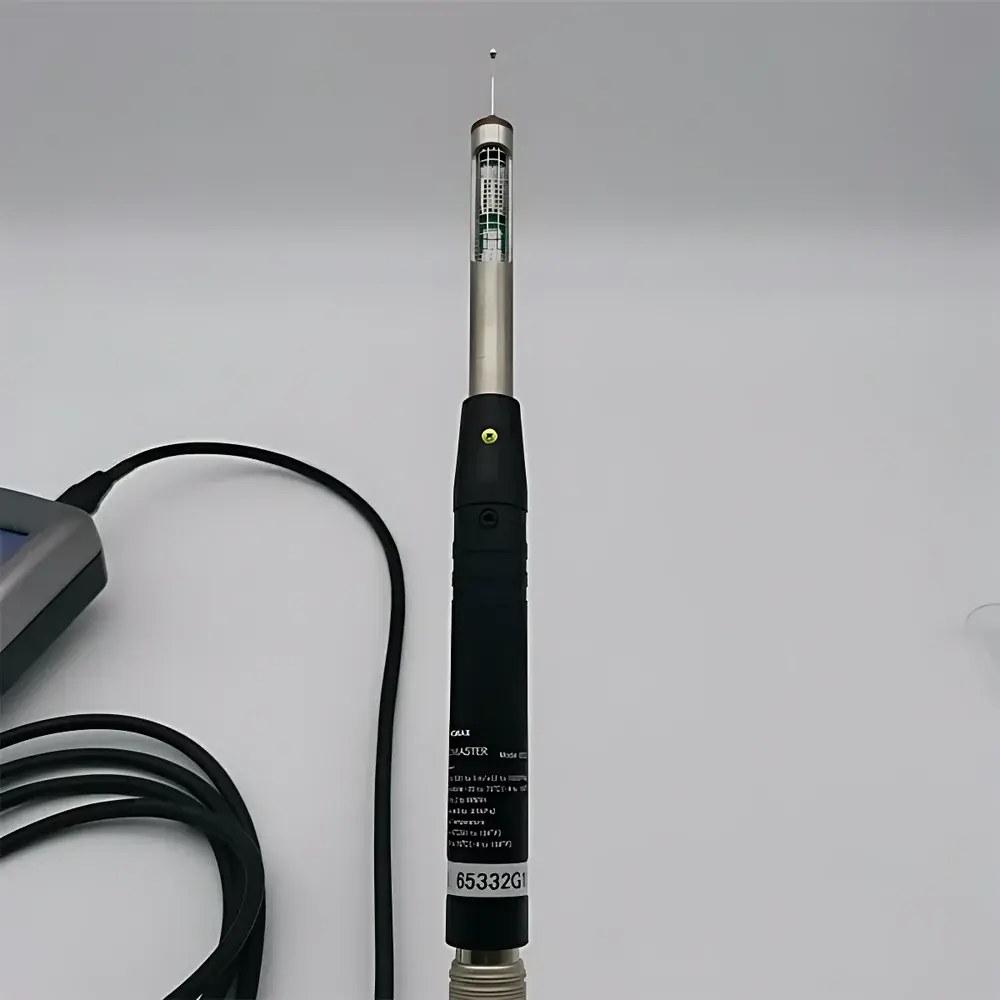
| Probe Compatibility | 8 interchangeable hot-wire and thermistor-based probes (including duct, vane, and omnidirectional configurations) |
Overview
The Kanomax 65 Ser is a precision-engineered hot-wire anemometer designed for comprehensive environmental airflow characterization in industrial hygiene, HVAC commissioning, cleanroom validation, and laboratory ventilation assessment. It operates on constant-temperature anemometry (CTA) principles: a fine platinum or tungsten wire is electrically heated to a fixed temperature differential above ambient; convective cooling by moving air alters the wire’s resistance, which is precisely regulated via feedback control—enabling direct, real-time calculation of volumetric flow velocity. Unlike cup or vane anemometers, the 65 Ser delivers high-frequency response (<10 ms time constant), low-flow sensitivity (down to 0.01 m/s), and immunity to directional bias—critical for turbulent or low-velocity duct and grille measurements. Its integrated multi-parameter architecture simultaneously acquires wind speed, static/differential pressure, ambient temperature, and relative humidity—enabling immediate volumetric flow rate computation when user-defined duct geometry (rectangular, circular, or irregular cross-sections) is entered into the onboard interface.
Key Features
- True hot-wire sensing technology with active temperature compensation for stable performance across −20 °C to +70 °C ambient conditions.
- Eight field-interchangeable probe options—including straight-rod, 90° bent, retractable telescopic, and multi-point array probes—supporting ISO 14644-3 duct traverse protocols and ASHRAE 111-2013 measurement positioning guidelines.
- On-device statistical processing: real-time calculation of mean, maximum, minimum, and standard deviation across sequential readings (up to 20,000 stored records).
- Dual power operation: six AA alkaline cells (typical runtime >20 hours) or optional AC adapter for extended benchtop use; auto-power-off and low-battery indicators ensure operational continuity.
- USB interface compliant with CDC/ACM class drivers for seamless integration with Windows/macOS/Linux systems; supports firmware updates and bulk data export without proprietary software dependencies.
- 0–1 V analog output enables connection to PLCs, SCADA systems, or data loggers for continuous process monitoring in GMP or ISO 14644-certified facilities.
Sample Compatibility & Compliance
The 65 Ser accommodates diverse sampling scenarios—from laminar airflow hoods and fume exhaust stacks to variable-air-volume (VAV) terminal units and biological safety cabinets. Its probe interchangeability ensures compliance with ASTM D1071 (airflow measurement in ducts), ISO 8573-7 (compressed air purity testing), and EN 13779 (ventilation for non-residential buildings). All probes meet IP54 ingress protection for dust and splash resistance during field deployment. Humidity and temperature sensors are NIST-traceable and factory-calibrated per ISO/IEC 17025 requirements. The instrument’s pressure module conforms to IEC 61260 Class 2 specifications for differential pressure transducers used in HVAC balancing.
Software & Data Management
Data acquisition and post-processing are supported via Kanomax’s free PC application (Windows 10/11 compatible), which provides timestamped CSV export, customizable report templates (PDF/Excel), and graphical trend analysis (velocity vs. time, RH vs. temp scatter plots). Audit trail functionality logs all configuration changes, calibration events, and user-initiated data deletions—meeting FDA 21 CFR Part 11 requirements for electronic records in regulated environments. Raw sensor outputs are stored with metadata (probe ID, operator tag, location code), enabling traceability during GLP or ISO 17025 audits. No cloud dependency: all processing occurs locally, preserving data sovereignty and cybersecurity integrity.
Applications
- HVAC system commissioning and TAB (Testing, Adjusting, Balancing) per NEBB Procedural Standards.
- Cleanroom airflow uniformity mapping and ISO 14644-1 classification verification.
- Occupational exposure assessment per OSHA Technical Manual Section III: Chapter 2 (industrial ventilation surveys).
- Filter leakage testing using upstream/downstream velocity differentials in HEPA/ULPA systems.
- Environmental chamber validation where simultaneous thermal-hygrometric-velocity profiling is required.
- Academic research in boundary-layer aerodynamics and indoor air quality modeling.
FAQ
What probe types are supported, and how do they affect measurement uncertainty?
The 65 Ser accepts eight probe variants—each calibrated individually. Uncertainty contributions include probe-specific velocity profile distortion (±0.5% for straight probes; ±1.2% for bent probes at angles >45°) and thermal inertia effects at transient flows. Calibration certificates list probe-specific correction factors.
Can the device perform automated duct traverse calculations per ISO 14644-3?
Yes—users input duct dimensions and select traverse method (log-Tchebycheff, equal-area, or grid); the unit computes point-weighted average velocity and total volumetric flow (m³/h or CFM) in real time.
Is the pressure module suitable for low-differential applications such as filter monitoring?
With ±5.00 kPa full-scale range and ±3% reading accuracy, it is optimized for HVAC static pressure checks and medium-differential filter monitoring—not ultra-low ΔP applications (<10 Pa) requiring micro-manometers.
Does the instrument support GLP-compliant calibration documentation?
Yes—factory calibration reports include uncertainty budgets, environmental conditions, reference standards (NIST-traceable), and technician signatures; field recalibration is supported via optional traceable reference anemometers.
How is data integrity maintained during battery replacement?
Non-volatile flash memory retains all stored records and configuration settings indefinitely—even with complete power loss—ensuring zero data corruption during battery swaps.
Related Products







