
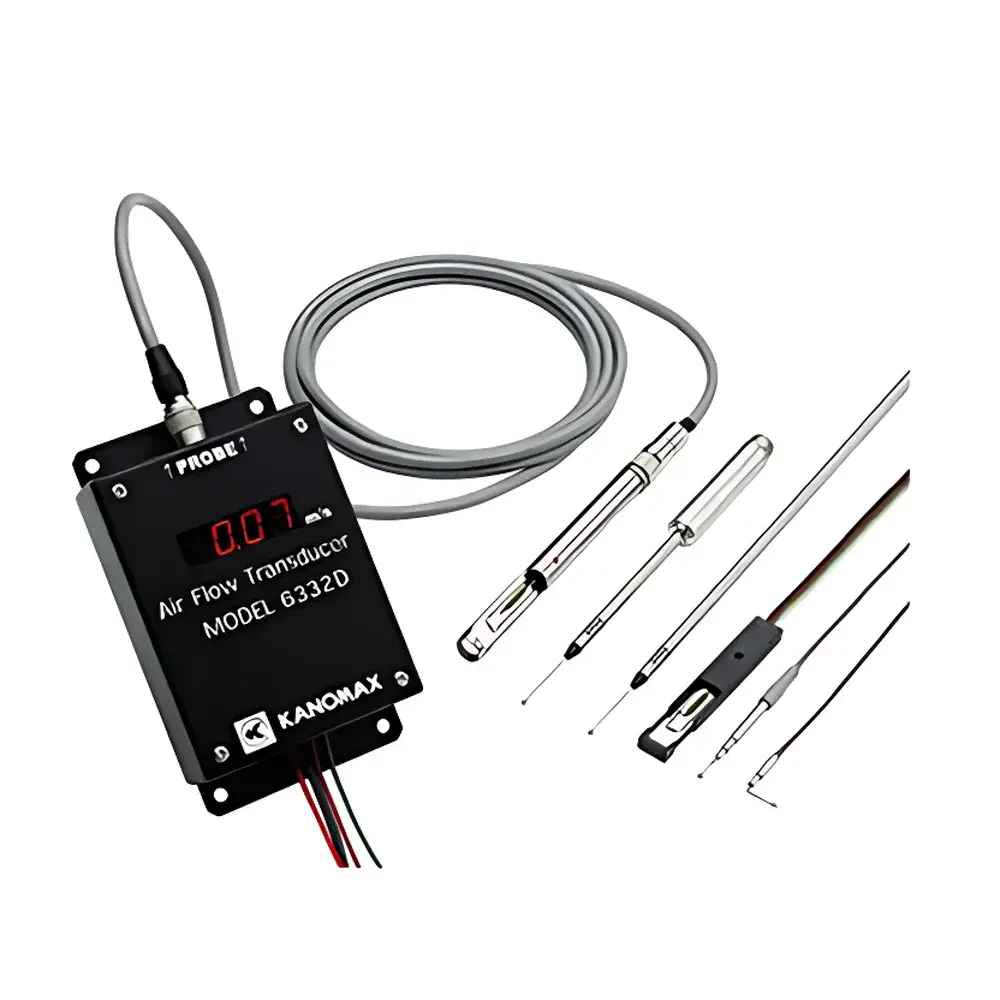
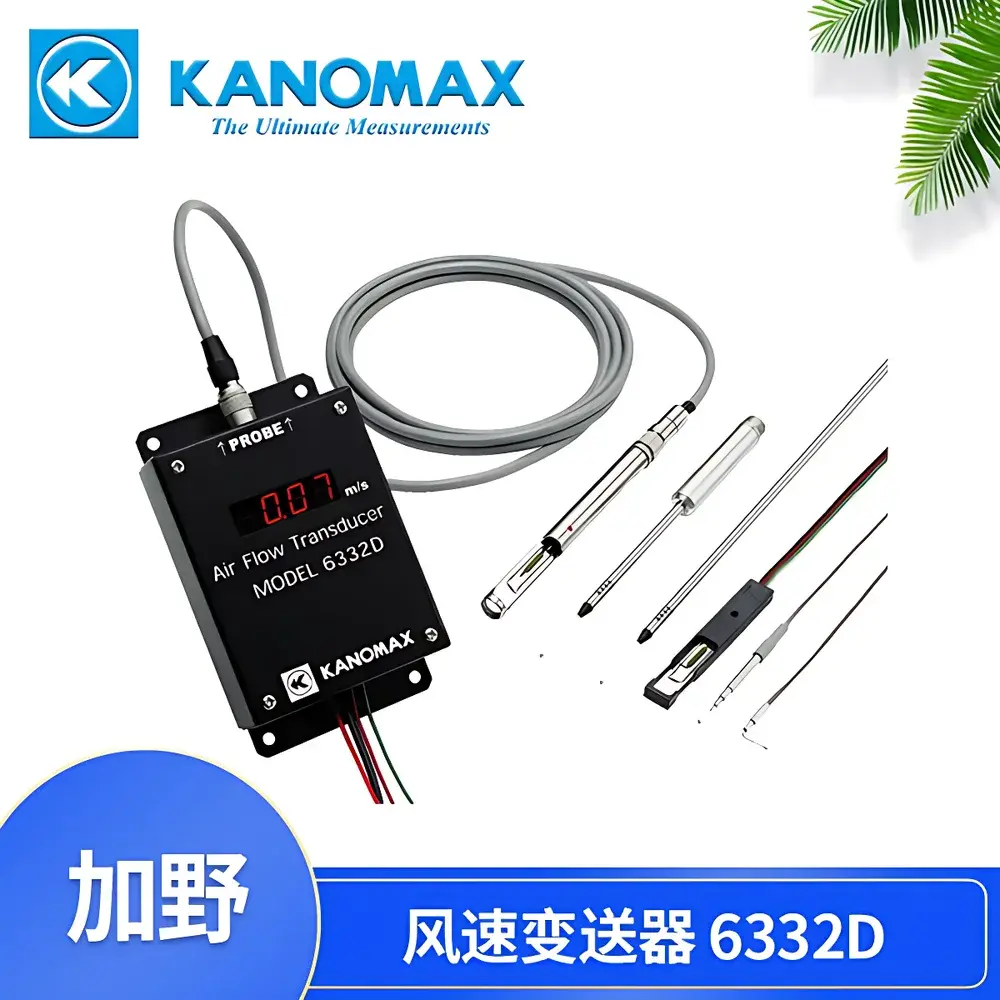
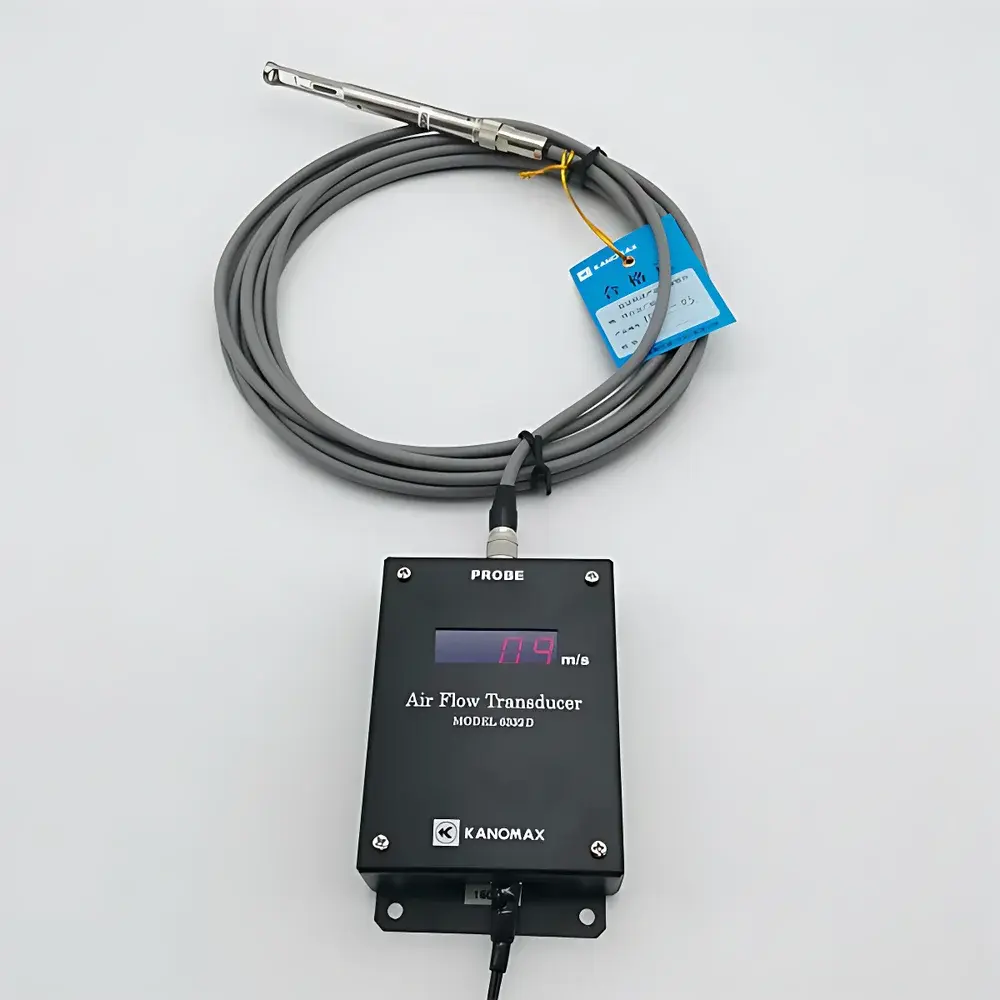
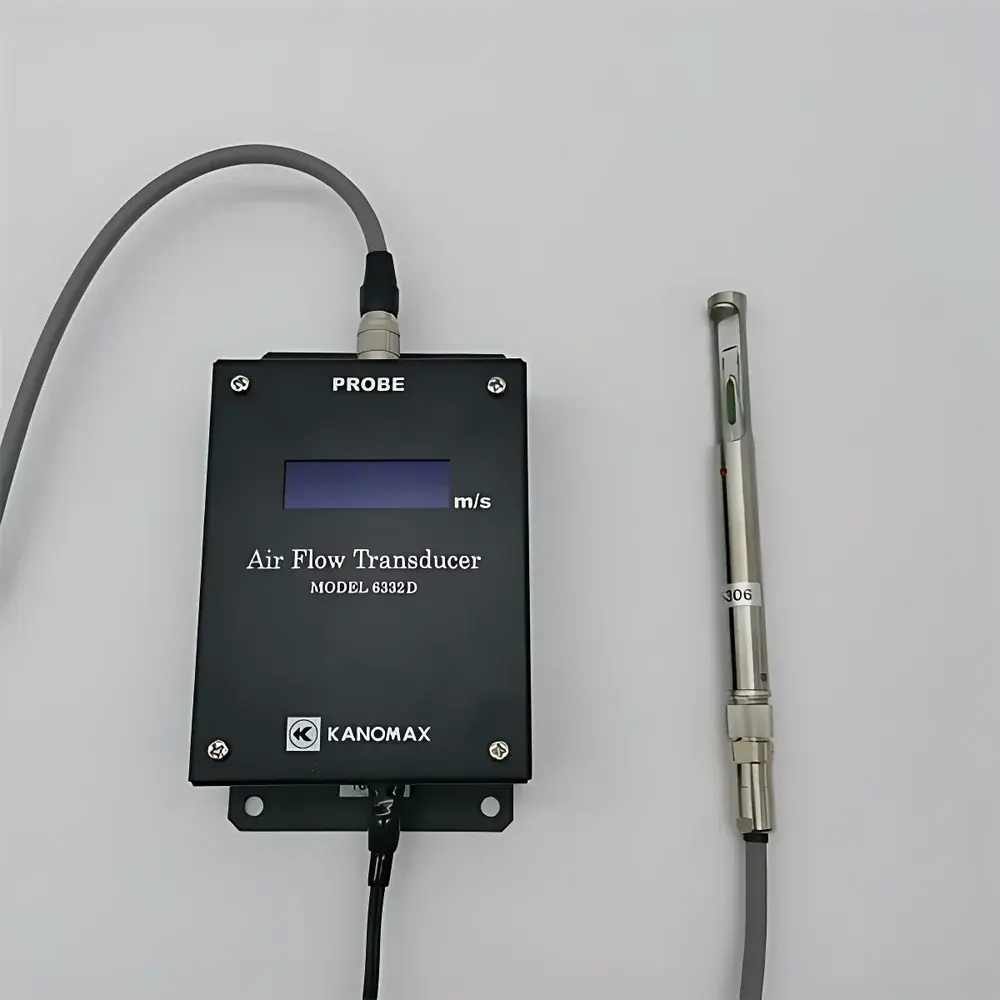
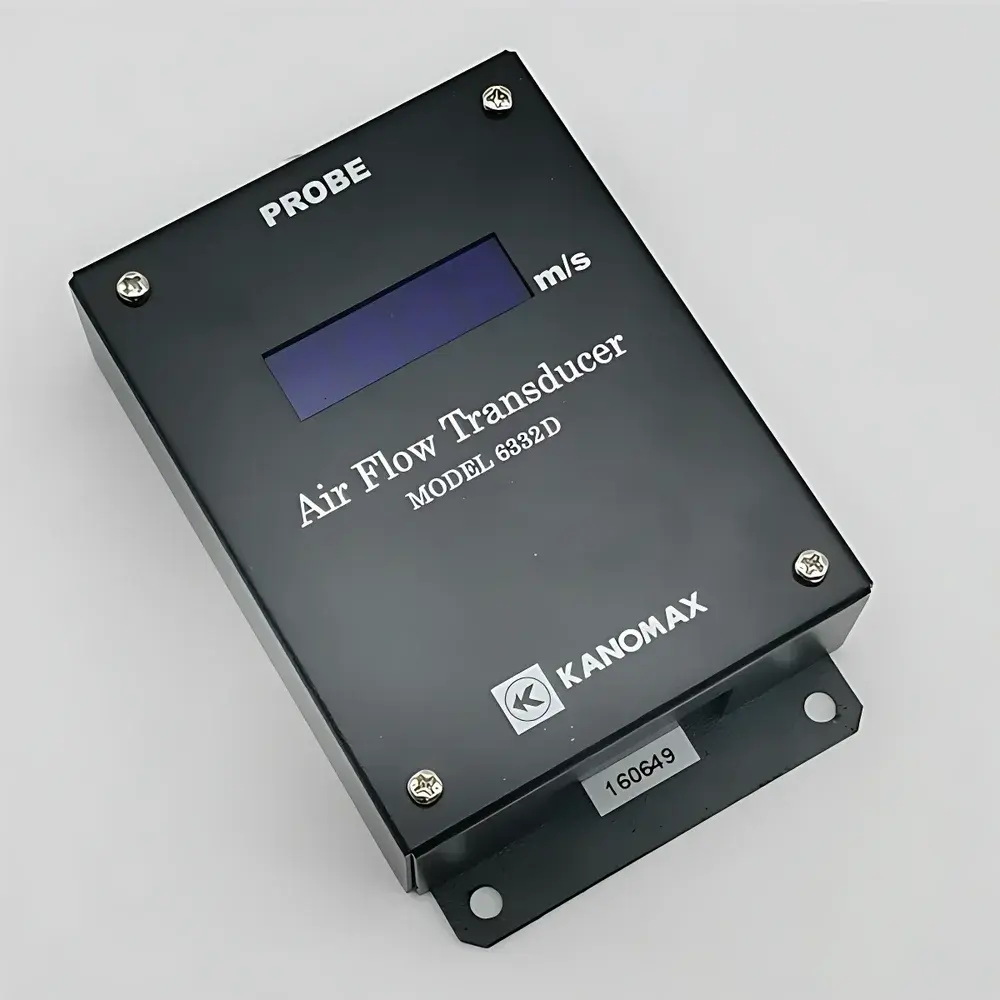
KANOMAX 6332/6332D Ultrasonic Anemometer Transmitter
| Brand | KANOMAX |
|---|---|
| Origin | Japan |
| Model | KANOMAX 6332/6332D |
| Instrument Type | Ultrasonic Anemometer |
| Resolution | 0.1 m/s |
| Measurement Range | 0.1–50 m/s (9–8,400 fpm), probe-dependent |
| Accuracy | ±3% of reading ±0.1 m/s (±20 fpm) |
| Operating Temperature | 5–40 °C (41–104 °F) |
| Output Options | 0–5 V DC or 4–20 mA analog output |
| Display | Built-in LCD (6332D only) |
| Probe Compatibility | Interchangeable with 10 standardized probe types |
| Multi-unit Cascading | Supported for multi-channel wind velocity monitoring |
Overview
The KANOMAX 6332/6332D Ultrasonic Anemometer Transmitter is a precision-engineered environmental monitoring instrument designed for continuous, real-time measurement of air velocity in controlled and semi-controlled environments. Utilizing time-of-flight ultrasonic transit-time differential measurement principles, the system calculates wind speed by precisely timing the propagation delay of high-frequency acoustic pulses between opposing transducer pairs. This non-mechanical, moving-part-free methodology ensures long-term stability, minimal drift, and immunity to bearing wear or mechanical hysteresis—critical advantages over cup or vane anemometers in cleanroom validation, HVAC commissioning, and laminar airflow verification. The transmitter architecture separates signal processing and analog output generation from the sensing probe, enabling flexible installation in ducts, hoods, chambers, or open-air test zones while maintaining signal integrity and electromagnetic compatibility (EMC) per IEC 61326-1.
Key Features
- Modular probe interface supporting 10 interchangeable KANOMAX-certified ultrasonic probes—including low-flow (0.1–5 m/s), high-velocity (up to 50 m/s), high-temperature (up to 80 °C), and compact-profile variants—each calibrated traceably to JIS Z 8000 and NIST-traceable standards.
- Dual-output capability: simultaneous 0–5 V DC and 4–20 mA analog outputs, configurable via DIP switches; both outputs comply with IEC 61000-4-2 (ESD) and IEC 61000-4-4 (EFT) immunity requirements.
- 6332D variant integrates a backlit monochrome LCD display with real-time wind speed readout, unit toggle (m/s, fpm, knots), and status indicators (probe connection, signal strength, fault codes).
- Multi-unit cascading architecture enables synchronization of up to 16 transmitters via RS-485 Modbus RTU protocol (optional module), facilitating spatially distributed wind mapping without external data loggers.
- Robust aluminum alloy housing rated IP54 for dust and splash resistance; operating humidity range: 20–80% RH non-condensing.
Sample Compatibility & Compliance
The KANOMAX 6332/6332D is validated for use with standard ISO 14644-3:2019 cleanroom airflow uniformity testing protocols and aligns with ASHRAE Guideline 12-2020 for infection control in healthcare ventilation systems. Probe selection determines application suitability: e.g., the 6332-P10 probe meets ISO 14644-1 Class 3–5 cleanroom certification requirements for unidirectional airflow velocity profiling, while the 6332-P20 probe supports ISO 16813-compliant thermal comfort assessments in occupied spaces. All factory calibrations are performed under controlled environmental conditions (23 ±1 °C, 50 ±5% RH) and documented with individual calibration certificates traceable to Japan Calibration Service System (JCSS). The device complies with CE marking directives (EMC Directive 2014/30/EU, RoHS 2011/65/EU) and carries a 2-year limited warranty.
Software & Data Management
While the 6332/6332D operates as a standalone analog transmitter, optional KANOMAX Data Logger Software (v3.2+) enables PC-based configuration, real-time waveform visualization, and timestamped CSV export. When integrated into larger monitoring networks, the device supports audit-trail-ready data acquisition under FDA 21 CFR Part 11-compliant systems when paired with validated SCADA or LIMS platforms. Analog output signals are linearized across the full 0.1–50 m/s range with ≤0.5% non-linearity error, and output stability is maintained at <0.1% FS/°C temperature coefficient. No firmware updates require proprietary hardware; configuration changes are made via front-panel buttons (6332D) or external potentiometer adjustment (6332).
Applications
- Cleanroom airflow qualification (ISO 14644-3, EU GMP Annex 1)
- HVAC system balancing and duct traverse surveys per ASHRAE Standard 111
- Laminar flow cabinet and biosafety cabinet face velocity verification (NSF/ANSI 49)
- Environmental chamber air exchange rate validation
- Industrial exhaust stack velocity profiling (EPA Method 2)
- Research-grade boundary layer studies in aerodynamic test facilities
FAQ
Does the 6332D support digital communication protocols out of the box?
No—digital communication (RS-485 Modbus RTU) requires the optional KANOMAX Communication Module (Cat. No. 6332-CM1), which installs internally and retains full analog output functionality.
Can the same probe be used interchangeably between 6332 and 6332D units?
Yes—both models share identical probe interface mechanics, electrical pinout, and calibration firmware architecture; no recalibration is required upon transfer.
Is the 0.1 m/s resolution maintained across the entire 0.1–50 m/s range?
Resolution is specified as 0.1 m/s for all readings ≥0.5 m/s; below 0.5 m/s, the effective resolution is limited by signal-to-noise ratio and is typically 0.05 m/s (verified per JIS B 7554-2 repeatability testing).
What is the maximum cable length between probe and transmitter?
Standard shielded twisted-pair cable supports up to 30 m; for lengths >30 m, KANOMAX recommends using low-capacitance coaxial cable (≤60 pF/m) with active signal conditioning to maintain signal fidelity and minimize phase shift errors.
Does KANOMAX provide on-site calibration services outside Japan?
Yes—certified field calibration services are available through KANOMAX’s global network of ISO/IEC 17025-accredited partners in North America, EMEA, and APAC regions, with turnaround times of ≤5 business days post-sampling.
Related Products







