
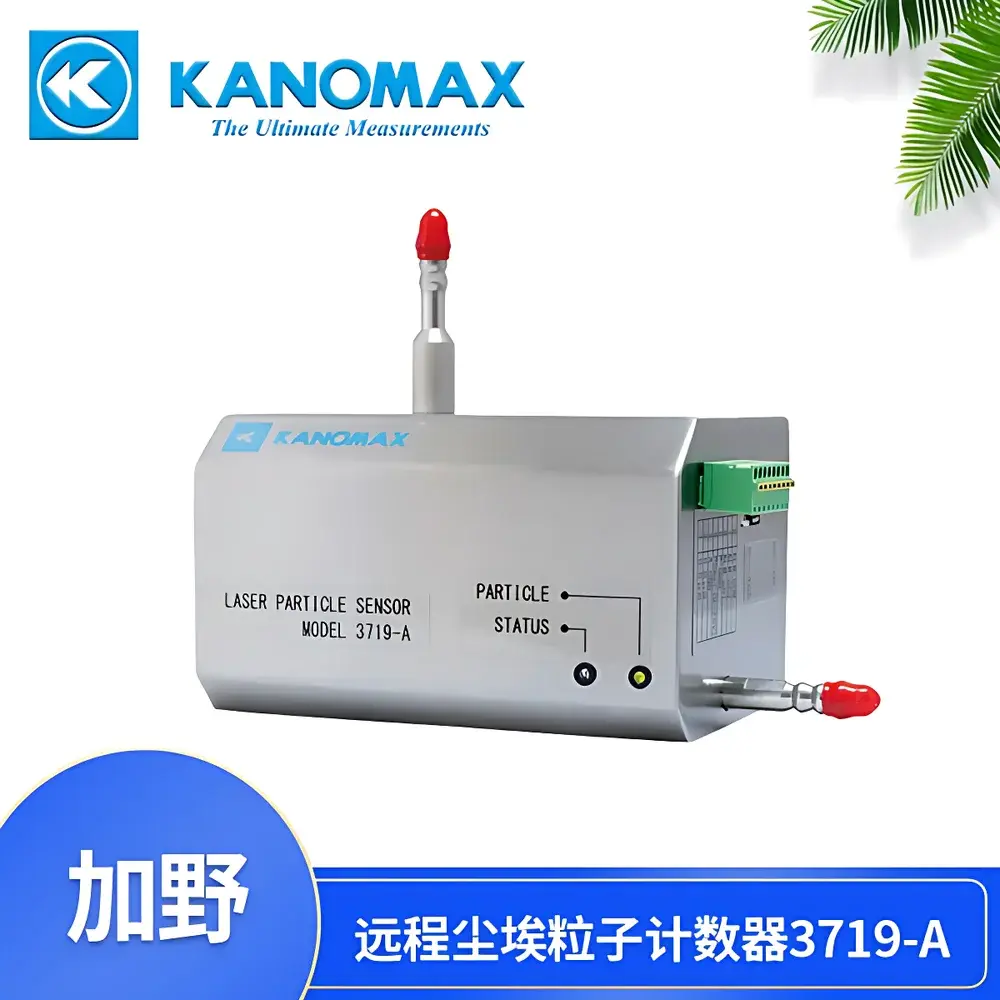
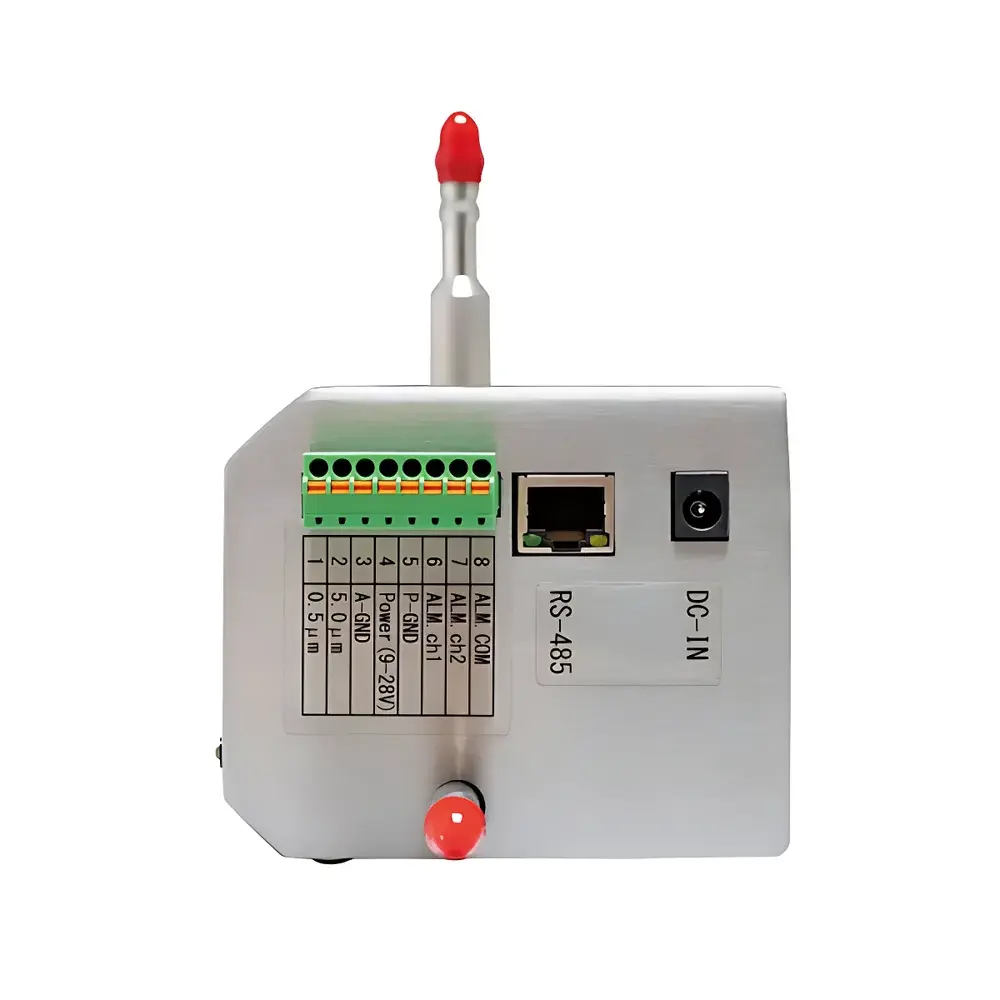
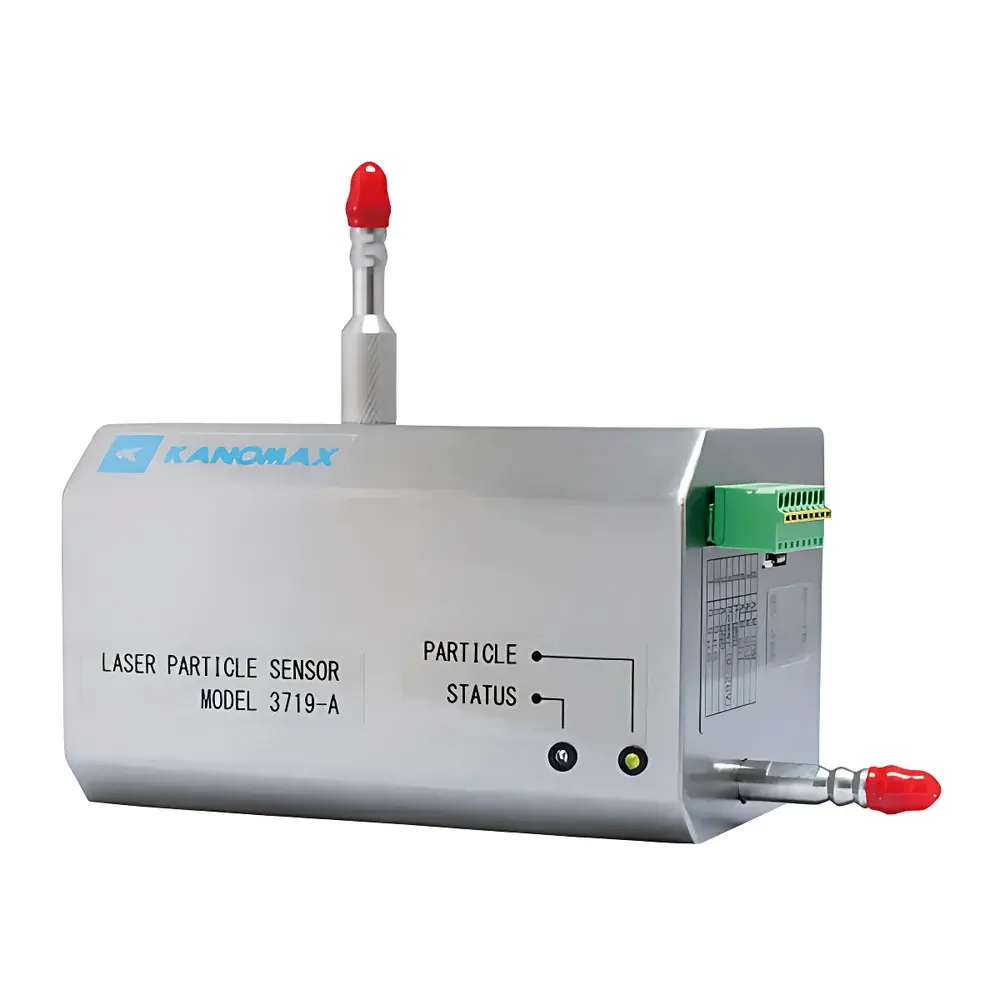
Kanomax Remote Airborne Particle Counter Model 3718-A / 3719-A
| Brand | Kanomax |
|---|---|
| Origin | Liaoning, China |
| Manufacturer Type | Authorized Distributor |
| Product Category | Domestic |
| Instrument Type | Online Particle Counter |
| Flow Rate | 28.3 L/min (1 CFM) |
| Particle Size Channels | 0.3 & 0.5 μm (3718-A) / 0.5 & 5.0 μm (3719-A) |
| Light Source | Long-life Laser Diode |
| Compliance | ISO 21501-4, JIS B 9921, ISO 14644-1:2015 |
| Data Storage | 2,000 Sample Records with Redundant Backup |
| Output Interfaces | RS485, Modbus RTU/TCP/IP, 4–20 mA Analog Output |
| Power Supply | DC 9–28 V, PoE, or AC 100–240 V |
| Enclosure Material | 316 Stainless Steel with VHP/Alcohol-Vapor Resistant Sealing |
| Operating Environment | 10–30 °C, 20–85% RH (non-condensing) |
| Dimensions | 133 × 95 × 80 mm |
| Weight | 1.0 kg |
Overview
The Kanomax Remote Airborne Particle Counter Models 3718-A and 3719-A are purpose-engineered online monitoring instruments for continuous, real-time quantification of airborne particulate contamination in critical environments. Based on the principle of light scattering photometry—where particles passing through a focused laser beam generate scattered light pulses proportional to their size—the instruments deliver high-fidelity, traceable particle concentration data compliant with international metrological standards. Designed for integration into facility-wide environmental monitoring systems (EMS), these units operate at a calibrated volumetric flow rate of 28.3 L/min (1 CFM), ensuring alignment with ISO 14644-1:2015 classification protocols for cleanroom qualification and routine surveillance. The dual-channel detection architecture enables simultaneous measurement of two discrete particle size thresholds: Model 3718-A targets 0.3 µm and 0.5 µm particles—critical for semiconductor fabrication and aseptic pharmaceutical processing—while Model 3719-A focuses on 0.5 µm and 5.0 µm particles, supporting HVAC validation, isolator monitoring, and non-sterile manufacturing compliance.
Key Features
- Stable 28.3 L/min airflow maintained via integrated pressure sensor and external vacuum source—ensuring consistent sampling velocity per ISO 21501-4 calibration requirements.
- High-reliability laser diode light source with ≥10 years MTBF and factory-calibrated counting efficiency meeting ISO 21501-4 and JIS B 9921 specifications.
- 316 stainless steel housing with IP65-rated hermetic sealing, validated for repeated exposure to vaporized hydrogen peroxide (VHP) and ethanol-based sterilants without performance degradation.
- Dual redundant data storage architecture: 2,000 local sample records retained in non-volatile memory, with automatic pre-failure backup to preserve integrity during power interruption or communication loss.
- Flexible power options including Power over Ethernet (PoE), wide-range DC input (9–28 V), and universal AC adapter—enabling deployment in constrained or legacy infrastructure environments.
- Hot-swappable design minimizes system downtime during maintenance; no recalibration required after module replacement.
Sample Compatibility & Compliance
These instruments are intended for use in controlled environments where particulate monitoring supports Good Manufacturing Practice (GMP), ISO 14644-1 certification, and FDA-regulated processes. They meet the optical and electronic performance criteria defined in ISO 21501-4 (Calibration and Verification of Particle Size Distribution Measurement Instruments) and JIS B 9921 (Method of Calibration for Airborne Particle Counters). Their construction and operational envelope—including resistance to VHP, alcohol vapor, and ambient humidity up to 85% RH—make them suitable for Grade A/B cleanrooms, isolators, RABS, and sterile filling lines. All firmware and data handling logic support audit-ready operation under 21 CFR Part 11-compliant EMS platforms when deployed with appropriate system-level controls.
Software & Data Management
Data output is structured for seamless integration into centralized SCADA, MES, or LIMS platforms. Standard communication protocols include Modbus RTU (RS485), Modbus TCP/IP (Ethernet), and analog 4–20 mA signals—each independently configurable per channel. Each recorded sample includes timestamp, particle counts per size bin, flow status, internal temperature/humidity, and diagnostic flags. Local storage retains full-resolution data even during network outages; upon reconnection, buffered records are transmitted in chronological order with sequence numbering to prevent gaps. Optional Kanomax-provided configuration utilities enable remote parameter adjustment—including sampling interval (1–60 s), alarm thresholds (0–100% of set limit), and output scaling—without physical access.
Applications
- Continuous monitoring of ISO Class 3–8 cleanrooms and controlled environments per ISO 14644-1:2015 Annex B.
- Real-time verification of HEPA/ULPA filter integrity and air change effectiveness during operational qualification (OQ).
- Environmental surveillance in aseptic processing suites, lyophilizer chambers, and glovebox systems.
- Supporting risk-based monitoring strategies under EU GMP Annex 1 (2022) and PIC/S guidance.
- Integration into HVAC commissioning workflows for airflow uniformity mapping and pressure cascade validation.
FAQ
What particle size channels are supported by each model?
Model 3718-A measures 0.3 µm and 0.5 µm simultaneously; Model 3719-A measures 0.5 µm and 5.0 µm.
Is external vacuum required for operation?
Yes—both models require a stable external vacuum source to maintain the specified 28.3 L/min flow rate; internal pressure feedback ensures flow consistency across variable backpressure conditions.
How is data integrity ensured during power failure?
All measurements are written to dual non-volatile memory banks; if primary storage fails or power drops, the secondary buffer preserves the most recent 2,000 records until system recovery.
Can the unit be integrated into an existing Modbus-based SCADA system?
Yes—Modbus RTU (RS485) and Modbus TCP/IP are natively supported, with register maps documented per IEC 61158 and compatible with major industrial automation platforms.
What certifications apply to the 316 stainless steel enclosure?
The housing meets ASTM A240/A240M for 316 stainless steel composition and undergoes helium leak testing to verify seal integrity against VHP penetration per ISO 14644-3 Annex C.
Related Products







