
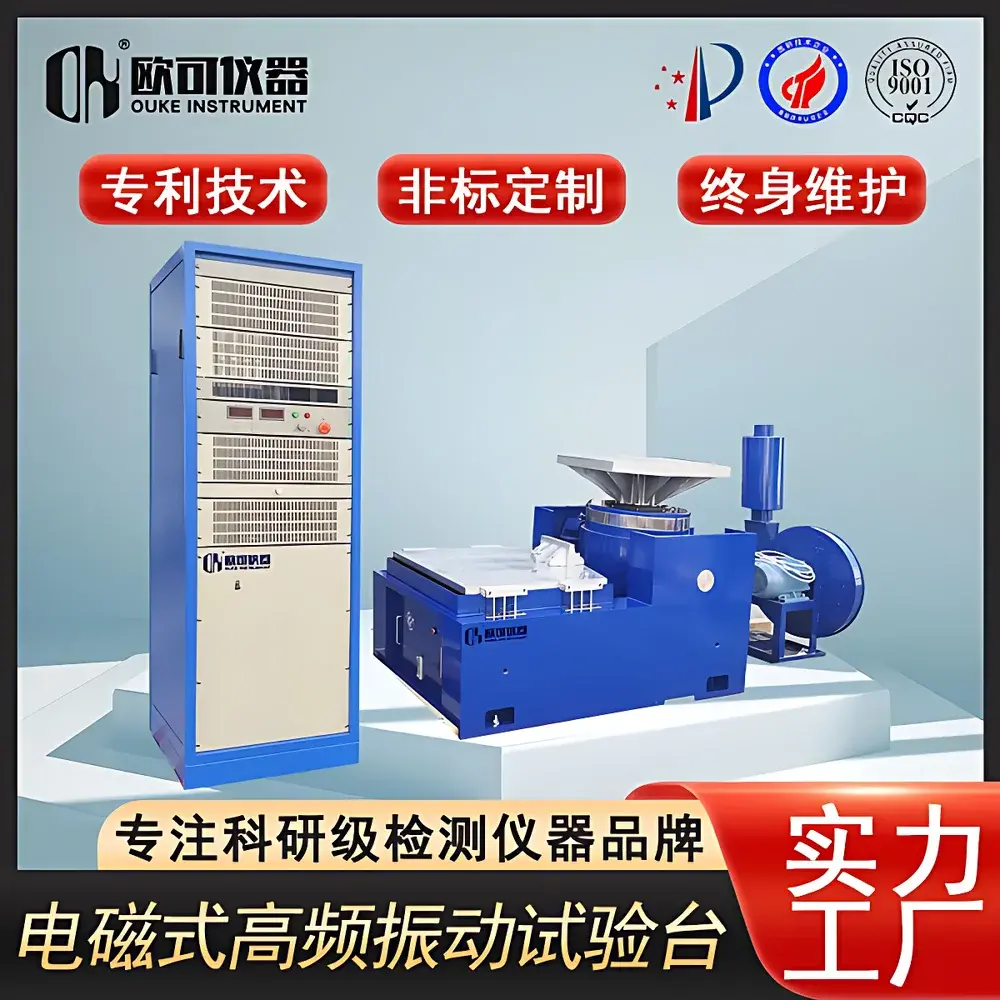
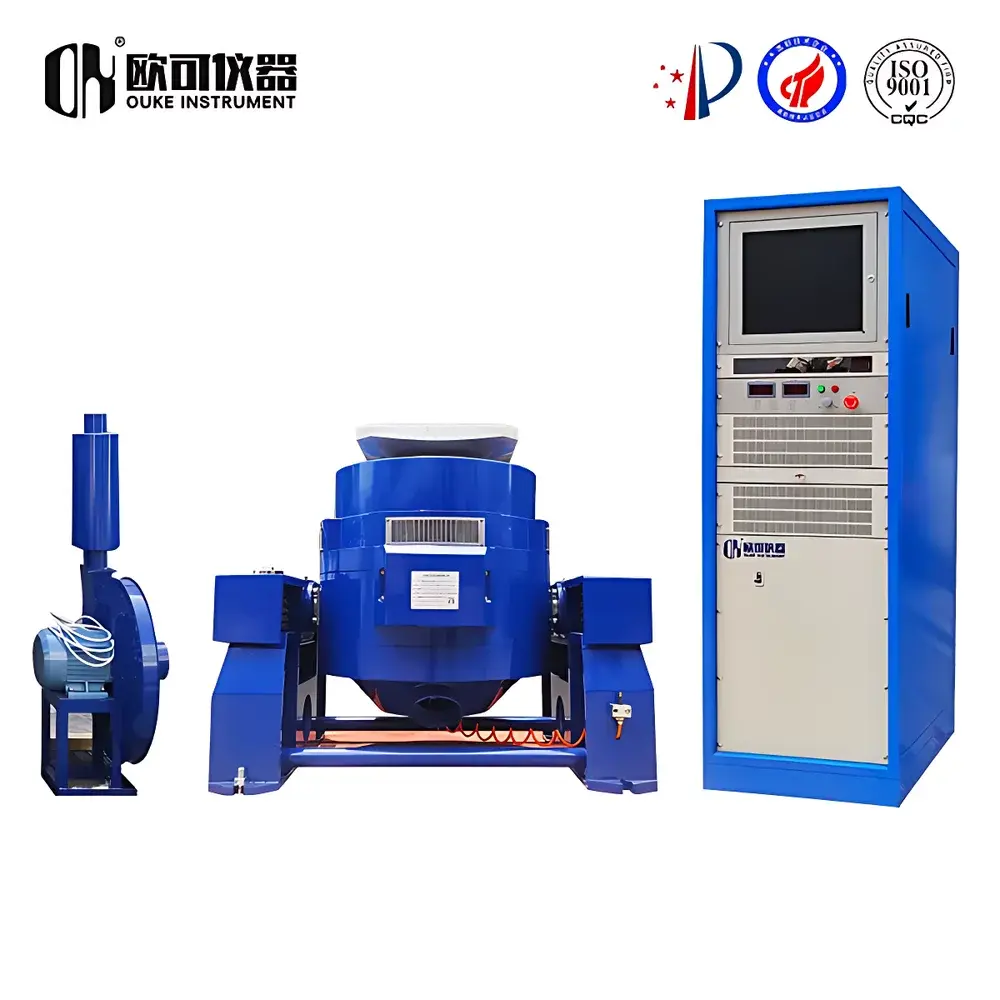
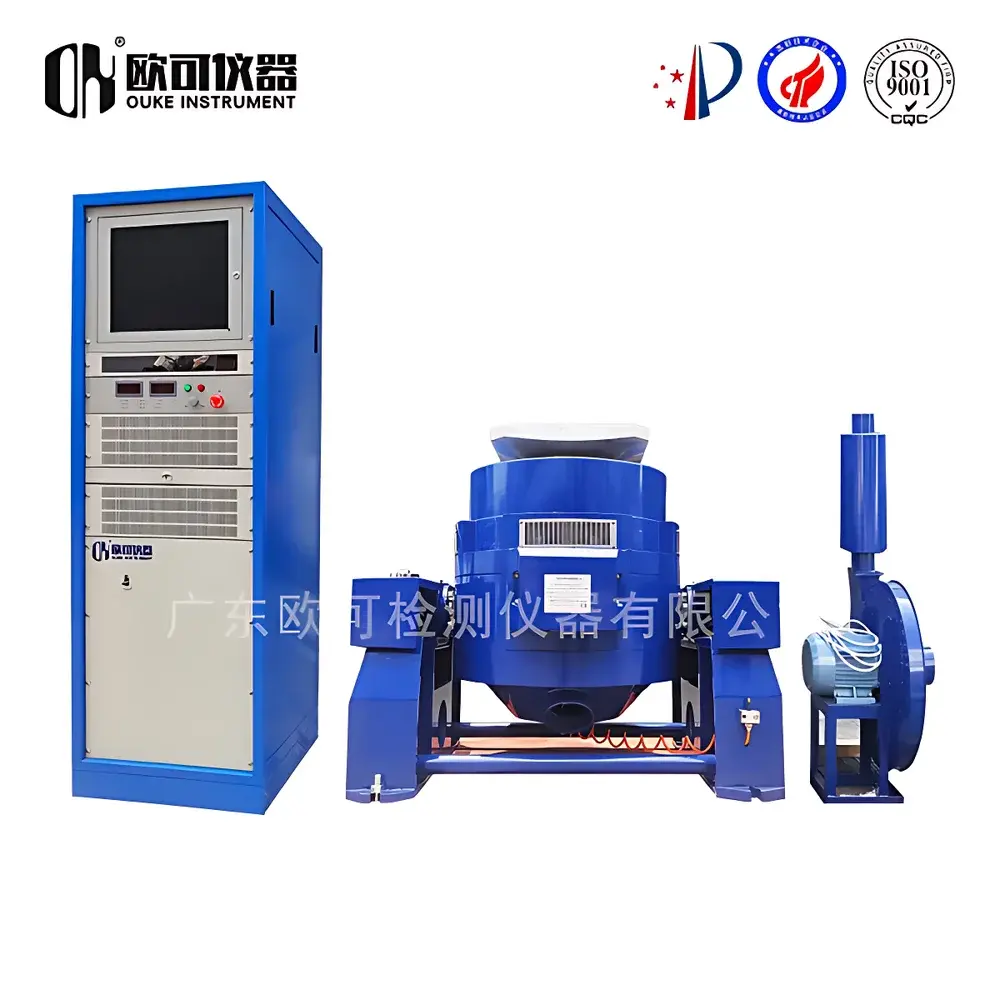
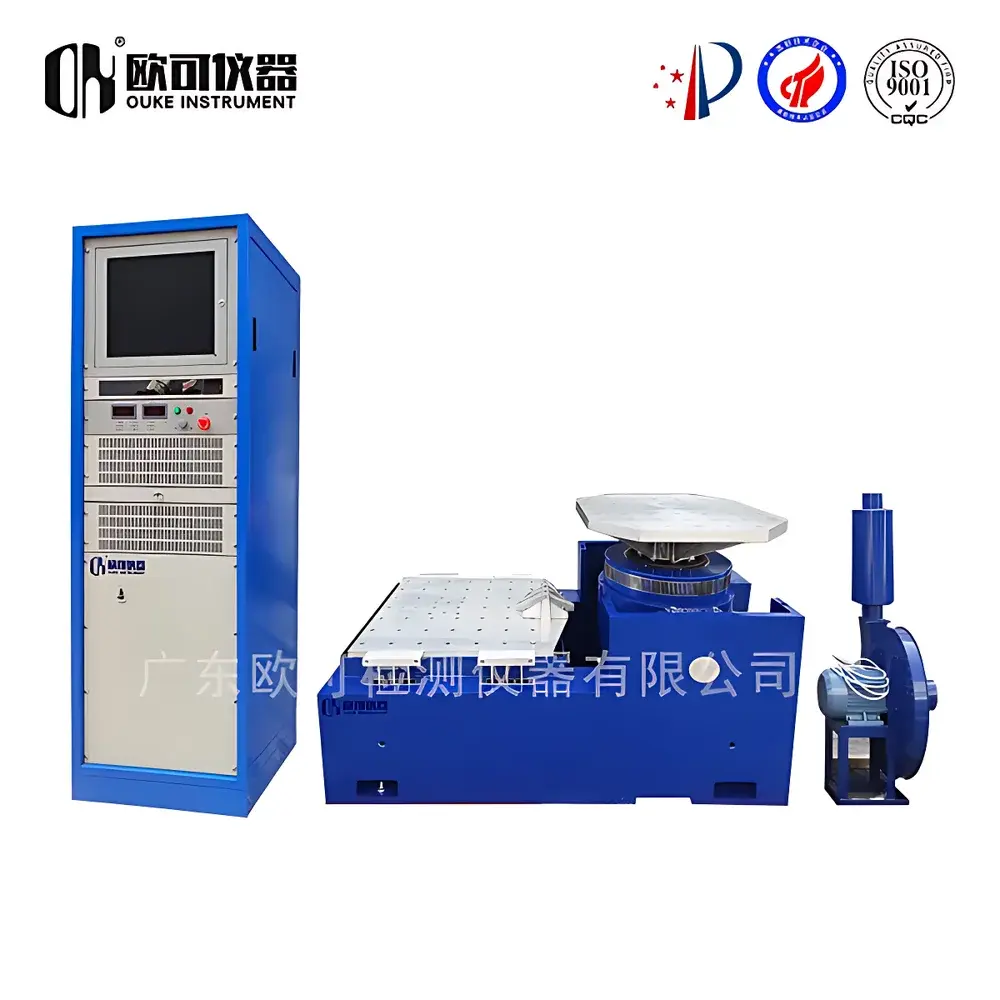
OK-ES-3.35 High-Frequency Hydraulic Vibration Shaker
| Brand | OK Instruments |
|---|---|
| Origin | Guangdong, China |
| Manufacturer Type | Direct Manufacturer |
| Instrument Type | Hydraulic Vibration Shaker |
| Rated Thrust | 1.98 kN |
| Frequency Range | 5–5000 Hz |
| Max. Test Load | 70 kg |
| Table Dimensions | 300 × 300 × 30 mm |
| Max. Acceleration | 10 g |
Overview
The OK-ES-3.35 High-Frequency Hydraulic Vibration Shaker is a precision-engineered dynamic excitation system designed for controlled generation and reproduction of high-frequency mechanical vibration in laboratory and engineering test environments. It operates on the principle of servo-hydraulic actuation—leveraging high-bandwidth hydraulic servo valves, low-inertia moving mass assemblies, and rigid force transmission architecture to achieve stable, repeatable acceleration profiles across a broad spectral range (5–5000 Hz). Unlike electrodynamic shakers optimized for mid-frequency fidelity or large-displacement testing, the OK-ES-3.35 is specifically configured for applications demanding high acceleration output (>10 g), tight frequency resolution, and robust performance under sustained high-cycle loading. Its design prioritizes structural rigidity, thermal stability, and closed-loop control integrity—making it suitable for modal analysis, high-cycle fatigue studies, sensor calibration, and aerospace component qualification where fidelity at the upper end of the audible and lower ultrasonic spectrum is critical.
Key Features
- Hydraulic actuation system with high-force density and low moving mass—enabling efficient energy transfer at frequencies up to 5 kHz
- Rigid 300 × 300 × 30 mm aluminum alloy table with integrated mounting threads and T-slots, engineered for minimal modal interference below 6 kHz
- Closed-loop acceleration control using piezoelectric accelerometers and real-time digital signal processing (DSP) feedback
- Rated thrust of 1.98 kN ensures stable excitation of test articles up to 70 kg under sinusoidal, swept-sine, or narrowband random input spectra
- Thermally compensated hydraulic power unit with pressure ripple suppression and oil temperature regulation (±1°C stability)
- Compliant with ISO 5344:2005 (Mechanical vibration — Requirements for the performance of vibration exciters) for reference calibration traceability
Sample Compatibility & Compliance
The OK-ES-3.35 accommodates specimens ranging from miniature MEMS packages (<5 g) to full-scale aircraft structural subcomponents (up to 70 kg), provided appropriate fixture design and modal decoupling are implemented. Fixture resonance must be verified via impact hammer testing or operational modal analysis (OMA) to ensure first bending mode exceeds 15 kHz—per ASTM E2534-22 guidelines for high-frequency shaker qualification. The system supports compliance testing per MIL-STD-810H Method 514.8 (Vibration), DO-160G Section 8 (Vibration and Acoustic Noise), and ISO 10816-3 (Evaluation of machine vibration by measurements on non-rotating parts). All control firmware logs timestamped waveform data with audit-trail capability aligned with GLP/GMP documentation requirements.
Software & Data Management
Control and analysis are executed via OK-VibControl™ v4.2—a deterministic real-time software platform compliant with IEC 61508 SIL2 functional safety standards. The interface supports dual-channel acceleration feedback, multi-axis synchronization (with optional auxiliary shaker integration), and automated sweep parameter scripting (logarithmic/linear, dwell, level stepping). Raw time-history data is stored in HDF5 format with embedded metadata (calibration coefficients, environmental conditions, operator ID). Export modules generate ASTM E1823-compliant fatigue life reports and ISO 18431-4 spectral descriptors. Data integrity meets FDA 21 CFR Part 11 requirements through electronic signatures, role-based access control, and immutable audit logs.
Applications
- Aerospace: Blade flutter simulation, inlet duct acoustic fatigue assessment, and avionics shock response spectrum (SRS) validation
- Materials Science: Ultrahigh-cycle fatigue (UHCF) testing of Ti-6Al-4V and nickel-based superalloys at 10⁷–10⁹ cycles
- Sensor Metrology: Primary calibration of Class 1 accelerometers per ISO 16063-21, traceable to NIM (China National Institute of Metrology)
- Microelectronics: Interconnect reliability evaluation under high-frequency mechanical stress (e.g., solder joint fatigue in BGA packages)
- Acoustics & Transducers: Characterization of piezoceramic stack actuators and sonar transducer impedance vs. frequency
- Automotive R&D: NVH analysis of lightweight composite chassis components subjected to engine-order harmonics above 2 kHz
FAQ
What is the maximum usable frequency when testing a 70 kg payload?
At full rated load, the effective flat-response bandwidth is 5–3200 Hz (±1.5 dB); above 3200 Hz, amplitude roll-off follows system mechanical cutoff characteristics.
Can the OK-ES-3.35 perform random vibration testing?
Yes—it supports Gaussian and tailored random profiles with PSD shaping up to 5000 Hz, compliant with MIL-STD-810H Annex G spectral definitions.
Is hydraulic oil contamination monitoring included?
The integrated hydraulic unit features real-time particle count sensors (ISO 4406:2022 Class 16/14/11) and automatic bypass filtration with service interval alerts.
Does the system support third-party DAQ integration?
Yes—via IEEE 1588 PTPv2 time synchronization and NI-DAQmx driver compatibility for external high-speed acquisition systems.
What fixture design recommendations apply for >3 kHz operation?
Titanium Grade 5 monolithic fixtures with FEA-validated modal separation ≥3× test frequency; bolted interfaces prohibited above 2 kHz without strain-gauge preload verification.



