
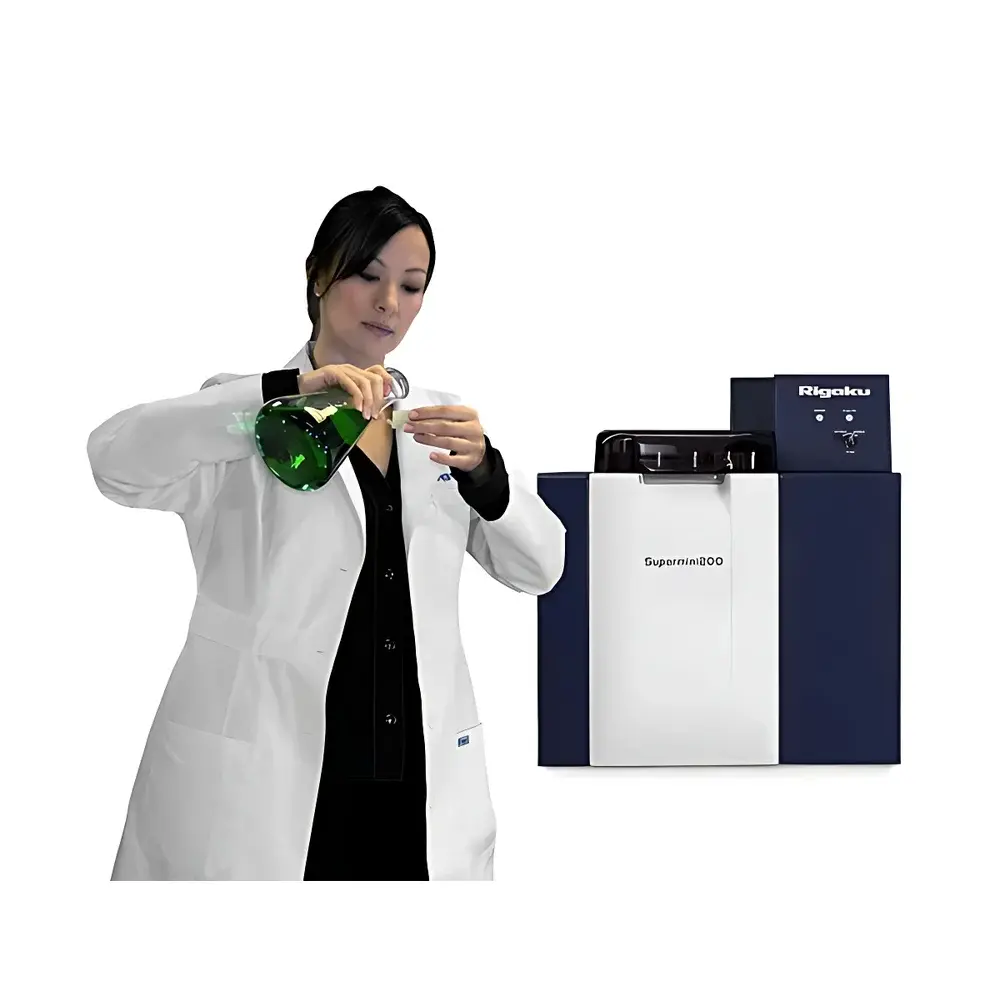
Rigaku Supermini200+ Single-Wavelength XRF Analyzer for Ultra-Low Sulfur, Chlorine, Silicon and Arsenic in Petroleum Products
| Brand | Rigaku |
|---|---|
| Origin | Japan |
| Model | Supermini200+ |
| X-ray Tube | Pd anode, 50 kV / 4 mA, 200 W |
| Detection Limits | S: 0.1 ppm, Cl: 0.1 ppm, Si: 0.5 ppm, As: 0.2 ppm |
| Detection Range | 0–99.99% |
| Standard Compliance | SH/T 0842 (S), SH/T 0977 (Cl), SH/T 0993 (Si) |
| Optical System | Automated multi-crystal spectrometer with high-resolution crystal selection |
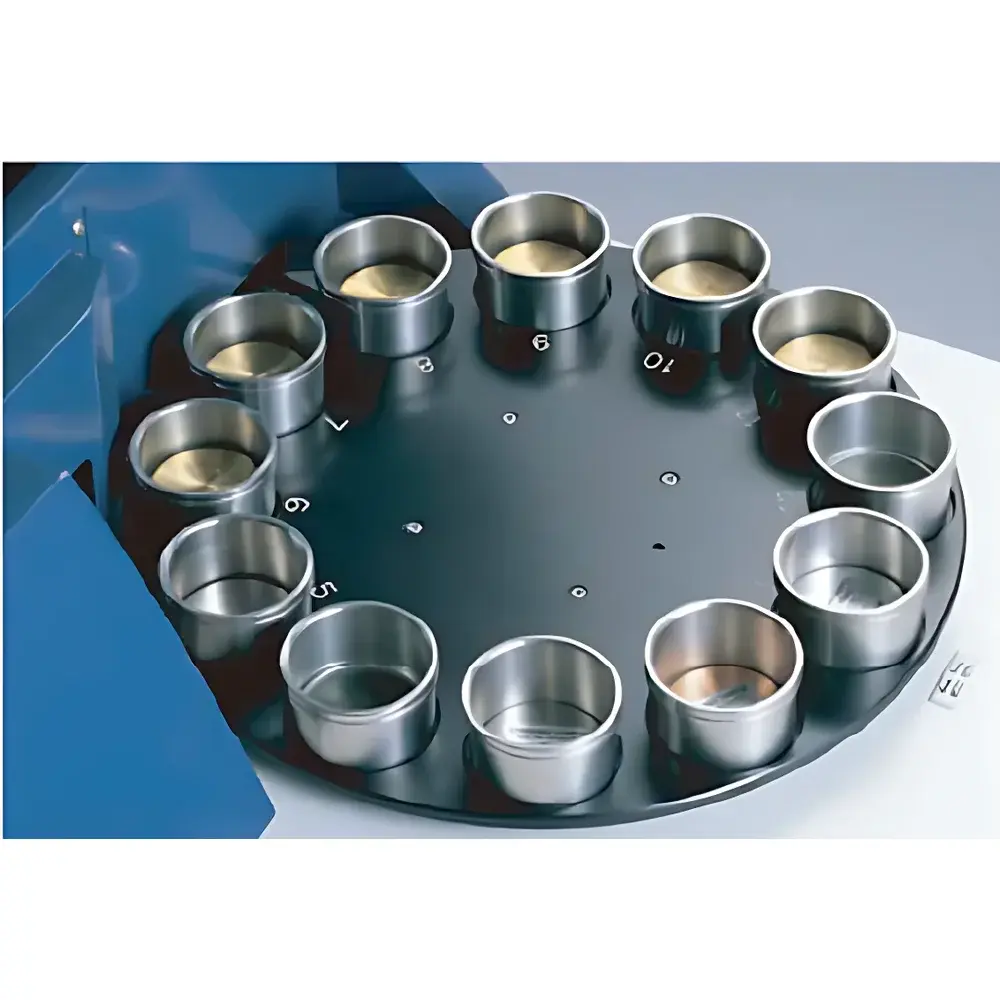
| Sample Handling | 12-position automatic sampler |
| Sample Types | Liquids (gasoline, diesel, naphtha, jet fuel, crude oil, residuum, water, wastewater), solids (catalysts, polypropylene, powders) |
Overview
The Rigaku Supermini200+ is a benchtop single-wavelength wavelength-dispersive X-ray fluorescence (WDXRF) spectrometer engineered for ultra-trace to major-element quantification of sulfur (S), chlorine (Cl), silicon (Si), and arsenic (As) in petroleum-based matrices. Unlike energy-dispersive (EDXRF) systems or conventional sequential WDXRF instruments limited to one element per configuration, the Supermini200+ integrates four dedicated monochromatic excitation channels—each optimized for a specific elemental absorption edge—within a single optical architecture. This design leverages Pd-target X-ray tube operation at 50 kV and 4 mA (200 W total power), enabling significantly improved peak-to-background ratios and lower detection limits compared to legacy 70 W single-element analyzers. The instrument operates on fundamental principles of Bragg diffraction, where characteristic X-rays emitted from the sample are dispersed by precisely selected analyzing crystals (e.g., LiF, PET, TAP) automatically switched via motorized turret, ensuring optimal resolution for each target element across diverse matrix types—from low-sulfur gasoline (<10 ppm S) to high-chlorine catalyst slurries.
Key Features
- Simultaneous four-element capability (S, Cl, Si, As) via integrated single-wavelength WDXRF optics—no hardware reconfiguration required between analyses.
- High-power (200 W) Pd-anode X-ray source delivering enhanced photon flux and superior counting statistics, directly contributing to sub-ppm detection limits and <1.5% RSD at trace levels.
- Automated crystal changer with ≥4 high-purity analyzing crystals, dynamically selected to match the Bragg angle requirements of each element’s Kα line, maximizing spectral resolution and minimizing inter-element interference—especially critical for Cl/S separation in high-sulfur, low-chlorine samples.
- Benchtop footprint (600 × 650 × 450 mm) with plug-and-play electrical interface; no external cooling water or vacuum pumps required.
- Standard 12-position XYZ robotic autosampler compatible with 10–40 mm diameter sample cups, vials, and solid discs—enabling unattended overnight operation and full method automation.
- Comprehensive calibration suite supporting fundamental parameter (FP) quantification, empirical calibration with certified reference materials (CRMs), and semi-quantitative analysis without standards.
Sample Compatibility & Compliance
The Supermini200+ accommodates a broad spectrum of petroleum-related specimens: liquid fuels (gasoline, diesel, jet A-1, naphtha, crude oil, vacuum residuum), aqueous phases (process water, refinery wastewater), and heterogeneous solids (fluid catalytic cracking (FCC) catalysts, hydrotreating catalysts, polypropylene pellets). All measurement protocols align with Chinese petroleum industry standards: SH/T 0842 for sulfur in light hydrocarbons, SH/T 0977 for chlorine in middle distillates, and SH/T 0993 for silicon in fuels. While not pre-certified to ASTM D7039, D7111, or ISO 8754, the instrument’s physical measurement performance (LOD, precision, linearity) meets or exceeds the technical requirements of these methods when validated using appropriate CRMs (e.g., NIST SRM 2721, Conostan S-22, or custom-blended refinery matrices). Instrument design supports GLP-compliant operation through audit-trail-enabled software logging, user access control, and electronic signature functionality.
Software & Data Management
The system runs Rigaku’s proprietary QuantExpress™ software—a fully localized English-language platform with intuitive workflow navigation, real-time spectrum visualization, and embedded spectral deconvolution algorithms. All quantitative routines comply with ISO/IEC 17025 data integrity requirements: raw counts, net intensities, background corrections, matrix corrections (ZAF or α-factor), and final concentration values are stored with full metadata (operator ID, timestamp, calibration ID, sample ID, instrument parameters). Data export supports CSV, XML, and LIMS-compatible formats (ASTM E1384, ASTM E1489). Software includes built-in functions for beam alignment verification, thin-film correction (for coated filters or membrane-separated liquids), and spectral library matching for rapid qualitative screening.
Applications
- Refinery process control: Real-time monitoring of sulfur removal efficiency in hydrotreaters and alkylation units.
- Fuel quality assurance: Verification of ultra-low-sulfur diesel (ULSD, ≤10 ppm S) and jet fuel chlorine compliance (≤1 ppm Cl) per JIG-1 and DEF STAN 91-91.
- Catalyst management: Quantification of Si and As poisoning in FCC and hydroprocessing catalysts to predict deactivation kinetics.
- Environmental compliance: Detection of chloride-induced corrosion precursors and arsenic contamination in sour crudes and produced waters.
- R&D laboratories: Multi-element correlation studies linking feedstock composition (S/Cl/Si/As ratios) to downstream unit fouling and catalyst lifetime.
FAQ
Does the Supermini200+ require helium purge or vacuum for light-element analysis?
No. The instrument uses air-path geometry optimized for S Kα (2.308 keV), Cl Kα (2.622 keV), Si Kα (1.740 keV), and As Kα (10.543 keV) detection; no gas purge or vacuum chamber is necessary.
Can it analyze solid catalysts without pelletization?
Yes. Flat-surface solids—including intact catalyst beads, crushed powders, and pressed pellets—are directly analyzed using the optional sample holder kit with height compensation.
Is method validation support available for regulatory submissions?
Rigaku provides IQ/OQ documentation templates, CRM-based validation protocols, and on-site installation qualification services aligned with ISO/IEC 17025 and internal QA/QC requirements.
What maintenance intervals are recommended for the X-ray tube and crystals?
The Pd tube is rated for ≥20,000 hours of operation; crystal cleanliness should be verified quarterly using reference spectra, with cleaning performed only if intensity drift exceeds ±3% over 30 days.
Is remote diagnostics supported?
Yes. Optional Rigaku RemoteConnect™ enables secure, encrypted technician access for firmware updates, spectral troubleshooting, and performance diagnostics under IT-administered firewall policies.
Related Products






