
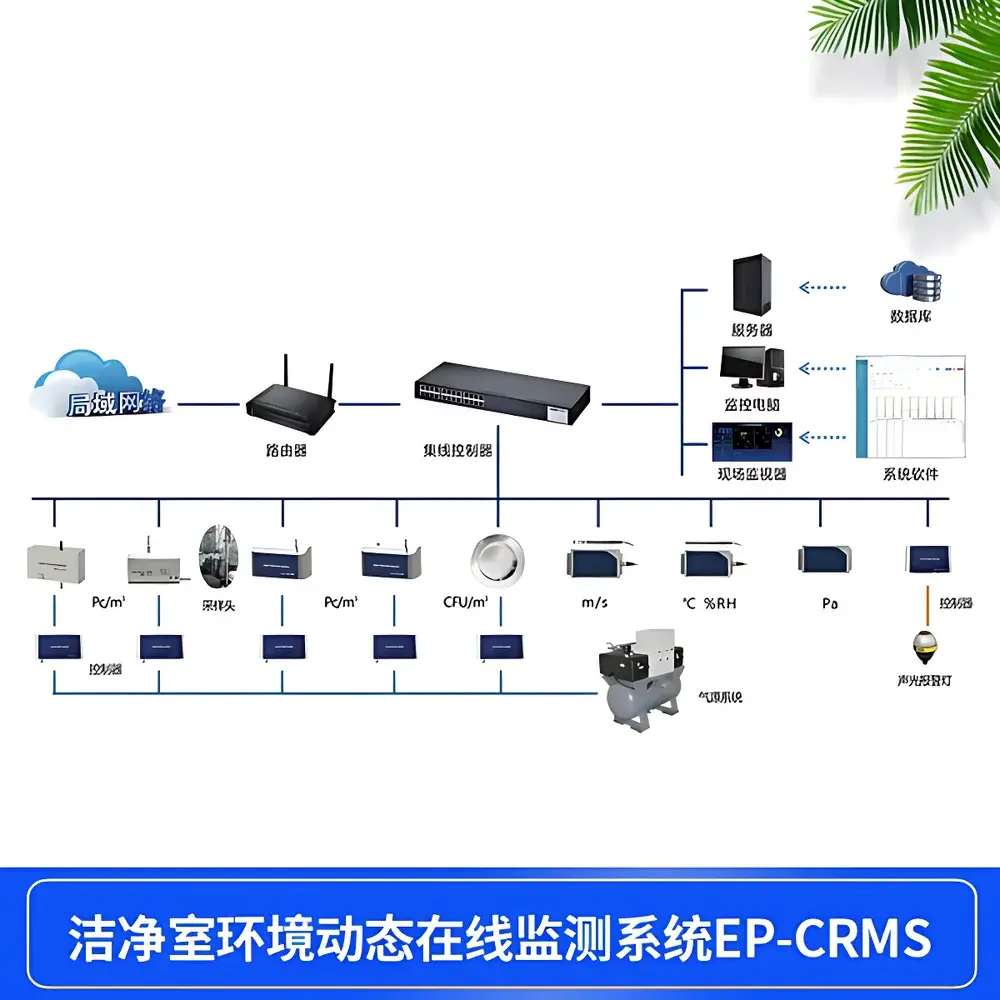
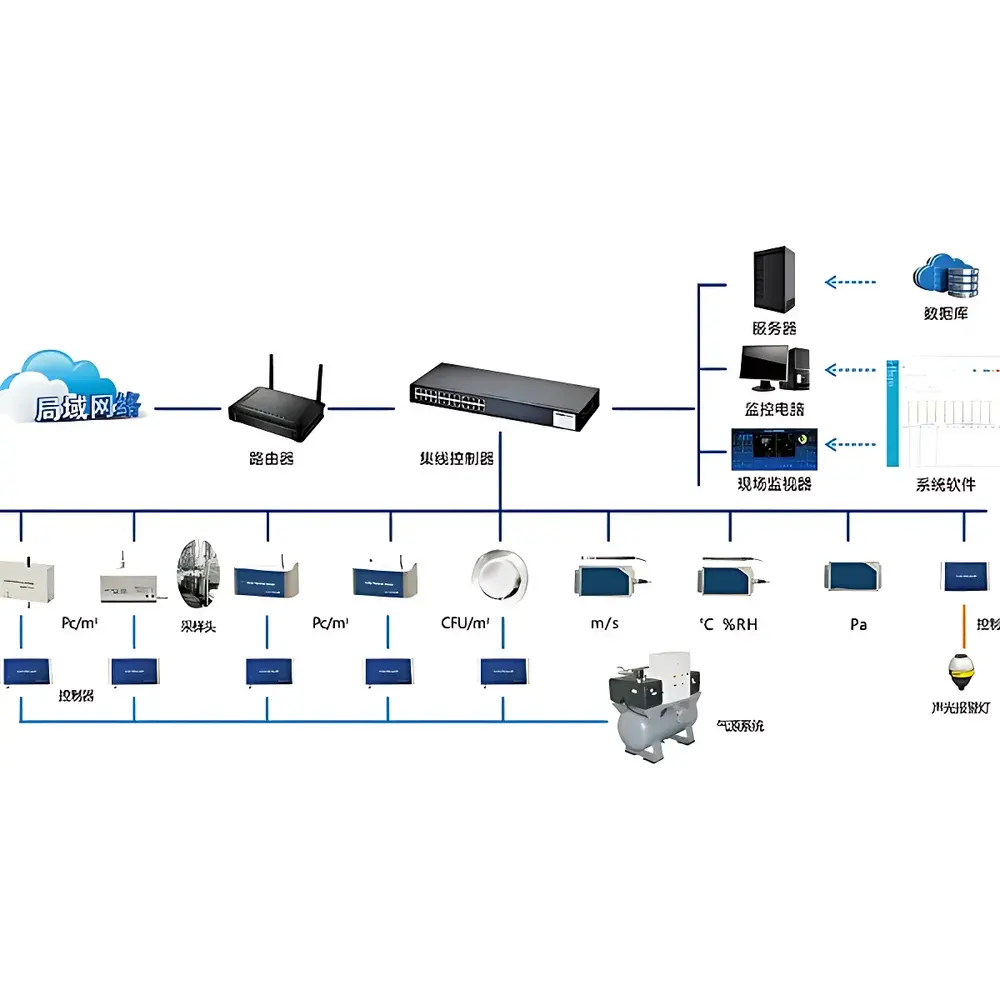
Kanomax EP-CRMS Continuous Environmental Monitoring System for Pharmaceutical Cleanrooms
| Brand | Kanomax |
|---|---|
| Origin | Japan |
| Model | EP-CRMS |
| Type | Online Particle & Environmental Monitoring System |
| Compliance | EU GMP Annex 1, FDA 21 CFR Part 11, ISO 14644-1/2, ISO 21501-4, ISO 14698-1, USP <797>/<800>, China GMP 2010, GB/T 16292–16293, GB 50591-2010 |
| Particle Sensor Options | 0.3/0.5 µm, 0.5/5.0 µm, or multi-channel (0.3–10.0 µm, 2–4 selectable sizes) |
| Flow Rates | 2.83 L/min (0.1 CFM) or 28.3 L/min (1.0 CFM) |
| Laser Source | Long-life diode (>100,000 hr MTBF) |
| Data Storage | Up to 4,320 records per sensor with timestamp, audit trail, and CRC integrity check |
| Communication | RS485 (Modbus RTU/TCP), 4–20 mA, Ethernet (select models) |
| Power | DC 9–28 V or AC 100–240 V |
| Enclosure Material | 316 stainless steel sampling heads |
| Vacuum System | Dual redundant dry-running oil-free rotary vane pumps (N+1 configuration) |
| Alarm Logic | Multi-level (Alert/Action/Alarm), configurable thresholds, real-time audible/visual notification, and automated equipment interlock (e.g., filler stop/start) |
| Software Features | Electronic signatures, 21 CFR Part 11-compliant audit trail, UCL calculation per ISO 14644-1, automated report generation (PDF/Excel), trend analysis, historical data review, and backup archiving |
Overview
The Kanomax EP-CRMS Continuous Environmental Monitoring System is an integrated, multi-parameter online platform engineered for real-time surveillance of critical environmental parameters in pharmaceutical cleanrooms classified under ISO 14644-1 Classes A–D. Designed explicitly to meet the stringent validation and operational requirements of EU GMP Annex 1, FDA 21 CFR Part 11, and China GMP 2010, the EP-CRMS employs laser-based light scattering particle counting (per ISO 21501-4 and JIS B 9921) combined with regulated microbial sampling (per ISO 14698-1) and synchronized physical parameter acquisition (air velocity, temperature, humidity, differential pressure, noise, and illuminance). Its architecture supports dynamic monitoring of high-risk process zones—including aseptic filling lines, lyophilizer loading/unloading stations, isolators, and tunnel sterilizers—enabling continuous verification of environmental control during both static and operational states. The system’s modular topology allows scalable deployment across hundreds of monitoring points while maintaining traceable, time-synchronized data streams compliant with ALCOA+ principles.
Key Features
- Multi-channel particle detection with selectable size bins (0.3 µm to 10.0 µm), supporting simultaneous dual-flow configurations (2.83 L/min and 28.3 L/min) for ISO 14644-1 compliance and routine qualification.
- Integrated floating microbial sampling using FKC-0S impactor with ≥12 m/s jet velocity, ≥50 L/min flow accuracy (±6%), and ≥98% collection efficiency—validated per ISO 14698-1 Annex B.
- Dual-redundant vacuum system featuring two oil-free dry rotary vane pumps (N+1 architecture), enabling uninterrupted 1 m³ sampling volume delivery even during pump maintenance or failure.
- Real-time flow monitoring and automatic compensation via built-in mass flow sensors; all particle and microbial sensors include on-board data caching (up to 4,320 records) with timestamp, checksum, and power-loss recovery.
- Configurable multi-tier alarm logic with user-defined Alert/Action/Alarm limits, root-cause tagging, manual annotation, and programmable interlocks to halt connected process equipment (e.g., fillers, air handlers) upon deviation.
- Fully validated software stack supporting electronic signatures, immutable audit trails (including login/logout, parameter changes, data export, and report generation), and full 21 CFR Part 11 compliance including role-based access control and biometric or token-based authentication.
Sample Compatibility & Compliance
The EP-CRMS accommodates a broad range of cleanroom-grade sampling interfaces, including isokinetic sampling probes fabricated from electropolished 316 stainless steel and internally fluoropolymer-lined sample tubing per GB 50591-2010. All particle sensors are calibrated traceably to NIST-traceable reference aerosols and certified per ISO 21501-4. Microbial samplers undergo annual performance qualification per ISO 14698-2 using defined biological challenge agents. The system’s hardware and firmware design satisfies IEC 61508 SIL 2 functional safety requirements for critical environmental monitoring. Documentation packages include full 4Q validation deliverables (DQ/IQ/OQ/PQ), FAT/SAT protocols, risk assessments (per ICH Q9), and change control logs aligned with GxP quality systems.
Software & Data Management
The central monitoring software provides a browser-based interface compatible with Windows/Linux clients and mobile tablets. It supports concurrent multi-user access with granular permission tiers (Administrator, QA Reviewer, Operator, IT Support). Data acquisition adheres to GAMP 5 Category 4 software standards, with version-controlled configuration files, automated database backups (daily incremental + weekly full), and encrypted archival to network-attached storage or cloud repositories. Reporting modules generate ISO 14644-1 UCL-compliant summaries, statistical process control (SPC) charts, batch environmental summaries, and deviation investigation templates. All exported reports retain embedded digital signatures and cryptographic hash verification for regulatory submission readiness.
Applications
The EP-CRMS is deployed in sterile manufacturing facilities for continuous monitoring of Grade A laminar airflow hoods, isolators, RABS, and background Grade B/C environments. It supports media fill simulations, aseptic process validation, cleaning cycle verification, HVAC requalification, and ongoing process verification per ICH Q5A and Q5C. In biologics and cell therapy suites, it monitors particulate ingress during open manipulations and cryopreservation workflows. Additional use cases include environmental qualification of clean utilities (WFI, PW, compressed gases), stability chambers, and analytical laboratories operating under GLP conditions.
FAQ
Does the EP-CRMS support 21 CFR Part 11 compliance out-of-the-box?
Yes—the system includes pre-validated electronic signature workflows, audit trail logging with immutable timestamps, and role-based access controls fully aligned with FDA requirements for electronic records and signatures.
Can particle sensors be calibrated in situ without removing them from the sampling line?
No—calibration requires traceable aerosol challenge in a controlled environment; however, the system supports automated zero-checks and flow verification between formal calibrations per ISO 21501-4 Clause 7.4.
Is remote monitoring supported over corporate networks or VPNs?
Yes—secure HTTPS access, TLS 1.2 encryption, and optional two-factor authentication enable remote supervision from authorized endpoints without compromising data integrity or audit trail continuity.
What is the maximum number of monitoring points supported in a single EP-CRMS installation?
The architecture scales to ≥500 distributed sensors via daisy-chained RS485 Modbus networks or Ethernet-based subnets, with centralized data aggregation on redundant SQL Server instances.
Are validation documents provided for IQ/OQ/PQ execution?
Yes—comprehensive validation templates, test scripts, acceptance criteria, and completed example protocols are supplied as part of the standard documentation package, aligned with ASTM E2500 and ISPE Baseline Guide Vol. 5.
Related Products







