
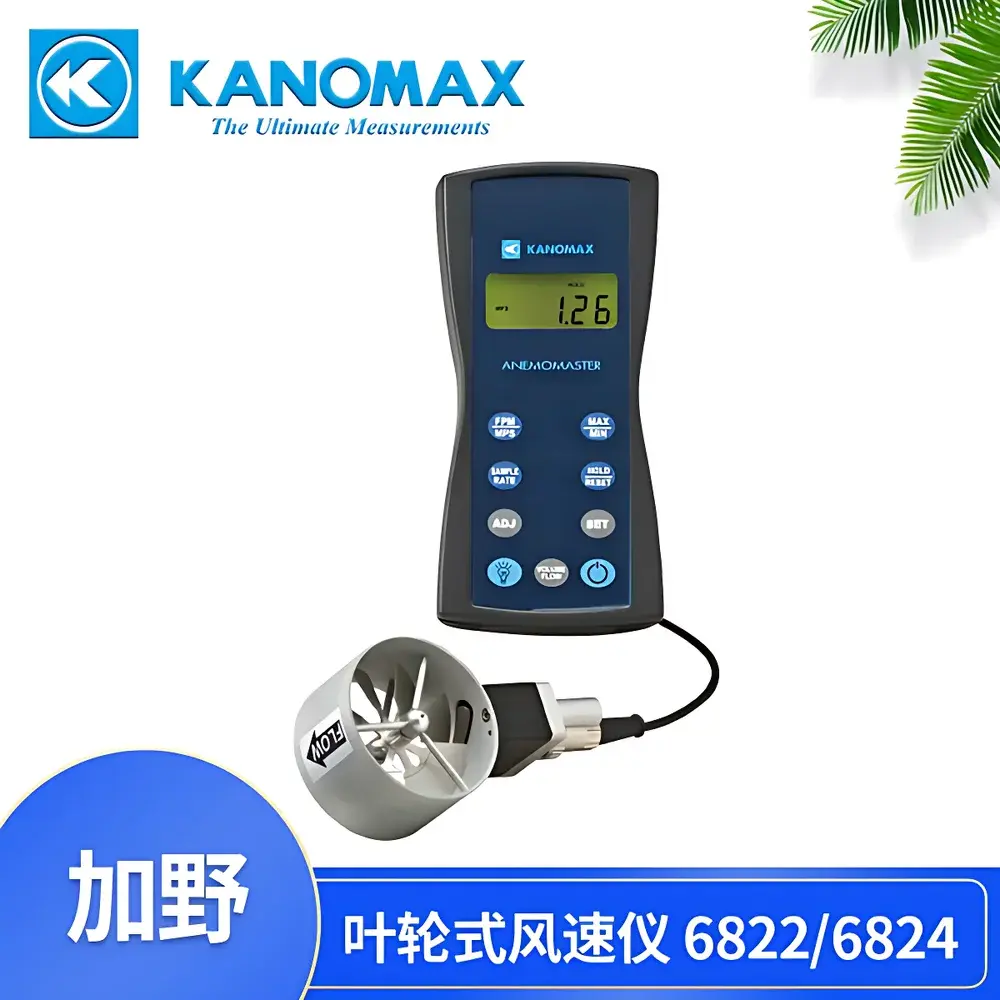
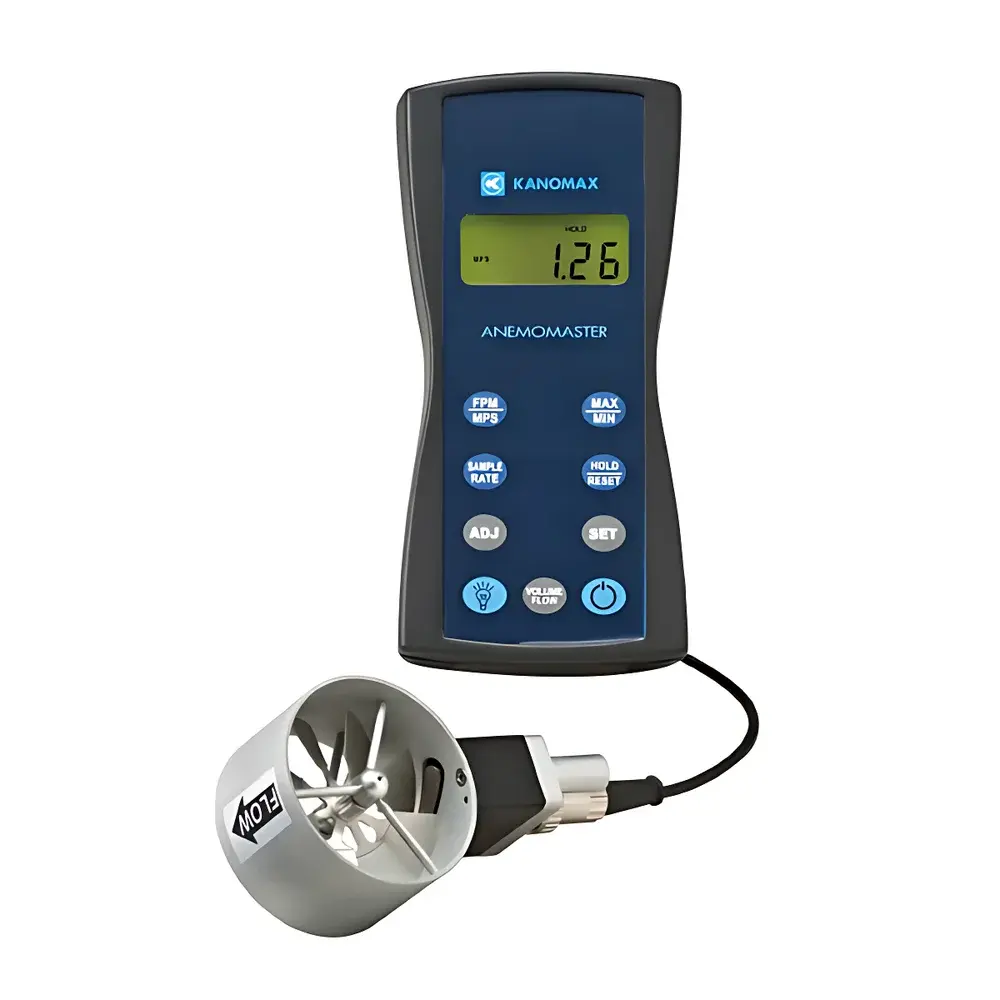
Kanomax Model 6822/6824 Vane Anemometer
| Brand | Kanomax |
|---|---|
| Type | Vane Anemometer |
| Measurement Range | 0.2–20.0 m/s |
| Resolution | 0.01 m/s |
| Accuracy | ±3% of reading or ±0.1 m/s (whichever is greater) |
| Temperature Range | −20 to +100 °C |
| Temperature Accuracy | ±1.0 °C |
| Humidity Range (Model 6824 only) | 5.0–95.0 %RH |
| Humidity Accuracy (Model 6824 only) | ±2.0 %RH |
| Air Volume Calculation | 0–9,999 CFM |
| Probe Diameter | 70 mm |
| Power Supply | 3 × AA batteries |
| Battery Life | Approx. 150 hours |
| Dimensions (W×H×D) | 81 × 165 × 38 mm |
| Weight | 175 g (including batteries) |
| Operating Environment | −20 to +100 °C, 5–95 %RH (non-condensing) |
Overview
The Kanomax Model 6822 and Model 6824 are handheld vane anemometers engineered for reliable, field-deployable measurement of air velocity, temperature, and—where applicable—volumetric airflow in HVAC systems, cleanrooms, industrial ductwork, and environmental validation protocols. These instruments operate on the principle of rotational torque transduction: airflow imparts angular momentum to a precision-balanced 70 mm-diameter vane rotor; rotational speed is converted via optical sensing into a linear velocity output calibrated per ISO 8540-2 and aligned with ASTM D1071 and ASHRAE Guideline 12–2020 requirements for air movement instrumentation. Unlike thermal anemometers, vane-based designs provide superior stability in turbulent, high-velocity, or thermally fluctuating environments—particularly at low-to-moderate flow rates (0.2–20.0 m/s)—and exhibit minimal drift over extended operation. The Model 6824 extends functionality with integrated temperature and relative humidity (RH) sensing, enabling real-time psychrometric calculations and environmental condition logging alongside velocity data.
Key Features
- High-resolution digital display with dual-parameter readout (e.g., velocity + temperature, or velocity + RH)
- Automatic air volume calculation: user inputs duct geometry (rectangular, circular, or irregular cross-section) and dimensions; instrument computes volumetric flow in CFM using standardized continuity equations
- Optically encoded vane sensor with stainless-steel rotor and low-inertia bearing assembly for rapid response (<1.5 s time constant) and long-term repeatability
- Rugged, ergonomic housing (81 × 165 × 38 mm) designed for one-handed operation in confined spaces and overhead duct access points
- Extended battery life: up to 150 hours on three standard AA alkaline cells—no proprietary power modules required
- Wide operating envelope: functional across −20 °C to +100 °C ambient temperatures and 5–95 %RH (non-condensing), supporting applications from freezer coil verification to exhaust stack surveys
Sample Compatibility & Compliance
The Model 6822/6824 is compatible with standard HVAC duct configurations—including rectangular, round, and oval cross-sections—as well as open-area measurements near diffusers, grilles, and laminar flow hoods. Its 70 mm probe diameter ensures representative sampling in ducts ≥150 mm in width or diameter, minimizing edge-effect errors per ISO 16814:2014 Annex C guidance. Calibration traceability follows NIST-traceable procedures maintained by Kanomax Japan’s metrology laboratory. The instrument supports GLP-compliant workflows through manual data recording and timestamped parameter logging; while it does not include built-in electronic audit trails, its deterministic analog-to-digital conversion architecture ensures measurement integrity suitable for ISO/IEC 17025-accredited laboratories conducting routine system balancing or commissioning tests.
Software & Data Management
These models operate as standalone field instruments without onboard memory or PC connectivity. All data must be recorded manually or transcribed into external systems (e.g., Excel, LabWare LIMS, or HVAC commissioning software). However, their consistent output formatting—velocity in m/s (0.01 resolution), temperature in °C (±1.0 °C), and RH in % (Model 6824 only)—facilitates structured entry into validated electronic records. For regulated environments requiring 21 CFR Part 11 compliance, users may integrate readings via secondary documentation controls—such as witnessed transcription with dual-signature logs—or pair the unit with third-party Bluetooth-enabled adapters (not supplied by Kanomax) that support CSV export under controlled configuration management.
Applications
- HVAC system commissioning and TAB (Testing, Adjusting, Balancing) per NEBB and AABC standards
- Cleanroom air change rate verification (ISO 14644-3)
- Fume hood face velocity surveys per ANSI/ASHRAE 110
- Industrial exhaust and ventilation duct profiling
- Environmental chamber airflow uniformity mapping
- Thermal comfort assessments (EN 16798-1, ASHRAE 55)
- Preventive maintenance checks on fans, filters, and dampers
FAQ
What is the difference between Model 6822 and Model 6824?
Model 6822 measures air velocity and temperature only. Model 6824 adds integrated relative humidity sensing, enabling simultaneous three-parameter acquisition.
Can this instrument measure airflow in metric units (m³/h)?
Yes—the device calculates volume flow in CFM by default, but users may apply standard conversion factors (1 CFM = 1.699 m³/h) during post-processing; no onboard SI-unit selection is available.
Is calibration certificate included with purchase?
A factory calibration report (traceable to JCSS/NIST standards) is provided; full ISO/IEC 17025 calibration certificates require separate ordering through authorized Kanomax service centers.
Does the vane probe require periodic cleaning or recalibration?
The rotor should be inspected monthly for dust or grease accumulation; cleaning with isopropyl alcohol and lint-free swabs is recommended. Recalibration is advised annually or after mechanical impact, per Kanomax Technical Bulletin TB-682x-Rev.D.
Is the instrument suitable for outdoor wind speed measurement?
It is not optimized for unshielded outdoor use due to lack of wind-shielded probe design and susceptibility to rain ingress above 95 %RH; indoor and semi-enclosed environments are preferred operational domains.
Related Products







