
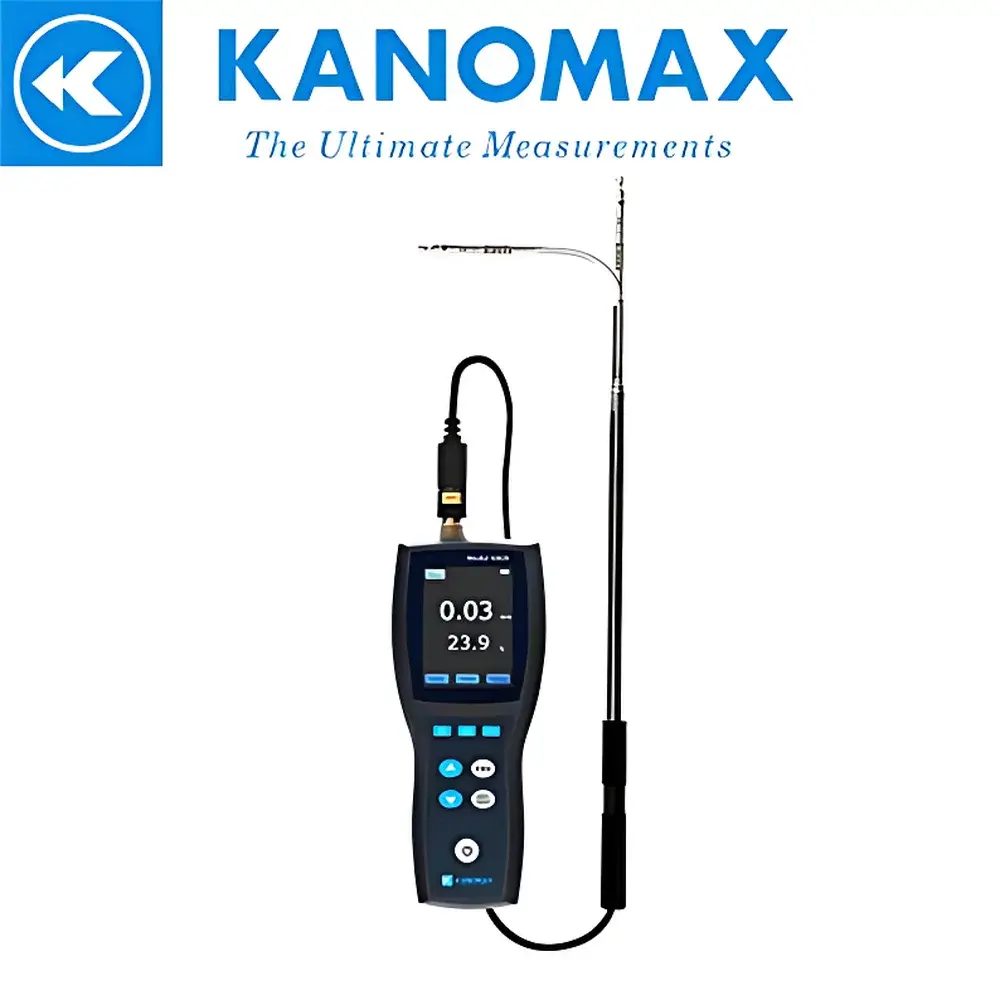
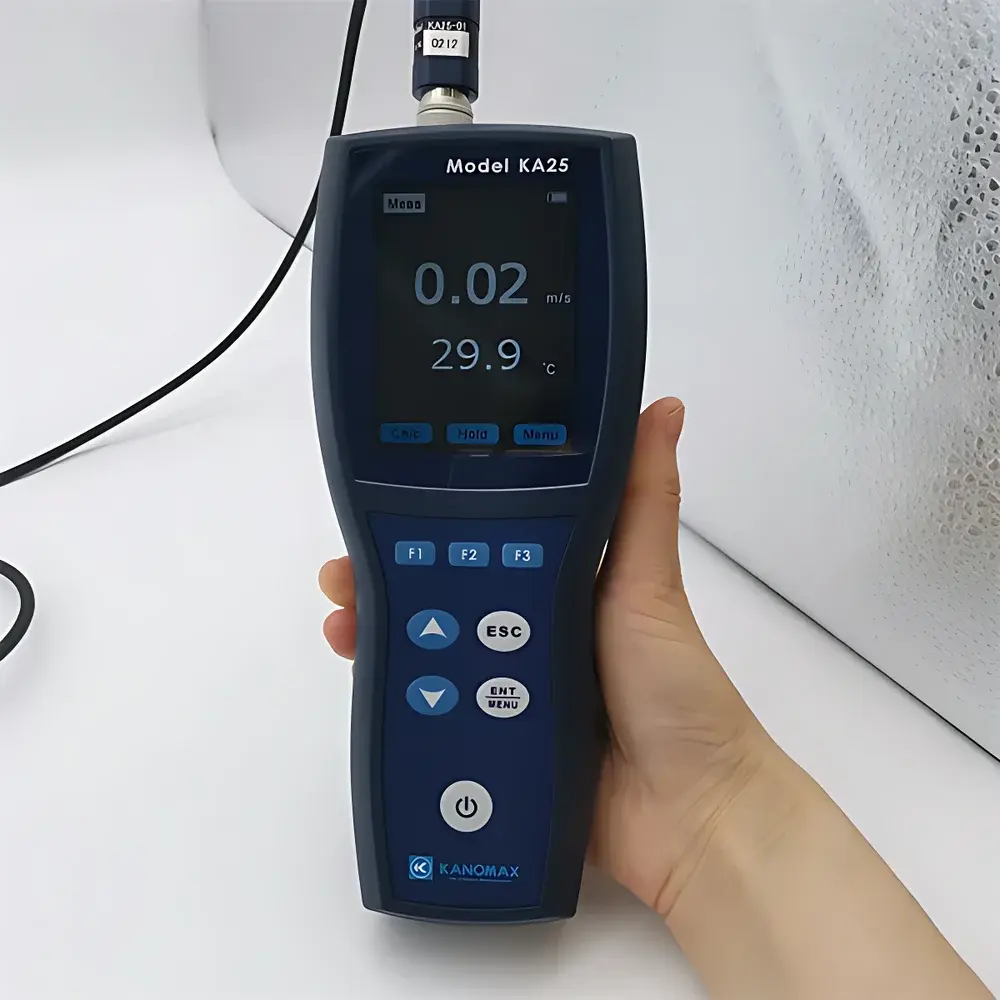
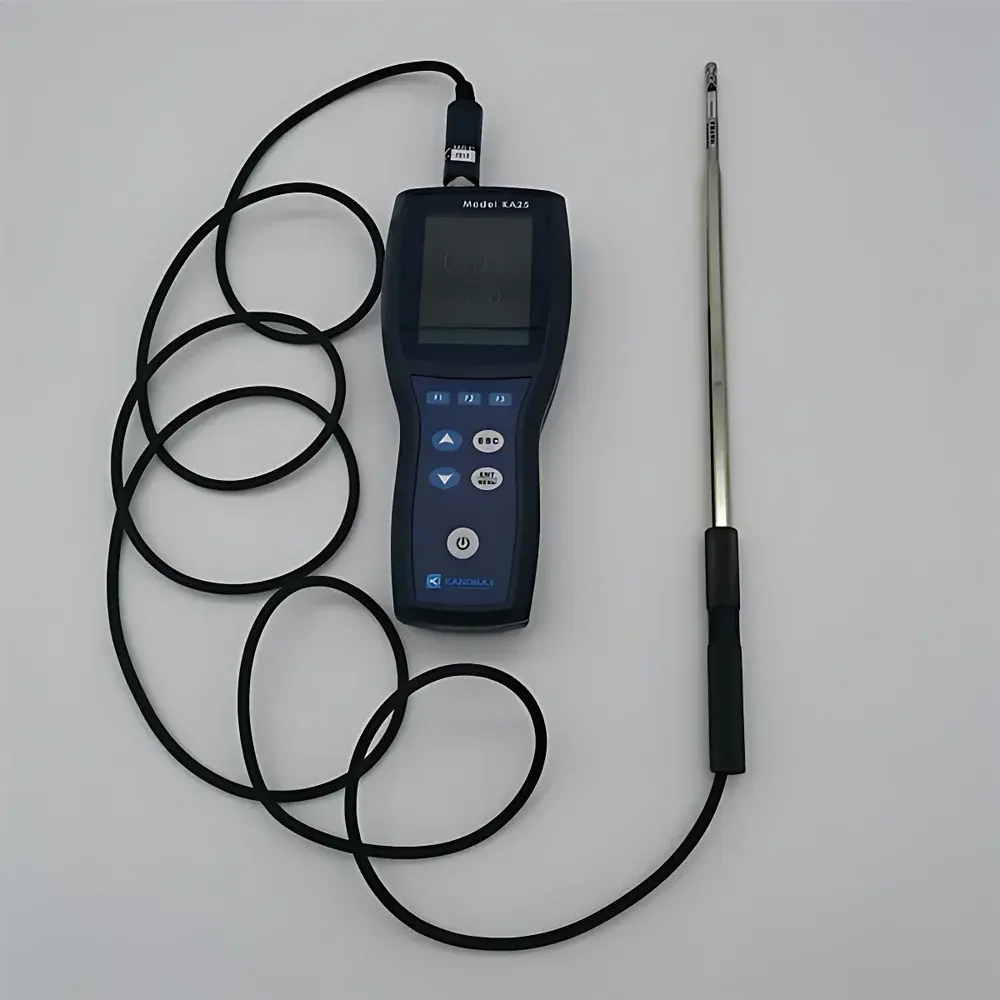
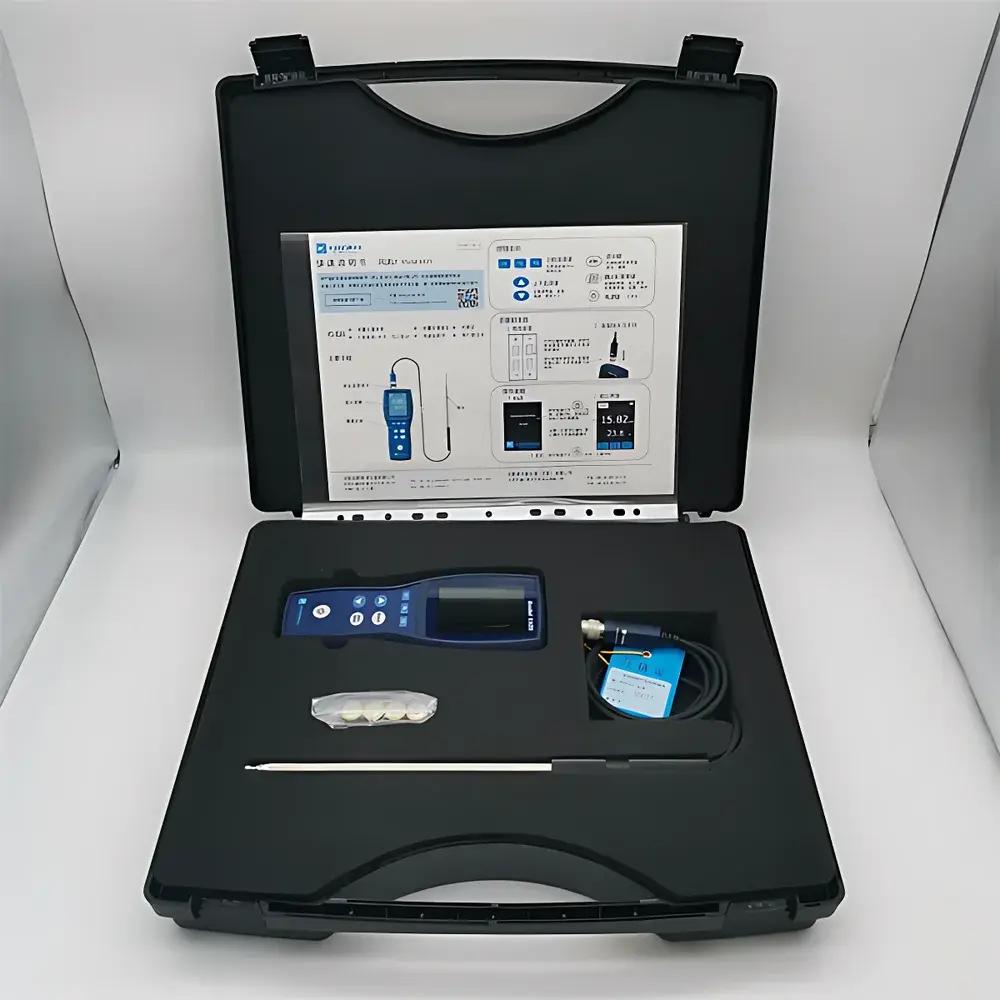
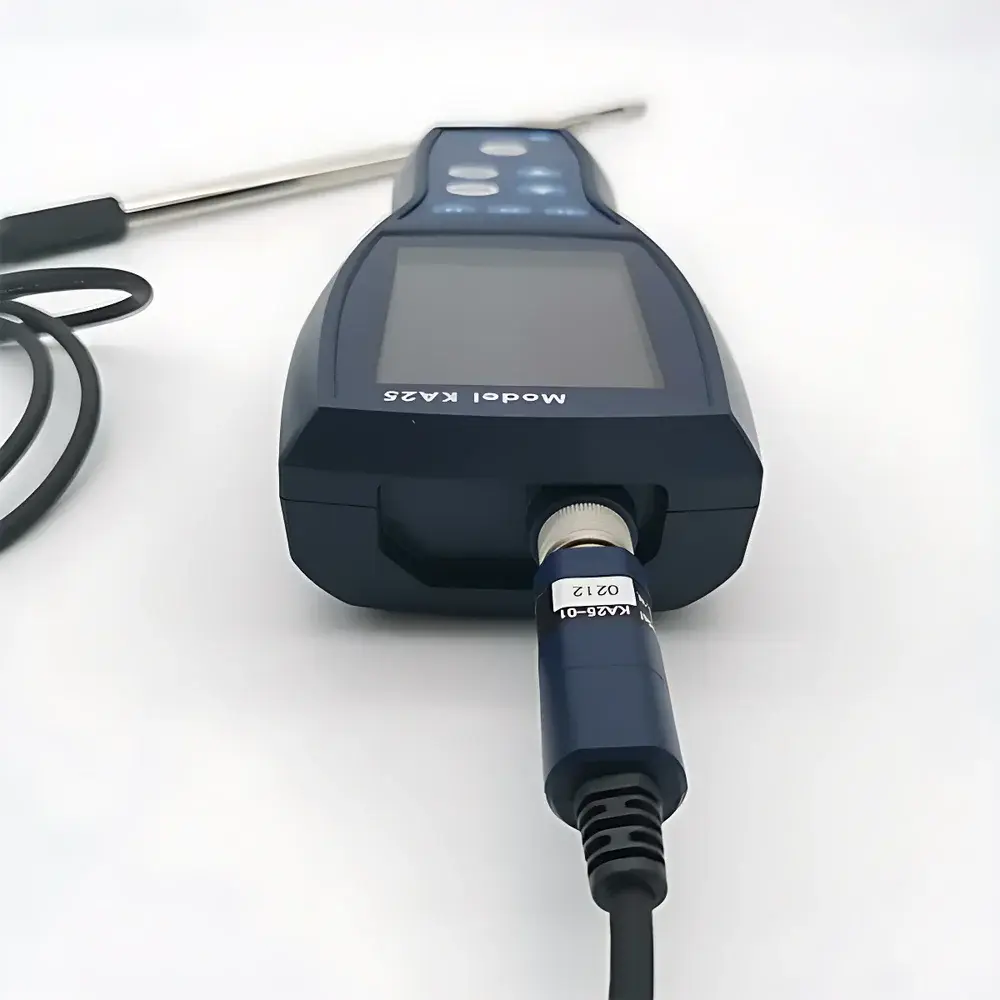
Kanomax KA25 Hot-Wire Anemometer with Air Flow Calculation
| Brand | Kanomax |
|---|---|
| Origin | Japan |
| Model | KA25 |
| Instrument Type | Hot-Wire Anemometer |
| Velocity Range | 0.01–20.0 m/s |
| Velocity Resolution | 0.01 m/s |
| Velocity Accuracy | ±(3% of reading + 0.03 m/s) |
| Temperature Range | −20 to +70 °C |
| Temperature Accuracy | ±0.5 °C (at v > 0.5 m/s) |
| Temperature Resolution | 0.1 °C |
| Response Time (Velocity) | ~1 s (90%, at 1 m/s) |
| Response Time (Temperature) | ~30 s (90%, at 1 m/s) |
| Air Volume Range | ≥1 m³/h |
| Pipe Shape Compatibility | Rectangular & Circular |
| Dimension Input Range | 0.1–255.0 cm |
| Data Hold Function | Yes |
| Auto Power-Off Options | 3/5/10 min |
| Time Constant Settings | 1/5/10/20 s |
| Display | 3-level backlight LCD |
| Power Supply | 4 × AA alkaline batteries |
| Battery Life | ~15 h (1 m/s, 20 °C) |
| Body Dimensions | 200 × 85 × 40 mm |
| Probe Dimensions | Ø6 mm (sensor) / Ø14 mm (handle) × 294–1060 mm (telescoping & bendable) |
| Cable Length | 2000 mm |
| Operating Environment (Body) | 5–40 °C |
| Storage Temperature | −20 to +60 °C |
| Weight | ~220 g (without batteries) |
Overview
The Kanomax KA25 is a precision-engineered hot-wire anemometer designed for reliable, real-time measurement of air velocity and ambient temperature in HVAC commissioning, indoor air quality (IAQ) assessment, cleanroom validation, and industrial ventilation audits. Based on constant-temperature anemometry (CTA), the KA25 employs a fine platinum-coated tungsten wire sensor maintained at a stable temperature differential above ambient. As airflow convectively cools the sensor, the instrument dynamically adjusts current to preserve thermal equilibrium—enabling highly responsive and linear velocity quantification across its full 0.01–20.0 m/s range. Unlike cup or vane anemometers, the KA25 delivers true low-velocity sensitivity down to 0.01 m/s with minimal flow disturbance, making it suitable for laminar flow characterization, duct traverse surveys, and localized air curtain verification.
Key Features
- Integrated dual-parameter sensing: Simultaneous real-time measurement of air velocity and temperature using a single probe
- On-device air volume calculation: User-input duct dimensions (rectangular or circular; 0.1–255.0 cm) enable direct m³/h output without external software
- Telescoping and bendable probe: Ø6 mm sensor tip mounted on a Ø14 mm handle with 294–1060 mm adjustable length and 360° flexible articulation for hard-to-reach locations
- Configurable time constant: Selectable response damping (1 s, 5 s, 10 s, or 20 s) to optimize stability vs. responsiveness per application requirement
- Intelligent statistical functions: On-screen display of min/max/average values during continuous measurement, supporting ISO 16813-compliant IAQ reporting
- Extended data retention: Manual hold function freezes current readings; auto-hold triggered by stable conditions (user-definable threshold)
- Rugged field-ready design: IP54-rated body (200 × 85 × 40 mm), 220 g weight, 3-level backlight LCD, and 15-hour battery life with standard AA alkalines
Sample Compatibility & Compliance
The KA25 is calibrated for clean, non-corrosive, particle-free air — consistent with ISO 7726:2001 ergonomic standards for thermal environment instrumentation. It is not intended for use in saturated, oily, or high-dust environments where sensor fouling may compromise accuracy. The device meets IEC 61000-4-2 (ESD immunity) and IEC 61000-4-3 (radiated RF immunity) requirements for portable test equipment. While not certified for intrinsic safety, its low-power operation (≤1.5 W) and absence of spark-prone components permit use in general laboratory, office, and manufacturing floor settings compliant with OSHA 1910.94 and ASHRAE Standard 62.1 ventilation verification protocols.
Software & Data Management
The KA25 operates as a standalone field instrument with no mandatory PC interface. All measurements, statistics, and configuration settings are managed via its intuitive keypad and LCD. Data export is not supported natively; however, manual transcription of min/max/avg values aligns with GLP documentation practices for HVAC system commissioning reports. The unit supports audit-ready traceability through user-configurable auto-shutdown (3/5/10 min), timestamp-independent hold logging, and battery-level monitoring — features that facilitate compliance with ISO/IEC 17025 clause 7.7 (reporting of results) when integrated into documented QA workflows.
Applications
- HVAC duct traverse and total air volume verification per SMACNA and ASHRAE Guideline 12
- Cleanroom ISO Class 5–8 airflow uniformity mapping and face velocity checks at HEPA filters
- Lab fume hood face velocity validation (ANSI/AIHA Z9.5) and containment performance screening
- Industrial exhaust system balancing and capture velocity assessment near hoods or slots
- Educational aerodynamics labs requiring low-range, high-resolution velocity profiling
- Building envelope leakage testing support (when used with blower door systems for localized infiltration analysis)
FAQ
What calibration standards does the KA25 follow?
The KA25 is factory-calibrated against NIST-traceable wind tunnel references per ISO/IEC 17025-accredited procedures. Certificate of Conformance (CoC) is supplied with each unit; optional NIST-traceable calibration certificate available upon request.
Can the probe be replaced or serviced in the field?
Yes — the KA25 uses a modular probe design with standardized electrical interface. Replacement probes (KANOMAX P/N K-PROBE-KA25) are available separately and require no recalibration when installed.
Is the KA25 suitable for outdoor use in rain or high humidity?
The probe is rated IP54 (dust-protected and splash-resistant), but prolonged exposure to precipitation or condensation is not recommended. The main body must remain within 5–40 °C operating range; extended cold-weather use requires thermal stabilization prior to measurement.
How does the time constant setting affect measurement uncertainty?
Shorter time constants (e.g., 1 s) increase sensitivity to turbulence-induced fluctuations, potentially elevating apparent uncertainty in unsteady flows. For ISO-standardized duct traverses, a 5–10 s setting is typically recommended to ensure representative averaging per ANSI/ASHRAE 111.
Does the KA25 comply with FDA 21 CFR Part 11 for electronic records?
No — the KA25 lacks electronic signature capability, audit trail generation, or secure user authentication. It is intended for use in environments where paper-based or manually transcribed records meet regulatory requirements (e.g., non-GMP HVAC pre-qualification).







