
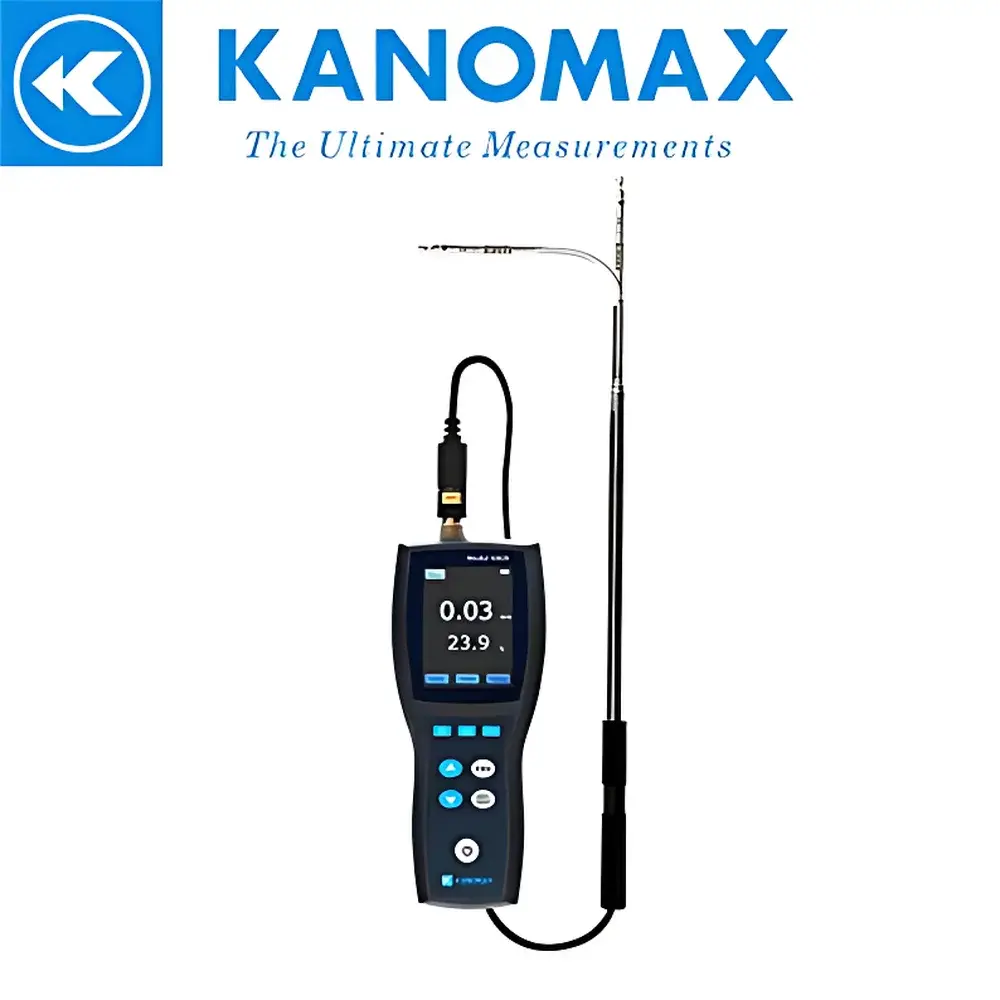
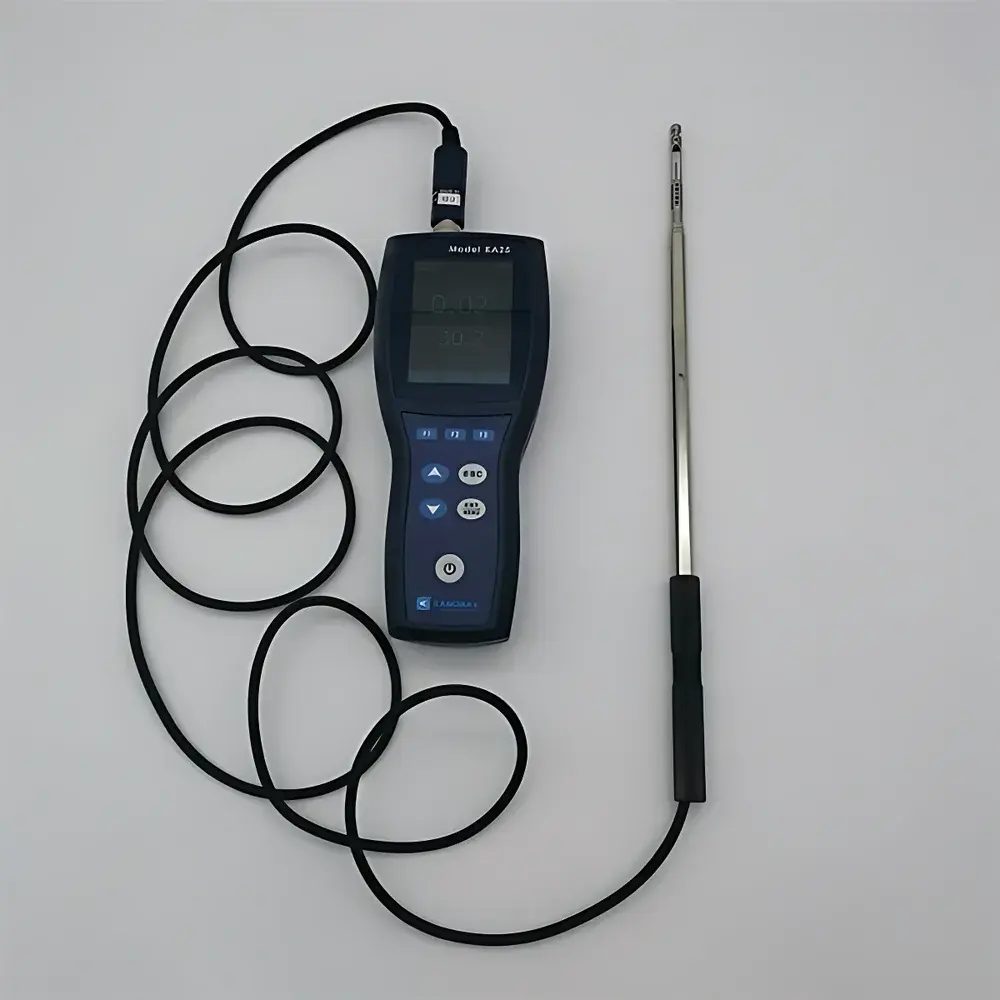
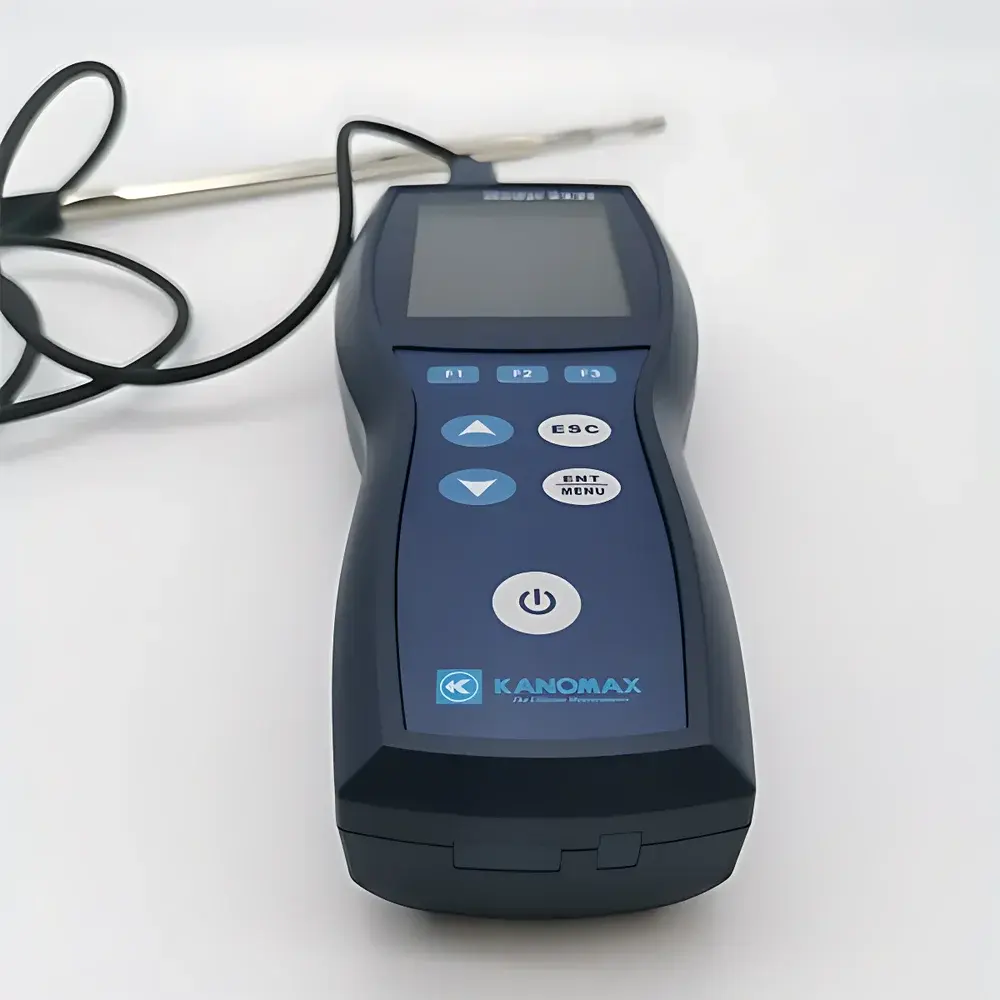
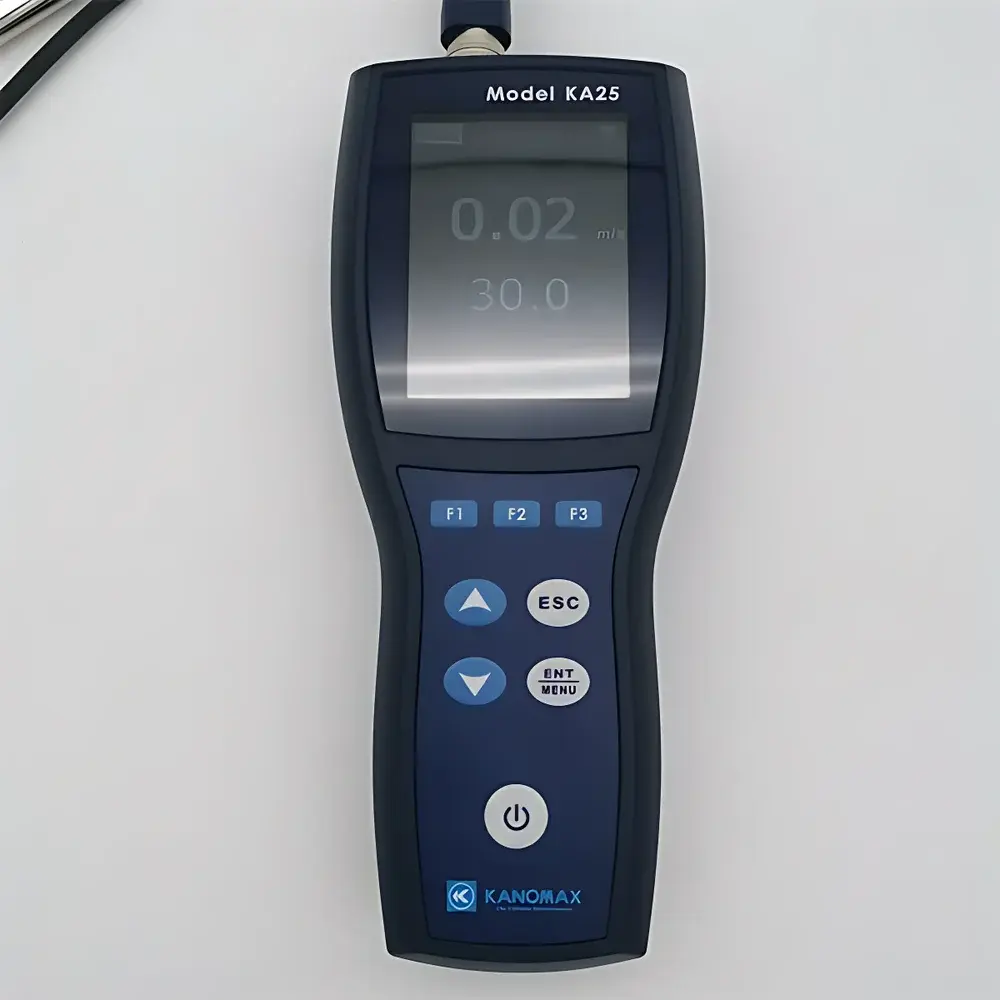
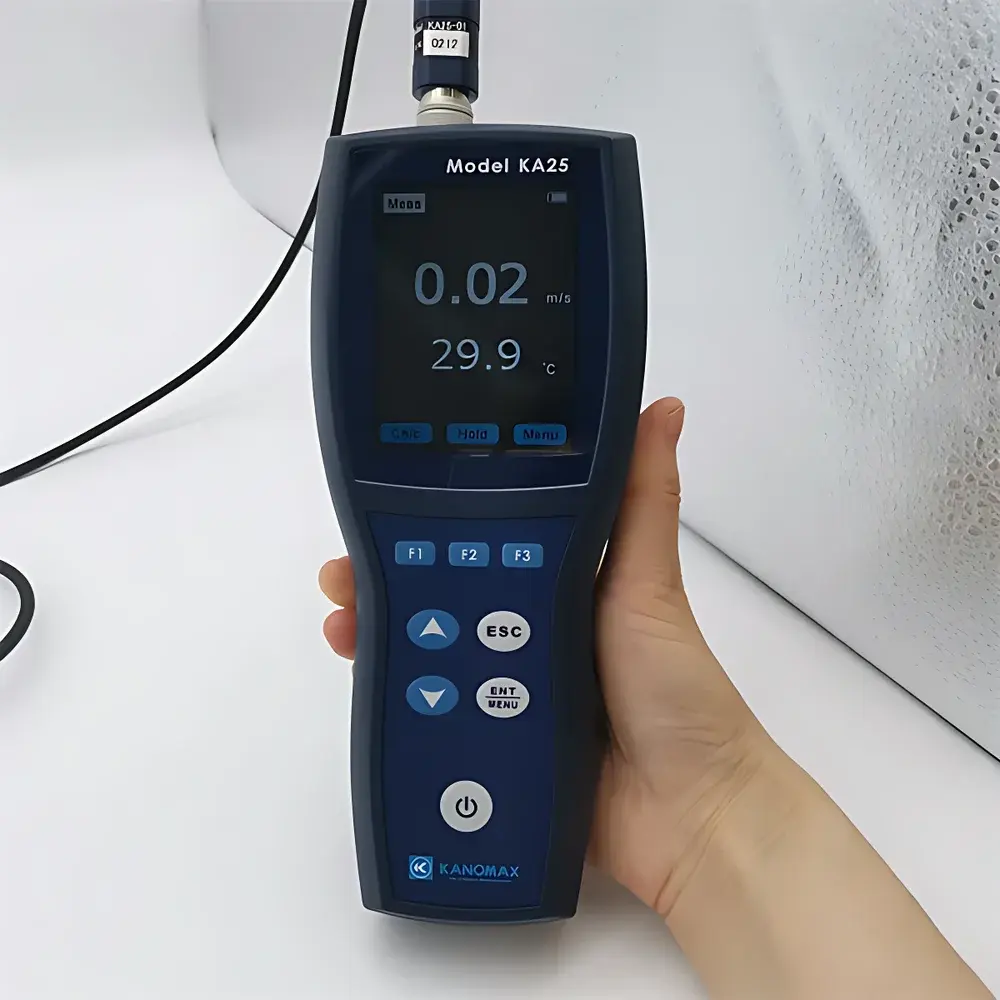
Kanomax KA25 Thermal Anemometer
| Brand | Kanomax |
|---|---|
| Origin | Japan |
| Model | KA25 |
| Instrument Type | Thermal Anemometer |
| Resolution | 0.01 m/s |
| Measurement Range | 0.01–20.0 m/s |
| Accuracy | ±(3% of reading + 0.03 m/s) |
| Operating Temperature | −20 to 70 °C |
| Temperature Accuracy | ±0.5 °C (at v > 0.5 m/s) |
| Temperature Resolution | 0.1 °C |
| Response Time (Wind Speed) | ~1 s (90% response at 1 m/s) |
| Response Time (Temperature) | ~30 s (90% response at 1 m/s) |
| Air Volume Calculation | Yes (rectangular & circular ducts, dimensions input required) |
| Data Hold, Min/Max/Avg Statistics, Adjustable Time Constant (1/5/10/20 s), Auto Power-Off (3/5/10 min), Backlit LCD (3-level), Battery Life | ~15 h (alkaline AA ×4), Weight: ~220 g (body only), Probe Dimensions: Ø6 mm (sensor) / Ø14 mm (handle) × 294–1060 mm (telescoping & bendable), Cable Length: 2000 mm |
Overview
The Kanomax KA25 Thermal Anemometer is a precision-engineered handheld instrument designed for reliable, real-time measurement of air velocity and ambient temperature in HVAC commissioning, indoor air quality (IAQ) assessment, cleanroom validation, and industrial ventilation system audits. Based on constant-temperature anemometry (CTA), the KA25 employs a fine-wire thermistor sensor heated to a stable differential above ambient; convective heat loss from the sensor is directly correlated to local airflow velocity via calibrated thermal transfer physics. This principle ensures high sensitivity at low velocities (down to 0.01 m/s) and stable performance across turbulent or laminar flow regimes—critical for accurate duct traverse measurements and localized air curtain verification. The device operates within a broad environmental envelope (−20 to 70 °C probe operating range), making it suitable for both chilled supply air and high-temperature exhaust applications. Its compact, ergonomic design integrates seamlessly into field workflows where portability, battery autonomy, and rapid deployment are essential.
Key Features
- Thermal sensing principle with 0.01 m/s resolution and full-scale range of 0.01–20.0 m/s, optimized for low-velocity accuracy in diffuser and grille testing.
- Integrated temperature measurement (−20 to 70 °C) with ±0.5 °C accuracy (valid at v > 0.5 m/s), enabling simultaneous thermal and aerodynamic profiling.
- Telescoping and flexible probe (Ø6 mm sensor tip, Ø14 mm handle, 294–1060 mm extended length) with 2 m detachable cable—designed for access into ducts, ceiling plenums, and confined mechanical spaces.
- On-device air volume calculation for both rectangular and circular duct geometries; users input cross-sectional dimensions to derive volumetric flow rate (m³/h) without external computation.
- Configurable time constant (1 s / 5 s / 10 s / 20 s) to match dynamic response requirements—e.g., fast response for transient jet characterization or dampened output for averaging turbulent fluctuations.
- Real-time statistical functions: live display of minimum, maximum, and average values over user-defined intervals; data hold function for stable reading capture during manual traverses.
- Three-level adjustable backlight LCD with intuitive icon-driven interface; auto power-off (3/5/10 min) and battery level indicator extend operational readiness in field conditions.
Sample Compatibility & Compliance
The KA25 is validated for use with clean, dry, non-corrosive air—consistent with standard HVAC and laboratory ambient air monitoring protocols. It is not rated for saturated, particulate-laden, or chemically aggressive gas streams. While not certified to specific ISO or ASTM standards as a standalone metrological artifact, its measurement methodology aligns with principles referenced in ISO 16813:2006 (HVAC air velocity measurement) and ASHRAE Guideline 12-2020 (for infection control in HVAC systems). The instrument supports traceable field verification through documented calibration records and is routinely deployed in environments subject to GLP-compliant facility audits and ISO 14644-3 cleanroom certification workflows. Its robust mechanical construction (IP40-rated housing) and wide operating temperature range ensure consistent repeatability under variable site conditions.
Software & Data Management
The KA25 operates as a fully self-contained field instrument with no proprietary PC software dependency. All measurement, calculation, and storage functions are executed onboard. Data persistence is limited to real-time statistical buffers and instantaneous hold values—no internal memory or USB export capability is included. For integration into structured QA/QC documentation, users typically transcribe readings manually or log them via external digital notebooks compliant with FDA 21 CFR Part 11 requirements (e.g., validated electronic lab notebooks). Calibration certificates issued by authorized Kanomax service centers include traceability to JCSS (Japan Calibration Service System) standards and may be archived as part of equipment qualification dossiers per ISO/IEC 17025 laboratory management systems.
Applications
- HVAC system balancing and duct traverse surveys (per ANSI/ASHRAE Standard 111)
- Diffuser and register performance verification in commercial and healthcare facilities
- Cleanroom air change rate validation (ISO 14644-1/3)
- Local exhaust ventilation (LEV) hood face velocity assessments (HSE HSG258)
- Indoor air quality (IAQ) baseline studies and occupancy-related airflow mapping
- Industrial process cooling air monitoring (e.g., electronics enclosures, transformer bays)
- Educational laboratory experiments in fluid mechanics and thermal engineering
FAQ
Is the KA25 suitable for measuring airflow in dusty or humid environments?
No. The thermal sensor is sensitive to contamination and condensation. Use only in clean, dry air. Regular probe cleaning with isopropyl alcohol is recommended after exposure to particulates.
Can the KA25 measure gas velocities other than air?
It is calibrated exclusively for air. Using it with other gases (e.g., CO₂, N₂) introduces unquantified errors due to differing thermal conductivity and specific heat ratios.
Does the KA25 support external data logging or Bluetooth connectivity?
No. It is a standalone, battery-powered field meter without communication interfaces. All data handling occurs in real time on the device display.
What is the recommended recalibration interval?
Kanomax recommends annual calibration against a NIST-traceable reference anemometer, or more frequently if used in harsh conditions or following mechanical impact to the probe.
How does the time constant setting affect measurement uncertainty?
A shorter time constant (e.g., 1 s) increases responsiveness but amplifies noise in turbulent flows; a longer setting (e.g., 20 s) improves signal stability at the expense of temporal resolution—select based on flow steadiness and reporting requirements.







