
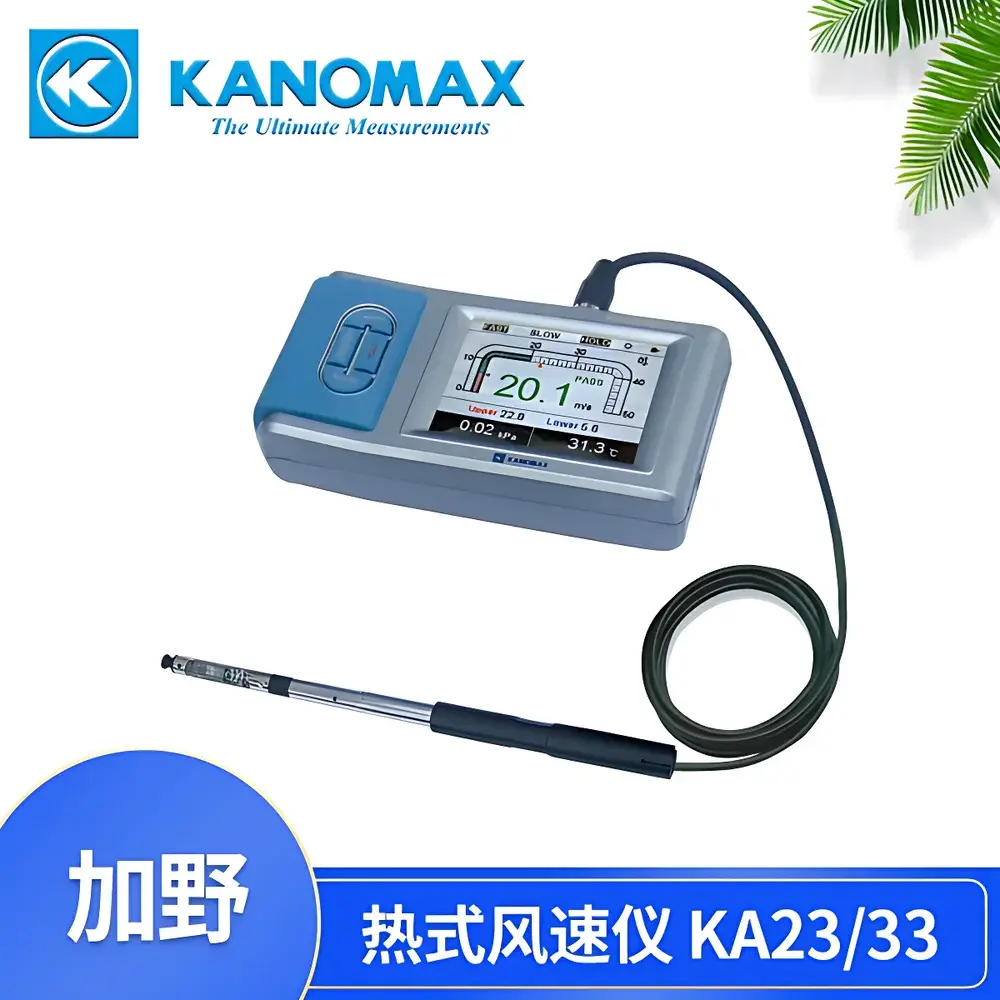
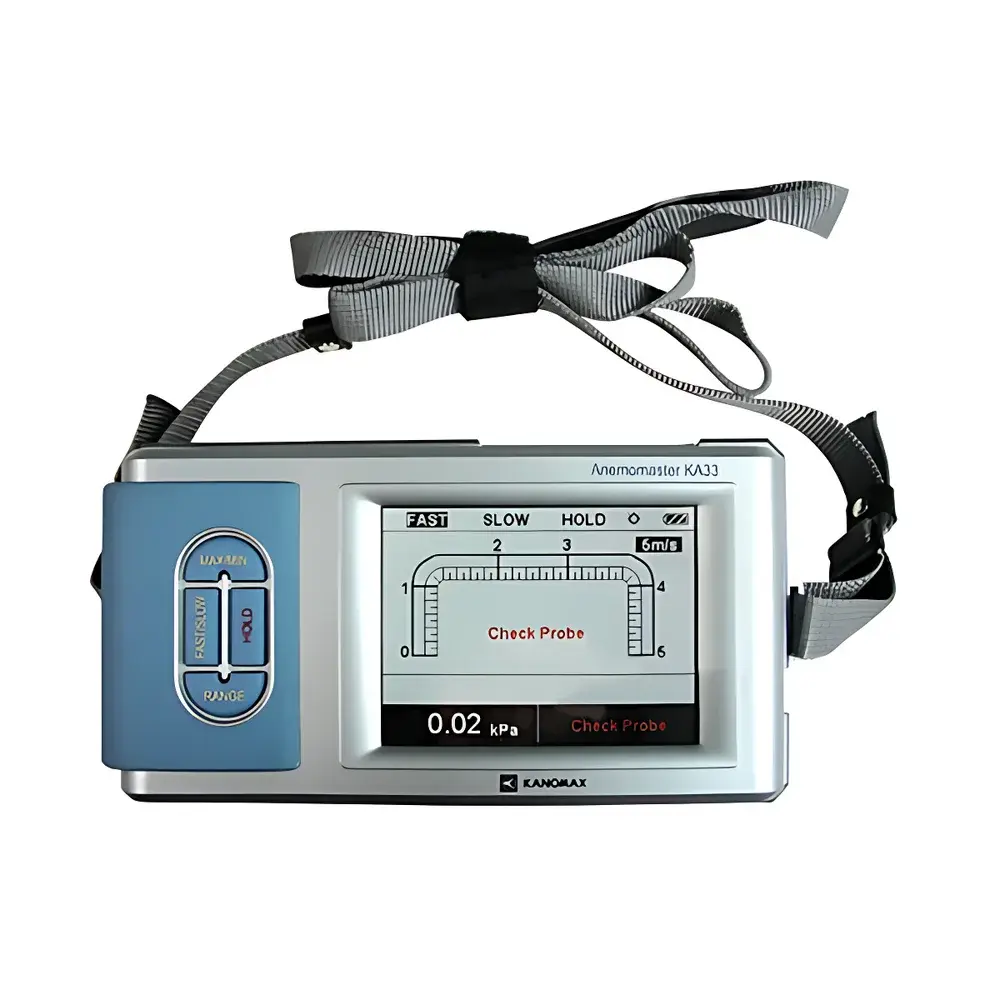
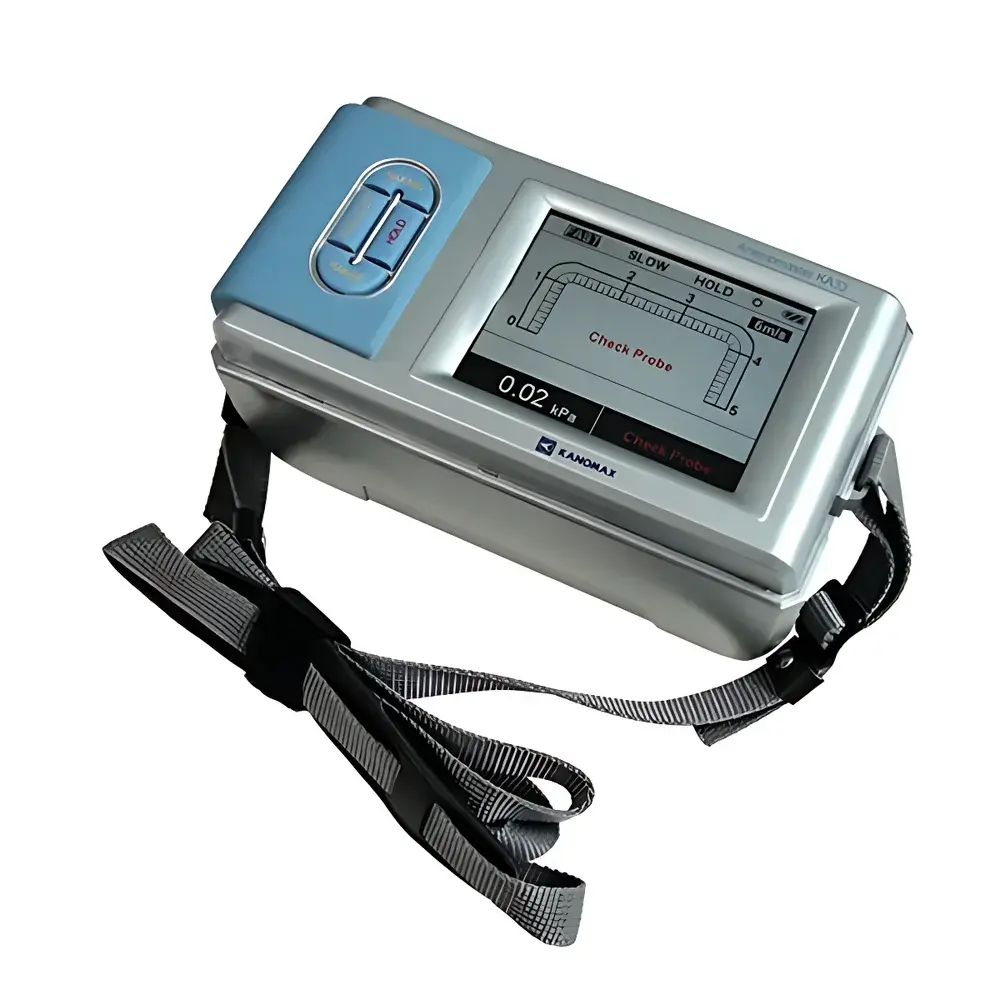
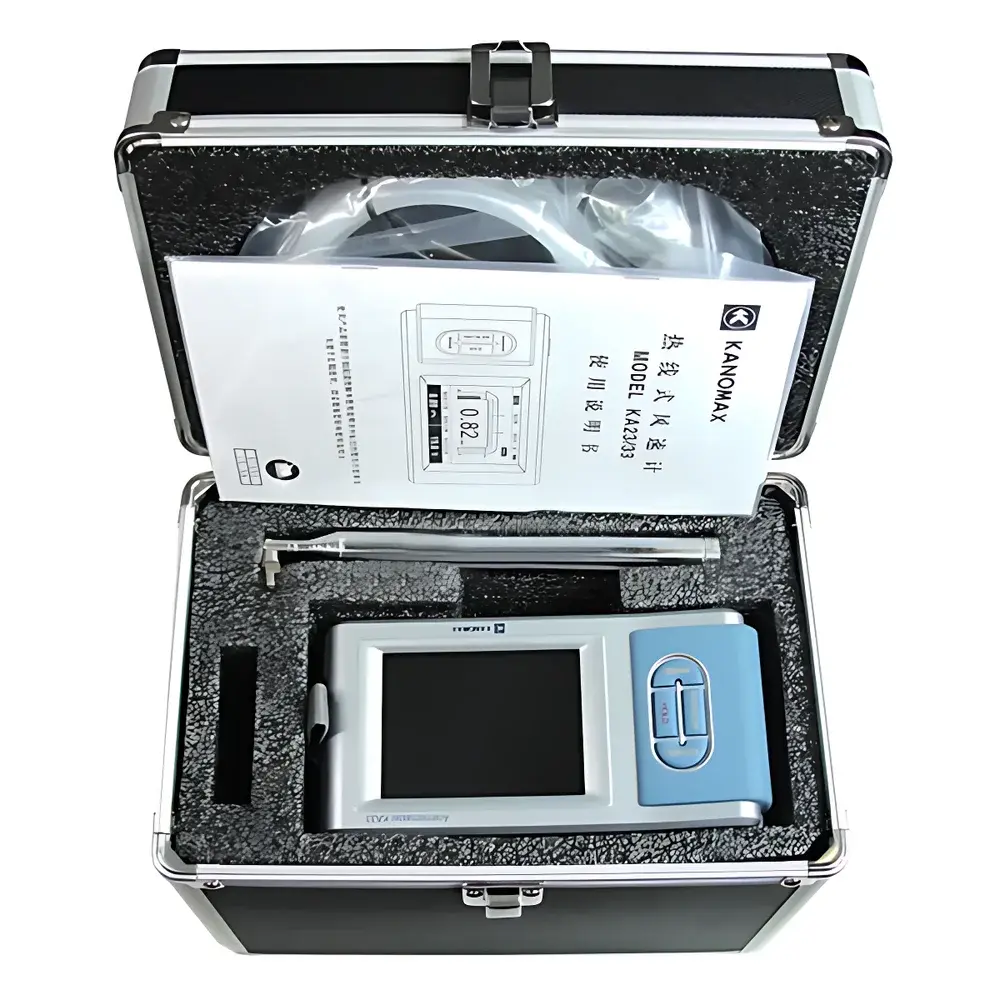
Kanomax KA23 Handheld Thermal Anemometer
| Brand | Kanomax |
|---|---|
| Origin | Japan |
| Model | KA23 |
| Instrument Type | Thermal Anemometer |
| Velocity Range | 0.01–50.0 m/s |
| Resolution | 0.01 m/s (0.00–9.99 m/s), 0.1 m/s (10.0–50.0 m/s) |
| Accuracy | ±2% FS |
| Temperature Range | −20–100 °C |
| Temperature Resolution | 0.1 °C |
| Temperature Accuracy | ±0.3 °C (−20–0 °C and 60–100 °C: ±0.5 °C) |
| Pressure Range | 0.00–±5.00 kPa |
| Pressure Resolution | 0.01 kPa |
| Pressure Accuracy | ±0.1 kPa |
| Operating Humidity | 2.0–98.0% RH |
| Dimensions (Main Unit) | 157 × 42 × 80 mm (W×H×D) |
| Probe Handle Diameter | Max Φ15 mm, Length Adjustable: 140–235 mm |
| Power | 4 × AA Alkaline Batteries or 5 V / 2 A AC Adapter |
| Weight | Approx. 450 g (incl. batteries) |
Overview
The Kanomax KA23 Handheld Thermal Anemometer is an engineered precision instrument designed for real-time, contactless measurement of air velocity, temperature, and differential pressure in HVAC commissioning, cleanroom validation, industrial ventilation assessment, and environmental monitoring applications. It operates on the principle of constant-temperature anemometry (CTA), where a heated sensor element immersed in airflow experiences convective cooling proportional to local gas velocity. The device maintains the sensing wire at a fixed temperature above ambient and measures the electrical power required to sustain that temperature—enabling highly responsive, low-inertia velocity quantification across a wide dynamic range. Unlike cup or vane anemometers, the KA23 delivers true volumetric flow capability when paired with duct geometry inputs, supporting ISO 14644-3, ASHRAE Standard 111, and EN 13779-compliant airflow verification protocols.
Key Features
- Simultaneous measurement of air velocity (0.01–50.0 m/s), ambient temperature (−20–100 °C), and differential pressure (±5.00 kPa) with independent calibration traceability
- Intelligent resolution switching: 0.01 m/s resolution below 10 m/s and 0.1 m/s above—optimized for both laminar and turbulent flow regimes
- Thermally compensated sensor architecture with integrated temperature compensation circuitry, ensuring ±2% full-scale accuracy across its operational temperature envelope
- Three-level adjustable backlight and dual digital/analog display mode for rapid visual interpretation under variable lighting conditions
- Configurable pass/fail thresholding with audible and visual alerts for real-time airflow compliance verification (e.g., ISO Class 5–8 cleanroom inflow criteria)
- Interchangeable probe design—compatible with KA23 and KA33 series probes—enabling field-reconfigurable measurement geometry without recalibration
- On-device statistical analysis: real-time calculation and storage of min/max/average values over user-defined sampling intervals
Sample Compatibility & Compliance
The KA23 is validated for use with clean, dry, non-corrosive air streams at standard atmospheric pressure (±10% deviation). It is not rated for saturated steam, explosive atmospheres (ATEX), or particulate-laden exhaust gases exceeding ISO 16890 G3 filtration class. Its mechanical and thermal specifications conform to IEC 61000-6-2 (immunity) and IEC 61000-6-3 (emissions). While not intrinsically safe, the unit meets CE marking requirements for portable instrumentation used in laboratory, facility, and light industrial environments. Data logging outputs comply with GLP audit trail expectations when exported via USB interface, supporting traceable record retention per FDA 21 CFR Part 11 Annex 11 principles (when used with validated software).
Software & Data Management
Data export is supported via USB connection to Windows-based PCs using Kanomax’s proprietary LogViewer software (v3.2+), which enables time-stamped CSV export, trend charting, and statistical summary generation. The instrument stores up to 10,000 measurement records internally with timestamp, probe ID, and operator tag fields. All stored data includes embedded metadata: measurement mode, units, calibration date, and environmental context (T, P, RH). Exported files are structured for direct import into LIMS platforms or Excel-based QA/QC workflows. No cloud connectivity or remote firmware updates are implemented—ensuring data sovereignty and alignment with controlled environment IT policies.
Applications
- HVAC system balancing and commissioning per ASHRAE Guideline 1 and ISO 16813
- Cleanroom airflow uniformity and velocity mapping (ISO 14644-3, EU GMP Annex 1)
- Biological safety cabinet face velocity verification (NSF/ANSI 49)
- Exhaust hood capture velocity assessments in chemical laboratories
- Industrial drying tunnel and oven air distribution profiling
- Environmental chamber airflow validation during stability testing (ICH Q1)
- Field verification of fan coil unit output and diffuser performance
FAQ
What is the recommended calibration interval for the KA23?
Kanomax recommends annual calibration against NIST-traceable standards; more frequent verification (e.g., pre- and post-critical test runs) is advised in regulated environments.
Can the KA23 measure velocity in high-humidity environments?
Yes—the sensor housing and electronics are rated for continuous operation at 2.0–98.0% RH; however, condensation on the hot-wire element must be avoided to prevent drift or damage.
Is probe interchangeability limited to KA23/KA33 models only?
Yes—only Kanomax-certified thermal probes designated for the KA23/KA33 platform maintain factory-calibrated accuracy; third-party or legacy probes invalidate metrological traceability.
Does the unit support analog output for integration with building management systems?
No—the KA23 provides USB data export only; analog 4–20 mA or 0–10 V output requires external signal conditioning hardware.
How is temperature compensation implemented during velocity measurement?
The KA23 employs a dual-sensor architecture: one thermistor monitors ambient temperature while the hot-wire sensor dynamically adjusts heating current to maintain constant ΔT, enabling real-time correction of convective heat transfer coefficients across −20–100 °C.







