
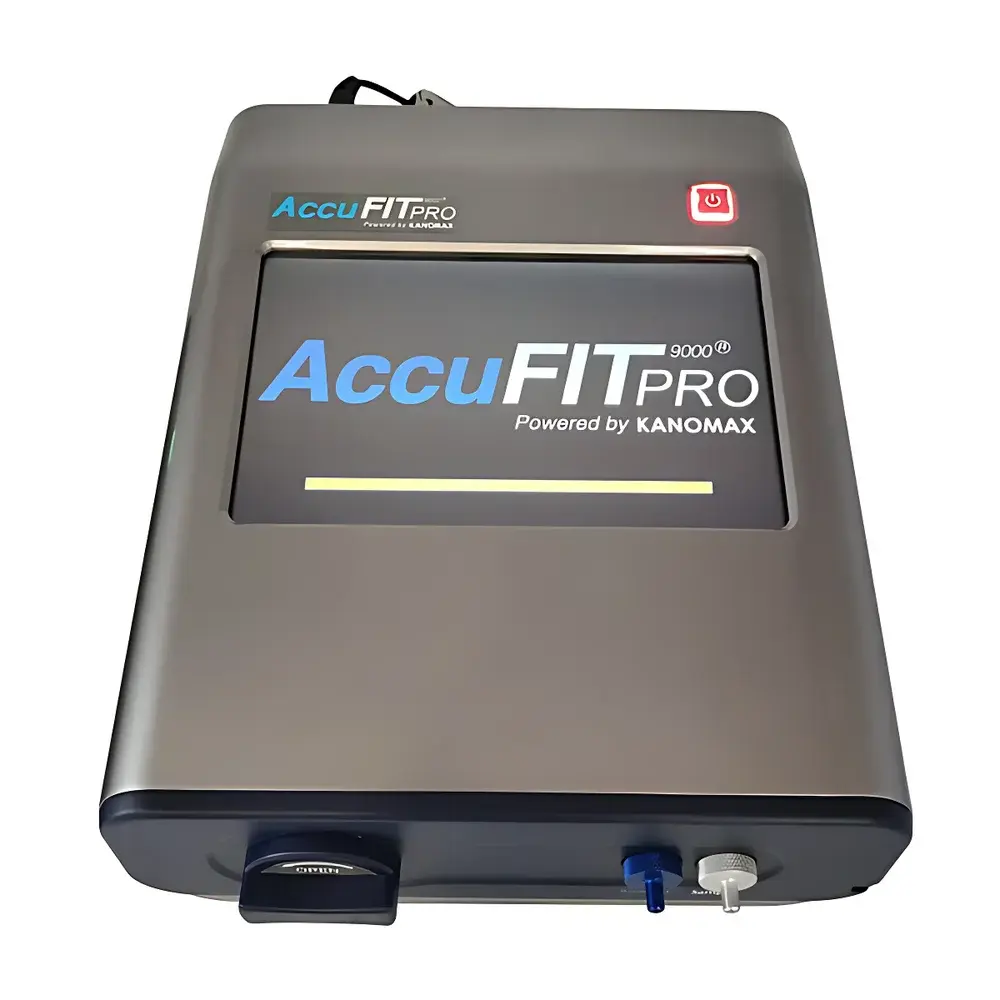
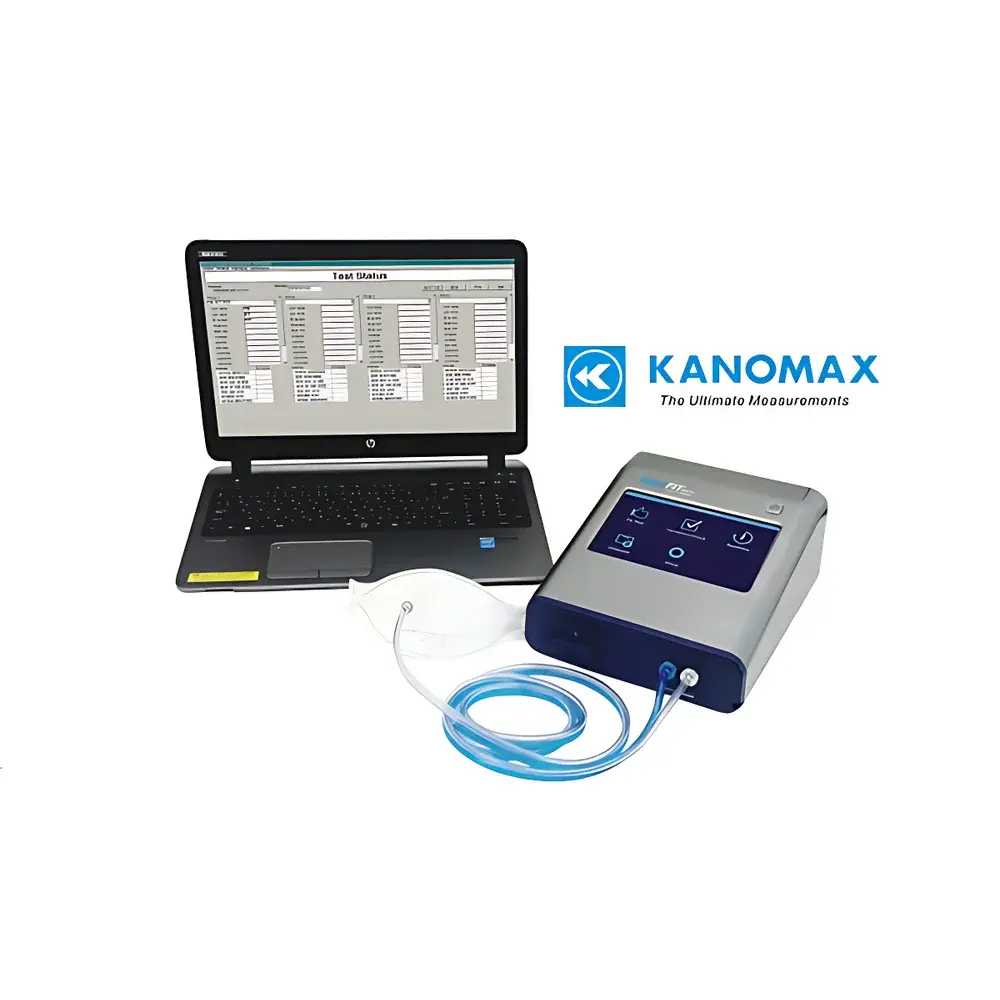
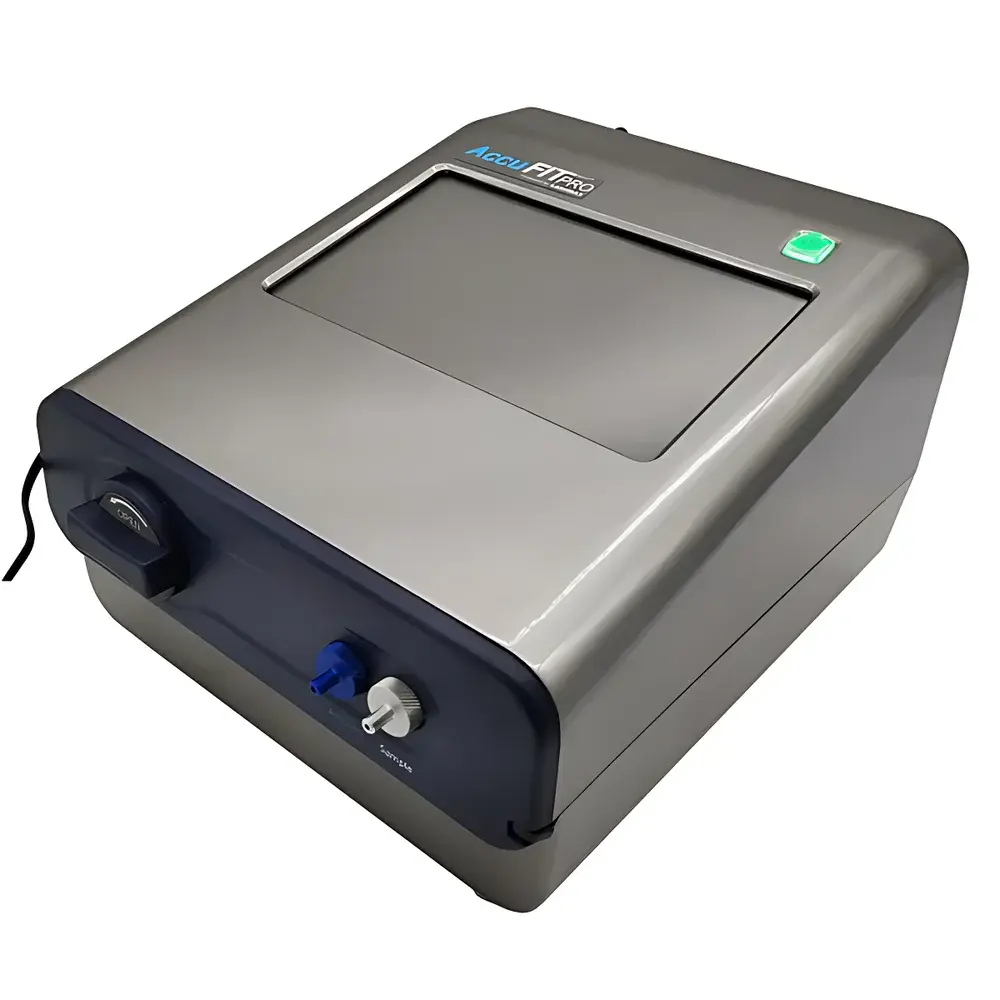
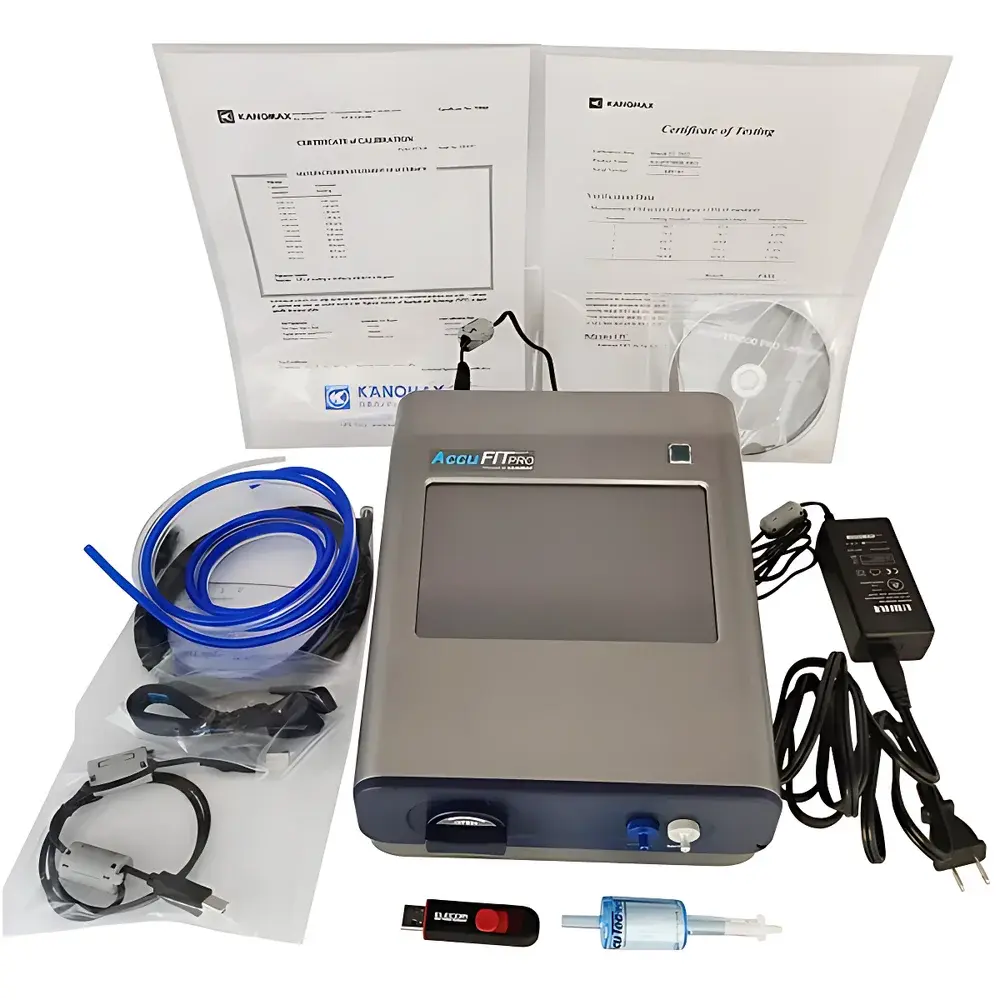
Kanomax AccuFIT 9000 Respirator Fit Tester Model 3000-C1
| Brand | Kanomax |
|---|---|
| Origin | Japan |
| Model | 3000-C1 |
| Concentration Range | 0–100,000 particles/cm³ |
| Particle Size Range | 0.02–1.0 µm |
| Sampling Flow Rate | 100 cm³/min |
| Total Flow Rate | 700 cm³/min |
| Fit Factor Measurement Method | Direct (Cout/Cin) |
| Challenge Agent | Isopropyl Alcohol (≥99.5% purity) or Ethanol |
| Display | 7-inch true-color touchscreen |
| Operating Temperature | 10–35 °C |
| Relative Humidity | 20–85% RH (non-condensing) |
| Power Supply | AC 110–240 V, 50/60 Hz |
| Dimensions | 208 × 117 × 262 mm (W × H × D) |
| Weight | 2.3 kg |
| Compliance Standards | OSHA 1910.134, CSA Z94.4, ANSI/AIHA Z88.10, UK HSE Guidance, GB 2626–2019, GB 19083–2010 |
| Communication Interfaces | USB, Ethernet, Wi-Fi |
| Software Compatibility | Windows 7/8/10, .NET Framework 3.5 |
| Data Export Format | Microsoft Excel (.xlsx) |
| Multi-unit Control | Up to 4 units per PC |
| Language Options | English, Japanese, Chinese, French, Spanish, Portuguese |
Overview
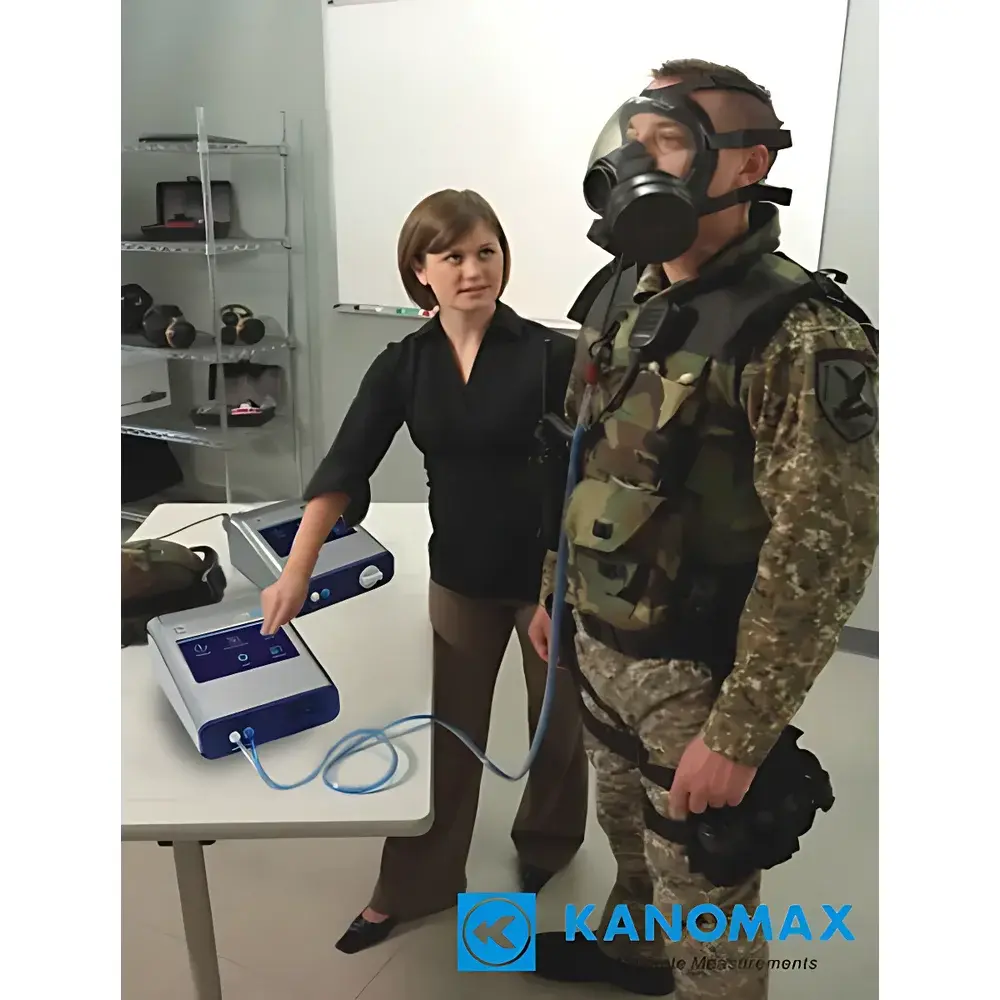
The Kanomax AccuFIT 9000 Respirator Fit Tester Model 3000-C1 is a precision-engineered, quantitative fit testing system designed for objective assessment of respirator-to-face seal integrity in occupational health, clinical, and regulatory compliance settings. It operates on the principle of ambient aerosol condensation particle counting (CPC), utilizing isopropyl alcohol (IPA) or ethanol as a challenge agent to generate a stable, monodisperse aerosol cloud in the breathing zone. The instrument simultaneously samples ambient air (outside the respirator) and inhaled air (inside the respirator facepiece) via dual parallel flow paths, enabling real-time calculation of the Fit Factor (FF) as the ratio of ambient particle concentration (Cout) to intramask concentration (Cin). This direct, non-invasive method eliminates reliance on subjective user feedback and meets the technical requirements for quantitative fit testing defined under OSHA 1910.134 Appendix A, CSA Z94.4, ANSI/AIHA Z88.10-2019, and China’s GB 2626–2019 and GB 19083–2010 standards. With a validated particle detection range of 0.02–1.0 µm and a dynamic concentration range up to 100,000 particles/cm³, the 3000-C1 supports rigorous evaluation of N95, KN95, KP95, KN100, P3, HEPA, and other filtering facepiece respirators (FFRs), half-masks, and full-face respirators.
Key Features
- Quantitative, real-time Fit Factor calculation using dual-sampling CPC technology with Cout/Cin methodology
- Integrated 7-inch true-color touchscreen interface with six-language support (English, Japanese, Chinese, French, Spanish, Portuguese)
- Modular airflow architecture: 100 cm³/min sampling flow + 700 cm³/min total system flow ensures stable aerosol delivery and responsive measurement kinetics
- Compliant challenge agent delivery: high-purity (≥99.5%) isopropyl alcohol or ethanol, thermally controlled for consistent vapor generation
- Multi-unit network capability: one Windows-based PC can control up to four 3000-C1 units simultaneously via USB, Ethernet, or Wi-Fi
- Rugged, portable design: compact footprint (208 × 117 × 262 mm), lightweight (2.3 kg), and rated for continuous operation in ambient conditions from 10–35 °C and 20–85% RH (non-condensing)
- Regulatory-grade data handling: audit-ready test logs with timestamped operator ID, subject ID, respirator model, test protocol, and pass/fail status
Sample Compatibility & Compliance
The 3000-C1 accommodates a broad spectrum of respiratory protection devices, including disposable N95/N90/KN95/KP95/KP100 filtering facepiece respirators, reusable elastomeric half-masks and full-facepieces, powered air-purifying respirators (PAPRs) with tight-fitting hoods, and surgical N95 hybrids compliant with GB 19083–2010. Its particle sizing and counting performance aligns with ISO 21501-4 for optical particle counters and satisfies the minimum detectable Fit Factor thresholds mandated by international frameworks: ≥100 for general workplace use (OSHA/CSA), ≥100 for medical-grade surgical N95s (GB 19083–2010), and ≥200 for positive-pressure PAPRs. All firmware and software modules are developed in accordance with IEC 62304 for medical device software lifecycle management, and raw data export functionality supports FDA 21 CFR Part 11-compliant electronic records when deployed with validated IT infrastructure.
Software & Data Management
The bundled AccuFIT Manager software (v4.x) runs natively on Windows 7/8/10 with Microsoft .NET Framework 3.5. It provides guided test sequencing—including qualitative screening mode, quantitative fit test protocols (e.g., OSHA 7-exercise or CSA 8-exercise regimens), and customizable pass/fail criteria based on respirator class (e.g., KN95: FF ≥ 100; KN100: FF ≥ 500). Test reports are generated in native Microsoft Excel format (.xlsx), preserving all metadata, time-series concentration traces, and statistical summaries (mean FF, standard deviation, worst-seal exercise). Data can be exported directly to USB storage or transmitted over Ethernet/Wi-Fi to centralized LIMS or EHS databases. Audit trail features include immutable timestamps, operator authentication, and change logs—enabling full traceability for GLP/GMP, ISO 45001, or hospital accreditation audits.
Applications
This instrument is deployed across industrial hygiene programs (mining, construction, pharmaceutical manufacturing), healthcare infection prevention units (hospitals, clinics, biosafety labs), government regulatory laboratories (NIOSH-accredited test facilities, CNAS-certified centers), and academic research in aerosol science and respiratory protection efficacy. Typical use cases include annual respirator fit verification for frontline workers, validation of new respirator models prior to procurement, comparative studies of facial anthropometry and seal performance, and development of evidence-based fit-testing protocols aligned with evolving national standards such as China’s GB 2626–2019 update. Its portability and battery-free AC operation also make it suitable for field deployment during outbreak response or emergency preparedness drills.
FAQ
What respirator standards does the 3000-C1 validate against?
It supports quantitative fit testing per OSHA 1910.134, CSA Z94.4, ANSI/AIHA Z88.10-2019, UK HSE guidance, GB 2626–2019, and GB 19083–2010.
Is the instrument suitable for both qualitative and quantitative fit testing?
The 3000-C1 performs only quantitative fit testing; it does not support qualitative methods (e.g., saccharin or Bitrex).
Can test data be integrated into an enterprise EHS platform?
Yes—via Ethernet or Wi-Fi, using standardized Excel export or custom API integration (available under extended support agreement).
Does the system require annual calibration by Kanomax or an accredited lab?
Yes. Annual performance verification against NIST-traceable aerosol generators and flow meters is recommended to maintain compliance with ISO/IEC 17025 requirements.
What is the minimum required sample volume per test cycle?
Each complete 7- or 8-exercise protocol requires approximately 12–15 minutes of continuous aerosol exposure, with no consumable parts beyond the challenge agent and zero-count filter.
Related Products







