
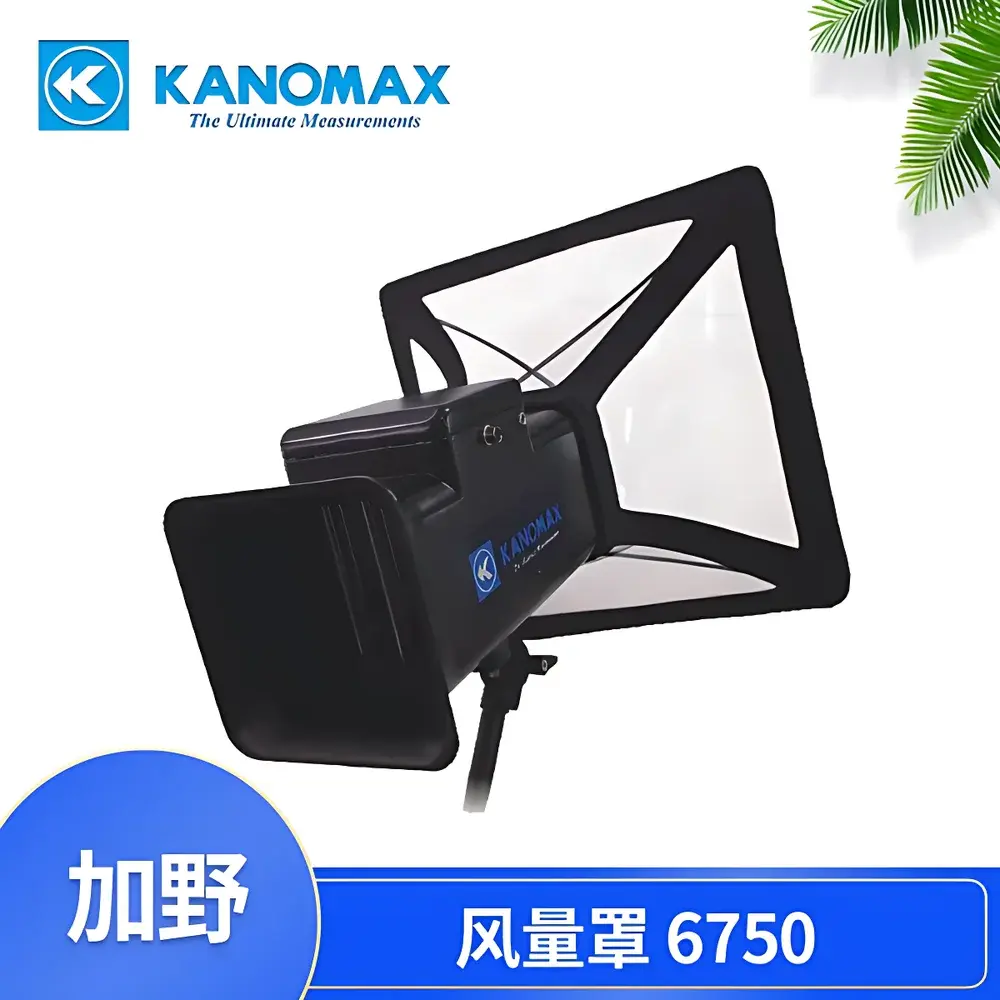
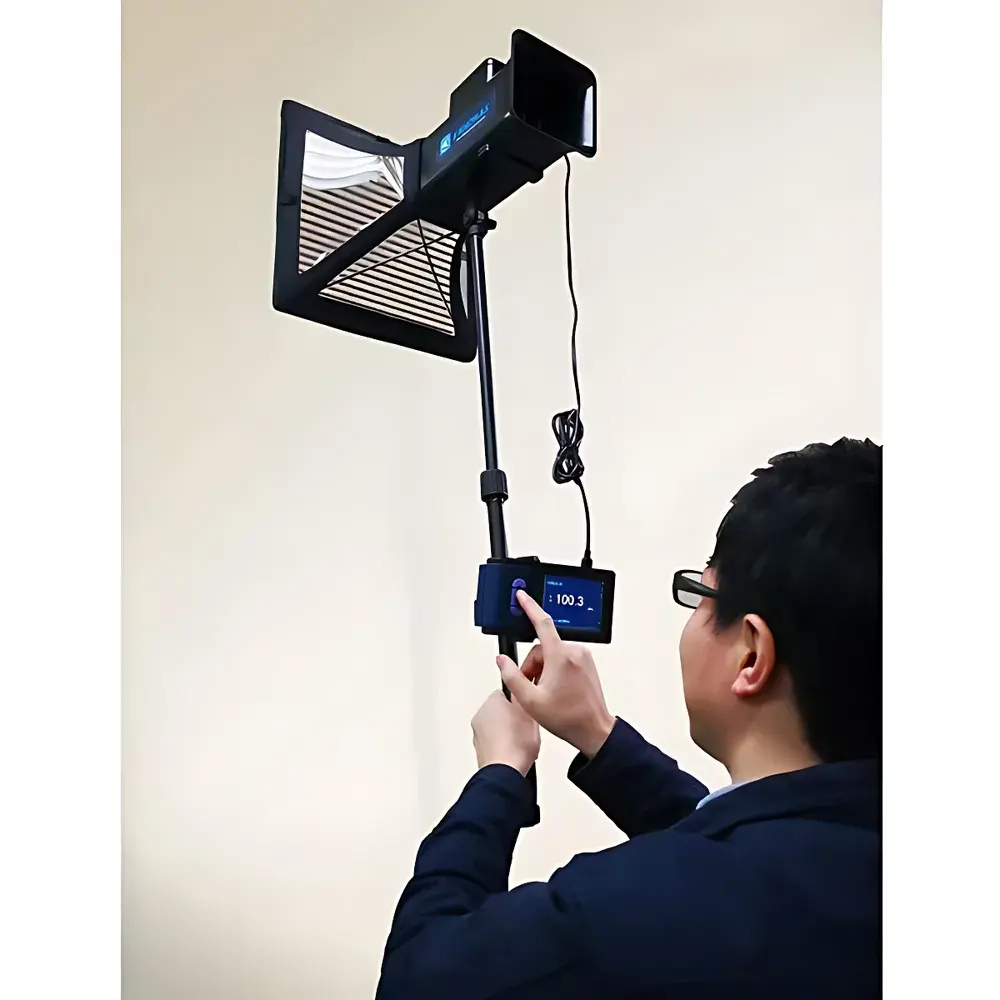
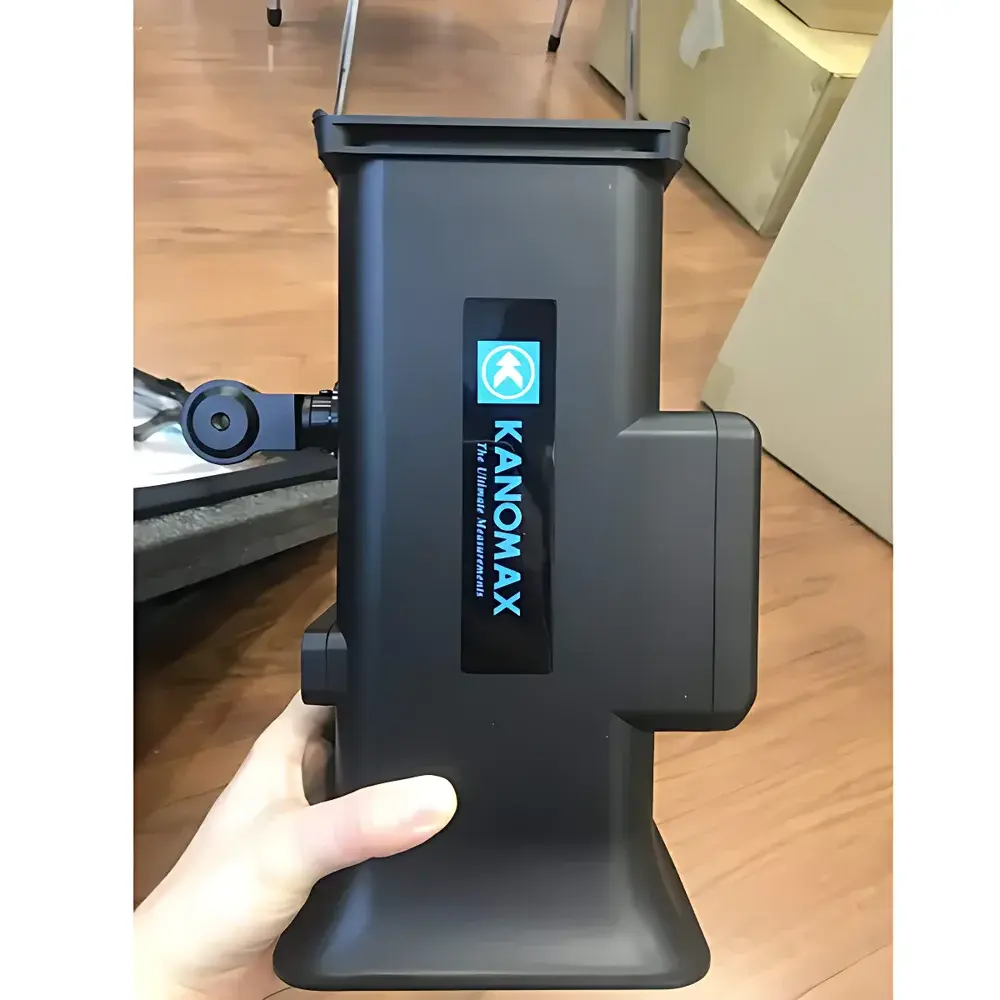
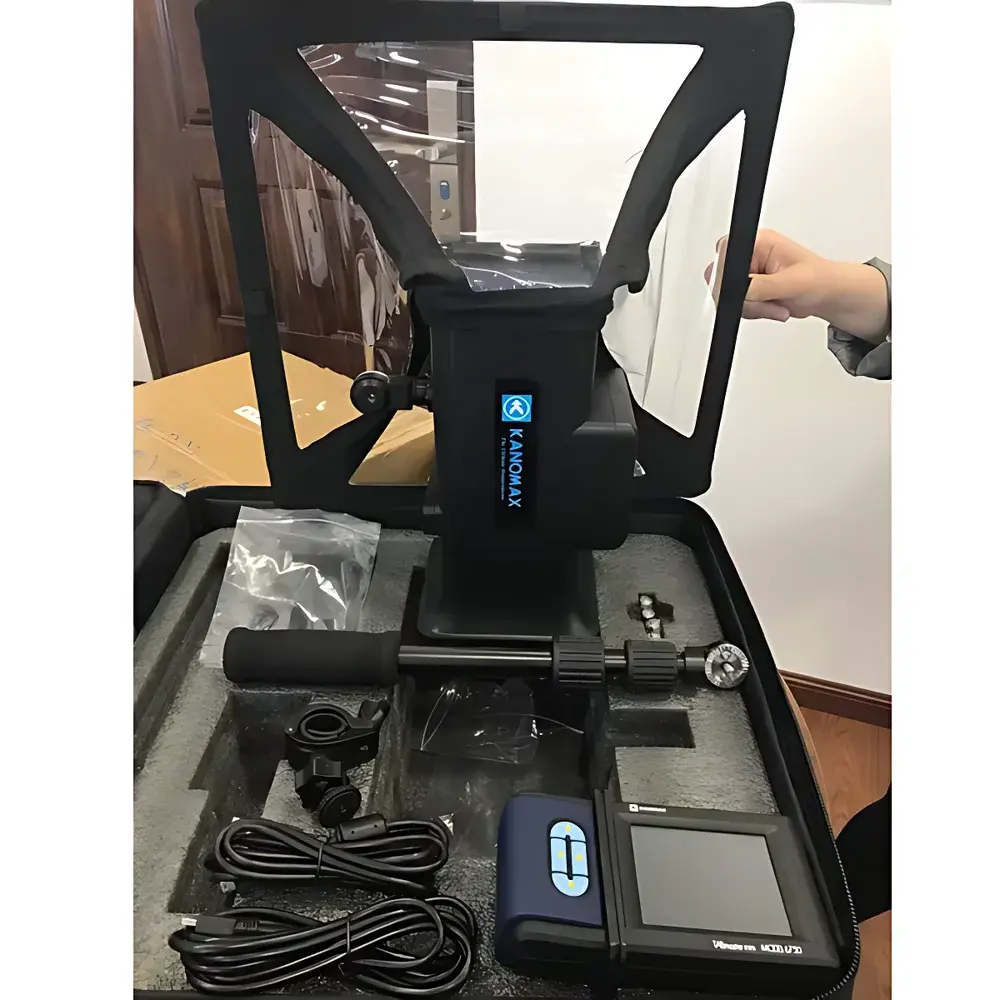
Kanomax 6750 Portable Air Flow Hood Anemometer
| Brand | Kanomax |
|---|---|
| Origin | Japan |
| Model | 6750 |
| Resolution | 1 m³/h |
| Flow Range | ±8–600 m³/h |
| Accuracy | ±(3% of reading + 1 m³/h) for 8–350 m³/h |
| Operating Temperature | 0–50 °C |
| Operating Humidity | 0–100 %RH |
| Temperature Measurement Range | 0–50 °C |
| Temperature Accuracy | ±0.5 °C |
| Display | Dual-parameter (airflow + temperature), battery level, unit toggle (m³/h / CFM, °C), on-device data processing |
| Communication | Bluetooth 4.0, USB output |
| Data Storage | Up to 6,000 records (internal memory) |
| Power | 4 × AA alkaline batteries or AC adapter |
| Battery Life | Approx. 8 hours continuous operation |
| Dimensions (Hood) | 355 × 355 × 450 mm (W×H×D) |
| Hood Aperture | 355 × 355 mm |
| Display Module | 160 × 80 × 45 mm |
| Weight | 1.5 kg |
Overview
The Kanomax 6750 Portable Air Flow Hood Anemometer is an engineered solution for accurate, field-deployable volumetric airflow measurement in HVAC system commissioning, validation, and routine maintenance. Designed around the principle of integrated pressure-differential-based flow capture, the instrument employs a calibrated, low-turbulence hood geometry that directs air through a precision-engineered internal sensor array. This architecture enables direct volumetric flow quantification without requiring duct-specific calibration or velocity profile correction—critical for consistent results across diffusers, grilles, VAV boxes, and laminar flow hoods. Its compact form factor, combined with real-time dual-parameter display (airflow and ambient temperature), supports single-operator workflows in constrained mechanical rooms, cleanrooms, and laboratory environments where traceability, repeatability, and ergonomic efficiency are essential.
Key Features
- True dual-parameter measurement: Simultaneous real-time display of volumetric airflow (m³/h or CFM) and ambient temperature (°C) with ±0.5 °C accuracy
- Integrated visual alignment window: Transparent polycarbonate viewport enables immediate verification of hood-to-grille contact integrity, minimizing seal leakage errors and improving measurement reproducibility
- High-resolution color LCD interface: 160 × 80 mm active display with intuitive icon-driven navigation, battery status indicator, and on-device unit switching
- Robust internal data logging: Stores up to 6,000 timestamped measurement records with flow value, temperature, date/time, and operator ID (via Bluetooth pairing)
- Wireless and wired connectivity: Bluetooth 4.0 Class 2 module for secure, short-range data transmission to iOS/Android tablets or Windows PCs; USB 2.0 interface for direct file export and firmware updates
- Field-optimized power management: Operates on standard AA alkaline batteries (4 pcs) for ~8 hours of continuous use; compatible with optional AC adapter for extended benchtop operation
- Compact, lightweight construction: Total mass of 1.5 kg with ergonomically balanced hood geometry (355 × 355 × 450 mm) facilitates one-person handling and repetitive testing cycles
Sample Compatibility & Compliance
The Kanomax 6750 is validated for use with square and rectangular supply/exhaust openings measuring 355 × 355 mm—making it suitable for standard ceiling diffusers, perforated panels, and terminal devices compliant with ISO 14644-3, ASHRAE Standard 111, and EU GMP Annex 1 requirements. Its measurement uncertainty profile meets the performance criteria referenced in ISO 5167-4 (differential pressure-based flow devices) and aligns with technical expectations for HVAC airflow verification under FDA 21 CFR Part 11–enabled workflows when paired with validated data capture software. The device operates reliably within 0–50 °C and 0–100 %RH, covering typical indoor environmental conditions encountered during pharmaceutical facility qualification, hospital ventilation audits, and academic lab HVAC assessments.
Software & Data Management
Data collected by the 6750 can be exported in CSV format via USB or synchronized wirelessly using Kanomax’s proprietary PC application (compatible with Windows 10/11). The software supports batch report generation, statistical analysis (mean, SD, CV%), and annotation tagging per test point—facilitating compliance with GLP and GMP documentation standards. Audit trail functionality—including user login, parameter change logs, and record modification timestamps—is available when configured with network-authenticated user accounts. All exported datasets retain native resolution (1 m³/h) and embedded metadata (temperature, timestamp, battery level), ensuring full traceability from field measurement to final validation report.
Applications
- HVAC system balancing and TAB (Testing, Adjusting, Balancing) in commercial, healthcare, and cleanroom facilities
- ISO Class 5–8 cleanroom supply airflow verification per ISO 14644-3 and EU GMP Annex 1
- VAV box minimum airflow setpoint validation and re-commissioning
- Laboratory fume hood face velocity and exhaust flow rate assessment
- Pharmaceutical manufacturing suite air change rate (ACH) calculations
- Educational and research applications requiring portable, repeatable volumetric flow quantification
FAQ
What is the recommended calibration interval for the Kanomax 6750?
Kanomax recommends annual calibration against NIST-traceable reference standards; field verification using zero-flow and known-velocity check points is advised before each critical measurement campaign.
Can the 6750 measure airflow in ducts or only at terminal outlets?
The 6750 is specifically designed for terminal device measurements (grilles, diffusers, VAV boxes) and is not intended for in-duct insertion or traverse-based profiling.
Does the device support custom reporting templates for regulatory submissions?
Yes—the companion software allows template customization for CSV or PDF export, including header fields for facility ID, test engineer, URS reference, and deviation notes.
Is Bluetooth communication encrypted?
Bluetooth pairing uses standard AES-128 link-layer encryption; data payloads are transmitted in plain text but require authenticated device pairing prior to connection.
How does temperature compensation affect airflow accuracy?
Internal temperature sensing enables automatic density correction for volumetric flow calculation; no manual input or external compensation is required for operation within the specified 0–50 °C range.







