
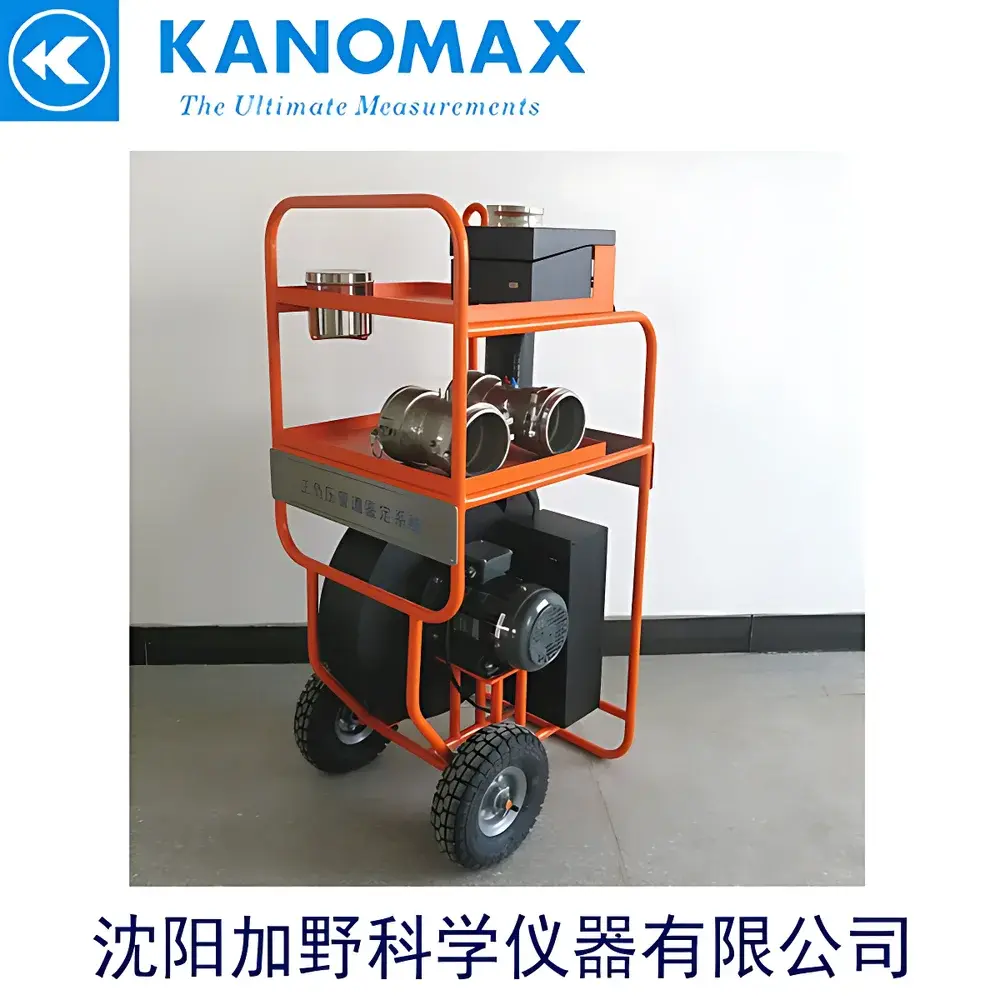
KANOMAX DAL T6900 High-Precision Positive/Negative Pressure Duct Air Leakage Tester
| Brand | KANOMAX |
|---|---|
| Origin | Liaoning, China |
| Manufacturer Type | Authorized Distributor |
| Country of Origin | China |
| Model | DAL T6900 |
| Flow Range | 36–640 m³/h (nozzle range: 4–36 m³/h) |
| Accuracy | ±2.5% of reading ±0.1 m³/h (flow), ±1% of reading ±1 Pa (static pressure), ±0.5 °C (temperature), ±2% of reading (atmospheric pressure) |
| Resolution | 0.01 m³/h (flow), 0.1 Pa (pressure), 0.1 °C (temperature), 0.1 kPa (atmospheric pressure) |
| Static Pressure Range | ±2500 Pa |
| Temperature Range | 0–60 °C |
| Atmospheric Pressure Range | 70–130 kPa |
| Power Supply | DAL T6900-0E: 110–120 V, 1-phase, 50/60 Hz, 16 A |
| DAL T6900-1E | 220–240 V, 1-phase, 50/60 Hz, 10 A |
| Net Weight | ~72 kg |
| Dimensions | 540 × 500 × 1200 mm |
| Data Storage | 1000 test records |
| Display | 4.7-inch color LCD touchscreen |
| Compliance Standards | EN 1507:2006, EN 12237:2002, Eurovent 2/2, DW/143, SMACNA HVAC Air Duct Leakage Testing Standard, GB 50243–2002 |
Overview
The KANOMAX DAL T6900 is a high-precision, dual-mode duct air leakage tester engineered for quantitative assessment of airtightness in HVAC ductwork systems under both positive and negative static pressure conditions. It operates on the principle of controlled pressurization—sealing the duct section or system under test and measuring volumetric airflow required to maintain a target static pressure differential across the boundary. This method directly quantifies leakage rate (m³/h) as a function of applied pressure (Pa), enabling compliance verification against internationally recognized duct sealing standards. Designed for field use in commercial and institutional construction environments, the DAL T6900 supports full-system commissioning as well as segment-level validation prior to insulation or enclosure, ensuring mechanical integrity before operational handover.
Key Features
- Dual-pressure capability: Simultaneous testing at positive and negative static pressures up to ±2500 Pa with independent calibration traceability
- High-resolution flow measurement: Dual-range flow path architecture—primary nozzle bank (4–36 m³/h) for low-leakage precision and auxiliary turbine sensor (36–640 m³/h) for high-capacity systems
- Real-time multi-parameter monitoring: Concurrent display of leakage volume, static pressure, ambient temperature, and local atmospheric pressure on a 4.7-inch capacitive touchscreen
- Embedded metrological integrity: All sensors certified to factory-calibrated reference standards; pressure transducers feature temperature-compensated silicon piezoresistive elements
- Robust mechanical architecture: Steel-reinforced frame, integrated pressure regulator, and modular quick-connect fittings for rapid deployment in constrained mechanical rooms or rooftop units
- On-device data governance: 1000-test non-volatile memory with timestamped records, including operator ID, test date/time, pressure setpoint, measured leakage, and pass/fail status per standard clause
Sample Compatibility & Compliance
The DAL T6900 is validated for use across rigid and semi-rigid duct constructions—including galvanized steel, aluminum, fiberglass-reinforced polymer (FRP), and flexible insulated ducts—provided sealing interfaces meet minimum flange flatness and gasket compression requirements. It conforms to mandatory testing protocols defined in EN 1507:2006 (metallic ductwork), EN 12237:2002 (flexible ductwork), Eurovent 2/2 (performance classification), DW/143 (UK ductwork specification), SMACNA HVAC Air Duct Leakage Testing Standard (US commercial practice), and GB 50243–2002 (Chinese ventilation and air conditioning engineering code). Test reports generated by the instrument support third-party audit trails required under ISO 9001 quality management systems and are admissible in LEED EA Credit 1 commissioning documentation.
Software & Data Management
Data export is supported via USB 2.0 interface to standard FAT32-formatted drives, generating CSV files compliant with ASTM E1554-22 data interchange format. Each record includes ISO 8601 timestamps, pressure ramp profiles, stabilization duration, and automatic pass/fail determination per selected standard’s allowable leakage class (e.g., Class A/B/C per SMACNA). The firmware implements read-only access control for stored results and maintains an immutable audit log of all configuration changes, aligning with GLP principles for test equipment qualification. While no cloud connectivity is embedded, exported datasets integrate natively with common building commissioning platforms such as Tridium Niagara, Siemens Desigo CC, and Schneider EcoStruxure Building Operation.
Applications
- Pre-commissioning verification of ductwork airtightness in high-efficiency HVAC installations for hospitals, laboratories, and cleanrooms
- Third-party inspection services mandated by municipal building codes and energy performance regulations (e.g., ASHRAE 90.1, China’s GB 50189)
- Quality assurance during fabrication and field assembly of sheet metal duct systems
- Root-cause analysis of excessive fan energy consumption linked to undetected leakage paths
- Validation of fire damper and control valve housing integrity under rated differential pressure
- Documentation for green building certification programs requiring documented air barrier performance
FAQ
What pressure ranges does the DAL T6900 support for leakage testing?
The instrument delivers stable, regulated static pressure from –2500 Pa to +2500 Pa, with closed-loop feedback control ensuring deviation remains within ±1 Pa of setpoint during steady-state measurement.
How is calibration traceability maintained for field use?
Each unit ships with a NIST-traceable calibration certificate covering flow, pressure, temperature, and barometric sensors; annual recalibration is recommended per ISO/IEC 17025 accredited laboratories.
Can the DAL T6900 be used for testing duct systems containing fire-rated dampers?
Yes—provided dampers are fully closed and mechanically latched, the system applies pressure across the sealed assembly without actuating internal mechanisms.
Does the device comply with FDA 21 CFR Part 11 requirements?
While not designed for regulated pharmaceutical manufacturing environments, its audit-log functionality and password-protected configuration meet foundational ALCOA+ data integrity criteria applicable to GxP-aligned HVAC commissioning.
Is external power conditioning required for stable operation?
No—integrated line filtering and voltage regulation accommodate ±10% nominal input variation; optional uninterruptible power supply (UPS) integration is supported for extended off-grid deployments.







