
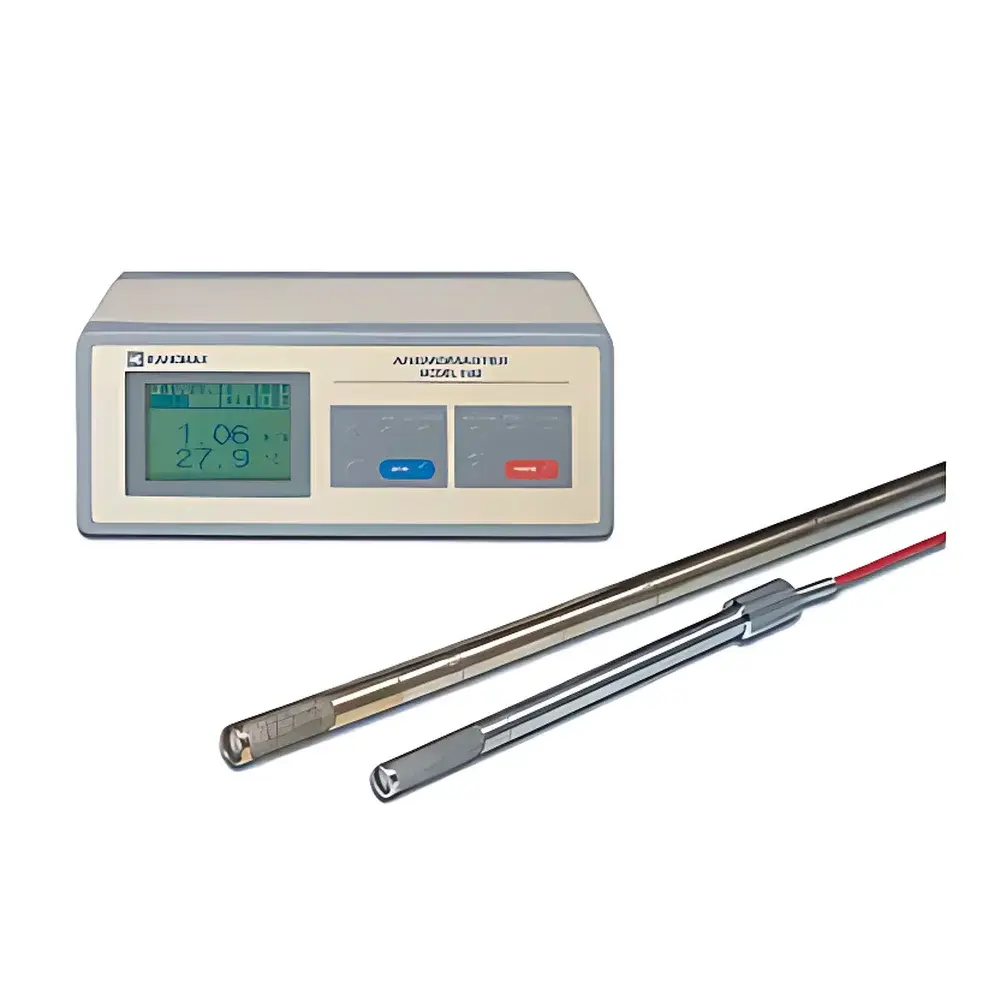
KANOMAX Model 6162 Intelligent Hot-Wire Anemometer for Medium-to-High-Temperature Air Flow Measurement
| Brand | KANOMAX |
|---|---|
| Origin | Japan |
| Model | 6162 |
| Instrument Type | Thermal Anemometer |
| Velocity Range | 0–50.0 m/s |
| Resolution | ±2% of reading |
| Accuracy | ±0.15 m/s (0–4.99 m/s), ±0.3 m/s (5.00–9.99 m/s), ±0.75 m/s (10.0–24.9 m/s), ±1.5 m/s (25.0–50.0 m/s) |
| Operating Temperature Range | 0–500 °C (probe-dependent) |
| Relative Humidity Range | 2.0–98.0 %RH |
| Probe Options | 0203 (0–200 °C), 0204 (0–400 °C), 0205 (0–500 °C) |
| Temperature Accuracy | ±(1% of reading + 1 °C) |
| Data Storage Capacity | 999 pages |
| Output Interfaces | RS-232C, 0–1 V analog output, remote control terminal |
| Power Supply | 6 × 1.5 V AA batteries or 12.5 V / 450 mA AC adapter |
| Probe Cable | PTFE-insulated, rated to 200 °C |
| extension cable | PVC-insulated, rated to 80 °C |
| Dimensions (main unit) | 220 × 150 × 85 mm |
| Weight (main unit) | 1.8 kg |
| Probe Dimensions | Φ11 × 208 mm (0203), Φ14 × 500 mm (0204), Φ14 × 1000 mm (0205) |
| Probe Weight | 500 g |
Overview
The KANOMAX Model 6162 is an intelligent, thermally compensated hot-wire anemometer engineered for reliable, high-fidelity air velocity and volumetric flow measurement in demanding industrial environments where elevated temperatures are present. Unlike conventional low-temperature anemometers, the 6162 employs a robust thermal sensing principle—based on constant-temperature anemometry (CTA)—in which a heated platinum wire element is maintained at a fixed temperature differential above ambient via active feedback control. Changes in convective heat loss due to airflow modulate the electrical power required to sustain that temperature, enabling precise derivation of velocity magnitude. Its modular probe architecture supports three interchangeable high-temperature sensor heads (models 0203, 0204, and 0205), each calibrated and rated for continuous operation up to 200 °C, 400 °C, and 500 °C respectively—making it suitable for flue gas monitoring, furnace draft analysis, kiln ventilation assessment, and combustion optimization in energy-intensive facilities.
Key Features
- Modular high-temperature probe system with quick-swap capability—no recalibration required when switching between 0203 (≤200 °C), 0204 (≤400 °C), and 0205 (≤500 °C) probes
- Three built-in measurement modes: real-time velocity averaging (with min/max/mean capture), time-interval sampling (user-defined intervals from 1 s to 9999 s), and volumetric flow calculation (cross-sectional area × mean velocity)
- Integrated data logging with 999-page storage capacity, each page containing timestamped velocity, temperature, and derived flow values
- Dual-output interface: isolated RS-232C serial port compliant with EIA/TIA-232 standards and 0–1 V analog output scalable to full-scale velocity range (0–50.0 m/s)
- Remote control terminal for external trigger input and status signaling—enabling integration into SCADA or PLC-based monitoring systems
- PTFE-insulated probe cable rated to 200 °C; optional high-temp extension cables available for extended reach in constrained or hazardous zones
- Self-contained power options: six standard AA alkaline cells (typical 20-hour runtime) or regulated 12.5 V DC input via included AC adapter
Sample Compatibility & Compliance
The Model 6162 is designed for use in non-corrosive, particle-limited gas streams typical of utility boiler exhausts, metallurgical process ducts, petrochemical stack vents, and HVAC commissioning applications. It complies with IEC 61000-4 electromagnetic immunity standards for industrial environments and meets CE marking requirements under the EU Electromagnetic Compatibility Directive. While not certified for intrinsically safe (ATEX/IECEx) zones, its probe construction—using stainless-steel sheathing, ceramic insulation, and high-purity platinum sensing elements—ensures mechanical durability and long-term stability under thermal cycling. The instrument’s temperature compensation algorithm adheres to ISO 7726 Annex C guidelines for thermal comfort and environmental parameter instrumentation. For regulated industries, raw data export via RS-232C supports traceable audit trails compatible with GLP/GMP documentation workflows when paired with validated third-party acquisition software.
Software & Data Management
KANOMAX provides a dedicated PC application (Windows-compatible) for bidirectional communication with the 6162, supporting firmware updates, configuration parameter upload/download, and batch retrieval of stored measurement pages. All logged data include embedded timestamps, probe identification codes, and measurement mode flags. Export formats include CSV and TXT, facilitating import into statistical analysis platforms (e.g., MATLAB, JMP, Minitab) or LIMS databases. The RS-232C protocol implements ASCII command-response framing with checksum validation, ensuring data integrity during transmission. Analog output signals are factory-calibrated and linear across the full 0–50.0 m/s range, allowing direct connection to chart recorders, DCS analog inputs, or programmable logic controllers without external signal conditioning.
Applications
- Power generation: Flue gas velocity profiling in ESP hoppers, SCR inlet ducts, and stack emission monitoring systems
- Steel manufacturing: Blast furnace tuyere air balance verification, ladle preheating airflow validation, and coke oven battery draft mapping
- Petrochemical refining: Fired heater convection section velocity uniformity checks, flare stack flow estimation, and catalyst regeneration air flow verification
- Energy efficiency audits: Duct leakage quantification, HVAC system balancing, and combustion air-to-fuel ratio optimization
- Research & development: High-temperature wind tunnel calibration, thermal boundary layer characterization, and heat exchanger performance testing
FAQ
Can the 6162 measure gas temperature simultaneously with velocity?
Yes—the integrated Pt100 RTD sensor in each probe provides concurrent temperature measurement with ±(1% of reading + 1 °C) accuracy over the full operating range.
Is calibration traceable to NIST or JIS standards?
All factory calibrations are performed against KANOMAX’s ISO/IEC 17025-accredited reference standards, with certificates including as-found/as-left data and uncertainty budgets per JIS Z 8401.
What maintenance is required for long-term accuracy?
No routine sensor cleaning is needed under normal operating conditions; however, periodic zero-checks using still-air verification and annual recalibration are recommended for critical applications.
Does the 6162 support Modbus or other industrial fieldbus protocols?
No—it uses a proprietary ASCII-based RS-232C protocol; however, third-party protocol converters can bridge to Modbus RTU or TCP networks via serial gateway devices.
Can multiple probes be connected to one main unit?
No—the 6162 supports only one probe at a time; however, probe interchangeability enables rapid reconfiguration for multi-point surveys without requiring additional main units.
Related Products







