
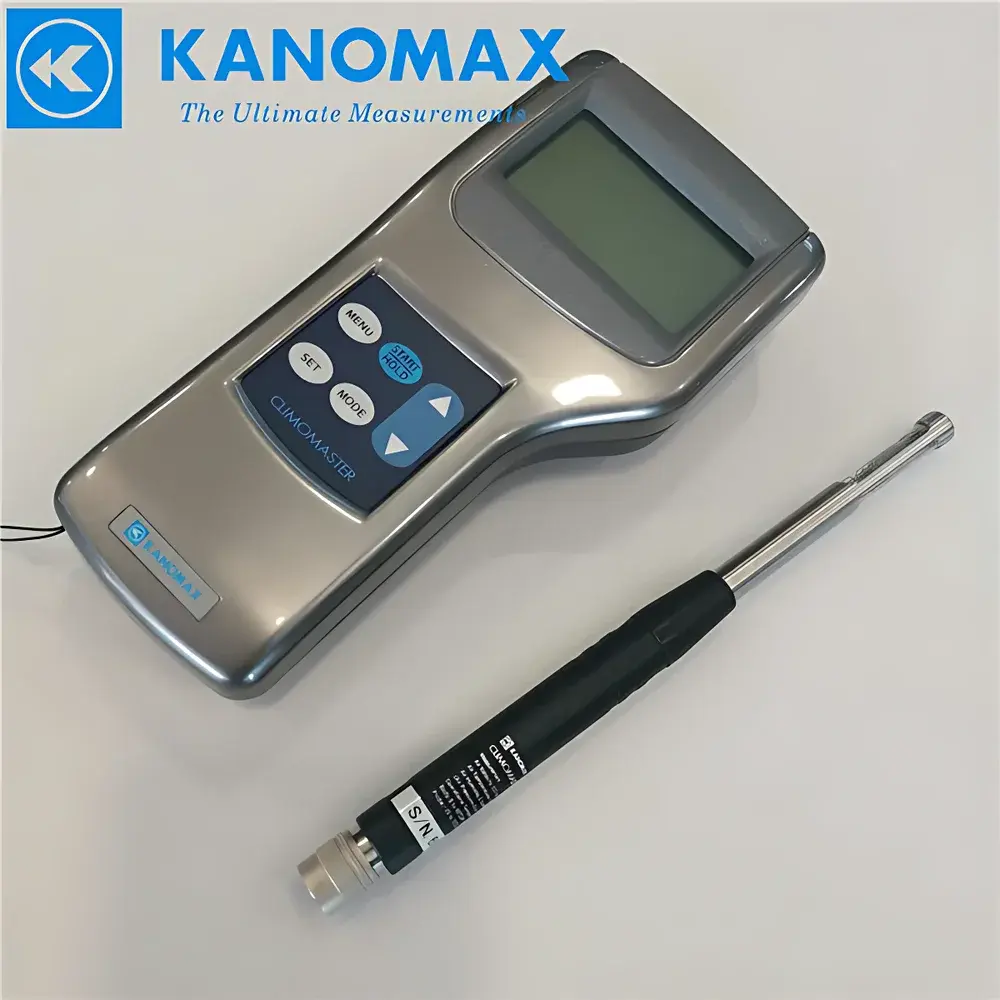
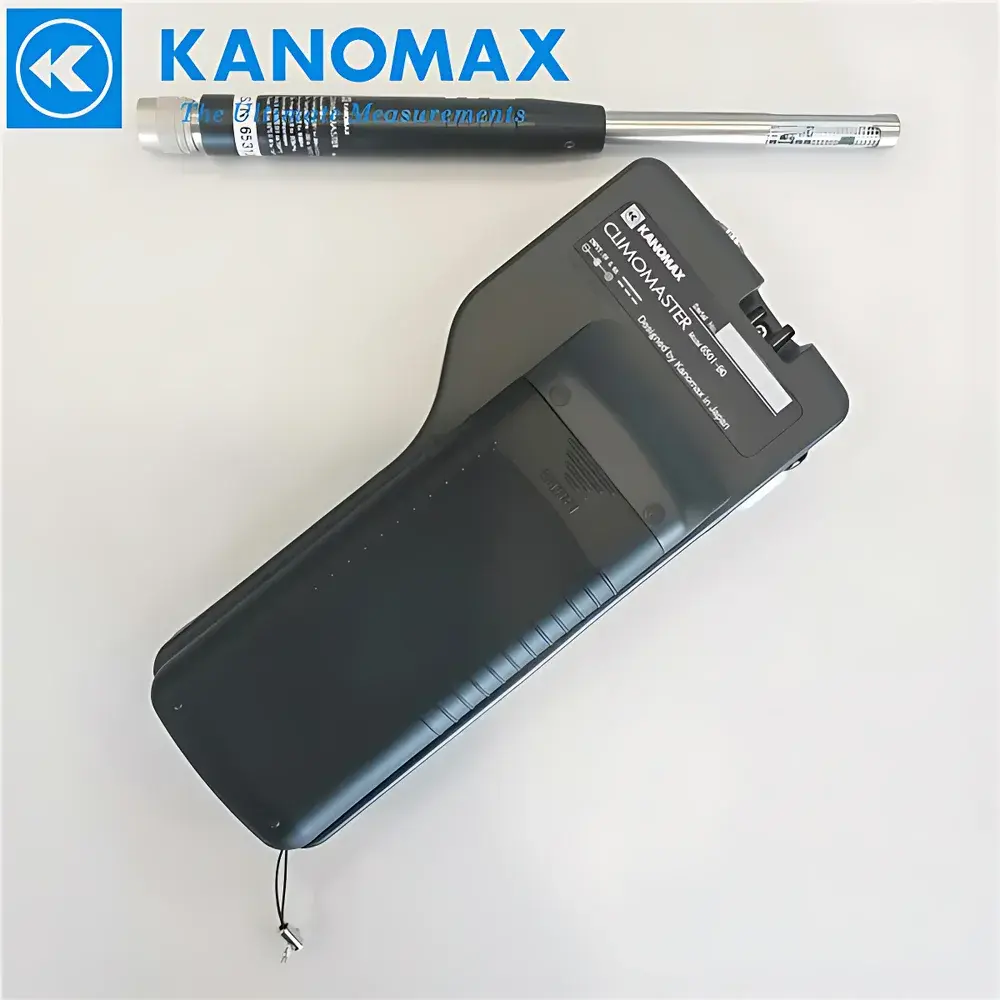
KANOMAX Smart Anemometer Series (Model-Specific Variant: e.g., KANOMAX 6162 or 6501 Platform-Based Smart Thermal Anemometer)
| Brand | KANOMAX |
|---|---|
| Origin | Japan |
| Instrument Type | Thermal Anemometer |
| Resolution | 0.01 m/s |
| Accuracy | ±2% of reading |
| Operating Temperature Range | −20 °C to +70 °C |
| Operating Relative Humidity Range | 2.0–98.0% RH |
| Probe Compatibility | 8 interchangeable thermal anemometry probes (hot-wire/hot-film) |
| Data Storage Capacity | Up to 20,000 measurement records |
| Built-in Calculations | Real-time air volume (m³/h or CFM) via user-defined duct geometry (rectangular, circular, oval cross-sections with dimensional input) |
| On-device Statistics | Min/Max/Avg values with hold function |
| Standard Accessories | 2 m probe cable × 1, carrying case × 1, operator manual |
Overview
The KANOMAX Smart Anemometer is a precision-engineered thermal anemometer platform designed for reliable, multi-parameter environmental airflow characterization in HVAC commissioning, cleanroom validation, industrial ventilation assessment, and indoor air quality (IAQ) studies. Utilizing constant-temperature anemometry (CTA) principles, the instrument measures convective heat transfer from a heated sensing element—typically a platinum-coated hot-wire or thin-film sensor—to quantify local air velocity with high temporal resolution and low flow sensitivity. Unlike cup or vane anemometers, thermal sensors respond instantaneously to laminar and turbulent flow fluctuations, enabling accurate capture of transient airflow dynamics in ducts, grilles, fume hoods, and laminar flow cabinets. The device integrates real-time temperature and relative humidity sensing (via capacitive RH sensor and NTC thermistor), and—when combined with user-input duct geometry parameters—performs on-the-fly volumetric airflow calculation (m³/h or CFM) compliant with ASHRAE Guideline 12 and ISO 16813 requirements for HVAC system performance verification.
Key Features
- Multi-sensor fusion architecture: Simultaneous acquisition of air velocity (m/s), static/dry-bulb temperature (°C), and relative humidity (% RH) in a single measurement cycle.
- Modular probe interface supporting eight KANOMAX-certified thermal probes—including retractable telescopic rods (up to 1.5 m), ultra-thin 3 mm diameter micro-probes for confined spaces, and 3-axis vector probes for directional flow analysis.
- Real-time volumetric flow computation engine: Accepts user-defined duct cross-sectional geometry (circular, rectangular, oval) with dimensional inputs (mm or inches); automatically applies continuity equation (Q = V × A) and corrects for temperature-dependent air density per ISO 5167 Annex C.
- On-device statistical processing: Continuous logging with min/max/average calculation across configurable time windows (1 s to 60 min); data-hold function freezes display for field annotation or photography.
- Ruggedized industrial enclosure rated IP54 for dust and splash resistance; operating range validated from −20 °C to +70 °C ambient, ensuring stability during cold-start HVAC diagnostics or rooftop unit surveys.
Sample Compatibility & Compliance
The KANOMAX Smart Anemometer is compatible with standard HVAC duct materials (galvanized steel, aluminum, fiberglass-lined), laboratory fume hood baffles, and cleanroom return grilles. Probe tip geometries are optimized to minimize flow disturbance per ISO 7726 Annex B recommendations for local mean velocity measurement. The instrument complies with IEC 61000-6-3 (EMC emission limits) and IEC 61000-6-2 (immunity to electrostatic discharge and RF fields). Calibration traceability follows JIS Z 8015 and NIST-traceable standards; factory calibration certificates include uncertainty budgets per ISO/IEC 17025 requirements. For regulated environments, the device supports audit-ready operation when used in conjunction with KANOMAX’s optional PC software (see Software section).
Software & Data Management
Data export is supported via USB-C interface to KANOMAX AirFlow Manager™ desktop application (Windows 10/11). The software enables full traceability: each stored record includes timestamp (with optional GPS tagging via connected mobile device), probe serial ID, environmental conditions, and operator-entered metadata (test point ID, duct number, facility zone). Export formats include CSV (for Excel/Python analysis) and PDF reports compliant with GLP documentation standards—including electronic signatures, revision-controlled templates, and 21 CFR Part 11–compatible audit trails when deployed with validated IT infrastructure. Raw velocity time-series data can be exported at up to 10 Hz sampling rate for turbulence intensity (TI) and turbulence kinetic energy (TKE) post-processing.
Applications
- HVAC system balancing and TAB (Testing, Adjusting, Balancing) per NEBB Procedural Standards.
- Cleanroom ISO 14644-3 classification: supply air uniformity mapping and recovery time verification.
- Fume hood face velocity validation per ANSI/ASHRAE 110 and EN 14175.
- Industrial exhaust stack monitoring and LEED IEQ credit documentation.
- Research-grade boundary layer profiling in wind tunnel test sections or building façade studies.
FAQ
Does the instrument require annual recalibration?
Yes—KANOMAX recommends annual recalibration against NIST-traceable reference standards; interval may be adjusted per internal quality procedures aligned with ISO/IEC 17025 Clause 6.5.
Can the device measure air velocity in high-humidity environments above 90% RH?
Yes—the capacitive RH sensor maintains accuracy up to 98.0% RH at 40 °C; however, prolonged exposure to condensing conditions (>99% RH) is not recommended and may affect long-term sensor drift.
Is probe interchangeability supported without firmware reconfiguration?
Yes—all eight KANOMAX thermal probes feature auto-detecting ID chips; the host unit recognizes probe type, calibration coefficients, and maximum rated velocity upon connection.
What duct shapes does the built-in air volume calculator support?
Circular (diameter input), rectangular (width × height), and oval (major × minor axis)—all accepting metric or imperial units with automatic unit conversion.
How is measurement uncertainty reported in calibration certificates?
Uncertainty budgets include contributions from sensor nonlinearity, temperature coefficient error, probe alignment tolerance, and reference standard uncertainty—calculated per GUM (JCGM 100:2008) methodology.







