
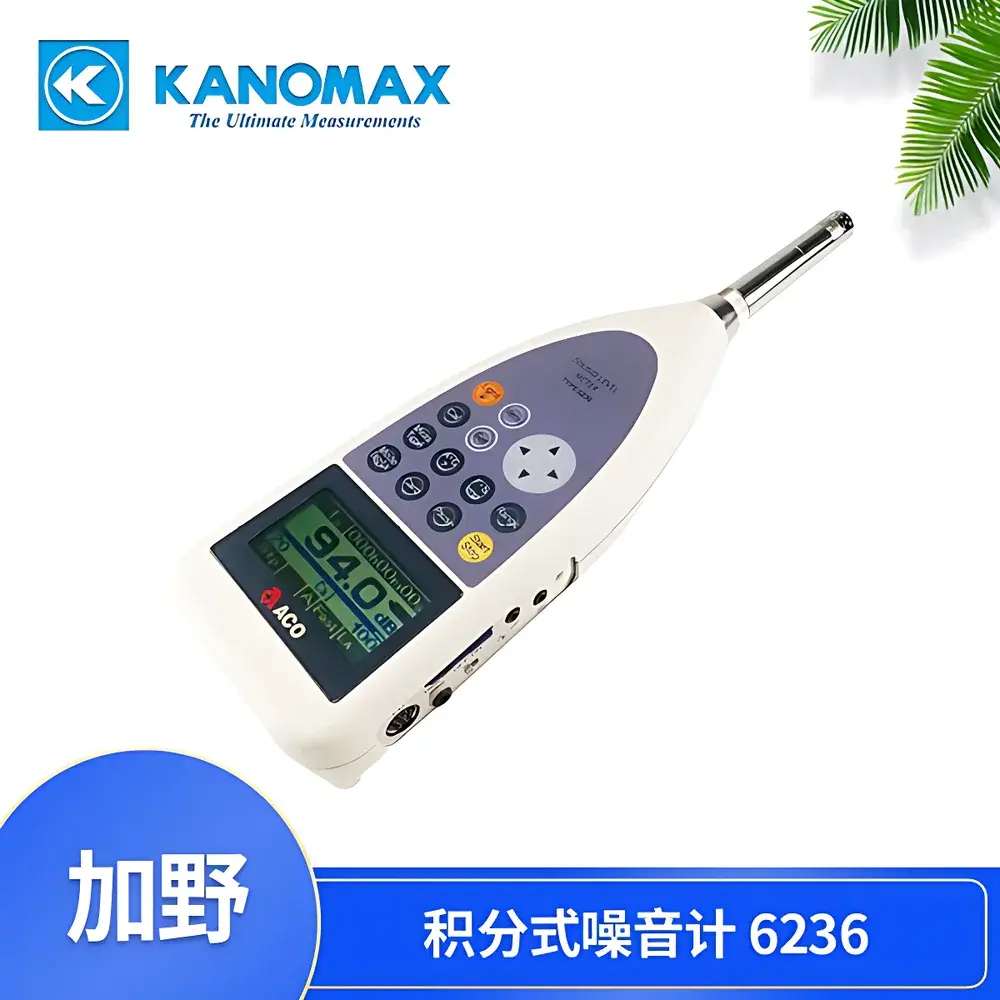
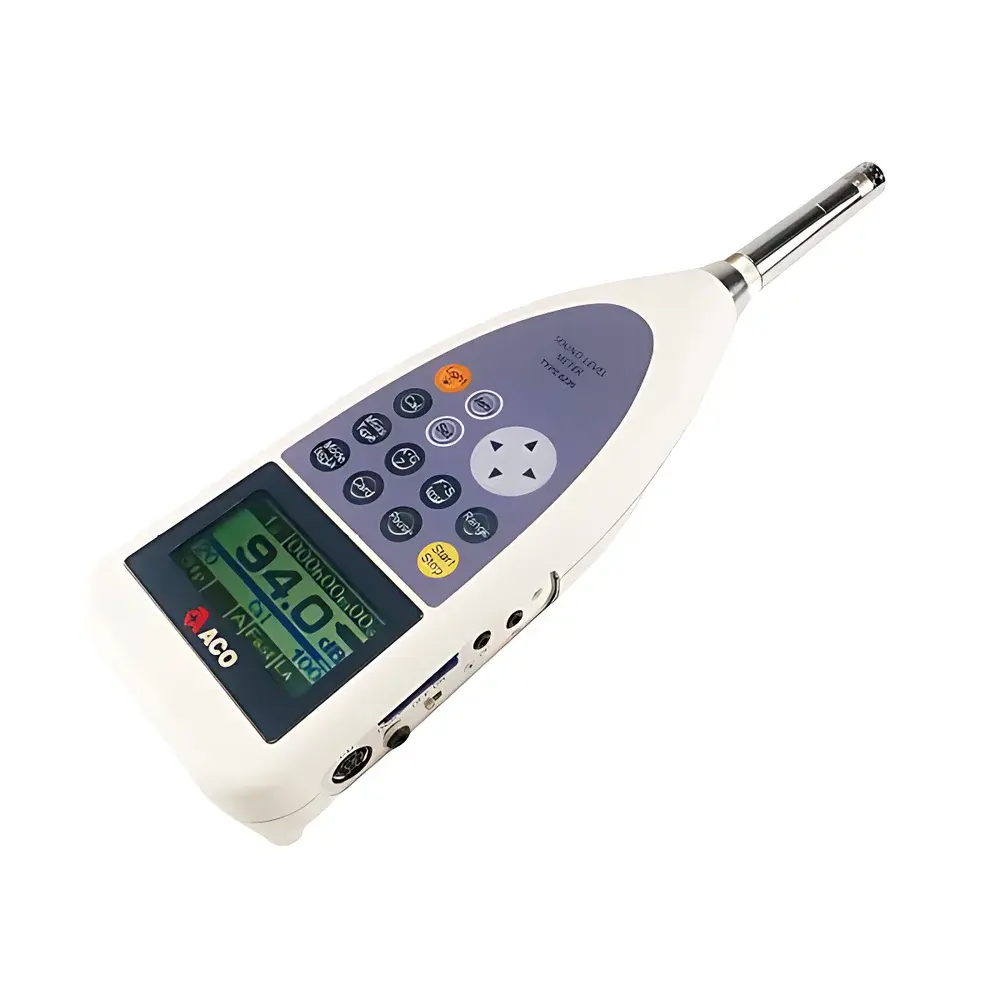
Kanomax Model 6236 Integrating Sound Level Meter
| Brand | Kanomax |
|---|---|
| Origin | USA |
| Manufacturer Type | Authorized Distributor |
| Country of Origin | Imported |
| Model | 6236 |
| Price | USD 2,950 (FOB) |
| Microphone | Type 7146NL (Sensitivity: −28 dB re 1 V/Pa, Standalone calibration: −23 dB) |
| Measurement Range | A-weighted 28–130 dB, Z-weighted 39–130 dB |
| Frequency Weighting | A, C, Z |
| Time Weighting | Fast, Slow |
| Conformance | IEC 61672-1:2013 Class 1, ANSI S1.4-1983 Type 1 |
| Power Supply | 4 × AA alkaline batteries (≈9 h operation) or optional AC adapter |
| Dimensions | 86 × 285 × 46 mm |
| Weight | ≈450 g |
| Display | Backlit LCD with real-time analog bar graph |
| Measurement Modes | Instantaneous SPL, Equivalent Continuous Sound Level (Leq), Single-Event Noise (SEL), Lmax, Lmin, Time-Weighted Average (Lx%) |
Overview
The Kanomax Model 6236 is a precision-engineered integrating sound level meter designed for compliance-grade environmental, occupational, and industrial noise assessment. Based on the fundamental principles of electroacoustic transduction and digital signal integration, the instrument employs a calibrated electret condenser microphone (Type 7146NL) to convert acoustic pressure fluctuations into proportional electrical signals. These signals undergo analog-to-digital conversion, followed by real-time spectral weighting (A, C, Z) and time-domain integration (Fast/Slow) in accordance with internationally recognized metrological frameworks. The device meets IEC 61672-1:2013 Class 1 performance requirements—ensuring traceable accuracy for regulatory reporting, workplace safety evaluations (OSHA/NIOSH), and community noise impact studies. Its compact ergonomic form factor and high-contrast backlit display support field deployment under variable ambient lighting conditions without compromising readability or measurement fidelity.
Key Features
- Class 1 compliant performance per IEC 61672-1:2013 and ANSI S1.4-1983 Type 1 specifications, validated through factory calibration with NIST-traceable reference standards
- Integrated electret condenser microphone (Type 7146NL) with nominal sensitivity of −28 dB re 1 V/Pa and built-in preamplifier for low-noise signal conditioning
- Simultaneous dual-weighting capability: selectable A-, C-, or Z-frequency weighting filters optimized for human hearing response, broadband analysis, and unweighted physical sound pressure evaluation
- Real-time analog bar graph display synchronized with numeric readout, enabling rapid visual assessment of dynamic acoustic events
- Comprehensive integrated metrics: Leq (equivalent continuous sound level), SEL (sound exposure level), Lmax/Lmin, instantaneous SPL, and percentile-based time-history analysis (L10, L50, L90)
- Extended dynamic range: 28–130 dB(A) and 39–130 dB(Z), supporting both low-level ambient monitoring and high-intensity industrial source characterization
- Robust power architecture: 4×AA alkaline battery operation (typical 9-hour runtime) with optional AC adapter for stationary applications and extended logging sessions
Sample Compatibility & Compliance
The Model 6236 is engineered for direct field measurement of airborne sound pressure levels across diverse physical environments—including manufacturing floors, construction sites, transportation corridors, HVAC systems, and urban residential zones. It does not require sample preparation or coupling media; measurements are conducted in free-field conditions using standardized microphone orientation and mounting protocols. Regulatory alignment includes full conformance with ISO 1996-2:2017 (acoustics — description, measurement and assessment of environmental noise), OSHA 29 CFR 1910.95 (occupational noise exposure), and EU Directive 2003/10/EC. Calibration verification is supported via external pistonphone (e.g., Brüel & Kjær Type 4231) or sound calibrator meeting IEC 60942 Class 1 requirements.
Software & Data Management
Data export is facilitated via RS-232 serial interface (standard) or optional USB-to-serial adapter, enabling seamless transfer to Windows-based analysis platforms. Kanomax-supplied software (Kanomax Data Logger v3.x) supports time-stamped waveform logging, statistical post-processing (e.g., cumulative distribution functions), report generation in PDF/CSV formats, and audit trail configuration compliant with GLP and FDA 21 CFR Part 11 requirements (when used with electronic signature-enabled host systems). Internal memory stores up to 10,000 data points with timestamp, measurement mode, and weighting parameters preserved per record.
Applications
- Ongoing occupational health surveillance per ISO 9612 and ANSI S1.25 for hearing conservation program validation
- Environmental noise mapping and baseline studies for EIA (Environmental Impact Assessment) submissions
- Product noise certification testing for consumer appliances, power tools, and automotive components against ISO 3744/3746
- Acoustic validation of noise control engineering interventions (e.g., enclosures, barriers, absorptive treatments)
- Educational laboratory instruction in acoustics, environmental science, and mechanical engineering curricula
- Regulatory inspections by municipal environmental agencies and national occupational safety authorities
FAQ
What calibration standards does the Model 6236 support?
It complies with IEC 61672-1:2013 Class 1 and ANSI S1.4-1983 Type 1; field calibration requires a Class 1 sound calibrator traceable to NIST or equivalent national metrology institute.
Can the device perform octave-band or 1/3-octave analysis?
No—this is a broadband integrating sound level meter; frequency-selective analysis requires a dedicated sound analyzer (e.g., Kanomax 6300 series).
Is the microphone permanently attached or interchangeable?
The Type 7146NL microphone is integrated and non-removable; replacement requires factory service and recalibration.
Does the instrument meet FDA or EU MDR requirements for medical facility noise monitoring?
While not a medical device itself, its Class 1 metrological performance satisfies EN ISO 14155 Annex B and HTM 08-01 Annex D criteria for environmental noise assessment in clinical settings.
How is measurement uncertainty quantified for regulatory reporting?
Total expanded uncertainty (k=2) is ±0.7 dB for Leq measurements within 45–120 dB(A) at 1 kHz, as documented in the Certificate of Calibration supplied with each unit.
Related Products







