
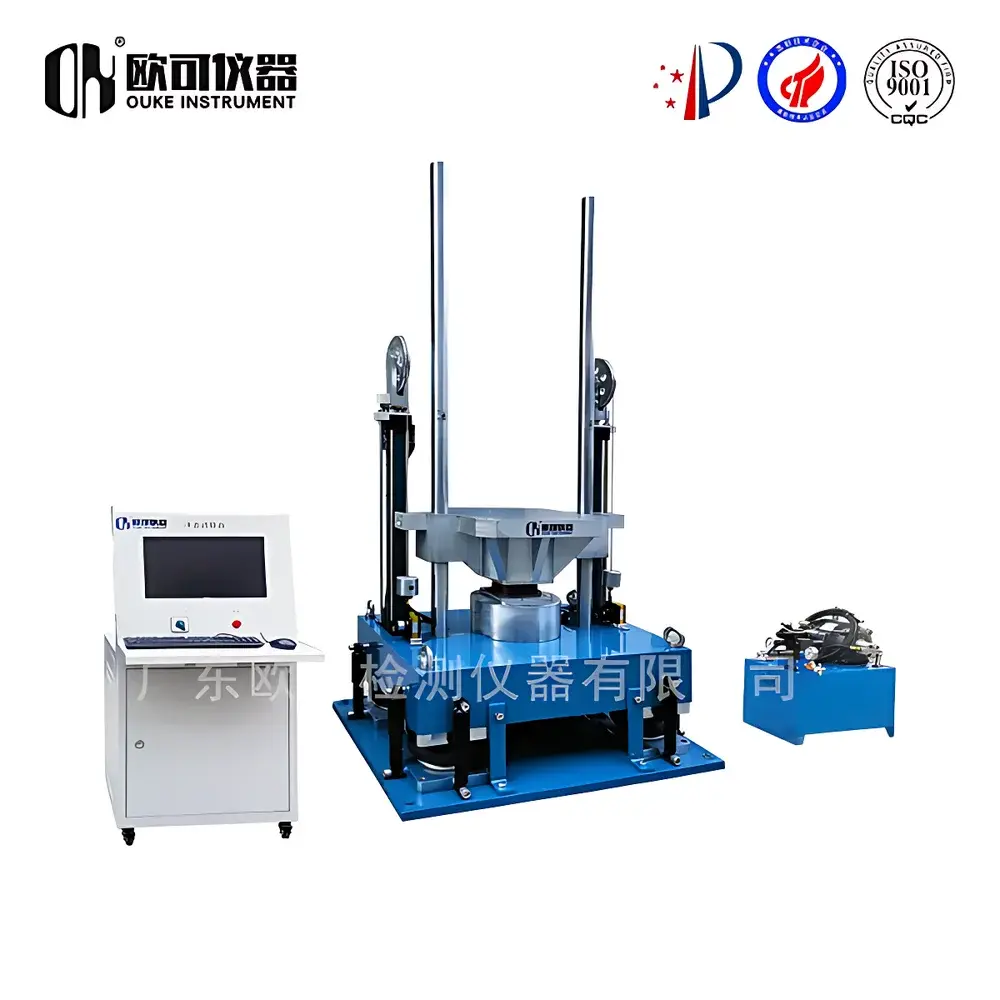
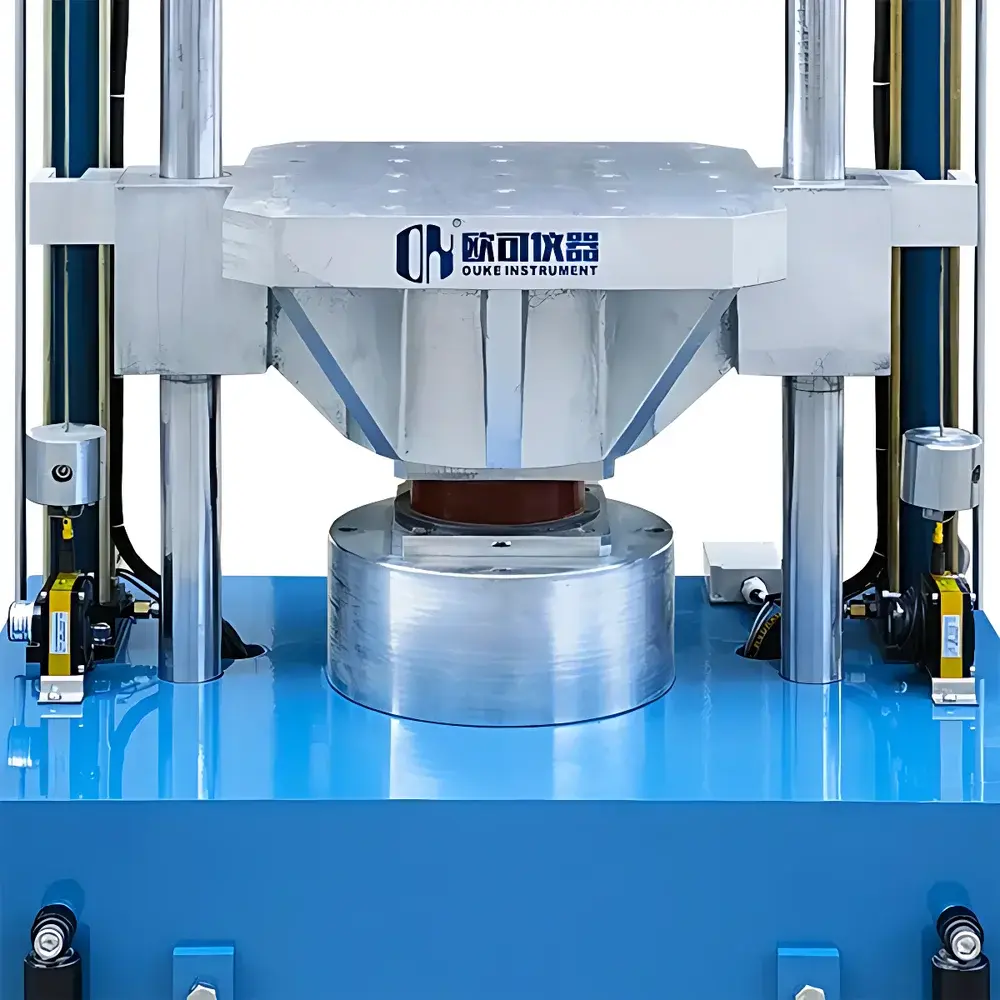
OK-S-10 Acceleration Shock Testing Machine
| Brand | OK Instruments |
|---|---|
| Origin | Guangdong, China |
| Manufacturer Type | OEM/ODM Manufacturer |
| Product Category | Domestic |
| Model | OK-S-10 |
| Instrument Type | Drop-Weight Impact Tester |
| Nominal Impact Energy | 30 G (peak acceleration) |
| Impact Velocity Change (Δv) | 1000 G (equivalent to ~9.8 m/s velocity change) |
| Pendulum Moment (Impact Constant) | 4.5 N·m·s |
| Force Sensor Range | 5 kN |
| Maximum Lifting Height | 10 mm |
Overview
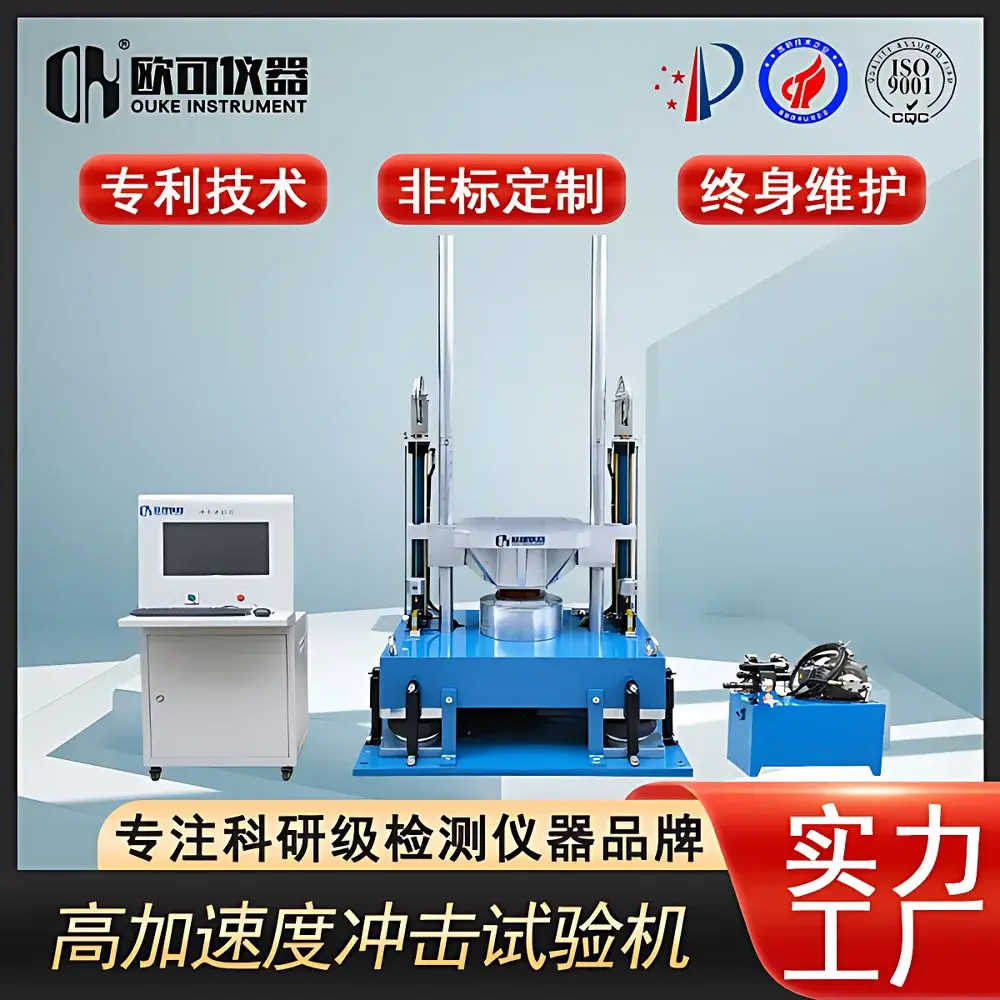
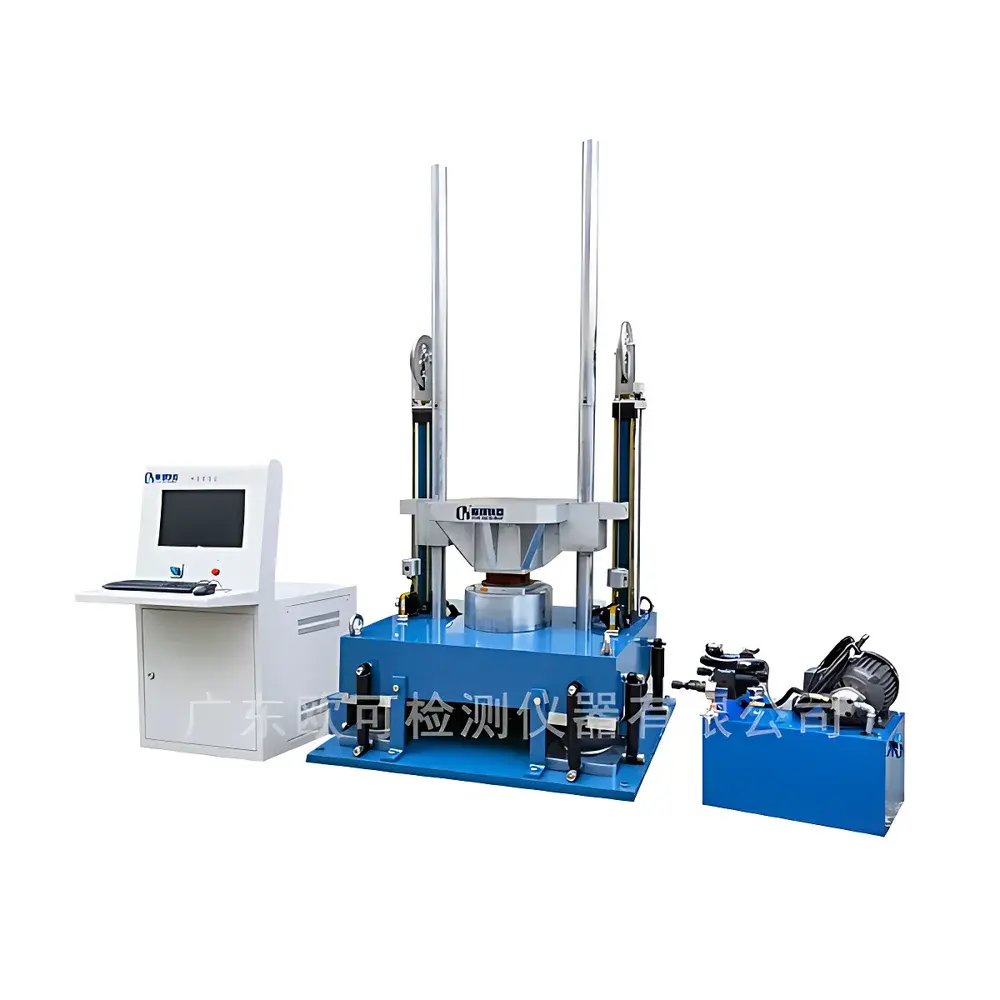
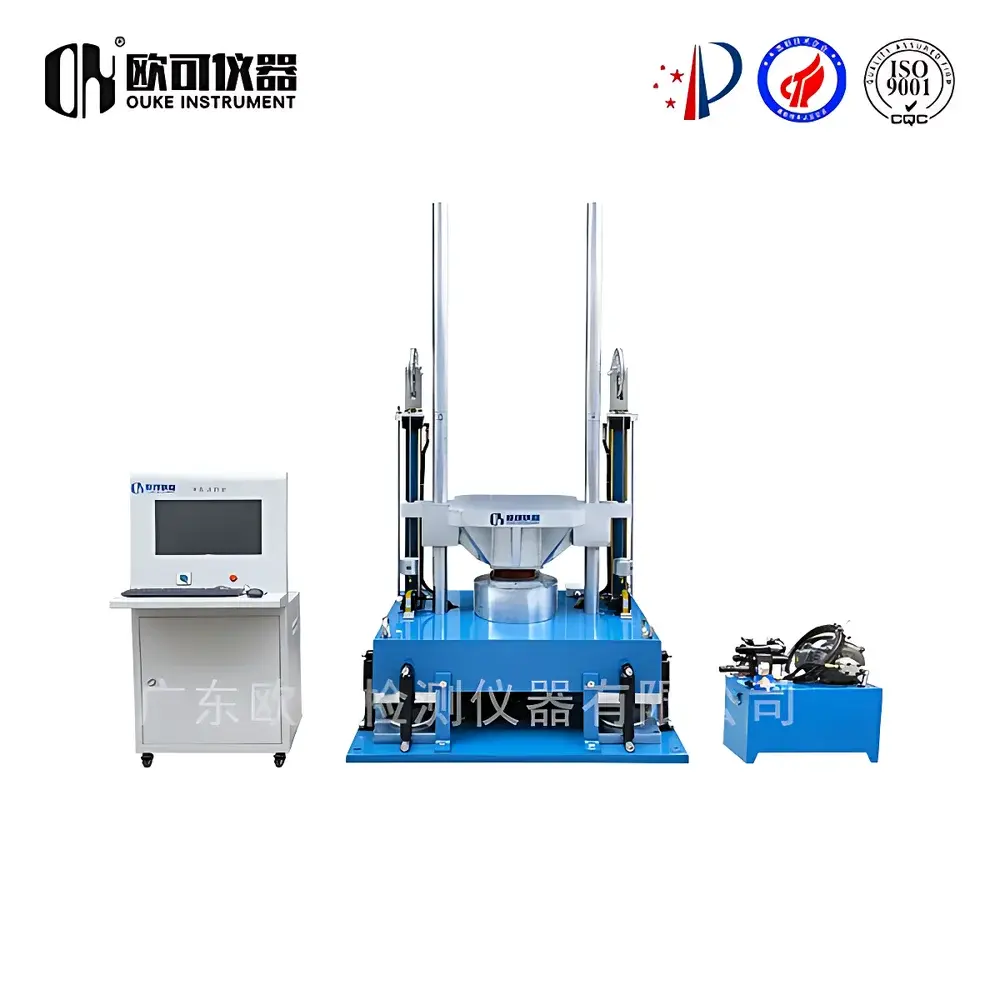
The OK-S-10 Acceleration Shock Testing Machine is a precision-engineered electro-mechanical shock simulator designed to replicate transient, high-intensity mechanical shocks encountered during transportation, handling, operational use, or accidental drop events. It operates on the principle of controlled deceleration: a test specimen—rigidly mounted on a rigid shock table—is accelerated and then subjected to rapid, programmable stopping or reversal, generating calibrated acceleration pulses with defined peak magnitude (G), pulse duration (ms), and waveform shape. Unlike static or quasi-static testers, this system delivers true dynamic shock loading in accordance with established shock physics models—including classical shock response spectrum (SRS) theory—and is fundamentally governed by Newton’s second law (F = ma) and impulse-momentum conservation (Δp = F·Δt). The OK-S-10 implements a gravity-driven free-fall configuration, where the shock table and fixture are elevated to a precise height and released onto a selectable waveform generator (e.g., elastomeric pads, lead anvil, or composite pulse shapers), enabling repeatable semi-sinusoidal, terminal-peak sawtooth, or trapezoidal shock pulses per IEC 60068-2-27, MIL-STD-883 Method 2002, and ASTM D7387.
Key Features
- Modular waveform generation architecture supporting interchangeable pulse shapers (rubber, silicone, felt, lead, and custom composite pads) for compliant reproduction of semi-sinusoidal, terminal-peak sawtooth, and trapezoidal shock profiles.
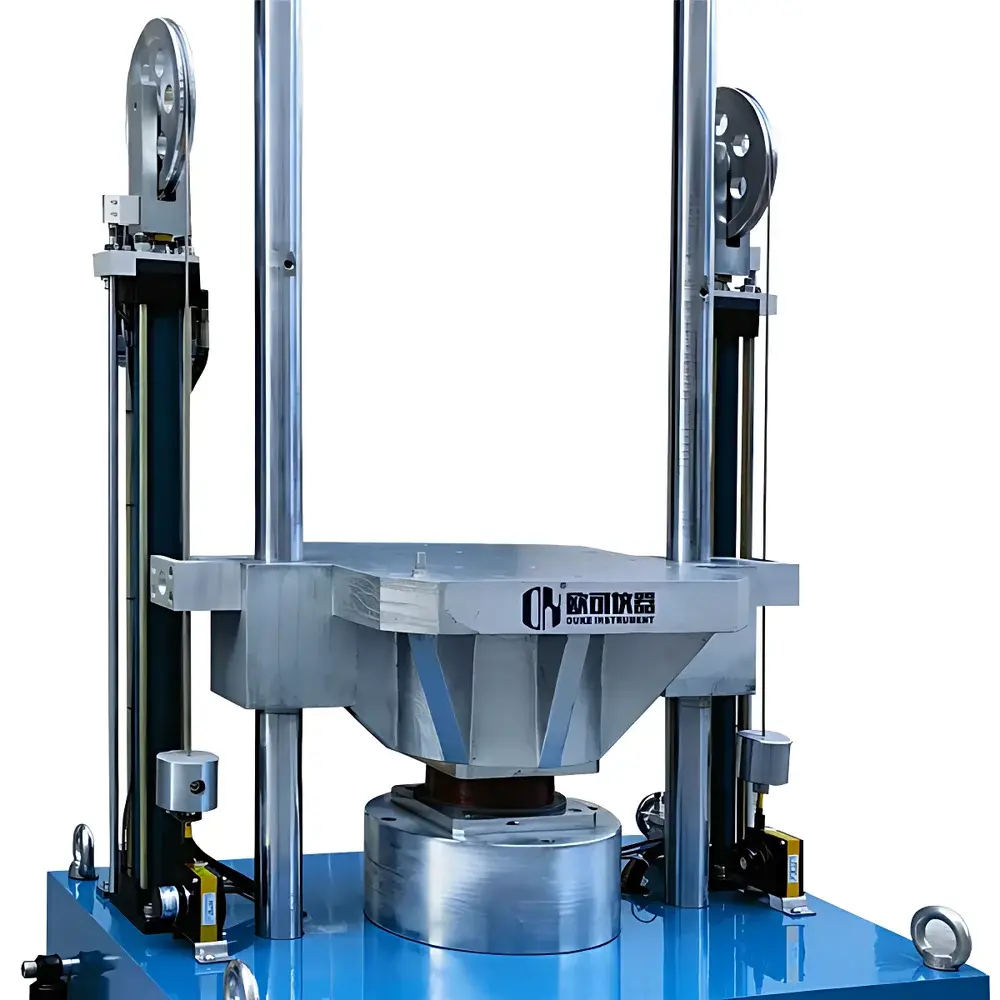
- High-rigidity steel frame and hardened aluminum shock table engineered for minimal modal coupling and consistent energy transmission across test cycles.
- Precision-height actuation system with digital encoder feedback ensures repeatable lifting accuracy within ±0.1 mm, critical for G-level reproducibility.
- Integrated 5 kN piezoelectric force sensor with IEPE output enables real-time measurement of reaction force at the table–anvil interface, supporting closed-loop validation against target shock spectra.
- Dual-channel data acquisition system (sample rate ≥ 1 MS/s) synchronizes acceleration (via triaxial MEMS or piezoresistive sensors) and force signals for full impulse characterization and SRS calculation.
- Embedded controller with intuitive touchscreen HMI allows direct input of target G-level, pulse width, and waveform type; supports up to 999 sequential shock events with configurable dwell time and polarity inversion.
Sample Compatibility & Compliance
The OK-S-10 accommodates specimens up to 10 kg (standard configuration) on a 200 × 200 mm mounting surface, with optional extended tables available for larger assemblies. Fixturing complies with ISO 13372:2012 guidelines for shock test fixture design—emphasizing rigidity, minimal resonant amplification below 5 kHz, and symmetric load distribution. The system is validated per IEC 60068-2-27 (Test Ea: Shock), MIL-STD-202G Method 213 (Shock), and JESD22-B104 (Board-Level Shock), and supports traceable calibration per ISO/IEC 17025-accredited procedures. All firmware and control logic adhere to GLP-relevant audit trail requirements, including user login logging, parameter change history, and test report timestamping—facilitating FDA 21 CFR Part 11 readiness when paired with compliant software.
Software & Data Management
The OK-S-10 is supplied with OK-ShockSuite™ v3.2—a Windows-based application supporting waveform setup, real-time oscilloscope-style monitoring, post-test SRS synthesis (per MIL-STD-810H Annex G), and automated compliance reporting. Raw binary data (.tdms) and metadata (XML) are stored with embedded calibration certificates, environmental logs (temperature/humidity), and operator ID. Export options include CSV, PDF test reports (with signature fields), and MATLAB-compatible .mat files. Optional API integration (REST/HTTP) enables linkage with enterprise LIMS or PLM systems for automated test scheduling and results ingestion. All software modules undergo annual verification per ASTM E2500-13 Annex A2 for analytical instrument qualification.
Applications
- Electronics reliability: Drop testing of smartphones, PCBAs, and MEMS devices per ISTA 3A/3E and IPC-9708; assessment of solder joint integrity under shock-induced strain rates >10⁴ s⁻¹.
- Automotive electronics: Qualification of ECUs, radar modules, and infotainment units per LV-124 and GMW3172 shock clauses.
- Aerospace components: Screening of avionics enclosures and satellite subsystems against launch vehicle separation shocks (trapezoidal, 5–20 ms).
- Packaging validation: Correlation of package performance with field logistics data using shock response spectrum matching per ASTM D6344.
- Electromechanical components: Life-cycle shock endurance testing of relays, switches, and connectors per IEC 61810-1 and UL 1054.
FAQ
What shock waveforms can the OK-S-10 generate?
The OK-S-10 produces semi-sinusoidal, terminal-peak sawtooth, and trapezoidal pulses via physical waveform shapers; complex transients require external electromagnetic shaker integration.
Is the system compliant with MIL-STD-883 Method 2002?
Yes—the mechanical design, pulse repeatability (<±3% G-peak over 50 cycles), and data traceability meet all mandatory requirements of Method 2002, including fixture resonance suppression and SRS verification.
Can the OK-S-10 be used for packaging certification per ISTA standards?
Yes—its free-fall architecture and height-controlled impact energy align directly with ISTA 3A, 3B, and 3E drop test protocols; waveform shapers are certified for use with corrugated, foam, and molded pulp packaging systems.
Does the system support remote operation and audit trails?
Yes—OK-ShockSuite™ includes role-based access control, electronic signatures, and immutable event logs compliant with 21 CFR Part 11 Annex 11 principles when deployed on validated infrastructure.
What is the maximum specimen mass supported without derating?
10 kg at full rated energy (30 G); loads exceeding 5 kg require verification of fixture natural frequency (>5 kHz) and table deflection (<1 µm under static preload).



