
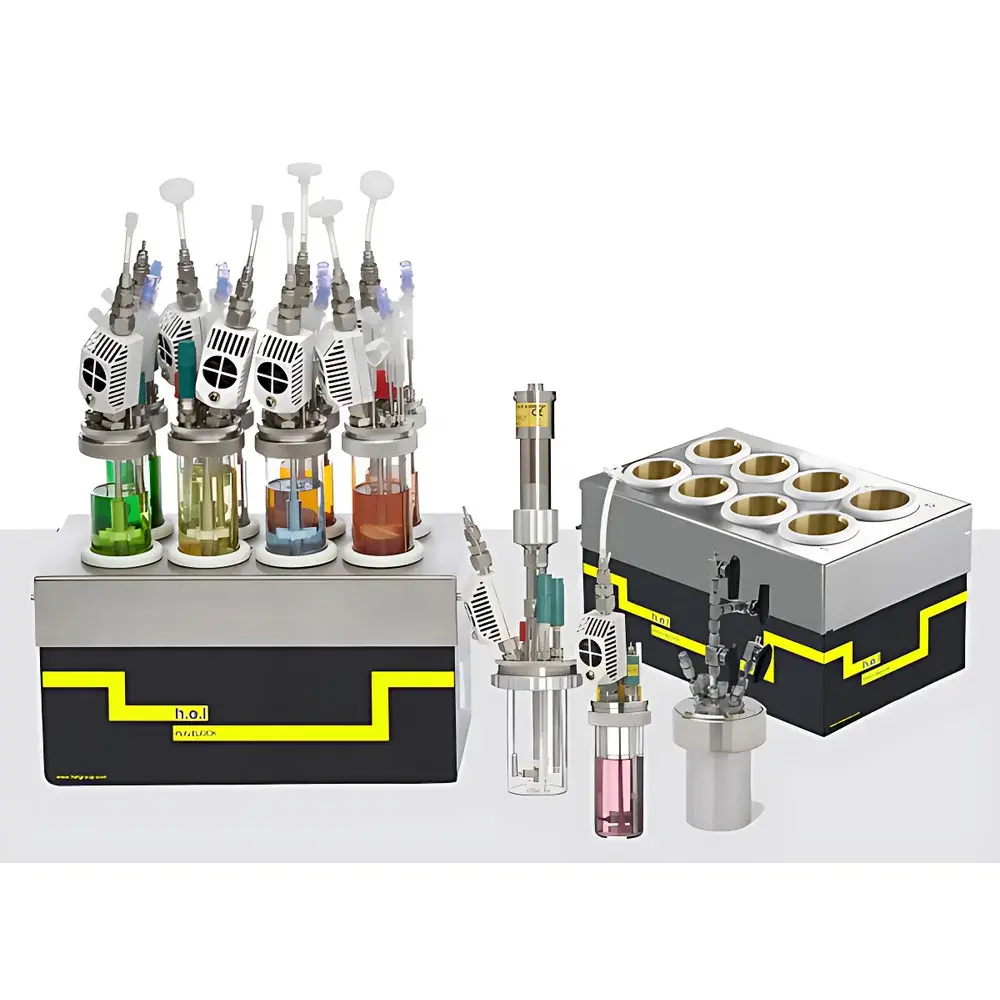
HEL PolyBLOCK 8 High-Throughput Parallel Synthesis Reactor
| Brand | HEL |
|---|---|
| Origin | United Kingdom |
| Model | PolyBLOCK 8 |
| Reactor Type | Modular Parallel Reaction System |
| Number of Independent Zones | 8 |
| Temperature Range | –60 °C to +230 °C (per zone) |
| Max. Inter-Zone ΔT | 100 °C |
| Vessel Compatibility | Standard and custom vessels (1–500 mL) |
| Vessel Diameter Limit | 48 mm |
| Vessel Depth Limit | 58 mm |
| Platform Dimensions | 350 × 200 × 200 mm |
| Stirring | Hovering mechanical stirrer (standard), configurable for heterogeneous systems and crystallization |
| Software | WinISO v7+ (Windows-based, FDA 21 CFR Part 11 compliant audit trail optional) |
| Data Export | Native .csv, .xlsx, and time-stamped binary formats |
| Optional Modules | Automated liquid dosing (multi-channel syringe pumps + multi-port valves), inline calorimetry (reaction heat flow), reflux & inert gas manifolds, pH/turbidity/pressure sensor integration |
Overview
The HEL PolyBLOCK 8 is a modular, computer-controlled parallel synthesis reactor engineered for high-throughput screening of chemical reaction conditions under precisely regulated thermal, mechanical, and atmospheric environments. Based on a robust stainless-steel platform with eight thermally isolated reaction zones, it implements independent Peltier- or fluid-circulator-assisted temperature control—enabling simultaneous execution of divergent reaction protocols across the same instrument. Each zone supports real-time monitoring and closed-loop regulation of temperature, stirring speed and torque, heating power, and (when equipped) pressure, pH, turbidity, or exothermic heat flow. Designed for process intensification and early-stage reaction optimization, the system adheres to fundamental principles of kinetic and thermodynamic reproducibility in synthetic chemistry—making it suitable for applications ranging from catalyst evaluation and hydrogenation studies to polymorph screening and continuous-flow precursor development.
Key Features
- Eight fully independent reaction zones with individual PID temperature control (–60 °C to +230 °C), supporting inter-zone differentials up to 100 °C.
- Hovering mechanical stirring mechanism standard across all zones—optimized for suspension stability, crystallization kinetics, and viscous or heterogeneous media.
- Modular vessel compatibility: accepts standard glassware (round-bottom flasks, vials, test tubes) and custom high-pressure reactors (up to 50 mL) or low-pressure vessels (up to 200 mL); maximum vessel footprint: Ø48 mm × 58 mm depth.
- Integrated WinISO software platform providing method scripting, real-time parameter visualization, automated data logging, and event-triggered actions (e.g., dose-on-temperature, stop-on-exotherm).
- Optional add-ons include automated liquid dispensing (multi-syringe + multi-port valve architecture), inline reaction calorimetry (no calibration required), and reflux/inert gas manifolds with auto-sealing dry-gas interfaces.
- FDA 21 CFR Part 11-compliant audit trail and electronic signature modules available for regulated environments (GMP/GLP laboratories).
Sample Compatibility & Compliance
The PolyBLOCK 8 accommodates a broad spectrum of sample types—including organometallic complexes, slurries, precipitating systems, and gas-liquid heterogeneous reactions—without cross-contamination between zones. Its stainless-steel construction meets ISO 14644-1 Class 7 cleanroom compatibility requirements when operated in controlled environments. Vessel sealing options support operation under inert atmosphere (N₂, Ar) or elevated pressure (rated to 10 bar with appropriate reactor inserts). All firmware and WinISO software versions comply with IEC 62304 (medical device software lifecycle) and are validated per ASTM E2500-13 (verification of laboratory automation systems). Instrument documentation includes full traceability of calibration certificates for temperature sensors (±0.2 °C accuracy) and stirring torque transducers.
Software & Data Management
WinISO serves as the central control and analysis interface, running natively on Windows 10/11 platforms. It supports hierarchical method templates, batch cloning across zones, and dynamic parameter override during active runs (e.g., ramp rate adjustment or hold-time extension). All acquired data—including timestamps, setpoints, actual values, alarms, and user annotations—are stored in structured binary archives with embedded metadata (timezone-aware UTC stamps, operator ID, method version). Export functions generate Excel-compatible .xlsx files with column-aligned parameters and optional derivative calculations (e.g., dT/dt, cumulative heat). Audit trail logs record every user action, configuration change, and system event with immutable hashing—enabling full reconstruction of experimental history for regulatory submissions or internal QA review.
Applications
- High-throughput reaction condition screening: solvent effects, stoichiometry mapping, additive profiling, and catalyst ligand variation.
- Crystallization and polymorph screening under controlled supersaturation and cooling profiles.
- Hydrogenation and other gas-consuming reactions using integrated mass-flow controllers and back-pressure regulators.
- Process safety assessment via real-time calorimetric monitoring of exothermic onset and heat accumulation.
- Automated reagent addition studies—kinetic profiling of stepwise nucleophilic additions or Grignard quenching sequences.
- Method transfer validation between lab-scale and pilot-scale reactors through parameter-space replication.
FAQ
Can the PolyBLOCK 8 operate under vacuum or inert gas without external manifold modifications?
Yes—each zone features dedicated gas inlet/outlet ports compatible with standard Swagelok fittings; optional inert gas manifolds include automatic purge cycles and leak-check routines.
Is calibration of temperature sensors performed in-house or by the end user?
Factory calibration is provided with NIST-traceable certificates; field recalibration is supported via WinISO’s built-in sensor verification wizard using certified reference standards.
What level of data integrity assurance does WinISO provide for GxP-regulated workflows?
With optional 21 CFR Part 11 module enabled, WinISO delivers role-based access control, electronic signatures, biometric or token-based authentication, and tamper-evident audit logs meeting ALCOA+ principles.
How is heat flow measured in the optional calorimetry module?
Using a differential heat-flux sensor array beneath each reaction block, calibrated against Joule heating references; output is reported as instantaneous power (W) and cumulative energy (J) with ±3% uncertainty over full operational range.
Are third-party vessel geometries supported—for example, microfluidic chips or custom alloy reactors?
Yes—mechanical adaptors and thermal interface kits are available for non-standard vessels; contact HEL Applications Engineering for dimensional feasibility assessment and thermal coupling validation.
Related Products



